Africa and Asia Diorama Hall Activity Guide
Total Page:16
File Type:pdf, Size:1020Kb
Load more
Recommended publications
-

Wild Yak Bos Mutus in Nepal: Rediscovery of a Flagship Species
Mammalia 2015; aop Raju Acharya, Yadav Ghimirey*, Geraldine Werhahn, Naresh Kusi, Bidhan Adhikary and Binod Kunwar Wild yak Bos mutus in Nepal: rediscovery of a flagship species DOI 10.1515/mammalia-2015-0066 2009). It has also been believed to inhabit the lower eleva- Received April 15, 2015; accepted July 21, 2015 tion Altai ranges in Mongolia (Olsen 1990). The possible fossil of wild yak discovered in Nepal (Olsen 1990) provided historical evidence of the species’ Abstract: Wild yak Bos mutus is believed to have gone presence in the country. Schaller and Liu (1996) also extinct from Nepal. Various searches in the last decade stated the occurrence of the wild yak in Nepal. Wild failed to document its presence. In Humla district, far- yak is said to inhabit the areas north of the Himalayas western Nepal, we used observation from transects and (Jerdon 1874, Hinton and Fry 1923), which also include vantage points, sign survey on trails, and informal dis- Limi Valley. Skins and horns were sporadically discov- cussions to ascertain the presence of wild yak in 2013 ered by explorers in the Himalayan and trans-Himala- (May–June) and 2014 (June–July). Direct sightings of two yan region of the country. These include evidence of individuals and hoof marks, dung piles, pelts, and head three horns of the species (around four decades old) of an individual killed in 2012 confirmed its presence. that can still be found in Lo Manthang (two pairs of The wild yak has an uncertain national status with con- horn) and Tsaile (one pair of horns) of Upper Mustang firmed records only from Humla district. -

Hippotragus Equinus – Roan Antelope
Hippotragus equinus – Roan Antelope authorities as there may be no significant genetic differences between the two. Many of the Roan Antelope in South Africa are H. e. cottoni or equinus x cottoni (especially on private properties). Assessment Rationale This charismatic antelope exists at low density within the assessment region, occurring in savannah woodlands and grasslands. Currently (2013–2014), there are an observed 333 individuals (210–233 mature) existing on nine formally protected areas within the natural distribution range. Adding privately protected subpopulations and an Cliff & Suretha Dorse estimated 0.8–5% of individuals on wildlife ranches that may be considered wild and free-roaming, yields a total mature population of 218–294 individuals. Most private Regional Red List status (2016) Endangered subpopulations are intensively bred and/or kept in camps C2a(i)+D*†‡ to exclude predators and to facilitate healthcare. Field National Red List status (2004) Vulnerable D1 surveys are required to identify potentially eligible subpopulations that can be included in this assessment. Reasons for change Non-genuine: While there was an historical crash in Kruger National Park New information (KNP) of 90% between 1986 and 1993, the subpopulation Global Red List status (2008) Least Concern has since stabilised at c. 50 individuals. Overall, over the past three generations (1990–2015), based on available TOPS listing (NEMBA) Vulnerable data for nine formally protected areas, there has been a CITES listing None net population reduction of c. 23%, which indicates an ongoing decline but not as severe as the historical Endemic Edge of Range reduction. Further long-term data are needed to more *Watch-list Data †Watch-list Threat ‡Conservation Dependent accurately estimate the national population trend. -
Phylogeographical Analyses of Domestic and Wild Yaks
View metadata, citation and similar papers at core.ac.uk brought to you by CORE provided by Digital.CSIC RIGIN AL Phylogeographical analyses of domestic AR TI C L E and wild yaks based on mitochondrial DNA: new data and reappraisal Zhaofeng Wang1†, Xin Shen2†, Bin Liu2†, Jianping Su3†, Takahiro Yonezawa4, Yun Yu2, Songchang Guo3, Simon Y. W. Ho5, Carles Vila` 6, Masami Hasegawa4 and Jianquan Liu1* 1Molecular Ecology Group, Key Laboratory of AB STRACT Arid and Grassland Ecology, School of Life Science, Lanzhou University, Lanzhou 730000, Aim We aimed to examine the phylogeographical structure and demographic 2 history of domestic and wild yaks ( ) based on a wide range of Gansu, China, Beijing Genomics Institute, Bos grunniens Chinese Academy of Sciences, Beijing 101300, samples and complete mitochondrial genomic sequences. 3 China, Key Laboratory of Evolution and Location The Qinghai-Tibetan Plateau (QTP) of western China. Adaptation of Plateau Biota, Northwest Plateau Institute of Biology, Chinese Academy Methods All available D-loop sequences for 405 domesticated yaks and 47 wild of Sciences, Xining 810001, Qinghai, China, yaks were examined, including new sequences from 96 domestic and 34 wild yaks. 4School of Life Sciences, Fudan University, We further sequenced the complete mitochondrial genomes of 48 domesticated Shanghai 200433, China, 5Centre for and 21 wild yaks. Phylogeographical analyses were performed using the Macroevolution and Macroecology, Research mitochondrial D-loop and the total genome datasets. School of Biology, Australian National Results We recovered a total of 123 haplotypes based on the D-loop sequences University, Canberra, ACT 0200, Australia, in wild and domestic yaks. -
Structural Characterisation of Toll-Like Receptor 1 (TLR1) and Toll-Like
RVC OPEN ACCESS REPOSITORY – COPYRIGHT NOTICE This is the peer-reviewed, manuscript version of the following article: Woodman, S., Gibson, A. J., García, A. R., Contreras, G. S., Rossen, J. W., Werling, D. and Offord, V. (2016) 'Structural characterisation of Toll-like receptor 1 (TLR1) and Toll-like receptor 6 (TLR6) in elephant and harbor seals', Veterinary Immunology and Immunopathology, 169, 10-14. The final version is available online via http://dx.doi.org/10.1016/j.vetimm.2015.11.006. © 2016. This manuscript version is made available under the CC-BY-NC-ND 4.0 license http://creativecommons.org/licenses/by-nc-nd/4.0/. The full details of the published version of the article are as follows: TITLE: Structural characterisation of Toll-like receptor 1 (TLR1) and Toll-like receptor 6 (TLR6) in elephant and harbor seals AUTHORS: Woodman, S., Gibson, A. J., García, A. R., Contreras, G. S., Rossen, J. W., Werling, D. and Offord, V. JOURNAL TITLE: Veterinary Immunology and Immunopathology VOLUME: 169 PUBLISHER: Elsevier PUBLICATION DATE: January 2016 DOI: 10.1016/j.vetimm.2015.11.006 1 Structural characterisation of Toll-like receptor 1 (TLR1) and Toll-like receptor 6 (TLR6) in 2 elephant and harbor seals 3 4 Sally Woodman1,Amanda J. Gibson1, Ana Rubio García2, Guillermo Sanchez Contreras2, John W. 5 Rossen3, Dirk Werling1, Victoria Offord1,* 6 7 1Molecular Immunology Group, Department of Pathology and Pathogen Biology, Royal Veterinary 8 College, Hawkshead Lane, Hatfield, AL9 7TA, UK; 9 2Veterinary Department, Seal Rehabilitation and Research Centre (SRRC), Pieterburen, The 10 Netherlands; 11 3Department of Medical Microbiology, University of Groningen, University Medical Center 12 Groningen, Groningen, the Netherlands; 13 * Corresponding author at the Research Support Office, Royal Veterinary College, Hawkshead Lane, 14 Hatfield, AL9 7TA, UK Tel: ++44 1707 667038; E-Mail: vofford@rvc.ac.uk 15 16 1 1 Abstract 2 Pinnipeds are a diverse clade of semi-aquatic mammals, which act as key indicators of ecosystem health. -

Genetic Variation of Mitochondrial DNA Within Domestic Yak Populations J.F
Genetic variation of mitochondrial DNA within domestic yak populations J.F. Bailey,1 B. Healy,1 H. Jianlin,2 L. Sherchand,3 S.L. Pradhan,4 T. Tsendsuren,5 J.M. Foggin,6 C. Gaillard,7 D. Steane,8 I. Zakharov 9 and D.G. Bradley1 1. Department of Genetics, Trinity College, Dublin 2, Ireland 2. Department of Animal Science, Gansu Agricultural University, Lanzhou 730070, Gansu, P.R. China 3. Livestock Production Division, Department of Livestock Services, Harihar Bhawan, Pulchowk, Nepal 4. Resource Development Advisor, Nepal–Australia Community Resource Management Project, Kathmandu, Nepal 5. Institute of Biology, Academy of Sciences of Mongolia, Ulaan Baatar, Mongolia 6. Department of Biology, Arizona State University, Tempe, AZ 85287–1501 USA 7. Institute of Animal Breeding, University of Berne, Bremgarten-strasse 109a, CH-3012 Berne, Switzerland 8. FAO (Food and Agricultural Organization of the United Nations) Regional Office for Asia and the Pacific, 39 Phra Atit Road, Bangkok 10200, Thailand 9. Vavilov Institute of General Genetics Russian Academy of Sciences, Gubkin str., 3, 117809 GSP-1, Moscow B-333, Russia Summary Yak (Bos grunniens) are members of the Artiodactyla, family Bovidae, genus Bos. Wild yak are first observed at Pleistocene levels of the fossil record. We believed that they, together with the closely related species of Bos taurus, B. indicus and Bison bison, resulted from a rapid radiation of the genus towards the end of the Miocene. Today domestic yak live a fragile existence in a harsh environment. Their fitness for this environment is vital to their survival and to the millions of pastoralists who depend upon them. -

Trade in Endangered Species Order 2011
Reprint as at 14 September 2014 Trade in Endangered Species Order 2011 (SR 2011/369) Trade in Endangered Species Order 2011: revoked, on 14 September 2014, by clause 4 of the Trade in Endangered Species Order 2014 (LI 2014/259). Jerry Mateparae, Governor-General Order in Council At Wellington this 10th day of October 2011 Present: His Excellency the Governor-General in Council Pursuant to section 53 of the Trade in Endangered Species Act 1989, His Excellency the Governor-General, acting on the advice and with the consent of the Executive Council, makes the following order. Contents Page 1 Title 2 2 Commencement 2 Note Changes authorised by subpart 2 of Part 2 of the Legislation Act 2012 have been made in this official reprint. Note 4 at the end of this reprint provides a list of the amendments incorporated. This order is administered by the Department of Conservation. 1 Reprinted as at cl 1 Trade in Endangered Species Order 2011 14 September 2014 3 New Schedules 1, 2, and 3 substituted in Trade in 2 Endangered Species Act 1989 4 Revocation 2 Schedule 3 New Schedules 1, 2, and 3 substituted in Trade in Endangered Species Act 1989 Order 1 Title This order is the Trade in Endangered Species Order 2011. 2 Commencement This order comes into force on the 28th day after the date of its notification in the Gazette. 3 New Schedules 1, 2, and 3 substituted in Trade in Endangered Species Act 1989 The Trade in Endangered Species Act 1989 is amended by revoking Schedules 1, 2, and 3 and substituting the schedules set out in the Schedule of this order. -
Chapter 15 the Mammals of Angola
Chapter 15 The Mammals of Angola Pedro Beja, Pedro Vaz Pinto, Luís Veríssimo, Elena Bersacola, Ezequiel Fabiano, Jorge M. Palmeirim, Ara Monadjem, Pedro Monterroso, Magdalena S. Svensson, and Peter John Taylor Abstract Scientific investigations on the mammals of Angola started over 150 years ago, but information remains scarce and scattered, with only one recent published account. Here we provide a synthesis of the mammals of Angola based on a thorough survey of primary and grey literature, as well as recent unpublished records. We present a short history of mammal research, and provide brief information on each species known to occur in the country. Particular attention is given to endemic and near endemic species. We also provide a zoogeographic outline and information on the conservation of Angolan mammals. We found confirmed records for 291 native species, most of which from the orders Rodentia (85), Chiroptera (73), Carnivora (39), and Cetartiodactyla (33). There is a large number of endemic and near endemic species, most of which are rodents or bats. The large diversity of species is favoured by the wide P. Beja (*) CIBIO-InBIO, Centro de Investigação em Biodiversidade e Recursos Genéticos, Universidade do Porto, Vairão, Portugal CEABN-InBio, Centro de Ecologia Aplicada “Professor Baeta Neves”, Instituto Superior de Agronomia, Universidade de Lisboa, Lisboa, Portugal e-mail: pbeja@cibio.up.pt P. Vaz Pinto Fundação Kissama, Luanda, Angola CIBIO-InBIO, Centro de Investigação em Biodiversidade e Recursos Genéticos, Universidade do Porto, Campus de Vairão, Vairão, Portugal e-mail: pedrovazpinto@gmail.com L. Veríssimo Fundação Kissama, Luanda, Angola e-mail: lmnverissimo@gmail.com E. -

Dry Season Browsing by Sable Antelope in Northern Botswana
Notes and records Dry season browsing by sable antelope in Methods northern Botswana The study area was located on the northern edge of the Michael C. Hensman*, Norman Owen-Smith, Francesca Okavango Delta in Botswana. An adult female sable in Parrini and Barend F.N. Erasmus each of three herds was fitted with a GPS collar to facilitate Animal, Plant, and Environmental Sciences, The University of observations. When the herd being observed from a vehicle the Witwatersrand, Private Bag 3, Wits, 2050, South Africa was foraging, we selected the closest female and watched her feeding from 10 to 50 m away. Beginning on any tenth minute of the hour, we recorded whether this animal Introduction was browsing, grazing or performing other activities on every tenth second over a minute (n = 879 1-min The late dry season is a crucial period for grazing observations). Records were pooled within each morning ungulates because the nutritional value of the remaining and afternoon observation session so that these sessions brown grass is lowest then and levels of crude protein and represented independent samples (n = 113 ranging in digestible organic matter may fall below the maintenance duration from 3 to 13 min). Following initial observations requirements of herbivores (Owen-Smith, 1982). During of browsing in late 2009, records representing early wet this adverse period, mixed feeders like impala (Aepyceros season conditions were collected from December 2009 melampus) increase the proportion of browse in the form of through January 2010 (n = 46), mid-dry season condi- the leaves of the woody plants they consume (Owen-Smith tions through August–September 2010 (n = 36), and late & Cooper, 1985). -
GNUSLETTER Vol 37#2.Pdf
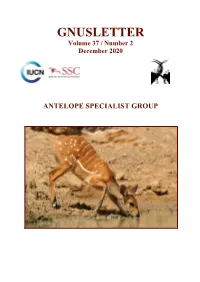
GNUSLETTER Volume 37 / Number 2 December 2020 ANTELOPE SPECIALIST GROUP IUCN Species Survival Commission Antelope Specialist Group GNUSLETTER is the biannual newsletter of the IUCN Species Survival Commission Antelope Specialist Group (ASG). First published in 1982 by first ASG Chair Richard D. Estes, the intent of GNUSLETTER, then and today, is the dissemination of reports and information regarding antelopes and their conservation. ASG Members are an important network of individuals and experts working across disciplines throughout Africa, Asia and America. Contributions (original articles, field notes, other material relevant to antelope biology, ecology, and conservation) are welcomed and should be sent to the editor. Today GNUSLETTER is published in English in electronic form and distributed widely to members and non-members, and to the IUCN SSC global conservation network. To be added to the distribution list please contact asgpo@marwell.org.uk. GNUSLETTER Editorial Board - David Mallon, ASG Co-Chair - Philippe Chardonnet, ASG Co-Chair ASG Program Office - Tania Gilbert, Marwell Wildife The Antelope Specialist Group Program Office is hosted and supported by Marwell Wildlife https://www.marwell.org.uk The designation of geographical entities in this report does not imply the expression of any opinion on the part of IUCN, the Species Survival Commission, or the Antelope Specialist Group concerning the legal status of any country, territory or area, or concerning the delimitation of any frontiers or boundaries. Views expressed in GNUSLETTER are those of the individual authors, Cover photo: Young female bushbuck (Tragelaphus scriptus), W National Park and Biosphere Reserve, Niger (© Daniel Cornélis) 2 GNUSLETTER Volume 37 Number 2 December 2020 FROM IUCN AND ASG………………………………………………………. -

Trade in Endangered Species Order 2008
2008/39 Trade in Endangered Species Order 2008 Anand Satyanand, GovernorGeneral Order in Council At Wellington this 25th day of February 2008 Present: His Excellency the GovernorGeneral in Council Pursuant to section 53 of the Trade in Endangered Species Act 1989, His Excellency the GovernorGeneral, acting on the advice and with the consent of the Executive Council, makes the following order. Contents Page 1 Title 2 2 Commencement 2 3 New Schedules 1, 2, and 3 substituted in Trade in 2 Endangered Species Act 1989 4 Revocation 2 Schedule 3 New Schedules 1, 2, and 3 substituted in Trade in Endangered Species Act 1989 1 cl 1 Trade in Endangered Species Order 2008 2008/39 Order 1 Title This order is the Trade in Endangered Species Order 2008. 2 Commencement This order comes into force on the 28th day after the date of its notification in the Gazette. 3 New Schedules 1, 2, and 3 substituted in Trade in Endangered Species Act 1989 The Trade in Endangered Species Act 1989 is amended by revoking Schedules 1, 2, and 3 and substituting the schedules set out in the Schedule of this order. 4 Revocation The Trade in Endangered Species Order 2005 (SR 2005/93) is revoked. 2 2008/39 Schedule cl 3 New Schedules 1, 2, and 3 substituted in Trade in Endangered Species Act 1989 Schedule 1 s 3(1) Species endangered by trade T rade The classes, families, and species listed in this schedule are arranged in descending order by class then in alphabetical order by order, family, and species. -
Kekexili Student Activity Booklet
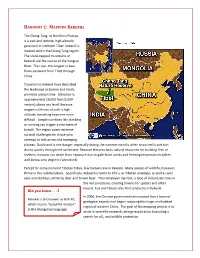
HANDOUT 1: MAPPING KEKEXILI The Chang Tang, or Northern Plateau, is a vast and remote, high altitude grassland in northern Tibet. Kekexili is located within the Chang Tang region. The snow‐capped mountains of Kekexili are the source of the Yangtze River. The river, the longest in Asia, flows eastward from Tibet through China. Travelers to Kekexili have described the landscape as barren and harsh, primitive and pristine. Elevation is approximately 16,000 feet (5,000 meters) above sea level. Because oxygen is thinner at such a high altitude, breathing becomes more difficult. Simple exertions like climbing or running can trigger a shortness of breath. The region poses extreme survival challenges for those who attempt to trek across the sweeping plateau. Quicksand is one danger, especially during the summer months when snow melts and rain drains quickly through the sandstone. Because the area lacks natural resources for building fires or shelters, humans risk death from exposure due to gale‐force winds and freezing temperatures (often well below zero degrees Fahrenheit). Except for some nomadic Tibetan tribes, few humans live in Kekexili. Many species of wildlife, however, thrive in this isolated place. Specifically, Kekexili is home to Chiru, or Tibetan antelope, as well as wild yaks and donkeys, white lip deer and brown bear. The Himalayan marmot, a type of rodent, burrows in the red sandstone, creating havens for spiders and other insects. Fox and falcons also find sanctuary in Kekexili. Did you know . .? In 2006, the Chinese government announced that a team of Kekexili is also known as Hoh Xil, geological experts had begun mapping this large uninhabited which means “beautiful maiden” region of western China. -

25 Years On: a Look at Endangered Species
25 Years On: a Look at Endangered Species Richard Fitter What has happened to the animals and birds listed as endangered species 25 years ago at IUCN's first technical meeting? The FPS Hon. Secretary investigates their present status and looks at the conservation methods that have proved most effective. In August 1949 two lists of endangered species were drawn up, one of fourteen mammals, the other of thirteen birds, all described as 'in need of emergency action if they are to be saved from extinction'. This was at the First Technical Conference, at Lake Success, of the International Union for the Protection of Nature, as IUCN (the International Union for Conservation of Nature and Natural Resources) was then called. It is of some interest now, 25 years later, to review these lists and see what, if anything has been done to save these animals. The mammals comprised two marsupials—thylacine and western banded anteater—chinchilla, Asiatic lion, Caribbean and Mediterranean monk seals, Addo bush elephant, mountain zebra, great Indian and Javan rhinos, Burmese brow-antlered deer, and three bovids—European bison, North African hartebeest and giant sable antelope. Of these fourteen, two are now regarded as extinct: the Caribbean monk seal Monachus tropicalis, last definitely reported in 1952, which a very recent and thorough survey has failed to rediscover; and the North African or bubal hartebeest Alcelaphus buselaphus buselaphus, which has not been reliably reported since 1925. Of the thylacine Thylacinus cynocephalus of Tasmania there has also been no recent scientifically verified sighting, though there have been a number of apparently well-founded but still unverified ones.