FIRST NATIONS and MÉTIS PEOPLES in ALBERTA Excerpt from Aboriginal Perspectives
Total Page:16
File Type:pdf, Size:1020Kb
Load more
Recommended publications
-
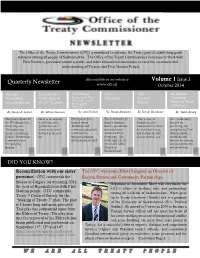
OTC October Newsletter Final Draft
The Office of the Treaty Commissioner (OTC) is mandated to advance the Treaty goal of establishing good relations among all people of Saskatchewan. The Office of the Treaty Commissioner continues to work with First Nation’s, provincial school systems, and other educational institutions to raise the awareness and understanding of Treaties and First Nations People Quarterly Newsletter Also available on our website at Volume 1 Issue 3 www.otc.ca October 2014 Annual Livelihood – Livelihood – OTC OTC All Nations Woodland Challenges in Saskatchewan First Education Speakers Traditional st Nations Economic Family & Youth Cree Gathering the 21 Century Development Bureau Network Gathering By: George E. Lafond By: Milton Tootoosis By: April Roberts By: Brenda Ahenekew By: Jennifer Heimbecker By: Robin Bendig This year’s theme for There is an urgency Participants also The community of “The people of The “Gathering” the Woodland Cree to defining what learned about Stanley Mission Saskatoon, you focused on Gathering was, “pimâcihisowin” ‘branding’ and hosts a spectacular walked with us when preserving and “Strengthening means as we move communicating their three day event the load was heavy, strengthening First Unity, Celebrating forward in the new communities; called the River and for that we will Nations culture, Culture, Promoting age business planning; Gathering. The always cherish you,” traditions and Community and and financial literacy Gathering is held identity by offering Recognizing next to the oldest various ceremonies History.” Church in and workshops. Saskatchewan 3-4 5 6 7 8 9 DID YOU KNOW? Reconciliation with our sister The OTC welcomes Rhett Sangster as Director of province - OTC commends the Reconciliation and Community Partnerships. -
Key Terms and Concepts for Exploring Nîhiyaw Tâpisinowin the Cree Worldview
Key Terms and Concepts for Exploring Nîhiyaw Tâpisinowin the Cree Worldview by Art Napoleon A Thesis Submitted in Partial Fulfillment of the Requirements for the Degree of MASTER OF ARTS in the Faculty of Humanities, Department of Linguistics and Faculty of Education, Indigenous Education Art Napoleon, 2014 University of Victoria All rights reserved. This thesis may not be reproduced in whole or in part, by photocopy or other means, without the permission of the author. ii Supervisory Committee Key Terms and Concepts for Exploring Nîhiyaw Tâpisinowin the Cree Worldview by Art Napoleon Supervisory Committee Dr. Leslie Saxon, Department of Linguistics Supervisor Dr. Peter Jacob, Department of Linguistics Departmental Member iii ABstract Supervisory Committee Dr. Leslie Saxon, Department of Linguistics Supervisor Dr. Peter Jacob, Department of Linguistics Departmental MemBer Through a review of literature and a qualitative inquiry of Cree language practitioners and knowledge keepers, this study explores traditional concepts related to Cree worldview specifically through the lens of nîhiyawîwin, the Cree language. Avoiding standard dictionary approaches to translations, it provides inside views and perspectives to provide broader translations of key terms related to Cree values and principles, Cree philosophy, Cree cosmology, Cree spirituality, and Cree ceremonialism. It argues the importance of providing connotative, denotative, implied meanings and etymology of key terms to broaden the understanding of nîhiyaw tâpisinowin and the need -

"I'm Glad to Hear That You Liked M Y Little Article": Letters Exchanged
"I'm glad to hear that you liked my little article": Letters Exchanged Between Frank T. Siebert and Fannie Hardy Eckstorm, 1938-1945 PAULEENA MACDOUGALL University of Maine Writing from his home at 127 Merbrook Lane, Merion Station, Pennsylvania, on 9 January 1938, Dr. Frank T. Siebert, Jr., penned the following: Dear Mrs. Eckstorm: Many thanks for your very nice letter. I am glad to hear that you liked my little article. I have several others, longer and of broader scope, in preparation, but they probably will not appear for some time to come. One of these is a volume of Penobscot linguistic texts, of which Dr. Speck and I are joint authors. The letter quoted above and others to follow offer a glimpse into the thoughts of two very different people who shared an interest in the Penobscot Indians: one, a woman of 73 years who had already published seven books and numerous articles at the time the two began correspond ing, the other a 26-year-old medical doctor. Siebert studied at Episcopal Academy, Haverford College, and received his M.D. at the University of Pennsylvania, where he made the acquaintance of anthropologist Frank Speck. The young doctor attended summer institutes in linguistics where he encountered Algonquianists such as Leonard Bloomfield, Edward Sapir and Mary Haas. His ability in the field of linguistics did not go unnoticed at the University of Pennsylvania, because Speck asked him to lecture in his anthropology class. Siebert visited the Penobscot Indian Reservation in 1932 for the first time and collected vocabulary and stories from Penobscot speakers thereafter on his summer vacations. -

A Reassessment of the Reverend John Mcdougall
University of Calgary PRISM: University of Calgary's Digital Repository University of Calgary Press University of Calgary Press Open Access Books 2017-02 Finding Directions West: Readings that Locate and Dislocate Western Canada's Past Colpitts, George; Devine, Heather University of Calgary Press http://hdl.handle.net/1880/51827 book https://creativecommons.org/licenses/by-nc-nd/4.0 Attribution 4.0 International Downloaded from PRISM: https://prism.ucalgary.ca FINDING DIRECTIONS WEST: READINGS THAT LOCATE AND DISLOCATE WESTERN CANADA’S PAST Edited by George Colpitts and Heather Devine ISBN 978-1-55238-881-5 THIS BOOK IS AN OPEN ACCESS E-BOOK. It is an electronic version of a book that can be purchased in physical form through any bookseller or on-line retailer, or from our distributors. Please support this open access publication by requesting that your university purchase a print copy of this book, or by purchasing a copy yourself. If you have any questions, please contact us at ucpress@ucalgary.ca Cover Art: The artwork on the cover of this book is not open access and falls under traditional copyright provisions; it cannot be reproduced in any way without written permission of the artists and their agents. The cover can be displayed as a complete cover image for the purposes of publicizing this work, but the artwork cannot be extracted from the context of the cover of this specific work without breaching the artist’s copyright. COPYRIGHT NOTICE: This open-access work is published under a Creative Commons licence. This means that you are free to copy, distribute, display or perform the work as long as you clearly attribute the work to its authors and publisher, that you do not use this work for any commercial gain in any form, and that you in no way alter, transform, or build on the work outside of its use in normal academic scholarship without our express permission. -

The Rose Collection of Moccasins in the Canadian Museum of Civilization : Transitional Woodland/Grassl and Footwear
THE ROSE COLLECTION OF MOCCASINS IN THE CANADIAN MUSEUM OF CIVILIZATION : TRANSITIONAL WOODLAND/GRASSL AND FOOTWEAR David Sager 3636 Denburn Place Mississauga, Ontario Canada, L4X 2R2 Abstract/Resume Many specialists assign the attribution of "Plains Cree" or "Plains Ojibway" to material culture from parts of Manitoba and Saskatchewan. In fact, only a small part of this area was Grasslands. Several bands of Cree and Ojibway (Saulteaux) became permanent residents of the Grasslands bor- ders when Reserves were established in the 19th century. They rapidly absorbed aspects of Plains material culture, a process started earlier farther west. This paper examines one such case as revealed by footwear. Beaucoup de spécialistes attribuent aux Plains Cree ou aux Plains Ojibway des objets matériels de culture des régions du Manitoba ou de la Saskatch- ewan. En fait, il n'y a qu'une petite partie de cette région ait été prairie. Plusieurs bandes de Cree et d'Ojibway (Saulteaux) sont devenus habitants permanents des limites de la prairie quand les réserves ont été établies au XIXe siècle. Ils ont rapidement absorbé des aspects de la culture matérielle des prairies, un processus qu'on a commencé plus tôt plus loin à l'ouest. Cet article examine un tel cas comme il est révélé par des chaussures. The Canadian Journal of Native Studies XIV, 2(1 994):273-304. 274 David Sager The Rose Moccasin Collection: Problems in Attribution This paper focuses on a unique group of eight pair of moccasins from southern Saskatchewan made in the mid 1880s. They were collected by Robert Jeans Rose between 1883 and 1887. -
Indigenous Languages
INDIGENOUS LANGUAGES PRE-TEACH/PRE-ACTIVITY Have students look at the Indigenous languages and/or language groups that are displayed on the map. Discuss where this data came from (the 2016 census) and what biases or problems this data may have, such as the fear of self-identifying based on historical reasons or current gaps in data. Take some time to look at how censuses are performed, who participates in them, and what they can learn from the data that is and is not collected. Refer to the online and poster map of Indigenous Languages in Canada featured in the 2017 November/December issue of Canadian Geographic, and explore how students feel about the number of speakers each language has and what the current data means for the people who speak each language. Additionally, look at the language families listed and the names of each language used by the federal government in collecting this data. Discuss with students why these may not be the correct names and how they can help in the reconciliation process by using the correct language names. LEARNING OUTCOMES: • Students will learn about the number and • Students will learn about the importance of diversity of languages and language groups language and the ties it has to culture. spoken by Indigenous Peoples in Canada. • Students will become engaged in learning a • Students will learn that Indigenous Peoples local Indigenous language. in Canada speak many languages and that some languages are endangered. INDIGENOUS LANGUAGES Foundational knowledge and perspectives FIRST NATIONS “One of the first acts of colonization and settlement “Our languages are central to our ceremonies, our rela- is to name the newly ‘discovered’ land in the lan- tionships to our lands, the animals, to each other, our guage of the colonizers or the ‘discoverers.’ This is understandings, of our worlds, including the natural done despite the fact that there are already names world, our stories and our laws.” for these places that were given by the original in- habitants. -

“Viewpoints” on Reconciliation: Indigenous Perspectives for Post-Secondary Education in the Southern Interior of Bc
“VIEWPOINTS” ON RECONCILIATION: INDIGENOUS PERSPECTIVES FOR POST-SECONDARY EDUCATION IN THE SOUTHERN INTERIOR OF BC 2020 Project Synopsis By Christopher Horsethief, PhD, Dallas Good Water, MA, Harron Hall, BA, Jessica Morin, MA, Michele Morin, BSW, Roy Pogorzelski, MA September 1, 2020 Research Funded by the Social Sciences and Humanities Research Council of Canada. Executive Summary This research project synopsis presents diverse Indigenous community perspectives regarding the efforts needed to enable systemic change toward reconciliation within a public post-secondary educational institution in the Southern Interior of British Columbia. The main research question for this project was “How does a community college respectfully engage in reconciliation through education with the First Nations and Métis communities in the traditional territories in which it operates?” This research was realized by a team of six Indigenous researchers, representing distinct Indigenous groups within the region. It offers Indigenous perspectives, insights, and recommendations that can help guide post-secondary education toward systemic change. This research project was Indigenous led within an Indigenous research paradigm and done in collaboration with multiple communities throughout the Southern Interior region of British Columbia. Keywords: Indigenous-led research, Indigenous research methodologies, truth and reconciliation, Indigenous education, decolonization, systemic change, public post- secondary education in BC, Southern Interior of BC ii Acknowledgements This research was made possible through funding from the Social Sciences and Humanities Research Council (SSHRC) of Canada. The important contributions from the Sinixt, Ktunaxa, Syilx, and Métis Elders, Knowledge Keepers, youth, men, and women within this project are essential to restoring important aspects of education that have been largely omitted from the public education system. -

An Examination of Nuu-Chah-Nulth Culture History
SINCE KWATYAT LIVED ON EARTH: AN EXAMINATION OF NUU-CHAH-NULTH CULTURE HISTORY Alan D. McMillan B.A., University of Saskatchewan M.A., University of British Columbia THESIS SUBMI'ITED IN PARTIAL FULFILLMENT OF THE REQUIREMENTS FOR THE DEGREE OF DOCTOR OF PHILOSOPHY in the Department of Archaeology O Alan D. McMillan SIMON FRASER UNIVERSITY January 1996 All rights reserved. This work may not be reproduced in whole or in part, by photocopy or other means, without permission of the author. APPROVAL Name: Alan D. McMillan Degree Doctor of Philosophy Title of Thesis Since Kwatyat Lived on Earth: An Examination of Nuu-chah-nulth Culture History Examining Committe: Chair: J. Nance Roy L. Carlson Senior Supervisor Philip M. Hobler David V. Burley Internal External Examiner Madonna L. Moss Department of Anthropology, University of Oregon External Examiner Date Approved: krb,,,) 1s lwb PARTIAL COPYRIGHT LICENSE I hereby grant to Simon Fraser University the right to lend my thesis, project or extended essay (the title of which is shown below) to users of the Simon Fraser University Library, and to make partial or single copies only for such users or in response to a request from the library of any other university, or other educational institution, on its own behalf or for one of its users. I further agree that permission for multiple copying of this work for scholarly purposes may be granted by me or the Dean of Graduate Studies. It is understood that copying or publication of this work for financial gain shall not be allowed without my written permission. -
Ethnohistory of the Kootenai Indians
University of Montana ScholarWorks at University of Montana Graduate Student Theses, Dissertations, & Professional Papers Graduate School 1983 Ethnohistory of the Kootenai Indians Cynthia J. Manning The University of Montana Follow this and additional works at: https://scholarworks.umt.edu/etd Let us know how access to this document benefits ou.y Recommended Citation Manning, Cynthia J., "Ethnohistory of the Kootenai Indians" (1983). Graduate Student Theses, Dissertations, & Professional Papers. 5855. https://scholarworks.umt.edu/etd/5855 This Thesis is brought to you for free and open access by the Graduate School at ScholarWorks at University of Montana. It has been accepted for inclusion in Graduate Student Theses, Dissertations, & Professional Papers by an authorized administrator of ScholarWorks at University of Montana. For more information, please contact scholarworks@mso.umt.edu. COPYRIGHT ACT OF 1976 Th is is an unpublished m a n u s c r ip t in w h ic h c o p y r ig h t su b s i s t s . Any further r e p r in t in g of it s c o n ten ts must be a ppro ved BY THE AUTHOR. MANSFIELD L ib r a r y Un iv e r s it y of Montana D a te : 1 9 8 3 AN ETHNOHISTORY OF THE KOOTENAI INDIANS By Cynthia J. Manning B.A., University of Pittsburgh, 1978 Presented in partial fu lfillm en t of the requirements for the degree of Master of Arts UNIVERSITY OF MONTANA 1983 Approved by: Chair, Board of Examiners Fan, Graduate Sch __________^ ^ c Z 3 ^ ^ 3 Date UMI Number: EP36656 All rights reserved INFORMATION TO ALL USERS The quality of this reproduction is dependent upon the quality of the copy submitted. -

Land Resources
Relationship with the Land - Resources This map shows one year’s travels of a clan of Amsskaapipikani in the last decade of the nineteenth century. Courtesy of Glenbow Museum Relationship with the Land – Seasonal Round Unit Resource Glenbow Museum Relationship with the Land - Resources Place Names on the Map: 1. Itsiputsimaup – Battle Coulee 2. Katoyissksi – Sweet Grass 3. Aiiyimmikoi – Cypress Hills 4. Pakoki Lake – Pakowki 5. Akaiiniskio – Manyberries 6. Einiotoka’nisi – Buffalo-Bull’s Head 7. Ihkitsitapiksi – Seven Persons 8. Aiiykimmikuyiu – Cypress Hills 9. Nokomis’s – Long Lakes 10. Matokeks oma’nistamoai otsitskiiitapiau – Women’s Society Left their Lodge Pole 11. A’ykomonoasiu – Green Lake 12. A’isinaiypi – Writing on Stone 13. A’kekoksistakskuyi – Women’s Point 14. Ponakiksi – Cut Bank Creek Relationship with the Land – Seasonal Round Unit Resource Glenbow Museum Relationship with the Land - Resources Blackfoot camps were composed of members of an extended family and other people who may have joined the clan. The arrangement of the tipis was not strictly defined in these camps, although all of them faced east. This allowed the morning prayers to travel towards the rising sun, helping it to come above the horizon for another day. Relationship with the Land – Seasonal Round Unit Resource Glenbow Museum Relationship with the Land - Resources Definition of the term – “Seasonal Round” The Blackfoot tribes had an enormous land base they inhabited. Within this territory they had areas where they would travel well over 500 miles during a yearly cycle to hunt, gather and renew religious commitments. Being knowledgeable of their environment and respectful of their gifts from the creator they would carefully select locations or places to travel to in a lifetime. -

Thundering Spirit" Call to Order Opening Prayer: Treaty Six Lead Elder Jon Ermineskin 9:00 A.M
ASSEMBLY OF FIRST NATIONS WATER RIGHTS CONFERENCE 2012 “Asserting our Rights to Water” Monday, March 5, 2012 7:00 a.m. Registration and continental breakfast 8:30 a.m. Drum Treaty 6 drum group "Thundering Spirit" Call to Order Opening prayer: Treaty Six Lead Elder Jon Ermineskin 9:00 a.m. Welcoming remarks: Host Chief Ron Morin, Enoch Cree Nation Treaty 6 Grand Chief Cameron Alexis 9:15 a.m. Opening remarks: Bringing national attention and awareness to Indigenous water rights Portfolio Regional Chief: Regional Chief Eric Morris (YT) 9:45 a.m. Opening Remarks: Indigenous rights to water – our sacred duties and responsibilities National Chief Shawn A-in-chut Atleo 10:00 a.m. Health Break Monday, March 5, 2012 10:15 a.m. Plenary Panel Presentation: Advancing our Full Understanding of the Inherent and Treaty Right to Water The nature of water rights: Dr. Leroy Littlebear, University of Lethbridge Community-based struggles for water rights: Chief Eli Mandamin, Iskatewizaagegan Independent First Nation Exercising Indigenous Water Rights - BC: Chief Bob Chamberlin, Kwicksutaineuk-Ah-Kwaw-Ah-Mish First Nation; Vice-President of Union of BC Indian Chiefs; Andrea Glickman, Policy Analyst, UBCIC., Legal dimensions for Alberta First Nations: Clayton D Leonard, MacPherson, Leslie &Tyerman LLP 12:00 Lunch (provided on site) p.m. Presentation: The Human Right to Water - Maude Barlow 1:00 p.m. Special Presentation: IikaatowapiwaNaapiitahtaan: The Old Man River is Sacred Chief Gayle Strikes With a Gun; Iitamyapii (Looks From Above): Byron Jackson; Saa-Ku-Waa- Mu-Nii (Last Otter): Councillor Fabian North Peigan; Moderator: PiiohkSooPanski (Comes Singing), Councillor Angela Grier, Piikani Nation 1:30 p.m. -

Perspectives of Blackfoot Confederacy People
University of Calgary PRISM: University of Calgary's Digital Repository Graduate Studies The Vault: Electronic Theses and Dissertations 2021-03-02 Indian Residential Schools: Perspectives of Blackfoot Confederacy People Fox, Terri-Lynn Fox, T.-L. (2021). Indian Residential Schools: Perspectives of Blackfoot Confederacy People (Unpublished doctoral thesis). University of Calgary, Calgary, AB. http://hdl.handle.net/1880/113142 doctoral thesis University of Calgary graduate students retain copyright ownership and moral rights for their thesis. You may use this material in any way that is permitted by the Copyright Act or through licensing that has been assigned to the document. For uses that are not allowable under copyright legislation or licensing, you are required to seek permission. Downloaded from PRISM: https://prism.ucalgary.ca UNIVERSITY OF CALGARY Indian Residential Schools: Perspectives of Blackfoot Confederacy People by Terri-Lynn Fox (Aai’piihkwikomotaakii) A THESIS SUBMITTED TO THE FACULTY OF GRADUATE STUDIES IN PARTIAL FULFILMENT OF THE REQUIREMENTS FOR THE DEGREE OF DOCTOR OF PHILOSOPHY GRADUATE PROGRAM IN EDUCATIONAL RESEARCH CALGARY, ALBERTA MARCH, 2021 © Terri-Lynn Fox 2021 English Abstract This qualitative research project explored two main themes: the Indian residential school (IRS) settlement agreement for survivors of federally funded and church-run institutions, and the participants’ perspectives (N = 16) on the apology to the survivors and subsequent generations that have been affected. I focus on the First Nation population of southern Alberta, specifically the Blackfoot Confederacy (Siksikaitsitapi). I use a Siksikaitsitapi lens and methodology on their experiences at an IRS, the IRS settlement, the Canadian government’s apology to former students, and the status of reconciliation as a whole.