Bach Harpsichord Works Jory Vinikour Dsl-92239
Total Page:16
File Type:pdf, Size:1020Kb
Load more
Recommended publications
-

Musica Antigua Para Nuestro Tiempo
Digitalizado por la Biblioteca Luis Ángel Arango del Banco de la República, Colombia. TOME NOTA Los conciertos iniciarán exactamente a la hora indicada en los avisos de prensa y en el programa de mano. Llegar con media hora de antelación le permitirá ingresar al concierto con tranquilidad y disfrutarlo en su totalidad. Si al momento de llegar al concierto éste ya ha iniciado, el personal del auditorio le indicará el momento adecuado para ingresar a la sala de acuerdo con las recomendaciones dadas por los artistas que están en escena. Agradecemos se abstenga de consumir comidas y bebidas, o fumar durante el concierto, con el fin de garantizar un ambiente adecuado tanto para el público como para los artistas. Durante el transcurso del concierto por favor mantenga apagados sus equipos electrónicos, incluyendo teléfonos celulares, buscapersonas y alarmas de reloj . Esto ayuda a crear un ambiente propicio para disfrutar la música. Por respeto a los derechos de autor de los compositores e intérpretes, no está permitido realizar grabaciones de audio o video ni tomar fotografías durante el concierto. Foto portada: corresponde a detalle del arpa del clavecin Rainer Schütze donado por Ra fel Puyana. Colección de Arte Banco de la República Los conciertos realizados en la Sala de Conciertos de la Biblioteca Lu1s Angel Arango están autorizados por la Dirección Administrativa de la Secretaria de Gobierno de Bogotá, mediante la Resolución 071 del 14 de febrero de 2014. Digitalizado por la Biblioteca Luis Ángel Arango del Banco de la República, Colombia. De Bach a Puyana A comienzos del siglo XIX , tras varios cambios políticos, sociales, culturales y estéticos, la música de Johann Sebastian Bach casi que había sido olvidada. -

2 Fifteenth Berkeley Festival & Exhibition 2
2 FIFTEENTH BERKELEY FESTIVAL & EXHIBITION 2 june 3–10, 2018 Festival Advisory Committee, Board of Directors & Staff ...............................................................................................2 Festival Supporters ...........................................................................................................................................................3 Welcome ..........................................................................................................................................................................6 Festival Calendar .............................................................................................................................................................8 Main Stage Players Sunday, June 3 Seattle Historical Arts for Kids ...............................................................................................................................14 California Bach Society ..........................................................................................................................................17 Monday, June 4 Christine Brandes & Elizabeth Blumenstock ..........................................................................................................23 Tuesday, June 5 San Francisco Conservatory Baroque Ensemble Students and Alumni ...................................................................27 Davis Senior High School Baroque Ensemble ........................................................................................................30 -

Halloween-Themed “Haunted Hearts” Features Bach’S Brandenburg Concerto No
Contact: Stefan Scherer-Emunds stefan@chicagophilharmonic.org (312) 957-0000 FOR IMMEDIATE RELEASE: Halloween-Themed “Haunted Hearts” Features Bach’s Brandenburg Concerto No. 5, Piazzolla’s Oblivion, Herrmann’s Psycho Score & More Alongside Bone-Chilling Narration Chicago, IL – (September 21, 2016) Just in time for Halloween, the Chicago Philharmonic’s 2016-17 season dedicated to love continues October 30 with Haunted Hearts, conjuring up bittersweet past loves, nightmarish scenes, and the bug that got away. C.P.E. Bach’s Symphony No. 5, a devilishly difficult showpiece, sets the tone with its careening runs and shocking use of harmony. Piazzolla’s tango-infused Oblivion, Michael Nyman’s minimalistic Concerto for Amplified Harpsichord and Strings, and a suite from Bernard Herrmann’s cataclysmic Psycho score follow. Next, the orchestra performs Woolf’s evocative tonal soundscape, My Insect Bride. Bach’s Brandenburg Concerto No. 5 – with its treacherous but beloved harpsichord cadenza – reminds the audience that it’s all in good fun after all. Tim Hopper of the Steppenwolf Theatre provides bone-chilling narration, and expert theremin player Mysterion performs eerie pre-concert music. Audience members are invited to come in costume. Haunted Hearts Sunday, October 30, 2016, 3 pm Harris Theater for Music and Dance (205 E Randolph St, Chicago) Scott Speck, conductor Jory Vinikour, harpsichord Marie Tachouet, flute David Perry, violin Tim Hopper of Steppenwolf Theatre, narrator NEXT! foyer music: Mysterion, theremin Carl Philipp Emanuel Bach: Symphony No. 5 Astor Piazzolla: Oblivion Michael Nyman: Concerto for Amplified Harpsichord and Strings Bernard Herrmann: Suite from Psycho Randall Woolf: My Insect Bride Johann Sebastian Bach: Brandenburg Concerto No. -
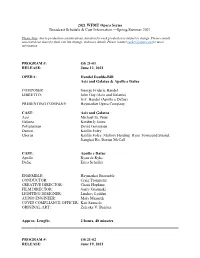
2021 WFMT Opera Series Broadcast Schedule & Cast Information —Spring/Summer 2021
2021 WFMT Opera Series Broadcast Schedule & Cast Information —Spring/Summer 2021 Please Note: due to production considerations, duration for each production is subject to change. Please consult associated cue sheet for final cast list, timings, and more details. Please contact eusher@wfmt.com for more information. PROGRAM #: OS 21-01 RELEASE: June 12, 2021 OPERA: Handel Double-Bill: Acis and Galatea & Apollo e Dafne COMPOSER: George Frideric Handel LIBRETTO: John Gay (Acis and Galatea) G.F. Handel (Apollo e Dafne) PRESENTING COMPANY: Haymarket Opera Company CAST: Acis and Galatea Acis Michael St. Peter Galatea Kimberly Jones Polyphemus David Govertsen Damon Kaitlin Foley Chorus Kaitlin Foley, Mallory Harding, Ryan Townsend Strand, Jianghai Ho, Dorian McCall CAST: Apollo e Dafne Apollo Ryan de Ryke Dafne Erica Schuller ENSEMBLE: Haymarket Ensemble CONDUCTOR: Craig Trompeter CREATIVE DIRECTOR: Chase Hopkins FILM DIRECTOR: Garry Grasinski LIGHTING DESIGNER: Lindsey Lyddan AUDIO ENGINEER: Mary Mazurek COVID COMPLIANCE OFFICER: Kait Samuels ORIGINAL ART: Zuleyka V. Benitez Approx. Length: 2 hours, 48 minutes PROGRAM #: OS 21-02 RELEASE: June 19, 2021 OPERA: Tosca (in Italian) COMPOSER: Giacomo Puccini LIBRETTO: Luigi Illica & Giuseppe Giacosa VENUE: Royal Opera House PRESENTING COMPANY: Royal Opera CAST: Tosca Angela Gheorghiu Cavaradossi Jonas Kaufmann Scarpia Sir Bryn Terfel Spoletta Hubert Francis Angelotti Lukas Jakobski Sacristan Jeremy White Sciarrone Zheng Zhou Shepherd Boy William Payne ENSEMBLE: Orchestra of the Royal Opera House, -

The Italian Girl in Algiers
Opera Box Teacher’s Guide table of contents Welcome Letter . .1 Lesson Plan Unit Overview and Academic Standards . .2 Opera Box Content Checklist . .8 Reference/Tracking Guide . .9 Lesson Plans . .11 Synopsis and Musical Excerpts . .32 Flow Charts . .38 Gioachino Rossini – a biography .............................45 Catalogue of Rossini’s Operas . .47 2 0 0 7 – 2 0 0 8 S E A S O N Background Notes . .50 World Events in 1813 ....................................55 History of Opera ........................................56 History of Minnesota Opera, Repertoire . .67 GIUSEPPE VERDI SEPTEMBER 22 – 30, 2007 The Standard Repertory ...................................71 Elements of Opera .......................................72 Glossary of Opera Terms ..................................76 GIOACHINO ROSSINI Glossary of Musical Terms .................................82 NOVEMBER 10 – 18, 2007 Bibliography, Discography, Videography . .85 Word Search, Crossword Puzzle . .88 Evaluation . .91 Acknowledgements . .92 CHARLES GOUNOD JANUARY 26 –FEBRUARY 2, 2008 REINHARD KEISER MARCH 1 – 9, 2008 mnopera.org ANTONÍN DVOˇRÁK APRIL 12 – 20, 2008 FOR SEASON TICKETS, CALL 612.333.6669 The Italian Girl in Algiers Opera Box Lesson Plan Title Page with Related Academic Standards lesson title minnesota academic national standards standards: arts k–12 for music education 1 – Rossini – “I was born for opera buffa.” Music 9.1.1.3.1 8, 9 Music 9.1.1.3.2 Theater 9.1.1.4.2 Music 9.4.1.3.1 Music 9.4.1.3.2 Theater 9.4.1.4.1 Theater 9.4.1.4.2 2 – Rossini Opera Terms Music -

Le Temple De La Gloire
april insert 4.qxp_Layout 1 5/10/17 7:08 AM Page 15 A co-production of Cal Performances, Philharmonia Baroque Orchestra & Chorale, and Centre de musique baroque de Versailles Friday and Saturday, April 28 –29, 2017, 8pm Sunday, April 30, 2017, 3pm Zellerbach Hall Jean-Philippe Rameau Le Temple de la Gloire (The Temple of Glory) Opera in three acts with a prologue Libretto by Voltaire featuring Nicholas McGegan, conductor Marc Labonnette Camille Ortiz-Lafont Philippe-Nicolas Martin Gabrielle Philiponet Chantal Santon-Jeffery Artavazd Sargsyan Aaron Sheehan New York Baroque Dance Company Catherine Turocy, artistic director Brynt Beitman Caroline Copeland Carly Fox Horton Olsi Gjeci Alexis Silver Meggi Sweeney Smith Matthew Ting Andrew Trego Philharmonia Baroque Orchestra & Chorale Bruce Lamott, chorale director Catherine Turocy, stage director and choreographer Scott Blake, set designer Marie Anne Chiment, costume designer Pierre Dupouey, lighting designer Sarah Edgar, assistant director Cath Brittan, production director Major support for Le Temple de la Gloire is generously provided by Philharmonia Baroque Orchestra & Chorale supporters: David Low & Dominique Lahaussois, The Waverley Fund, Mark Perry & Melanie Peña, PBO’s Board of Directors, and The Bernard Osher Foundation. Cal Performances and Philharmonia Baroque Orchestra & Chorale dedicate Le Temple de la Gloire to Ross E. Armstrong for his extraordinary leadership in both our organizations, his friendship, and his great passion for music. This performance is made possible, in part, by Patron Sponsors Susan Graham Harrison and Michael A. Harrison, and Francoise Stone. Additional support made possible, in part, by Corporate Sponsor U.S. Bank. april insert 4.qxp_Layout 1 5/10/17 7:08 AM Page 16 Title page of the original 1745 libretto of Le Temple de la Gloire . -
Program Notes.Docx
CALIFORNIA STATE UNIVERSITY, NORTHRIDGE Pipe Organ Recital An abstract submitted in partial fulfillment of the requirements For the degree of Master of Music, Performance By Hae-Yul Grace Chung August 2014 The abstract of Hae-Yul Grace Chung is approved: _________________________________________ ______________ Dr. Elizabeth Sellers Date _________________________________________ ______________ Dr. Liviu Marinescu Date _________________________________________ ______________ Dr. Timothy Howard, Chair Date California State University, Northridge ii TABLE OF CONTENTS Signature Page ii Abstract iv 1. Johann Sebastian Bach (1685-1750) 1 1.1 Analysis of Prelude and Fugue in A Minor, BWV 543 7 2. Dan Locklair (b.1949) 11 2. 1 Analysis of In Mystery and Wonder 12 3. Louis Vierne (1870-1937) 15 3. 1 Analysis of Troisième Symphonie Pour Grand Orgue 19 Bibliography 23 Appendix A: Map of Bach’s Travels 25 Appendix B: The Record of Bach’s Recommendations to repair 26 Appendix C: Specifications of the Notre Dame Organ 27 Appendix D: Themes in Troisième symphonie pour grand orgue 28 Appendix E: Recital Program 32 Appendix F: Recital Program Notes 35 iii ABSTRACT Pipe Organ Recital By Hae-Yul Grace Chung Master of Music, Performance The contributions made by Johann Sebastian Bach, Louis Vierne, and Dan Locklair hold a very distinct landmark in the development of organ music. Bach creatively brought Baroque music to its culmination, and is known for his expert contrapunctal craftsmanship that has proven itself through the ages. In the French Romantic period the zenith of symphonic organ music was achieved by Vierne through his six organ symphonies. Vierne modified sonata form, created subtle nuance in harmony, and utilized orchestral timbres made possible by the innovative organs of Aristide Cavaillé-Coll in the 19th century. -

Johann Sebastian Bach Orchestral Suite No. 3 in D Major, BWV No. 3 in D Major, BWV 1068
PROGRAM NOTES by Phillip Huscher Johann Sebastian Bach Born March 21, 1685, Eisenach, Thuringia, Germany. Died July 28, 1750, Leipzig, Germany. Orchestral Suite No. 3 in D Major, BWV 1068 Although the dating of Bach’s four orchestral suites is uncertain, the third was probably written in 1731. The score calls for two oboes, three trumpets, timpani, and harpsichord, with strings and basso continuo. Performance time is approximately twenty -one minutes. The Chicago Sympho ny Orchestra’s first subscription concert performances of Bach’s Third Orchestral Suite were given at the Auditorium Theatre on October 23 and 24, 1891, with Theodore Thomas conducting. Our most recent subscription concert performances were given on May 15 , 16, 17, and 20, 2003, with Jaime Laredo conducting. The Orchestra first performed the Air and Gavotte from this suite at the Ravinia Festival on June 29, 1941, with Frederick Stock conducting; the complete suite was first performed at Ravinia on August 5 , 1948, with Pierre Monteux conducting, and most recently on August 28, 2000, with Vladimir Feltsman conducting. When the young Mendelssohn played the first movement of Bach’s Third Orchestral Suite on the piano for Goethe, the poet said he could see “a p rocession of elegantly dressed people proceeding down a great staircase.” Bach’s music was nearly forgotten in 1830, and Goethe, never having heard this suite before, can be forgiven for wanting to attach a visual image to such stately and sweeping music. Today it’s hard to imagine a time when Bach’s name meant little to music lovers and when these four orchestral suites weren’t considered landmarks. -

J. S. Bach and the Two Cultures of Musical Form*
Understanding Bach, 10, 109–122 © Bach Network UK 2015 J. S. Bach and the Two Cultures of Musical Form* GERGELY FAZEKAS Leopold Godowsky, the celebrated pianist of the first decades of the twentieth century, left the USA for a tour of the Far East in 1923.1 During the lengthy boat journeys between different stops on the concert tour, he prepared virtuoso transcriptions of Bach’s Cello Suites and Violin Solos, principally because he needed ‘warm-up’ opening pieces for his concerts. On 12 March, travelling from Java to Hong Kong aboard the passenger steamboat SS Tjikembang, he finished his version of the Sarabande of the C-minor cello suite, which he dedicated to Pablo Casals (Example 1). The original piece is in binary form, characteristic of eighteenth-century dance suites. The first part modulates from C minor to the relative E-flat major; the second part finds its way back from E-flat major to the tonic after a short detour in F minor. In Bach’s composition, the first part consists of eight bars, the second twelve bars. In Godowsky’s transcription, however, the second part is extended by four additional bars. From bar 17, the first four bars of the piece return note for note. Accordingly, the form becomes three-part in a symmetric arrangement: the first eight bars that modulate from tonic to the relative major are followed by eight bars that modulate from the relative major to the fourth degree, and these are followed by another eight bars of the return of the beginning. When the transcriptions were published by Carl Fischer in New York in 1924, Godowsky gave the following explanation as to why he changed Bach’s form: On several occasions I have been tempted to slightly modify the architectural design in order to give the structural outline a more harmonious form. -

"Mixed Taste," Cosmopolitanism, and Intertextuality in Georg Philipp
“MIXED TASTE,” COSMOPOLITANISM, AND INTERTEXTUALITY IN GEORG PHILIPP TELEMANN’S OPERA ORPHEUS Robert A. Rue A Thesis Submitted to the Graduate College of Bowling Green State University in partial fulfillment of the requirements for the degree of MASTER OF MUSIC May 2017 Committee: Arne Spohr, Advisor Mary Natvig Gregory Decker © 2017 Robert A. Rue All Rights Reserved iii ABSTRACT Arne Spohr, Advisor Musicologists have been debating the concept of European national music styles in the Baroque period for nearly 300 years. But what precisely constitutes these so-called French, Italian, and German “tastes”? Furthermore, how do contemporary sources confront this issue and how do they delineate these musical constructs? In his Music for a Mixed Taste (2008), Steven Zohn achieves success in identifying musical tastes in some of Georg Phillip Telemann’s instrumental music. However, instrumental music comprises only a portion of Telemann’s musical output. My thesis follows Zohn’s work by identifying these same national styles in opera: namely, Telemann’s Orpheus (Hamburg, 1726), in which the composer sets French, Italian, and German texts to music. I argue that though identifying the interrelation between elements of musical style and the use of specific languages, we will have a better understanding of what Telemann and his contemporaries thought of as national tastes. I will begin my examination by identifying some of the issues surrounding a selection of contemporary treatises, in order explicate the problems and benefits of their use. These sources include Johann Joachim Quantz’s Versuch einer Anweisung die Flöte zu spielen (1752), two of Telemann’s autobiographies (1718 and 1740), and Johann Adolf Scheibe’s Critischer Musikus (1737). -

Publicity Book
JORY VINIKOUR conductor, harpsichordist Jory Vinikour is recognized as one of the outstanding harpsichordists of his generation. A highly diversified career brings him to the world!s most important festivals and concert halls as recital and concerto soloist, partner to several of today!s finest singers, and increasingly as a conductor. Born in Chicago, Jory Vinikour came to Paris on a scholarship from the Fulbright Foundation to study with Huguette Dreyfus and Kenneth Gilbert. First Prizes in the International Harpsichord Competitions of Warsaw (1993) and the Prague Spring Festival (1994) brought him to the public!s attention, and he has since appeared in festivals and concert series such as Besançon Festival, Deauville, Nantes, Monaco, Cleveland Museum of Art, Miami Bach Festival, Indianapolis Early Music Festival, etc. A concerto soloist with a repertoire ranging from Bach to Nyman, passing by Poulenc!s Concert Champêtre, Jory Vinikour has performed as soloist with leading orchestras including Rotterdam Philharmonic, Flanders Opera Orchestra, Orchestre de la Suisse Romande, Lausanne Chamber Orchestra, Philharmonic of Radio France, Ensemble Orchestral de Paris, and Moscow Chamber Orchestra with conductors such as Armin Jordan, Marc Minkowski, Marek Janowski, Constantine Orbelian, John Nelson, and Fabio Luisi. He recorded Frank Martin!s Petite Symphonie Concertante with the Lausanne Chamber Orchestra under the direction of Armin Jordan (Suisse Romande, 2005), and also performed the Harpsichord Concerto by the same composer with the Symphony Orchestra of the MDR in Leipzig!s Gewandhaus under the direction of Martin Haselböck in January of 2003. A complete musician, Mr. Vinikour is gaining a reputation as a conductor (studies with Vladimir Kin and Denise Ham) and music director. -

AHLMAN-DMA-TREATISE.Pdf (14.62Mb)
Copyright by Christopher Stephen Ahlman 2011 The Treatise Committee for Christopher Stephen Ahlman Certifies that this is the approved version of the following treatise: The Compositional Nature and Performance Practice of the Grave of Johann Sebastian Bach’s Toccata in C, BWV 564 Committee: Luisa Nardini, Supervisor Gerre E. Hancock, Co-Supervisor Judith E. Hancock Guido Olivieri A. D. Renner Cinzia Russi The Compositional Nature and Performance Practice of the Grave of Johann Sebastian Bach’s Toccata in C, BWV 564 by Christopher Stephen Ahlman, B.A.; M.Div.; M.S.M. Treatise Presented to the Faculty of the Graduate School of The University of Texas at Austin in Partial Fulfillment of the Requirements for the Degree of Doctor of Musical Arts The University of Texas at Austin May 2011 Dedication This work is dedicated to my wife and son, who have endured so much during our time in Austin. I am enormously grateful to them for their love, support, and patience, even in the midst of an unfairly challenging time. Acknowledgements I acknowledge and thank the members of my doctoral Treatise committee for their support and willingness to work with me on my chosen topic, especially Dr. Luisa Nardini, Supervisor, and Prof. Gerre E. Hancock, Co-Supervisor. I also express gratitude to all those who have contributed to my musical education in many and various ways, particularly piano instructors Mr. Stephen W. Hoelter, Ms. Jeanelle A. Mooney, and Ms. Tamara Riley Wyman; organ instructors Dr. Craig J. Cramer, Prof. Gerre E. Hancock, Prof. Judith E. Hancock, Ms. Carol Jarman, Mr.