Thomas Jupiter Harris.Indb
Total Page:16
File Type:pdf, Size:1020Kb
Load more
Recommended publications
-
Joseph Grimaldi
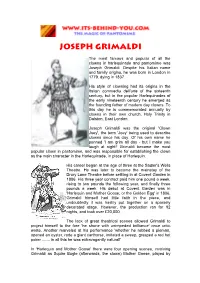
Joseph Grimaldi The most famous and popular of all the clowns in harlequinade and pantomime was Joseph Grimaldi. Despite his Italian name and family origins, he was born in London in 1779, dying in 1837. His style of clowning had its origins in the Italian commedia dell'arte of the sixteenth century, but in the popular Harlequinades of the early nineteenth century he emerged as the founding father of modern day clowns. To this day he is commemorated annually by clowns in their own church, Holy Trinity in Dalston, East London. Joseph Grimaldi was the original 'Clown Joey', the term 'Joey' being used to describe clowns since his day. Of his own name he punned 'I am grim all day - but I make you laugh at night!' Grimaldi became the most popular clown in pantomime, and was responsible for establishing the clown as the main character in the Harlequinade, in place of Harlequin. His career began at the age of three at the Sadler's Wells Theatre. He was later to become the mainstay of the Drury Lane Theatre before settling in at Covent Garden in 1806. His three year contract paid him one pound a week, rising to two pounds the following year, and finally three pounds a week. His debut at Covent Garden was in 'Harlequin and Mother Goose; or the Golden Egg' in 1806. Grimaldi himself had little faith in the piece, and undoubtedly it was hastily put together on a sparsely decorated stage. However, the production ran for 92 nights, and took over £20,000. The lack of great theatrical scenes allowed Grimaldi to project himself to the fore 'he shone with unimpeded brilliance' once critic wrote. -

The Low-Status Character in Shakespeare's Comedies Linda St
Western Kentucky University TopSCHOLAR® Masters Theses & Specialist Projects Graduate School 5-1-1973 The Low-Status Character in Shakespeare's Comedies Linda St. Clair Western Kentucky University Follow this and additional works at: http://digitalcommons.wku.edu/theses Part of the English Language and Literature Commons Recommended Citation St. Clair, Linda, "The Low-Status Character in Shakespeare's Comedies" (1973). Masters Theses & Specialist Projects. Paper 1028. http://digitalcommons.wku.edu/theses/1028 This Thesis is brought to you for free and open access by TopSCHOLAR®. It has been accepted for inclusion in Masters Theses & Specialist Projects by an authorized administrator of TopSCHOLAR®. For more information, please contact topscholar@wku.edu. ARCHIVES THE LOW-STATUS CHARACTER IN SHAKESPEAREf S CCiiEDIES A Thesis Presented to the Faculty of the Department of English Western Kentucky University Bov/ling Green, Kentucky In Partial Fulfillment of the Requirements for the Degree Master of Arts Linda Abbott St. Clair May, 1973 THE LOW-STATUS CHARACTER IN SHAKESPEARE'S COMEDIES APPROVED >///!}<•/ -J?/ /f?3\ (Date) a D TfV OfThesis / A, ^ of the Grafduate School ACKNOWLEDGEMENTS With gratitude I express my appreciation to Dr. Addie Milliard who gave so generously of her time and knowledge to aid me in this study. My thanks also go to Dr. Nancy Davis and Dr. v.'ill Fridy, both of whom painstakingly read my first draft, offering invaluable suggestions for improvement. iii TABLE OF CONTENTS ACKNOWLEDGEMENTS iii INTRODUCTION 1 THE EARLY COMEDIES 8 THE MIDDLE COMEDIES 35 THE LATER COMEDIES 8? CONCLUSION 106 BIBLIOGRAPHY Ill iv INTRODUCTION Just as the audience which viewed Shakespeare's plays was a diverse group made of all social classes, so are the characters which Shakespeare created. -
Gesture and Movement in Silent Shakespeare Films
Gesticulated Shakespeare: Gesture and Movement in Silent Shakespeare Films Thesis Presented in Partial Fulfillment of the Requirements for the Degree of Master of Arts in the Graduate School of The Ohio State University By Jennifer Rebecca Collins, B.A. Graduate Program in Theatre The Ohio State University 2011 Thesis Committee: Alan Woods, Advisor Janet Parrott Copyright by Jennifer Rebecca Collins 2011 Abstract The purpose of this study is to dissect the gesticulation used in the films made during the silent era that were adaptations of William Shakespeare's plays. In particular, this study investigates the use of nineteenth and twentieth century established gesture in the Shakespearean film adaptations from 1899-1922. The gestures described and illustrated by published gesture manuals are juxtaposed with at least one leading actor from each film. The research involves films from the experimental phase (1899-1907), the transitional phase (1908-1913), and the feature film phase (1912-1922). Specifically, the films are: King John (1899), Le Duel d'Hamlet (1900), La Diable et la Statue (1901), Duel Scene from Macbeth (1905), The Taming of the Shrew (1908), The Tempest (1908), A Midsummer Night's Dream (1909), Il Mercante di Venezia (1910), Re Lear (1910), Romeo Turns Bandit (1910), Twelfth Night (1910), A Winter's Tale (1910), Desdemona (1911), Richard III (1911), The Life and Death of King Richard III (1912), Romeo e Giulietta (1912), Cymbeline (1913), Hamlet (1913), King Lear (1916), Hamlet: Drama of Vengeance (1920), and Othello (1922). The gestures used by actors in the films are compared with Gilbert Austin's Chironomia or A Treatise on Rhetorical Delivery (1806), Henry Siddons' Practical Illustrations of Rhetorical Gesture and Action; Adapted to The English Drama: From a Work on the Subject by M. -

Italian Theater Prints, Ca
http://oac.cdlib.org/findaid/ark:/13030/kt9b69q7n7 No online items Finding aid for the Italian theater prints, ca. 1550-1983 Finding aid prepared by Rose Lachman and Karen Meyer-Roux. Finding aid for the Italian theater P980004 1 prints, ca. 1550-1983 Descriptive Summary Title: Italian theater prints Date (inclusive): circa 1550-1983 Number: P980004 Physical Description: 21.0 box(es)21 boxes, 40 flat file folders ca. 677 items (623 prints, 13 drawings, 23 broadsides, 16 cutouts, 1 pamphlet, 1 score) Repository: The Getty Research Institute Special Collections 1200 Getty Center Drive, Suite 1100 Los Angeles, California, 90049-1688 (310) 440-7390 Abstract: The Italian theater prints collection documents the development of stage design, or scenography, the architecture of theaters, and the iconography of commedia dell'arte characters and masks. Request Materials: Request access to the physical materials described in this inventory through the catalog record for this collection. Click here for the access policy . Language: Collection material is in Italian Access Open for use by qualified researchers. Publication Rights Contact Library Reproductions and Permissions . Preferred Citation Italian theater prints, ca. 1550-1983, Getty Research Institute, Research Library, Accession no. P980004. http://hdl.handle.net/10020/cifaP980004 Acquisition Information Acquired in 1998. Processing History The Italian theater prints collection was first processed in 1998 by Rose Lachman. Karen Meyer-Roux completed the processing of the collection and wrote the present finding aid in 2004. Separated Materials All of the approximately 4380 secondary sources from the Italian theater collection were separated to the library. In addition, ca. 1500 rare books, some of which are illustrated with prints, have also been separately housed, processed and cataloged. -

LATE 20Th and EARLY 21St CENTURY CLOWNING's
CLOWNING ON AND THROUGH SHAKEPEARE: LATE 20th AND EARLY 21st CENTURY CLOWNING’S TACTICAL USE IN SHAKESPEARE PERFORMANCE by David W Peterson BA, University of Michigan, 2007 Masters, Michigan State University, 2009 Submitted to the Graduate Faculty of The Kenneth P. Dietrich School of Arts and Sciences in partial fulfillment of the requirements for the degree of Doctor of Philosophy University of Pittsburgh 2014 UNIVERSITY OF PITTSBURGH THE KENNETH P. DIETRICH SCHOOL OF ARTS AND SCIENCES This dissertation was presented by David W Peterson It was defended on April 16, 2014 and approved by Dr. Attilio “Buck” Favorini, Professor Emeritus, Theatre Arts Dr. Bruce McConachie, Professor, Theatre Arts Dr. Jennifer Waldron, Associate Professor, English Dissertation Advisor: Dr. Lisa Jackson-Schebetta, Assistant Professor, Theatre Arts ii Copyright © by David Peterson 2014 iii CLOWNING ON AND THROUGH SHAKEPEARE: LATE 20th AND EARLY 21st CENTURY CLOWNING’S TACTICAL USE IN SHAKESPEARE PERFORMANCE David Peterson, PhD University of Pittsburgh, 2014 This dissertation argues that contemporary clown performance (as developed in the latter half of the 20th century) can be understood in terms of three key performance practices: the flop, interruption, and audience play. I further argue that these three features of flop, interruption, and audience play are distinctively facilitated by Shakespeare in both text and performance which, in turn, demonstrates the potential of both clown and Shakespeare to not only disrupt theatrical conventions, but to imagine new relationships to social and political power structures. To this end, I ally the flop with Jack Halberstam’s sense of queer failure to investigate the relationship between Macbeth and 500 Clown Macbeth. -
Information to Users
INFORMATION TO USERS This manuscript has been reproduced from the microfilm master. UMI films the text directly from the original or copy submitted. Thus, some thesis and dissertation copies are in typewriter face, while others may be from any type of computer printer. The quality of this reproduction is dependent upon the quality of the copy submitted. Broken or indistinct print, colored or poor quality illustrations and photographs, print bleedthrough, substandard margins, and improper alignment can adversely afreet reproduction. In the unlikely event that the author didsend notUMI a complete manuscript and there are missing pages, these will be noted. Also, if unauthorized copyright material had to be removed, a note wül indicate the deletion. Oversize materials (e.g., maps, drawings, charts) are reproduced by sectioning the original, beginning at the upper left-hand comer and continuing from left to right in equal sections with small overlaps. Each original is also photographed in one exposure and is included in reduced form at the back of the book. Photographs included in the origmal manuscript have been reproduced xerographically in this copy. Higher quality 6” x 9” black and white photographic prints are available for any photographs or illustrations appearing in this copy for an additional charge. Contact UMI directly to order. UMI A Bell & Howell Infonnation Company 300 Horth Zeeb Road, Ann Arbor MI 48106-1346 USA 313/761-4700 800/521-0600 THOMAS KING AT SADLER'S WELLS AND DRURY LANE: PROPRIETORSHIP AND MANAGEMENT IN LATE EIGHTEENTH-CENTURY ENGLISH THEATRE, 1772-1788 DISSERTATION Presented in Partial Fulfillment of the Requirements for the Degree Doctor of Philosophy in the Graduate School of The Ohio State University By Evan M. -
A Touch of Greasepaint, Apr
CANADIAN BROADCASTING CORP. RADIO DRAMA A Touch of Greasepaint, Apr. 24, 1954 Inventory Series 1 1. Some “firsts” & beginnings of the theatre: The Contrast, New York, 1787 2. Morals, Restoration & Victorian: The Provoked Wife and Lady Windermere’s Fan 3. Melodrama: Ticket of Leave Man, East Lynne and Caste 4. The Admirable Bashville (G.B.S) 5. Sarah Siddons: Venice Preserved and Zara 6. The Bucktails, or Americans in England and Fashion 7. The Land of Promise (Somerset Maugham) 8. Tom Robertson and Garrick 9. David Garrick: The Old Batchelor 10. David Garrick: “Actors’ Fund Prologue” and The Wonder 11. Irish Theatre: In the Shadow of the Glen 12. Edmund Kean: A New Way to Pay Old Debts 13. Edmund Kean: Othello, Act 3, Scene 3. 14. Chekhov, The Seagull 15. Henry Irving: Two Roses 16. Henry Irving: The Bells 17. Sheridan: The School for Scandal 18. Dion Boucicault: The Colleen Bawn and London Assurance 19. Comedy: Sir Thomas More, Gammer Gurton’s Needle and The Relapse 20. Henrik Ibsen, Little Eyolf Canadian Broadcasting Corporation Radio Drama A Touch of Greasepaint Inventory Page 2 of 11 21. Ben Jonson: Volpone 22. Pirandello: Naked 23. Macready: The Distrest Mother 24. Macready: Virginus 25. Oscar Wilde: An Ideal Husband 26. Moliere: The School for Wives 27. August Stringberg: The Dance of Death 28. Marriage: Proposal scenes from The Shoemaker’s Holiday, The Way of the World, Money and The White Headed Boy Series 2 1. Repeat 2. D.H. Lawrence: The Widowing of Mrs. Holroyd 3. Shelley: The Cenci 4. Sheridan: The Rivals 5. -
The Artistic Approach of the Grieve Family to Selected Problems of Nineteenth Century Scene Painting
This dissertation has been microfilmed exactly as received 67-6318 HAMBLIN, Junius N., 1930- THE ARTISTIC APPROACH OF THE GRIEVE FAMILY TO SELECTED PROBLEMS OF NINETEENTH CENTURY SCENE PAINTING. The Ohio State University, Ph.D., 1966 Speech-Theater University Microfilms, Inc., Ann Arbor, Michigan C Copyright by Junius N. Hamblin 1967 THE ARTISTIC APPROACH OF THE GRIEVE FAMILY TO SELECTED PROBLEMS OF NINETEENTH CENTURY SCENE PAINTING DISSERTATION Presented in Partial Fulfillment of the Requirements for the Degree Doctor of Philosophy in the Graduate School of The Ohio State University By Junius N . Hamblin* B .S.* M.S. ****** The Ohio State University 1966 Approved by Department of Speech PLEASE NOTE: Figure pages are not original copy. They tend to "curl". Filmed in the best possible way. UNIVERSITY MICROFILMS PREFACE The conduct of this investigation would not have been possible without the large number of drawings by members of the Grieve family available for analysis through the microfilm holdings of The Ohio State University Theatre Collection. These holdings are from three sources: (l) The British Museum collection of drawings by John Henderson Grieve (OSUTC film No. 1454). (2) The Victoria and Albert Museum holdings of drawings by members of the Grieve family (OSUTC film No. 1721). It is from these two sources that the drawings were selected for analysis and illustration in this study. (3) Drawings by Thomas Grieve in the Charles Kean Collection at the Victoria and Albert Museum (OSUTC film Nos. 893, 894 and 895 )• These drawings are catalogued in Appendix A and were examined but were not used as illustrations for the study because they are from the second half of the century when theatrical conditions had begun to change. -

John Bill Ricketts and the Edinburgh Equestrian Circus
5 Kim Baston La Trobe University, Australia Transatlantic Journeys: John Bill Ricketts and the Edinburgh Equestrian Circus John Bill Ricketts is generally credited as the founder of American circus, setting up a circus in Philadelphia in 1793. This paper examines evidence from Ricketts’ early career in England and Scotland and argues that the successful transplant of the early modern circus form initiated by Philip Astley into America rested on Ricketts’ experiences with a small circus in Edinburgh, established by the equestrian performers George Jones and William Parker. Not only did this circus provide a repertoire and a business model which Ricketts replicated in his American circuses but, crucially, provided him with a network of experienced performers whom he subsequently employed. The first circus in America owed much to the first circus in Scotland. Kim Baston is a Senior Lecturer in Theatre and Drama at La Trobe University, Melbourne. Keywords: John Bill Ricketts, circus, equestrian, American circus, Edinburgh circus, James Jones, George Jones he equestrian performer, John Bill Ricketts, is generally credited with T being the founder of circus in the Americas, setting up a circus in Philadelphia in 1793, and going on to establish circus buildings along the eastern seaboard, and in Canada. As an originating figure, his achievements are listed in almost every history of the American circus, whether popular or academic. Many existing histories, however, attach Ricketts in a seamless lineage to either Philip Astley, founder of Astley’s Amphitheatre and the institution of the early modern circus in England, or, more commonly, to an apprenticeship with Astley’s rival, Charles Hughes, founder of the Royal Circus.1 This link was first questioned by James S. -
Grim-All-Day
Grim-All-Day A Play by Chas LiBretto December 13. 2017 Agent contact: Katie Gamelli katiegamelli@abramsartsny.com A3 Artists Agency Literary Division The Empire State Building Fifth Ave. 38th Floor New York, NY 10118 1 Dramatis Personae Actor 1: Joseph Grimaldi Actor 2: JS Grimaldi / John Grimaldi Actor 3: Mary Actor 4: Signor Grimaldi / John Philip Kemble / Charles Actor 5: Charles Dickens Actor 6: Columbine / Young JS / Young Grimaldi Time: 1832 and earlier Place: London I make you laugh at night but I am Grim All Day. - Joseph Grimaldi Nobody likes a clown at midnight. - Stephen King 2 Scene 1 1832 London, 1832. Music from Regency-era Pantomime shows plays softly and sadly in the background, while the lights brighten very, very slowly on a dilapidated old theatre. GRIMALDI Stop me if you’ve heard this one. A man goes to visit a doctor to treat his melancholy. “I can’t eat,” he says. “I can’t sleep. I feel constantly miserable. Please help me, doctor.” The doctor looks him over and he says “Laughter is the best medicine, my friend. Take yourself off to Covent Garden Theatre where you will find the Great Grimaldi performing in ‘Harlequin and Mother Goose.’ It is exquisitely funny and will cure you of all your ills without any pills or potions from my cabinet.” The man looks at the doctor a moment. “Ah,” he says. “That won’t help.” “Well, why not, sir?” The man shrugs. “I am Grimaldi.” CHARLES (off) Mister Grimaldi? Ah, Mister Grimaldi? Are you there? GRIMALDI (off) I’m up on stage. -
Appendix Appendices Page 1 from Oxford Dictionary of National
Appendix From Oxford Dictionary of National Biography Charles Dibdin 1745-1814 actor, composer, and writer, Charles Dibdin (bap. 1745, d. 1814), by Thomas Phillips, 1799 Dibdin next accepted an invitation from his elder brother Thomas Dibdin, Charles (bap. 1745, d. 1814), actor, composer, and writer, (later the father of Thomas Frognall Dibdin) to move to London. was baptized privately (possibly because he was sickly at birth) There he quickly learned extempore playing at the organ, and he on 4 March 1745 at Southampton, and again publicly on 26 often played the congregation out at St Bride's, Fleet Street. He March at Holyrood Church, Southampton, where his father, also entered into a working relationship (unlikely to have been as Thomas Dibdin, was parish clerk; his mother's name has been an apprentice) with the music and instrument seller John Johnson; given as Sarah, née Wesgarth. later he claimed that all he did at Johnson's shop, the Harp and Crown in Cheapside, was to tune harpsichords. Thomas sailed Youth and early career with the Hope in 1757, during the Seven Years' War, and the ship was captured by the French. Charles Dibdin soon discerned a Charles was probably the twelfth of fourteen children, and his cooling of interest by his brother's friends, and one of them, father was ‘a silversmith, a man of considerable credit’ Richard Berenger, an Irishman, advised him that this was because (Professional Life, 1.15); nothing is known of his mother's family. of his refusal to act as a ‘fiddler and a buffoon’ while in their His father died when he was young and the family moved to company; Berenger advised him to consider the stage as a career. -

“Who Will Change New Lamps for Old Ones?”: Aladdin and His Wonderful Lamp in British and American Children’S Entertainment
chapter 5 “Who Will Change New Lamps for Old Ones?”: Aladdin and His Wonderful Lamp in British and American Children’s Entertainment Jennie MacDonald On Tuesday, the 20th of April, 1813, the dramatic Thanks to the familiarity of the play’s origin sto- reviewer for The Morning Chronicle reported on ry, theatrical spectacle presenting a “truly oriental” the previous night’s opening of Theatre Royal Cov- wonderland of scenery and special effects, and an ent Garden’s new “Melo-Dramatic Romance” by affecting cast, the reviewer concluded, “[t]he Man- actor/playwright Charles Farley, Aladdin; or, The agers having thus got possession of the Wonderful Wonderful Lamp:1 Lamp, it will probably be productive to them of considerable profit.” Over the next six weeks, the “Whoever has read the Arabian Nights Entertain- play was presented thirty nights and consistently ment2 (and who has not) cannot fail to recollect revived through to the end of 1815. During subse- with pleasure the story of Aladdin, and the Won- quent revivals that saw it performed well into the derful Lamp…. The machinery of the piece, on mid-nineteenth century, it found additional life in which all the effect of a tale of enchantment de- the booming juvenile drama and its companion in- pends, was admirably worked, and seemed tangi- dustry, the toy theater, and contributed to later bly to perform the fabled operations of magic. This nineteenth-century reconceptions of the tale that was aided by a splendour and magnificence truly can still be found in residual form in modern Brit- oriental, and which threw over the spectacle a ish pantomime.