Shambellie House, New Abbey, Dumfries & Galloway: Options
Total Page:16
File Type:pdf, Size:1020Kb
Load more
Recommended publications
-

Dumfries & Galloway
Survey Report Dumfries & Galloway 2013 Revised Native Woodland Survey of Scotland Introduction Native woodlands are a vital part of Scotland’s natural and cultural heritage, providing us with a wide range of social, environmental and economic benefits. What is left today is only a small proportion of the native woodland that once covered much of Scotland, though much has been done since the 1980s to protect and restore the areas that remain. The Scottish Forestry Strategy (2006) promotes continuing action to expand our native woods, to improve their condition and to restore native woodland habitats on ancient woodland sites. To support this work Forestry Commission Scotland (FCS) has developed the Native Woodland Survey of Scotland (NWSS), which is the most extensive habitat survey of its kind ever undertaken in Scotland. The survey will provide a nationwide map and a comprehensive picture of our native woodland resource for the first time. Results will be reported separately for each local authority area and in a national summary. This report presents summary information from the Native Woodland Survey of Scotland for the Dumfries and Galloway authority area. Survey Aims The Native Woodland Survey of Scotland will create a woodland map linked to a spatial dataset which describes the type, extent, composition and condition of all native woods in Scotland over 0.5ha in area. Planted woods on ancient woodland sites (PAWS) will also be surveyed, even where they are not mainly native in species composition, in order to provide information to help maintain or restore their remaining biodiversity value. Method The fieldwork for Dumfries and Galloway was carried out between January 2008 and June 2012. -

The Lockerbie "Extradition by Analogy" Agreement: "Exceptional Measure" Or Template for Transnational Criminal Justice? Donna E
American University International Law Review Volume 18 | Issue 1 Article 4 2002 The Lockerbie "Extradition by Analogy" Agreement: "Exceptional Measure" or Template for Transnational Criminal Justice? Donna E. Arzt Follow this and additional works at: http://digitalcommons.wcl.american.edu/auilr Part of the International Law Commons Recommended Citation Arzt, Donna E. "The Lockerbie "Extradition by Analogy" Agreement: "Exceptional Measure" or Template for Transnational Criminal Justice?" American University International Law Review 18, no. 1 (2002): 163-236. This Article is brought to you for free and open access by the Washington College of Law Journals & Law Reviews at Digital Commons @ American University Washington College of Law. It has been accepted for inclusion in American University International Law Review by an authorized administrator of Digital Commons @ American University Washington College of Law. For more information, please contact fbrown@wcl.american.edu. THE LOCKERBIE "EXTRADITION BY ANALOGY" AGREEMENT: "EXCEPTIONAL MEASURE" OR TEMPLATE FOR TRANSNATIONAL CRIMINAL JUSTICE? DONNA E. ARZT* INTRODU CTION .............................................. 164 I. THE EXTRADITION LACUNA ............................ 172 II. THE SECRETARY-GENERAL'S INTERVENTION ........ 179 A. PRE-TRIAL DEVELOPMENTS .............................. 179 B. THE "GOOD OFFICES" FUNCTION ......................... 186 C. THE 17 FEBRUARY 1999 "LETTER OF UNDERSTANDING" .. 193 1. Context and Cover Letter ............................. 194 2. The Letter's Annex -

Place-Names in and Around the Fleet Valley ==== D ==== Daffin Daffin Is a Farm at the Head of the Cleugh of Doon Above Carsluith
Place-names in and around the Fleet Valley ==== D ==== Daffin Daffin is a farm at the head of the Cleugh of Doon above Carsluith. There is a Daffin Tree marked on the 1st edition OS map at Killochy in Balmaclellan parish, and Daffin Hill in this location on current OS maps, across the Dee from Kenmure Castle; Castle Daffin is a hill in Parton parish and a house by Auchencairn. This is likely to be Gaelic *Dà pheiginn ‘two pennylands’. Peighinn is ‘a penny’, but in place-names it refers to a unit of land, based on yield rather than area. It probably originated in the Gaelic-Norse context of Argyll and the southern Hebrides, and was introduced into the south-west by the Gall- Ghàidheil (see Ardwell above). It occurs in place-names in Galloway and, especially, Carrick as ‘Pin- ‘ as first element, ‘-fin’ with ‘softened ‘ph’ after a numeral or other pre-positioned adjective. Originally a pennyland was a relatively small division of a davoch (dabhach, see Cullendoch above), but in the south-west places whose names contain this element appear in mediaeval records as holdings of relatively substantial landowners, comprising good extents of pasture, meadow and woodland as well as the arable core, and yielding much higher taxes than the pennylands further north. Indeed, peighinn may have come to be used more generally in the region for a fairly substantial estate without implying a specific valuation. *Dà pheiginn ‘two pennylands’ would, then, have been a large and productive landholding. However, a Scots origin is also possible, or if the origin was Gaelic, reinterpretation by Scots speakers is possible: daffin or daffen is a Scots word for ‘daffodil’, but as a verb, daffin(g) is ‘playing daft, larking about’. -

BUTLER LAND MANAGEMENT LTD Newhall Farm, Tundergarth, Lockerbie for Sale Privately
BUTLER LAND MANAGEMENT LTD 01461 201200 butlerlm.co.uk Newhall Farm, Tundergarth, Lockerbie A productive stock farm extending to around 111.87ha (276.41ac) For Sale Privately on the instructions of Mr E Halliday Location Newhall Farm is situated just off the B7068 along an unclassified road. Lockerbie and Langholm are easily accessible, approximately 7 and 11 miles respectively along this road. There are good transport links to both North and South via the M74 at Eaglesfield or Lockerbie. Glasgow is only 1hour and 30mins by car. Local amenities and schools are nearby in the towns of Lockerbie and Langholm. Bankshill and Eaglesfield have small primary schools. Productive Stock Farm in an accessible location Accommodation The property affords the following accommodation:- Entrance Hall Utility Room (3.9m x 1.94m) Washing Machine, Tumble dryer and sink Sitting Room (4.9m x 4.5m) LPG Gas Fireplace Kitchen (4.05m x 2.6m) Electric cooker and fitted units Bathroom (2.8m x 3m) Four piece suite in white Bedroom 1 (3.75m x 3.3m) Built in wardrobe Bedroom 2 (4.07m x 2.45m) Built in cupboard Bedroom 3 (4.07m x 2.55m) Built in cupboard Attic Garden Easily maintained gravel garden with well stocked borders on three sides. Council Tax We are informed that the property is assessed as Band C for Council Tax purposes. Steading The Steading comprises of both traditional and modern buildings. Traditional Steading Former hay shed (5.25m x 15.9m) Workshop (15.2m x 5.15m) Modern Steading Polytunnel (9.3m x 36m) o Used as former lambing shed Cattle -
1841 Census List
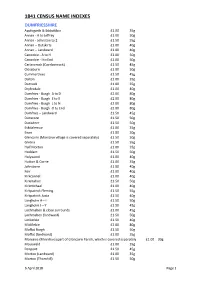
1841 CENSUS NAME INDEXES DUMFRIESSHIRE Applegarth & Sibbaldbie £1.00 35g Annan - A to Jeffrey £1.00 50g Annan - Johnston to Z £1.50 55g Annan – Outskirts £1.00 40g Annan – Landward £1.00 40g Canonbie - A to H £1.00 50g Canonbie - I to End £1.00 50g Carlaverock (Caerlaverock) £1.50 45g Closeburn £1.00 50g Cummertrees £1.50 45g Dalton £1.00 35g Dornock £1.00 35g Dryfesdale £1.00 40g Dumfries - Burgh A to D £2.00 80g Dumfries - Burgh E to K £2.00 80g Dumfries - Burgh L to N £2.00 80g Dumfries - Burgh O to End £2.00 80g Dumfries – Landward £1.50 45g Dunscore £1.50 50g Durisdeer £1.50 50g Eskdalemuir £1.00 35g Ewes £1.00 30g Glencairn (Moniaive village is covered separately) £1.50 50g Gretna £1.50 55g Half Morton £1.00 35g Hoddam £1.50 50g Holywood £1.00 40g Hutton & Corrie £1.00 35g Johnstone £1.00 40g Keir £1.00 40g Kirkconnel £1.00 40g Kirkmahoe £1.50 50g Kirkmichael £1.00 40g Kirkpatrick Fleming £1.50 55g Kirkpatrick Juxta £1.50 40g Langholm A—I £1.50 50g Langholm J—Y £1.50 45g Lochmaben & close surrounds £1.00 45g Lochmaben (landward) £1.50 50g Lockerbie £1.50 40g Middlebie £2.00 80g Moffat Burgh £1.50 50g Moffat (landward) £1.00 35g Moniaive (Minnihive) part of Glencairn Parish, which is covered separately £1.00 30g Mouswald £1.00 35g Penpont £1.50 45g Morton (Landward) £1.00 35g Morton (Thornhill) £1.50 50g 6 April 2018 Page 1 1841 CENSUS NAME INDEXES Ruthwell £1.00 40g Sanquhar Burgh £1.50 70g Sanquhar Parish (Landward) £1.00 35g St. -

The Cistercian Abbey of Coupar Angus, C.1164-C.1560
1 The Cistercian Abbey of Coupar Angus, c.1164-c.1560 Victoria Anne Hodgson University of Stirling Submitted for the degree of Doctor of Philosophy August 2016 2 3 Abstract This thesis is an examination of the Cistercian abbey of Coupar Angus, c.1164-c.1560, and its place within Scottish society. The subject of medieval monasticism in Scotland has received limited scholarly attention and Coupar itself has been almost completely overlooked, despite the fact that the abbey possesses one of the best sets of surviving sources of any Scottish religious house. Moreover, in recent years, long-held assumptions about the Cistercian Order have been challenged and the validity of Order-wide generalisations disputed. Historians have therefore highlighted the importance of dedicated studies of individual houses and the need to incorporate the experience of abbeys on the European ‘periphery’ into the overall narrative. This thesis considers the history of Coupar in terms of three broadly thematic areas. The first chapter focuses on the nature of the abbey’s landholding and prosecution of resources, as well as the monks’ burghal presence and involvement in trade. The second investigates the ways in which the house interacted with wider society outside of its role as landowner, particularly within the context of lay piety, patronage and its intercessory function. The final chapter is concerned with a more strictly ecclesiastical setting and is divided into two parts. The first considers the abbey within the configuration of the Scottish secular church with regards to parishes, churches and chapels. The second investigates the strength of Cistercian networks, both domestic and international. -

Moffat Academy Newsletter
Moffat Academy Newsletter Summer 2019 Introduction Dear Parent/Carer Although the weather was certainly changeable over the holidays, I hope you all enjoyed this precious time with your children. The school is always very quiet when they are not in, so I was delighted to welcome them and the buzz they create last Wednesday. They all appear to have settled well and I am sure they will be enjoying getting to know their new teachers and making some new friends. We have enrolled a number of new pupils in our school and I would like to extend a warm welcome to them and their families. Exam Results Congratulations to all our senior pupils who received their exam results during the holidays. The examination picture across our entire senior phase was particularly strong. Our S4 pupils broke school records with 70% achieving 5 or more National 5 qualifications. Yet again, our statistics compare favourably with schools across the authority. There were some outstanding individual performances and these children should be commended. However, there are some pupils who may be feeling disappointed. Our message for them is to regroup, come and seek advice and work hard during this coming year to achieve all they possibly can. The excellent results across our senior phase is testament not only to the hard work of our pupils but also the dedication and commitment of our staff team. We are very fortunate that staff go above and beyond to ensure that our young people achieve all they are capable of. Staffing There has been a number of changes to our staffing to start the new academic session. -
Report on the Current Position of Poverty and Deprivation in Dumfries and Galloway 2020
Dumfries and Galloway Council Report on the current position of Poverty and Deprivation in Dumfries and Galloway 2020 3 December 2020 1 Contents 1. Introduction 1 2. National Context 2 3. Analysis by the Geographies 5 3.1 Dumfries and Galloway – Geography and Population 5 3.2 Geographies Used for Analysis of Poverty and Deprivation Data 6 4. Overview of Poverty in Dumfries and Galloway 10 4.1 Comparisons with the Crichton Institute Report and Trends over Time 13 5. Poverty at the Local Level 16 5.1 Digital Connectivity 17 5.2 Education and Skills 23 5.3 Employment 29 5.4 Fuel Poverty 44 5.5 Food Poverty 50 5.6 Health and Wellbeing 54 5.7 Housing 57 5.8 Income 67 5.9 Travel and Access to Services 75 5.10 Financial Inclusion 82 5.11 Child Poverty 85 6. Poverty and Protected Characteristics 88 6.1 Age 88 6.2 Disability 91 6.3 Gender Reassignment 93 6.4 Marriage and Civil Partnership 93 6.5 Pregnancy and Maternity 93 6.6 Race 93 6.7 Religion or Belief 101 6.8 Sex 101 6.9 Sexual Orientation 104 6.10 Veterans 105 7. Impact of COVID-19 Pandemic on Poverty in Scotland 107 8. Summary and Conclusions 110 8.1 Overview of Poverty in Dumfries and Galloway 110 8.2 Digital Connectivity 110 8.3 Education and Skills 111 8.4 Employment 111 8.5 Fuel Poverty 112 8.6 Food Poverty 112 8.7 Health and Wellbeing 113 8.8 Housing 113 8.9 Income 113 8.10 Travel and Access to Services 114 8.11 Financial Inclusion 114 8.12 Child Poverty 114 8.13 Change Since 2016 115 8.14 Poverty and Protected Characteristics 116 Appendix 1 – Datazones 117 2 1. -
Walking in and Around Dalbeattie and Colvend
1 WALKING in and around Dalbeattie & Colvend The natural place to walk 3 3 Kippford The Dalbeattie and Colvend area is one of the most beautiful and diverse in Dumfries & Galloway with scenery ranging from forest to woodland and from saltmarsh to rocky coast. The area is also home to the town of Dalbeattie, the picturesque coastal villages of Rockcliffe and Kippford, and the popular Sandyhills beach. The variety of habitats support an abundance of wildlife. Red squirrels are a common sight, colourful dragonflies skim the surface of lochs and birdlife abounds. Look out for sparrowhawks, peregrine falcon perching on rocky outcrops and the many waders such as oystercatcher feeding on the mudflats. The area is particularly renowned for its rich diversity of butterfly species including the small copper, pearl bordered fritillary and purple hairstreak. Plant highlights include the shimmering carpets of bluebells in May and the tapestries of tiny coastal flowers such as English stonecrop and birds foot trefoil during June and July. Those interested in archaeology can visit the Iron Age fort sites of Mote of Mark and Castle Point on the coast near Rockcliffe. The town of Dalbeattie provides a good range of services and Rockcliffe has been a choice holiday village since Victorian times. 4 5 THE WALKS Wick Dumfries A 7 1 A 3 A75 7 1 6 Rounall Wood ...........................................8 2 Inverness 1 1 Aberdeen 7 A 2 Dalbeattie Forest Easy Access Trail A 74 5 Castle (and other waymarked routes).............10 DALBEATTIE 0 1 7 Edinburgh Douglas -

Ayrshire & the Isles of Arran & Cumbrae
2017-18 EXPLORE ayrshire & the isles of arran & cumbrae visitscotland.com WELCOME TO ayrshire & the isles of arran and cumbrae 1 Welcome to… Contents 2 Ayrshire and ayrshire island treasures & the isles of 4 Rich history 6 Outdoor wonders arran & 8 Cultural hotspots 10 Great days out cumbrae 12 Local flavours 14 Year of History, Heritage and Archaeology 2017 16 What’s on 18 Travel tips 20 VisitScotland iCentres 21 Quality assurance 22 Practical information 24 Places to visit listings 48 Display adverts 32 Leisure activities listings 36 Shopping listings Lochranza Castle, Isle of Arran 55 Display adverts 37 Food & drink listings Step into Ayrshire & the Isles of Arran and Cumbrae and you will take a 56 Display adverts magical ride into a region with all things that make Scotland so special. 40 Tours listings History springs to life round every corner, ancient castles cling to spectacular cliffs, and the rugged islands of Arran and Cumbrae 41 Transport listings promise unforgettable adventure. Tee off 57 Display adverts on some of the most renowned courses 41 Family fun listings in the world, sample delicious local food 42 Accommodation listings and drink, and don’t miss out on throwing 59 Display adverts yourself into our many exciting festivals. Events & festivals This is the birthplace of one of the world’s 58 Display adverts most beloved poets, Robert Burns. Come and breathe the same air, and walk over 64 Regional map the same glorious landscapes that inspired his beautiful poetry. What’s more, in 2017 we are celebrating our Year of History, Heritage and Archaeology, making this the perfect time to come and get a real feel for the characters, events, and traditions that Cover: Culzean Castle & Country Park, made this land so remarkable. -

Catalogue Description and Inventory
= CATALOGUE DESCRIPTION AND INVENTORY Adv.MSS.30.5.22-3 Hutton Drawings National Library of Scotland Manuscripts Division George IV Bridge Edinburgh EH1 1EW Tel: 0131-466 2812 Fax: 0131-466 2811 E-mail: manuscripts@nls.uk © 2003 Trustees of the National Library of Scotland = Adv.MSS.30.5.22-23 HUTTON DRAWINGS. A collection consisting of sketches and drawings by Lieut.-General G.H. Hutton, supplemented by a large number of finished drawings (some in colour), a few maps, and some architectural plans and elevations, professionally drawn for him by others, or done as favours by some of his correspondents, together with a number of separately acquired prints, and engraved views cut out from contemporary printed books. The collection, which was previously bound in two large volumes, was subsequently dismounted and the items individually attached to sheets of thick cartridge paper. They are arranged by county in alphabetical order (of the old manner), followed by Orkney and Shetland, and more or less alphabetically within each county. Most of the items depict, whether in whole or in part, medieval churches and other ecclesiastical buildings, but a minority depict castles or other secular dwellings. Most are dated between 1781 and 1792 and between 1811 and 1820, with a few of earlier or later date which Hutton acquired from other sources, and a somewhat larger minority dated 1796, 1801-2, 1805 and 1807. Many, especially the engravings, are undated. For Hutton’s notebooks and sketchbooks, see Adv.MSS.30.5.1-21, 24-26 and 28. For his correspondence and associated papers, see Adv.MSS.29.4.2(i)-(xiii). -

Sweetheart Abbey and Precinct Walls Statement of Significance
Property in Care (PIC) ID: PIC216 Designations: Scheduled Monument (SM90293) Taken into State care: 1927 (Guardianship) Last reviewed: 2013 STATEMENT OF SIGNIFICANCE SWEETHEART ABBEY AND PRECINCT WALLS We continually revise our Statements of Significance, so they may vary in length, format and level of detail. While every effort is made to keep them up to date, they should not be considered a definitive or final assessment of our properties. Historic Environment Scotland – Scottish Charity No. SC045925 Principal Office: Longmore House, Salisbury Place, Edinburgh EH9 1SH © Historic Environment Scotland 2018 You may re-use this information (excluding logos and images) free of charge in any format or medium, under the terms of the Open Government Licence v3.0 except where otherwise stated. To view this licence, visit http://nationalarchives.gov.uk/doc/open- government-licence/version/3/ or write to the Information Policy Team, The National Archives, Kew, London TW9 4DU, or email: psi@nationalarchives.gov.uk Where we have identified any third party copyright information you will need to obtain permission from the copyright holders concerned. Any enquiries regarding this document should be sent to us at: Historic Environment Scotland Longmore House Salisbury Place Edinburgh EH9 1SH +44 (0) 131 668 8600 www.historicenvironment.scot You can download this publication from our website at www.historicenvironment.scot Historic Environment Scotland – Scottish Charity No. SC045925 Principal Office: Longmore House, Salisbury Place, Edinburgh EH9 1SH SWEETHEART ABBEY SYNOPSIS Sweetheart Abbey is situated in the village of New Abbey, on the A710 6 miles south of Dumfries. The Cistercian abbey was the last to be set up in Scotland.