Religion and Society in Qajar Iran
Total Page:16
File Type:pdf, Size:1020Kb
Load more
Recommended publications
-

The Opposition of a Leading Akhund to Shi'a and Sufi
The Opposition of a Leading Akhund to Shi’a and Sufi Shaykhs in Mid-Nineteenth- Century China Wang Jianping, Shanghai Normal University Abstract This article traces the activities of Ma Dexin, a preeminent Hui Muslim scholar and grand imam (akhund) who played a leading role in the Muslim uprising in Yunnan (1856–1873). Ma harshly criticized Shi’ism and its followers, the shaykhs, in the Sufi orders in China. The intolerance of orthodox Sunnis toward Shi’ism can be explained in part by the marginalization of Hui Muslims in China and their attempts to unite and defend themselves in a society dominated by Han Chinese. An analysis of the Sunni opposition to Shi’ism that was led by Akhund Ma Dexin and the Shi’a sect’s influence among the Sufis in China help us understand the ways in which global debates in Islam were articulated on Chinese soil. Keywords: Ma Dexin, Shi’a, shaykh, Chinese Islam, Hui Muslims Most of the more than twenty-three million Muslims in China are Sunnis who follow Hanafi jurisprudence when applying Islamic law (shariʿa). Presently, only a very small percentage (less than 1 percent) of Chinese Muslims are Shi’a.1 The historian Raphael Israeli explicitly analyzes the profound impact of Persian Shi’ism on the Sufi orders in China based on the historical development and doctrinal teachings of Chinese Muslims (2002, 147–167). The question of Shi’a influence explored in this article concerns why Ma Dexin, a preeminent Chinese Muslim scholar, a great imam, and one of the key leaders of the Muslim uprising in the nineteenth century, so harshly criticized Shi’ism and its accomplices, the shaykhs, in certain Sufi orders in China, even though Shi’a Islam was nearly invisible at that time. -

Iran Eco Adventure Tours
Iran Eco Adventure TOURS “My mother was one of the first professional female rock climbers in Iran and she was the memberof first Iranian student team to climb Mount Everest.She introduced my uncle to mountaineering then my uncle in turn converted other members of the family.” SahandAghdaie recalls as he explains the backstory of Iran Eco Adventure. For Sahand, the founder and CEO of Iran Eco Adventure Tours Co., mountaineering and nature are like family heirlooms. Thus, he joined his uncle in 2006 to bring into being one of the pioneer Iranian companies in Eco adventures. Iran Eco Adventure is the brand name of incoming tours and a division of Spilet Eco Adventures Co. It’s an Iran based company and for over 10 years we’ve been made memories and trips for people who love outdoor activities and hiking, have a passion for travel and a bucket list of exciting adventures. Iran Eco Adventure Our travel experience runs deep, from years mountaineering and traveling in nature of Iran to research trips and just bouncing around every corner of the country. This deep experience is the reason behind our pioneering approach to winning itineraries. Whether you’ve taken many trips, or you’re tying up for the first time, we design and offer everything in the tour program according to your needs. Our tours offer variety of adventure activities ranging from hiking, trekking and biking to alpine skiing and desert safari. Giving you the joy of adventure in numerous locations of our beautiful country under our proficiency steam is what our company mission is all about and we pride ourselves on our knowledge of destinations and our dedication to nature. -

Īmān, Islām, Taqwā, Kufr, Shirk, and Nifāq: Definitions, Examples and Impacts on Human Life
IIUC Studies 14(2) DOI: https://doi.org/10.3329/iiucs.v14i2.39882 Īmān, Islām, taqwā, kufr, shirk, and nifāq: Definitions, examples and impacts on human life Md. Mahmudul Hassan Centre for University Requirement Courses (CENURC) International Islamic University Chittagong (IIUC), Bangladesh Abstract The Holy Qur‟an encompasses the comprehensive code for mankind to live a rewarding life in this world, to rescue from the Jahannam and to enter the Jannah in the Hereafter. Īmān, Islām, taqwā, kufr, shirk, and nifāq are, the six significant terms, used in the Noble Qur‟an frequently. All of them represent the characteristics of human beings. The possessors of these characters will go to their eternal destination; the Jannah or Jahannam. The Jannah is the aftermath of īmān, Islam and taqwā. On the other hand, kufr, shirk, and nifāq lead to the Jahannam. This study intends to present the definitions and examples of these six terms according to the Qur‟anic statement, and then shed light on the impact of each character on human life quoting the evidence from the Holy Qur‟an and the Traditions of the Prophet Muhammad (PBUH). The possessors of these six remarkable terms are entitled successively as mu'min, muslim, muttaqī to be rewarded Jannah and kafīr, mushrik, and munāfiq to be punished in Jahannam. Keywords The Comprehensive code, Eternal destination, Qur‟anic terms Paper type Literature review 1. Introduction Īmān, Islām, and taqwā are three positive divine instructions whereas, kufr, shirk, and nifāq are three negative characteristics which are strongly prohibited by divine decrees. The Jannah and the Jahannam are two eternal destinations of humanities in the Hereafter. -

Mineralogy, Petrology and Geochemistry of Mafic Dikes in the Southeast Jebal-E-Barez Granitoids
Turkish Journal of Earth Sciences Turkish J Earth Sci (2019) 28: 920-938 http://journals.tubitak.gov.tr/earth/ © TÜBİTAK Research Article doi:10.3906/yer-1809-34 Mineralogy, petrology and geochemistry of mafic dikes in the southeast Jebal-E-Barez Granitoids (Bam, Kerman province, Iran): Studies from mafic dikes formed in a volcanic arc-setting 1, 1 1 2 Shirin BEHPOUR *, Abbas MORADIAN , Hamid AHMADIPOUR , Kazuo NAKASHIMA 1 Department of Geology, College of Sciences, Shahid Bahonar University, Kerman, Iran 2 Department of Earth and Environmental Sciences, Yamagata University, Yamagata, Japan Received: 28.09.2018 Accepted/Published Online: 25.04.2019 Final Version: 07.11.2019 Abstract: In the southeastern part of the Jebal-E-Barez Oligocene granitoids (Kerman province, Iran), there are numerous mafic dikes and this work attempts to investigate the petrological, geochemical and mineral chemistry of these dikes. The dikes clearly follow faults which trend mainly N50-70W and N20-40W. Their thicknesses vary from 1 cm to 3 m and their contacts with the host granitic rocks are sharp without any extensive contact metamorphism which may be due to the lack of magmatic fluids. The Jebal-E-Barez mafic dikes contain plagioclase, clinopyroxene and amphibole as major minerals and overall show porphyritic texture, but intergranular, ophitic and subophitic textures are also visible. The amphiboles are classified mainly as paragasite and tschermakite. These are magmatic, as indicated by Si content of the studied mafic dikes. Based on Al-in-hornblende geothermobarometry, average crystallization pressures are estimated from 5.25 to 7.07 kbar and temperatures from 867 to 872 °C. -

Al-Risāla Al-Sharafiyya Fī Al-Nisab Al- Ta'līfiyya
Safī al-Dīn al-Urmawī and the Theory of Music: Al-Risāla al-sharafiyya fī al-nisab al- ta’līfiyya Content, Analysis, and Influences IMPORTANT NOTICE: Author: Dr. Fazli Arslan Chief Editor: Prof. Mohamed El-Gomati All rights, including copyright, in the content of this document are owned or controlled for these purposes by FSTC Limited. In Deputy Editor: Prof. Mohammed Abattouy accessing these web pages, you agree that you may only download the content for your own personal non-commercial Associate Editor: Dr. Salim Ayduz use. You are not permitted to copy, broadcast, download, store (in any medium), transmit, show or play in public, adapt or Release Date: March, 2007 change in any way the content of this document for any other purpose whatsoever without the prior written permission of FSTC Publication ID: 673 Limited. Material may not be copied, reproduced, republished, Copyright: © FSTC Limited, 2007 downloaded, posted, broadcast or transmitted in any way except for your own personal non-commercial home use. Any other use requires the prior written permission of FSTC Limited. You agree not to adapt, alter or create a derivative work from any of the material contained in this document or use it for any other purpose other than for your personal non-commercial use. FSTC Limited has taken all reasonable care to ensure that pages published in this document and on the MuslimHeritage.com Web Site were accurate at the time of publication or last modification. Web sites are by nature experimental or constantly changing. Hence information published may be for test purposes only, may be out of date, or may be the personal opinion of the author. -

Balicka-Witakowska Syriac Codicology.Pdf
Comparative Oriental Manuscript Studies An Introduction Comparative Oriental Manuscript Studies An Introduction Edited by Alessandro Bausi (General Editor) Pier Giorgio Borbone Françoise Briquel-Chatonnet Paola Buzi Jost Gippert Caroline Macé Marilena Maniaci Zisis Melissakis Laura E. Parodi Witold Witakowski Project editor Eugenia Sokolinski COMSt 2015 Copyright © COMSt (Comparative Oriental Manuscript Studies) 2015 COMSt Steering Committee 2009–2014: Ewa Balicka-Witakowska (Sweden) Antonia Giannouli (Cyprus) Alessandro Bausi (Germany) Ingvild Gilhus (Norway) Malachi Beit-Arié (Israel) Caroline Macé (Belgium) Pier Giorgio Borbone (Italy) Zisis Melissakis (Greece) Françoise Briquel-Chatonnet (France) Stig Rasmussen (Denmark) =X]DQD*DåiNRYi 6ORYDNLD Jan Just Witkam (The Netherlands) Charles Genequand (Switzerland) Review body: European Science Foundation, Standing Committee for the Humanities Typesetting, layout, copy editing, and indexing: Eugenia Sokolinski Contributors to the volume: Felix Albrecht (FA) Arianna D’Ottone (ADO) Renate Nöller (RN) Per Ambrosiani (PAm) Desmond Durkin-Meisterernst (DDM) Denis Nosnitsin (DN) Tara Andrews (TA) Stephen Emmel (SE) Maria-Teresa Ortega Monasterio (MTO) Patrick Andrist (PAn) Edna Engel (EE) Bernard Outtier (BO) Ewa Balicka-Witakowska (EBW) =X]DQD*DåiNRYi =* Laura E. Parodi (LEP) Alessandro Bausi (ABa) Antonia Giannouli (AGi) Tamara Pataridze (TP) Malachi Beit-Arié (MBA) Jost Gippert (JG) Irmeli Perho (IP) Daniele Bianconi (DB) Alessandro Gori (AGo) Delio Vania Proverbio (DVP) André Binggeli (ABi) Oliver Hahn (OH) Ira Rabin (IR) Pier Giorgio Borbone (PGB) Paul Hepworth (PH) Arietta Revithi (AR) Claire Bosc-Tiessé (CBT) Stéphane Ipert (SI) Valentina Sagaria Rossi (VSR) Françoise Briquel-Chatonnet (FBC) Grigory Kessel (GK) Nikolas Sarris (NS) Paola Buzi (PB) Dickran Kouymjian (DK) Karin Scheper (KS) Valentina Calzolari (VC) Paolo La Spisa (PLS) Andrea Schmidt (AS) Alberto Cantera (AC) Isabelle de Lamberterie (IL) Denis Searby (DSe) Laurent Capron (LCa) Hugo Lundhaug (HL) Lara Sels (LS) Ralph M. -
Nmusba.Wordpress.Com Ra'fatul Bari Commentary Sahih Al-Bukhari (Vol-1)
nmusba.wordpress.com Ra'fatul Bari Commentary Sahih al-Bukhari (Vol-1) Chapter No.: 1 Preface to second edition All praises to Allah Subhanahu Wa Ta'ala for His Mercy and munificence which made it possible for this worthless creature to compile some fundamentals about the sayings of the greatest man ever in the history of mankind, Hadhrat Muhammad (Sallallahu Alaihi Wasallam). May Allah shower His countless Durood and Salaam upon His beloved Prophet (Sallallahu Alaihi Wasallam) and accept this humble work and make it a means of Magfirat for me. The feedback and response I received for the first edition and also the popularity this book earned in a very short span of time encouraged us to go for the second edition so soon. There were also some spelling mistakes and lacunae in proof reading in the first edition, which we have tried to rectify in this edition. I must thank to Mr. Syed Sajid Sahib of Adam Publishers, New Delhi for publishing this book and also his endeavour to make it available in countries like USA, UK, South Africa and other parts of the globe. I am thankful to my dear Sameem Husain for untiring pains he took to proofread this edition. I must not fail to thank Mr. Nisar Ahmad also for his help. May Allah constantly elevate the rank of my spiritual mentor and guide Maseeh- ul-Ummat Mawlana Maseeh-Ullah Khan Sahib Jalalabadi (RA), the special Khalifah of great reformer (Mujaddid) of recent times, Hadhrat Hakeem-ul-Ummat Mawlana Ashraf Ali Thavi (RA). Whatever this worthless creature has, is only due to his guidance and Dua. -
Day and Night of a Mu'min 1
Day and Night of a Mu’min 1 Day and Night of a Mu’min A lecture on how a Muslim should pass his twenty-four hour daily life by Shafeequl-Ummat Hazrat Moulana Hajee Muhammad Farouq Sahib (RA), the eminent Khalifa of Maseehul Ummat Hazrat Moulana Shah Muhammad MaseehullahThe Khan Day Sahib (RA). and Night of a Mumin Translated by: Moulana Yunus Bobat PREFACE The secret of acceptability and rapid success in the widely acclaimed Spiritual Order of Sayyidut Taa-ifa, Shaikhul Arab wal Ajam, Hazrat Hajee Imdaadullah rahmatullahi alaihi is subservience and obedience to the Sunnat of Rasoolullah sallallahu alaihi wasallam. In the present era, this (following the Sunnat) is the special distinction of this Order. Almighty Allah has chosen Hazrat Moulana Muhammed Farooq sahib, the distinctive khalifa of Maseehul Ummat Hazrat Moulana Maseehullah (who is the senior khalifa of Hakimul Ummat, Hazrat Moulana Ashraf Ali Thanwi), for the service of Deen, to spread the Path of Sulook, and to promote the ta’leemaate ashrafiyya (teachings of Hazrat Ashraf Ali Thanwi) according to the perception and design of Hazrat Maseehul- Ummat (rahmatullahi alaihi). Normally the succession of talks conducted by Hazrat wala continues at all times, be it at home or on a journey. However, this series increases in quantity and quality during the month of Ramadaan. A large number of saalikeen concerned with their spiritual reformation, join Hazrat for i’tikaaf, and follow the comprehensive daily time-table formulated by Hazrat himself. One night during Ramadaan 1413 Hazrat spoke on how a Muslim should pass his day and night in order to attain the hayaate tayyiba or “the pure life” (promised in The Quran Shareef). -

The Age of Akbar
CHAPTER 3 THE AGE OF AKBAR MUGHAL THEORIES OF KINGSHIP AND STATE POLITY Akbar is generally recognized as the greatest and most capable of the Mughal rulers. Under him Mughal polity and statecraft reached maturity; and under his guidance the Mughals changed from a petty power to a major dynastic state. From his time to the end of the Mughal period, artistic production on both an imperial and sub-imperial level was closely linked to notions of state polity, religion and kingship. Humayun died in 1556, only one year after his return to Hindustan. Upon hearing the call to prayers, he slipped on the steep stone steps of the library in his Din-Panah citadel in Delhi. Humayun's only surviving son and heir- apparent, Akbar, then just fourteen years of age, ascended the throne and ruled until 1605 the expanding Mughal empire. Until about 1561, Akbar was under the control of powerful court factions, first his guardian, Bhairam Khan, and then the scheming Maham Anga, a former imperial wet-nurse. Between about 1560 and 1580, Akbar devoted his energies to the conquest and then the con- solidation of territory in north India. This he achieved through battle, marriage, treaty and, most significantly, administrative reform. Concurrent with these activities, Akbar developed an interest in religion that, while initially a personal concern, ultimately transformed his concept of state. Many of the policies he adopted, such as the renunciation of the poll-tax (jiziya) for non- Muslims, had a solid political basis as well as a personal one, for Akbar, much more than his Mughal predecessors, saw every advantage in maintaining good relations with the Hindu majority. -

PENANAMAN KARAKTER RELIGIUS DALAM PEMBELAJARAN AQIDAH AKHLAK DI Mts NEGERI SUMBANG KABUPATEN BANYUMAS
PENANAMAN KARAKTER RELIGIUS DALAM PEMBELAJARAN AQIDAH AKHLAK DI MTs NEGERI SUMBANG KABUPATEN BANYUMAS SKRIPSI Diajukan Kepada Fakultas Tarbiyah dan llmu Keguruan IAIN Purwokerto Untuk Memenuhi Salah Satu Syarat Guna Memperoleh Gelar Sarjana Pendidikan (S.Pd) Oleh: Ragil Achmad Nurudin NIM: 1323308077 PROGRAM STUDI PENDIDIKAN AGAMA ISLAM FAKULTAS TARBIYAH DAN ILMU KEGURUAN INSTITUT AGAMA ISLAM NEGERI PURWOKERTO 2018 i DAFTAR ISI HALAMAN JUDUL ..................................................................................... i HALAMAN PEERNYATAAN KEASLIAN ............................................... ii HALAMAN PENGESAHAN ....................................................................... iii HALAMAN NOTA DINAS PEMBIMBING ............................................... iv ABSTRAK ..................................................................................................... v HALAMAN MOTTO .................................................................................... vi HALAMAN PERSEMBAHAN .................................................................... vii KATA PENGANTAR ................................................................................... viii DAFTAR ISI ................................................................................................. xi DAFTAR TABEL ......................................................................................... xiv DAFTAR BAGAN ........................................................................................ xv DAFTAR LAMPIRAN ................................................................................ -
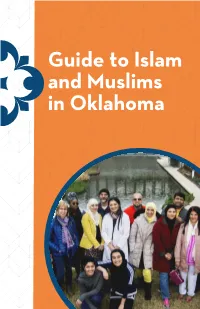
Guide to Islam and Muslims in Oklahoma
Guide to Islam and Muslims in Oklahoma ABOUT CAIR OKLAHOMA The Oklahoma Chapter of the Council on American-Islamic Relations (CAIR Oklahoma) exists to enhance the understanding of Islam, encourage dialogue, protect civil liberties, empower American Muslims, and build coalitions that promote justice and mutual understanding. CAIR-Oklahoma is a nonprofit 501(c) (3) grassroots civil rights and advocacy group. Established in 2006 by a group of local Muslims, CAIR Oklahoma serves the entire state of Oklahoma through its Oklahoma City office. CAIR Oklahoma is a chapter of the Council on American- Islamic Relations (CAIR), America’s largest Islamic civil liberties group with chapters nationwide. The national headquarters is located on Capitol Hill in Washington D.C. Special thanks to Imam Dr. Imad Enchassi. Contributors: Suleiman Shehu, Saleem Dotani, Adam Soltani, Veronica Laizure, Tyrese Rice, Kadijah Almarales, Lani Habrock, Natasha Saya, Gabriela Ramirez-Perez, Zishan Mahmood. TABLE OF CONTENTS 1 Introduction 2 Glossary of Muslim Terms 3 Theology and Interfaith Aspects 12 Demographics 15 Islamic Centers and Schools in Oklahoma 22 Social and Civic Involvement 28 Islamophobia and Its Impact on Our State 32 Conclusion INTRODUCTION The information in this booklet is designed to assist you in having a better understanding of the Islamic faith and Muslim community in Oklahoma. It is intended as a general outline of religious practices and beliefs; individual applications of these observances may vary. According to demographers, Islam is the world’s second largest faith, with more than 1.6 billion adherents worldwide.1 It is the fastest-growing religion in the U.S., with one of the most diverse and dynamic communities, representing a variety of ethnic backgrounds, languages, and nationalities. -

IRAN Handbuch Für Individuelles Entdecken
RUSSLAND KASACHSTAN TURKMENISTAN Hartmut Niemann TÜRKEI Teheran AFGHANISTAN Ludwig Paul SYR IRAK IRAN Handbuch für individuelles Entdecken PAKISTAN ET SAUDI- ARABIEN SUDAN INDIEN 500 km ETH INDISCHER OZEAN Mit Glossar und Sprachhilfe TIPPS Mit REISE KNOW-HOW gut vorbereitet nach Iran: Viele Hintergrundinformationen, spannende Details & gute Tipps Iran Ein Freilichtmuseum islamischer Baukunst: mit diesem kompletten Reiseführer entdecken: Iran das legendäre Isfahan | 242 Z Sorgfältige Beschreibung aller sehenswerten Orte und Landschaften Schwefeldämpfe und grandioser Ausblick: Z Unterkunftshinweise für jeden Geldbeutel: Hotels und Gasthäuser Besteigung des Damavand im Alborz | 72 Z Alle praktischen Reisefragen von A bis Z Lebendiger Orient in überkuppelten Gängen: Z Unterwegs in Iran: Transporthinweise vom Flugzeug bis zum Bus im Teppichbazar von Tabriz | 147 Z Kulinarische Tipps von Kennern: die ganze Vielfalt der iranischen Küche Die heiligste Stadt: Kauderwelsch Z Ausführliche Kapitel zu Geschichte, Natur, Kultur und Traditionen Qom am Rande der Kavir-Wüste | 290 Persisch – Z Tipps für den iranischen Alltag: Bazare, Feste und Teehäuser Wort für Wort: GPS Outdoor- KulturSchock Gefährdete Delikatesse: Z Spezielle Hinweise und Verhaltenstipps zu Moscheen und heiligen Stätten der unkomplizierte Navigation: Vorderer Orient: Störe im Kaspischen Meer | 530 Sprachführer Infos zu Technik, andere Länder, Z Besichtigungstipps zu archäologischen Highlights Anbietern, Geräten, andere Sitten … Schmuck, Gold und Edelsteine: Bedienung usw. im Nationalen