GANGNEUNG DANOJE FESTIVAL 2018 Information Map
Total Page:16
File Type:pdf, Size:1020Kb
Load more
Recommended publications
-

Liste Représentative Du Patrimoine Culturel Immatériel De L'humanité
Liste représentative du patrimoine culturel immatériel de l’humanité Date de Date récente proclamation Intitulé officiel Pays d’inscriptio Référence ou première n inscription Al-Ayyala, un art traditionnel du Oman - Émirats spectacle dans le Sultanat d’Oman et 2014 2014 01012 arabes unis aux Émirats arabes unis Al-Zajal, poésie déclamée ou chantée Liban 2014 2014 01000 L’art et le symbolisme traditionnels du kelaghayi, fabrication et port de foulards Azerbaïdjan 2014 2014 00669 en soie pour les femmes L’art traditionnel kazakh du dombra kuï Kazakhstan 2014 2014 00011 L’askiya, l’art de la plaisanterie Ouzbékistan 2014 2014 00011 Le baile chino Chili 2014 2014 00988 Bosnie- La broderie de Zmijanje 2014 2014 00990 Herzégovine Le cante alentejano, chant polyphonique Portugal 2014 2014 01007 de l’Alentejo (sud du Portugal) Le cercle de capoeira Brésil 2014 2014 00892 Le chant traditionnel Arirang dans la République 2014 2014 00914 République populaire démocratique de populaire Date de Date récente proclamation Intitulé officiel Pays d’inscriptio Référence ou première n inscription Corée démocratique de Corée Les chants populaires ví et giặm de Viet Nam 2014 2014 01008 Nghệ Tĩnh Connaissances et savoir-faire traditionnels liés à la fabrication des Kazakhstan - 2014 2014 00998 yourtes kirghizes et kazakhes (habitat Kirghizistan nomade des peuples turciques) La danse rituelle au tambour royal Burundi 2014 2014 00989 Ebru, l’art turc du papier marbré Turquie 2014 2014 00644 La fabrication artisanale traditionnelle d’ustensiles en laiton et en -

Korean Dance and Pansori in D.C.: Interactions with Others, the Body, and Collective Memory at a Korean Performing Arts Studio
ABSTRACT Title of Document: KOREAN DANCE AND PANSORI IN D.C.: INTERACTIONS WITH OTHERS, THE BODY, AND COLLECTIVE MEMORY AT A KOREAN PERFORMING ARTS STUDIO Lauren Rebecca Ash-Morgan, M.A., 2009 Directed By: Professor Robert C. Provine School of Music This thesis is the result of seventeen months’ field work as a dance and pansori student at the Washington Korean Dance Company studio. It examines the studio experience, focusing on three levels of interaction. First, I describe participants’ interactions with each other, which create a strong studio community and a women’s “Korean space” at the intersection of culturally hybrid lives. Second, I examine interactions with the physical challenges presented by these arts and explain the satisfaction that these challenges can generate using Csikszentmihalyi’s theory of “optimal experience” or “flow.” Third, I examine interactions with discourse on the meanings and histories of these arts. I suggest that participants can find deeper significance in performing these arts as a result of this discourse, forming intellectual and emotional bonds to imagined people of the past and present. Finally, I explain how all these levels of interaction can foster in the participant an increasingly rich and complex identity. KOREAN DANCE AND PANSORI IN D.C.: INTERACTIONS WITH OTHERS, THE BODY, AND COLLECTIVE MEMORY AT A KOREAN PERFORMING ARTS STUDIO By Lauren Rebecca Ash-Morgan Thesis submitted to the Faculty of the Graduate School of the University of Maryland, College Park, in partial fulfillment of the requirements for the degree of Master of Arts 2009 Advisory Committee: Dr. Robert C. Provine, Chair Dr. -
I. Introduction
TRANSACTIONS ROYAL ASIATIC SOCIETY Korea Branch Volume 93 – 2018 1 COVER: The seal-shaped emblem of the RAS-KB consists of the following Chinese characters: 槿 (top right), 域 (bottom right), 菁 (top left), 莪 (bottom left), pronounced Kŭn yŏk Ch’ŏng A in Korean. The first two characters mean “the hibiscus region,” referring to Korea, while the other two (“luxuriant mugwort”) are a metaphor inspired by Confucian commentaries on the Chinese Book of Odes, and could be translated as “enjoy encouraging erudition.” SUBMISSIONS: Transactions invites the submission of manuscripts of both scholarly and more general interest pertaining to the anthropology, archeology, art, history, language, literature, philosophy, and religion of Korea. Manuscripts should be prepared in MS Word format and should be submitted in digital form. The style should conform to The Chicago Manual of Style (most recent edition). The covering letter should give full details of the author’s name, address and biography. Romanization of Korean words and names must follow either the McCune-Reischauer or the current Korean government system. Submissions will be peer- reviewed by two readers specializing in the field. Manuscripts will not be returned and no correspondence will be entered into concerning rejections. Transactions (ISSN 1229-0009) General Editor: Jon Dunbar Copyright © 2019 Royal Asiatic Society – Korea Branch Room 611, Christian Building, Daehangno 19 (Yeonji-dong), Jongno-gu, Seoul 110-736 Republic of Korea Tel: (82-2) 763-9483; Fax: (82-2) 766-3796; Email: royalasiatickorea@gmail.com Visit our website at www.raskb.com TRANSACTIONS Volume 93 – 2018 Contents The Diamond Mountains: Lost Paradise Brother Anthony 1 Encouragement from Dongducheon 19 North Korean Fragments of Post-Socialist Guyana Moe Taylor 31 The Gyehu Deungnok Mark Peterson 43 “Literature Play” in a New World Robert J. -

List of the 90 Masterpieces of the Oral and Intangible Heritage
Albania • Albanian Folk Iso-Polyphony (2005) Algeria • The Ahellil of Gourara (2005) Armenia • The Duduk and its Music (2005) Azerbaijan • Azerbaijani Mugham (2003) List of the 90 Masterpieces Bangladesh • Baul Songs (2005) of the Oral and Belgium • The Carnival of Binche (2003) Intangible Belgium, France Heritage of • Processional Giants and Dragons in Belgium and Humanity France (2005) proclaimed Belize, Guatemala, by UNESCO Honduras, Nicaragua • Language, Dance and Music of the Garifuna (2001) Benin, Nigeria and Tog o • The Oral Heritage of Gelede (2001) Bhutan • The Mask Dance of the Drums from Drametse (2005) Bolivia • The Carnival Oruro (2001) • The Andean Cosmovision of the Kallawaya (2003) Brazil • Oral and Graphic Expressions of the Wajapi (2003) • The Samba de Roda of Recôncavo of Bahia (2005) Bulgaria • The Bistritsa Babi – Archaic Polyphony, Dances and Rituals from the Shoplouk Region (2003) Cambodia • The Royal Ballet of Cambodia (2003) • Sbek Thom, Khmer Shadow Theatre (2005) Central African Republic • The Polyphonic Singing of the Aka Pygmies of Central Africa (2003) China • Kun Qu Opera (2001) • The Guqin and its Music (2003) • The Uyghur Muqam of Xinjiang (2005) Colombia • The Carnival of Barranquilla (2003) • The Cultural Space of Palenque de San Basilio (2005) Costa Rica • Oxherding and Oxcart Traditions in Costa Rica (2005) Côte d’Ivoire • The Gbofe of Afounkaha - the Music of the Transverse Trumps of the Tagbana Community (2001) Cuba • La Tumba Francesa (2003) Czech Republic • Slovácko Verbunk, Recruit Dances (2005) -

Master's Degree Programme in Economics and Management of Arts and Cultural Activities(LM-76) the “Living Human Treasures”
Master’s Degree Programme in Economics and Management of Arts and Cultural Activities (LM-76) Master Thesis The “Living Human Treasures” System in the Republic of Korea Advisor: Professor Lauso Zagato Co-Advisor: Professor Vincenza D’Urso Student: Jessica Rossi Student number: 836329 Academic Year: 2017-2018 CONTENTS Acknowledgments…………………………………………………………………………………4 Introduction………………………………………………………………………………………..5 Chapter 1 Sources…………………………………………………………………………....10 1. International Universal Instruments……………………………………………..10 a. Hard Law b. Soft Law 2. International Regional Instruments……………………………………………...16 a. Asia-Pacific b. Europe 3. National Legislations……………………………………………………………21 a. Republic of Korea b. Japan c. France Chapter 2 Definitions, Frameworks and Historical Background……………………………23 Section 1: Defining and Understanding ICH…………………………………………….23 1. Intangible Cultural Heritage: A Definition……………………………………..23 2. Recommendation on the Safeguarding of Traditional Culture and Folklore (UNESCO - 1989)……………………………………………………………....33 3. Marrakech Meeting - 1997 …………………………………………………….42 4. The Washington Conference – 1999…………………………………………...45 5. Proclamation of the Masterpieces of the Oral and Intangible Heritage of Humanity (UNESCO - 2001)……………………………………………………48 6. Towards 2003 Convention: Turin, Elche and Rio Meetings…………………...52 7. 2003 Convention………………………………………………………………..59 Section 2: Defining and Understanding the Living Human Treasures System………….68 1. Living Human Treasures: A Definition in Multiple Definitions………………..68 2. ROK Proposal -

Utility of Digital Technologies for the Sustainability of Intangible Cultural
sustainability Article Utility of Digital Technologies for the Sustainability y of Intangible Cultural Heritage (ICH) in Korea Seulah Kim 1, Dong-uk Im 1, Jongoh Lee 1 and Heejae Choi 2,* 1 Graduate School, Global Culture & Contents, Hankuk University of Foreign Studies, 107, Imun-ro, Dongdaemun-gu, Seoul 02450, Korea; kimseulah94@gmail.com (S.K.); im.dong.uk@gmail.com (D.-u.I.); santon@hufs.ac.kr (J.L.) 2 College of Education, Hankuk University of Foreign Studies, 107, Imun-ro, Dongdaemun-gu, Seoul 02450, Korea * Correspondence: hjchoi@hufs.ac.kr; Tel.: +82-10-9170-9430 The research material has been utilised in a preliminary study, and some preliminary results have been y presented at the ‘2nd Eurasian Conference on Educational Innovation 20190, Singapore, 26–30 January 2019. Received: 10 July 2019; Accepted: 25 October 2019; Published: 3 November 2019 Abstract: The importance of preserving intangible cultural heritage (ICH) for sustainable development has been widely acknowledged by the international society. Various forms of cooperation have taken place to prevent deterioration and destruction due to its inherent characteristic of ‘intangibleness’. Public engagement, however, has largely been excluded from the system in spite of its significance in safeguarding ICH by inducing people to be trained as successors. In this respect, this paper discusses and emphasises the necessity of public engagement in safeguarding ICH. To this end, it suggests the use of digital technologies to create museum content to encourage public involvement with and learning about ICH. Focusing on ICH in Korea, digital exhibitions on Jultagi and Daemokjang utilising virtual reality technology are proposed. -
Representative List of the Intangible Cultural Heritage Of
RL cover [temp]:Layout 1 1/6/10 17:35 Page 2 2009 United Nations Intangible Educational, Scientific and Cultural Cultural Organization Heritage Representative List of the Intangible Cultural Heritage of Humanity RL cover [temp]:Layout 1 1/6/10 17:35 Page 5 Rep List 2009 2.15:Layout 1 26/5/10 09:25 Page 1 2009 Representative List of the Intangible Cultural Heritage of Humanity Rep List 2009 2.15:Layout 1 26/5/10 09:25 Page 2 © UNESCO/Michel Ravassard Foreword by Irina Bokova, Director-General of UNESCO UNESCO is proud to launch this much-awaited series of publications devoted to three key components of the 2003 Convention for the Safeguarding of the Intangible Cultural Heritage: the List of Intangible Cultural Heritage in Need of Urgent Safeguarding, the Representative List of the Intangible Cultural Heritage of Humanity, and the Register of Good Safeguarding Practices. The publication of these first three books attests to the fact that the 2003 Convention has now reached the crucial operational phase. The successful implementation of this ground-breaking legal instrument remains one of UNESCO’s priority actions, and one to which I am firmly committed. In 2008, before my election as Director-General of UNESCO, I had the privilege of chairing one of the sessions of the Intergovernmental Committee for the Safeguarding of the Intangible Cultural Heritage, in Sofia, Bulgaria. This enriching experience reinforced my personal convictions regarding the significance of intangible cultural heritage, its fragility, and the urgent need to safeguard it for future generations. Rep List 2009 2.15:Layout 1 26/5/10 09:25 Page 3 It is most encouraging to note that since the adoption of the Convention in 2003, the term ‘intangible cultural heritage’ has become more familiar thanks largely to the efforts of UNESCO and its partners worldwide. -

NGO Review of Accreditation
NGO Review of Accreditation ICH-08 Report- Form Rec;u CLT I CIH I ITH United Nations • Intangible ::ducationa!, Scientific and • Cultural Cultural Organization • Heritage Le 13 FEV. 2017 0 t!JtJI(! N ·········· ···· ···· ··· ·· ···· ·· ···· ·· ·· ·· ·· REPORT BY A NoN-GOVERNMENTAL ORGANIZATION ACCREDITED TO ACT IN AN ADVISORY CAPACITY TO THE COMMITTEE ON ITS CONTRIBUTION TO THE IMPLEMENTATION OF THE CONVENTION DEADLINE 15 FEBRUARY 2017 FOR EXAMINATION IN 2017 File may be downloaded at: http:lhviJI/Vi. unesco. orqlculturelich/enlforms Please provide only the information requested below. Annexes or other additional materials cannot be accepted. A. Identification of the organization A.1. Name of the organization submitting this report A.1 .a. Provide the full official name of the organization in its original language, as it appears on the official documents. A.1 .b. Name of the organization in English and/or French. Inter-City Intangible Cultural Cooperation Network (ICCN) A.1 .c. Accreditation number of the organization (as indicated on all previous correspondence: NG0-90XXX) ING0-90228 A.2. Address of the organization Provide the complete postal address of the organization, as well as additional contact information such as its telephone, e-maif address, website, etc. This should be the postal address where the organization carries out its business, regardless of where it may be legally domiciled. In case of internationally active organizations, please provide the address of the headquarters. Organization: Inter-City Intangible Cultural Cooperation Network (ICCN) Address: 18F City Hall, 33 Gangneung Ave., Gangneung, Gangwon, Republic of Korea, 25522 Form ICH-08 Report-2017- EN- revised on 31/08/2016- paQe 1 Telephone number: +82-33-640-5475 E-mail address: iccnsecretariat@gmail.com Website: www.iccn.or.kr Other relevant information: A.3. -

Representative List of the Intangible Cultural Heritage of Humanity As Heritage Fund
ElemeNts iNsCriBed iN 2012 oN the UrGeNt saFeguarding List, the represeNtatiVe List iNTANGiBLe CULtURAL HERITAGe aNd the reGister oF Best saFeguarding praCtiCes What is it? UNESCo’s ROLe iNTANGiBLe CULtURAL SECRETARIAT Intangible cultural heritage includes practices, representations, Since its adoption by the 32nd session of the General Conference in HERITAGe FUNd oF THE CoNVeNTION expressions, knowledge and know-how that communities recognize 2003, the Convention for the Safeguarding of the Intangible Cultural The Fund for the Safeguarding of the The List of elements of intangible cultural as part of their cultural heritage. Passed down from generation to Heritage has experienced an extremely rapid ratification, with over Intangible Cultural Heritage can contribute heritage is updated every year by the generation, it is constantly recreated by communities in response to 150 States Parties in the less than 10 years of its existence. In line with financially and technically to State Intangible Cultural Heritage Section. their environment, their interaction with nature and their history, the Convention’s primary objective – to safeguard intangible cultural safeguarding measures. If you would like If you would like to receive more information to participate, please send a contribution. about the 2003 Convention for the providing them with a sense of identity and continuity. heritage – the UNESCO Secretariat has devised a global capacity- Safeguarding of the Intangible Cultural building strategy that helps states worldwide, first, to create -

The Bawdy, Brawling, Boisterous World of Korean Mask Dance Dramas: a Brief Essay to Accompany Photographs
The Bawdy, Brawling, Boisterous World of Korean Mask Dance Dramas: A Brief Essay to Accompany Photographs CedarBough Saeji, University of California, Los Angeles Note: This essay is a companion piece to “Korean Mask Dance Dramas,” a photo essay also published in the September 2012 issue of the Cross-Currents e-journal. The photo essay features 24 photographs taken by the author in Korea in the years 2008-2011. Introduction Korean mask dance dramas are captivating and entrancing. Comedy, tragedy, and social commentary meld with energetic dance, distinctive masks, and lively music. These dramas are often colloquially and incorrectly referred to as talchum (“mask dance”) in Korean—in fact, talchum is one of the major variants of mask dance drama from Hwanghae Province in present- day North Korea. Performers of other variants have long objected to the broad application of the term (akin to calling all in-line skates “Rollerblades” or all MP3 players “iPods”). Only in the late 1990s did academia catch on, when two highly respected midcareer mask dance drama scholars, Bak Jintae (Daegu University) and Jeon Kyungwook (Korea University), began to use the terminology talnoli (“mask play”) and gamyeon-geuk (“mask drama”) in their publications. I needed to watch only one performance, in 1997, to fall in love with the mask dance dramas, but at first the many forms of the genre melded together in my mind. It took repeated exposure and study over more than a dozen years for me to see the profound similarities and differences among all of Korea’s mask dance dramas. Part of my learning process was exploring the existing scholarship on mask dance dramas. -

Press Release Los Angeles, CA 90036
[2017-54] LA한국문화원 www.kccla.org 5505 Wilshire Blvd. Press Release Los Angeles, CA 90036 Tel (323)936-7141 Request For Immediate Release Pages : 5 Date of 07.26.2017 (Wednesday) Contact Tammy Chung 323-936-3015 Release 2017 ARI PROJECT: Performing Arts New Wave of Korea ▶ Title : 2017 ARI PROJECT: Performing Arts New Wave of Korea ▶ Date: Friday, August 4, 2017 at 7:30pm ▶ Place: Korean Cultural Center, Los Angeles 3rd Fl. Ari Hall ▶ Presenters : Korean Cultural Center, LA & American Youth Performing Artists (KAYPA) ▶ Online Reservation : www.kccla.org ▶ For more Info: tammy@kccla.org or 323-936-3015 Tammy Chung -1- The Korean Cultural Center Los Angeles (KCCLA) and American Youth Performing Artists (KAYPA) will present a special performance, “New Wave of Korea”, on Friday, August 4, 2017 at 7:30P.M. on the 3rd floor of the Korean Cultural Center Los Angeles in the Ari Hall. KAYPA has reconstructed Korean music, dance, and art into modern performance repertoire. The program features the ‘Gurium: Violin’, Beniida: Gayageum & Soprano’, ‘Chohon: Voice, Dance, Ajaeng, Violin’, ‘Chunangjeon/Cheoyongmu: Dance’, ‘Saesanjo: 25 string Gayageum’, ‘Ssukdaemuri: Dance’, ‘Nongbuga+Amazing Arirang: Instruments’, and ‘All Korean Percussion instruments: Dance’. Participating artists include Jae Eun Lee (Artistic Director, KAYPA/Dance), Jumi Kim (Soprano), Sevy Lee (Dance), Junghwa Lee (Gayageum), Jeesong Ahn (Violin), Jiyoung Park (Composer), Yuna Lee (Art), and members of KAYPA, and they are all joining together for this special performance. KAYPA, Korean American Youth Performing Artists, is a non-profit organization led by Artistic Director JaeEun Park Lee and is rooted in southern California. -
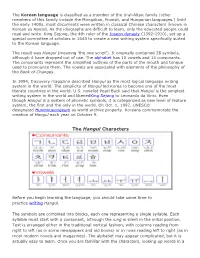
The Hangul Characters
The Korean language is classified as a member of the Ural-Altaic family (other members of this family include the Mongolian, Finnish, and Hungarian languages.) Until the early 1400s, most documents were written in classical Chinese characters (known in Korean as Hanja). As the idiographs are difficult to learn, only the educated people could read and write. King Sejong, the 4th ruler of the Joseon dynasty (1392-1910), set up a special committee of scholars in 1443 to create a new writing system specifically suited to the Korean language. The result was Hangul (meaning 'the one script'). It originally contained 28 symbols, although 4 have dropped out of use. The alphabet has 10 vowels and 14 consonants. The consonants represent the simplified outlines of the parts of the mouth and tongue used to pronounce them. The vowels are associated with elements of the philosophy of the Book of Changes. In 1994, Discovery magazine described Hangul as the most logical language writing system in the world. The simplicity of Hangul led Korea to become one of the most literate countries in the world. U.S. novelist Pearl Buck said that Hangul is the simplest writing system in the world and likenedKing Sejong to Leonardo da Vinci. Even though Hangul is a system of phonetic symbols, it is categorized as new level of feature system, the first and the only in the world. On Oct. 1, 1997, UNESCO designated Hunminjeongeum as world archive property. Koreans commemorate the creation of Hangul each year on October 9. The Hangul Characters Before you begin learning the language, you should take some time to practice writing Hangul.