The Managerial Revolution in UK Companies Before 1914
Total Page:16
File Type:pdf, Size:1020Kb
Load more
Recommended publications
-

Who Owns the Air?
Marquette University e-Publications@Marquette Marquette University Press Publications 1958 Who Owns the Air? Marya Mannes Follow this and additional works at: https://epublications.marquette.edu/mupress-book ,., WHO Owns the Air? by MARYA MANNES .J WHO Owns the Air? The text of this booklet was delivered as a speech by Marya Mannes on March 23, 1959, in Milwaukee, .Wisconsin. The notes are selections from her writings which have appeared in THE REPORTER, as indicated. WHO Owns the Air? by MARYA MANNES 1960 MARQUETTE UNIVERSITY PRESS Milwaukee LIBRARY OF CONGRESS CATAWGUE CARD NUMBER: 60-9738 © Copyright 1960 by the Marquette University Press PIINTED AT THE MAR.QUETTE UNIVEB.SITY PB.ESS, MILWAUKEE, WISCONSIN, U.S.A. Foreword These comments on television were written and spoken before the quiz scandals brought into sharp focus-and on a national scale-the major faults and lacks of the commercial system. Since then, an alarmed and publicly penitent industry has promised improvements in tele vision fare and performed a few. Both CBS and NBC have stepped up their news and documentary programs, a number of which are scheduled-from time to time during prime viewing hours at night. And an independent station, WNTA, has made an extremely important break through by presenting a play a week, seven times a week, by distinguished writers and with excellent casts. It remains to be seen, however, how widespread and sustained these efforts will be; and whether the major weaknesses implicit in sponsored programming can ever be overcome "in the public interest." Marya Mannes ) WHO Owns the Air? I'M GOING TO START by asking you some questions. -
Reinohl Collection Album List
Reinohl Collection album list The Reinohl Collection consists of 180 albums compiled by two brothers, Herbert and Albert Reinohl. The brothers were born in the late nineteenth century and began collecting material about transport (buses in particular) from childhood, continuing through to the 1950s. The collection is principally made up of tickets, but it also includes illustrations, press cuttings, journal articles and other ephemera from the UK and around the world. The list below gives brief details of what is covered by each album. If you would like to enquire about specific contents in the albums please contact us. The collection forms part of the Library collection at London Transport Museum (LTM) and is stored at the Museum Depot at Acton. Visits are available monthly, please check our website for further information https://www.ltmuseum.co.uk/collections/research/library. For all appointments, or any queries, please contact us. London Transport Museum Library Albany House, 98 Petty France, London SW1H 9EA Tel: +44 (0)343 222 5000 and select option 3 Email: enquiry@ltmuseum.co.uk October 2019 1 Abbreviations used in the list: LGOC London General Omnibus Company LCC London County Council LPTB London Passenger Transport Board LT London Transport UDC Urban District Council Album Description 1 1829 London's First Omnibus to 1968 Woodruff's Omnibuses 2 Unknown Proprietors to James Powell 3 London & Suburban Omnibus Company to LGOC Route 14A 4 LGOC & Associate Companies Route 15 to LGOC & Thomas Tilling Ltd. Route 33A 5 LGOC & Thomas -

National Tramway Museum
G B 1402 National Tramway Museum This catalogue was digitised by The National Archives as part of the National Register of Archives digitisation project NRA 33431 The National Archives 13DEC90 NRA 33431 National Tramway Museum: ms collections National Tramway Museum Crich Matlock Derbyshire DE4 5DP Subject Index: Personal Index: N Companies Index: ^ MDR: N TDR: N class[ ARCHIVE author[ ROTHERHAM CORPORATION TRAMWAYS DEPARTMENT title[ INTERNAL CORRESPONDENCE FILE OF COMPLAINTS 1908 - 1911 pub[ ROTHERHAM CORPORATION seriesf ] pp[ 999 ISBN[ ] Edit[ ] Date[ notes[ BOUND CARBON COPIES ON TISSUE PAPER keywords[ class[ ARCHIVE author[ ROTHESAY TRAMWAYS COMPANY title[ WAGES ALLOCATION SHEET. 1912 - 1915 pub[ ROTHESAY TRAMWAYS CO. series t ] PP[ VAR ISBN[ ] Edit[ ] Date[ notes[ keywords[ ADMINISTRATION SCOTLAND class[ ARCHIVE ^author[ SHEFFIELD CORPORATION TRAMWAYS DEPARTMENT title[ PERSONAL LEDGER ACCOUNT BOOK 1. 1896 - 1903; 2. 1915 - 1920 pub[ SHEFFIELD CORPORATION series[ ] pp[ 212 ISBN[ ] Edit[ ] Date[ notes[ HAND WRITTEN keywords! ADMINISTRATION FINANCE class[ ARCHIVE author[ SHEFFIELD CORPORATION TRAMWAYS AND MOTORS SHJStfFlJSjjU TKANSFUKT DJSFAKTMEINT title [ (TRAMWAY ROUTE CARDS) pub[ SHEFFIELD TRANSPORT series[ ] PPt ISBN[ ] Edit[ ] Date[ notes[ HAND WRITTEN RECORD CARDS EARLIEST 1918? keywords[ ADMINISTRATION class[ ARCHIVE author[ SHEFFIELD TRANSPORT title [ DAILY RETURN OF ORDINARY SERVICE CARS. 5 APRIL, 1940 - 28 AUGUST, 19^ CROOKES DEPOT pub[ SHEFFIELD TRANSPORT series[ ] pp[ ISBNt ] Edit[ ] Datef notes[ HAND WRITTEN LEDGER keywords[ ADMINISTRATION MAINTENANCE class[ ARCHIVE author! SHEFFIELD TRANSPORT title [ DAILY RETURN OF SPECIAL CARS IN SERVICE. 11 SEPTEMBER, 1940 - 11 JANl 1941. CROOKES DEPOT pub[ SHEFFIELD TRANSPORT series! ] pp[ 176 ISBN[ ] Editt ] Date[ notes[ HAND WRITTEN LEDGER keywords[ ADMINISTRATION MAINTENANCE class[ ARCHIVE author[ SHEFFIELD TRANSPORT title t LOADING BOOK. -

Five Year Strategy (2014 – 2019)
TRAMWAY MUSEUM SOCIETY FIVE YEAR STRATEGY (2014 – 2019) March 2014 Approved by …………………………. Chairman Next review due by …………………………….2015 1 TRAMWAY MUSEUM SOCIETY FIVE YEAR STRATEGY (2014 – 2019) Contents Page 1 Our Vision for the Future 2 2 Context and Background 2 2.1 The Society, the Village and the National Museum 2 2.2 Statement of Purpose 3 2.3 Key Aims 3 2.4 Statement of Values 4 2.5 Guiding Principles 4 3 Situational Analysis 6 3.1 The Visitor Attraction Market 6 3.2 Income 6 3.3 Human Resources 8 3.4 Recent Achievements 8 4 Strategic priorities 8 5 Key Projects 11 6 Operational Plan 14 7 Financial Plan 17 8 Monitoring and Review 18 Appendix 1 20 Consultation Appendix 2 22 SWOT Analysis Appendix 3 National Strategic background for Museums 26 Arts Council England’s priorities for the Museum sector 1 1. Our Vision for the future For more than 50 years the Tramway Museum Society, from acquiring disused quarry premises at Crich for storing and operating tramcars, has grown to a very prestigious Nationally recognised Museum with a Designated Collection and which attracts around 100, 000 visitors each year. This has been achieved in many respects with a clear documented vision with regard to both the tramcar collection and the development of the Museum environment. The total commitment and passion to preserve and demonstrate function and form of tramcars by a core of volunteers has resulted in the creation of a street scene based visitor attraction. With this in mind the following vision has been defined: “To be the best heritage tramway experience in the world.” This vision will not be achieved without commitment and planning, significant time, money, and human endeavour being invested. -

GROWING with INDIA 1997 Was a Milestone
HINDUSTAN LEVER : GROWING WITH INDIA 1997 was a milestone for India, being our 50th year of Independence. This was also around the time when Hindustan Lever undertook the consolidation of Unilever's operations into a single corporate entity. It is therefore an opportune time to review how the company has grown, in India and with India. Hindustan Lever and its constituent companies have been in India since 1912. Over these decades, the company has benefitted greatly from the developments in the country; I believe that the company equally, in its own way, has contributed to these developments. This congruence of interests can best be exemplified by seeing the way in which the company has reflected national priorities over the years, through its strategy and operations. Looking ahead, it is clear that the country is now dedicated to growth with a renewed sense of purpose and that national interests will evolve. As a company, we remain committed to evolving national priorities and see a bright and promising future both for ourselves and for the country; indeed we believe that the future of Hindustan Lever depends on the future of India. The relationship between the company and India is enduring and truly synergistic. It is the result of the company's history, but is more fundamentally shaped by our ethos and that of our parent company. Unilever, in its worldwide operations, strives to be a multilocal multinational. For Hindustan Lever this means that the seed with which the company began was foreign, but our roots are deeply planted in Indian soil. The growth of this plant depends on the soil and the benefits accrue directly and indirectly to many in India. -

Case Study: Unilever1
CASE STUDY: UNILEVER1 1. Introduction Unilever is a British-Dutch company that operates in the market of consumer goods and sells its products in around 190 countries. Another remarkable fact is that they own more than 400 brands, what means an important diversification in both risk and the products they sell, among which there is food, personal care products and cleaning agents. In fact, twelve of these brands have sales of more than a billion euros. The importance of this multinational is reflected too in the fact 2.5 billion people use Unilever products every day, being part of their daily life. They also are responsible for the employment of 161,000 people in the different countries they operate. Finally, they believe in a sustainable business plan in which they reduce the environmental footprint and increase their positive social impact at the time they keep growing. 2. History Unilever was officially formed in 1929 by the merger of a margarine Dutch company and a British soapmaker. The margarine company of Netherlands was also a merger between the first margarine factory called in the world and another factory of the same product and from the same city, Oss, in the Netherlands. The soapmaker company revolutionized the market because it helped to a more hygienic society and the manufacturing of the product was wrapped. The name of the company is a fusion between the Dutch firm called Margarine Unie and the British firm called Lever Brothers. What Unilever did, was to expand its market locations to the American Latin and Africa. Moreover they widened the product areas to new sectors such as particular food and chemical products. -
1972 Annual Report and Account
UNILEVER Report and accounts UNILEVER N.V. Directors G. D. A. Klijnstra, chairman G. E. Graham E. G. Woodroofe, vice-chairman C. T. C. Heyning A. W. J. Caron, vice-chairman H. F. van den Hoven A. I. Anderson J. J. H. Nagel M. R. Angus M. Ormerod W. B. Blaisse D.A. Orr E. Brough E. Smit J. G. Collingwood A. W. P. Stenham R. H. Del Mar S. G. Sweetman J. P. Erbe The Viscount Trenchard J. M. Goudswaard K. H. Veldhuis Advisory directors H. S. A. Hartog R. Mueller J. H. van Roijen H. J. Witteveen Secretaries C. Zwagerman H. A. Holmes Auditors Price Waterhouse & Co. Cooper Brothers & Co. A special survey of part of Unilever’s Food and Drinks activities is issued as a supplement to this Report. Unilever Unilever comprises Unilever N.V., and manufacturers of timber the combined affairs of N.V. and Rotterdam (N.V.) and Unilever products, in diverse industrial Limited are more important to Limited, London (Limited) and ventures, and in the operation of shareholders than the separate their respective subsidiary an ocean fleet. Unilever also has affairs of either company. companies which operate in more interests in plantations. than seventy countries and are The Report and Accounts as usual mainly engaged in the manufacture N.V. and Limited have identical combine the results and operations and sale of a wide variety of goods Boards of Directors and are linked of N.V. and Limited. for household use. The principal by agreements, including an products are foods (including Equalisation Agreement which This is a translation of the original margarine, other fats and oils; requires dividends and other rights Dutch report. -
Disclaimer Notes to the Annual Report and Accounts This PDF
Disclaimer Notes to the Annual Report and Accounts This PDF version of the Unilever Annual Report and Accounts 2005 is an exact copy of the document provided to Unilever’s shareholders. Certain sections of the Unilever Annual Report and Accounts 2005 have been audited. Sections that have been audited are set out on pages 78 to 151, 157 to 172 and 174 to 177. The auditable part of the report of the Remuneration Committee as set out on page 69 has also been audited. The maintenance and integrity of the Unilever website is the responsibility of the Directors; the work carried out by the auditors does not involve consideration of these matters. Accordingly, the auditors accept no responsibility for any changes that may have occurred to the financial statements since they were initially placed on the website. Legislation in the United Kingdom and the Netherlands governing the preparation and dissemination of financial statements may differ from legislation in other jurisdictions. Disclaimer Except where you are a shareholder, this material is provided for information purposes only and is not, in particular, intended to confer any legal rights on you. This Annual Report and Accounts does not constitute an invitation to invest in Unilever shares. Any decisions you make in reliance on this information are solely your responsibility. The information is given as of the dates specified, is not updated, and any forward-looking statements are made subject to the reservations specified on page 4 of the Report. Unilever accepts no responsibility for any information on other websites that may be accessed from this site by hyperlinks. -
The Formation of Unilever 16944-Unilever 20Pp A5:Layout 1 15/11/11 14:35 Page 2
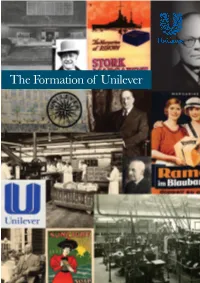
16944-Unilever 20pp A5:Layout 1 15/11/11 14:35 Page 1 The Formation of Unilever 16944-Unilever 20pp A5:Layout 1 15/11/11 14:35 Page 2 Unilever House, London, c1930 16944-Unilever 20pp A5:Layout 1 15/11/11 14:36 Page 03 In September 1929 an agreement was signed which created what The Economist described as "one of the biggest industrial amalgamations in European history". It provided for the merger in the following year of the Margarine Union and Lever Brothers Limited. The Margarine Union had been formed in 1927 by the Van den Bergh and Jurgens companies based in the Netherlands, and was later joined by a number of other Dutch and central European companies. Its main strength lay in Europe, especially Germany and the UK and its interests, whilst mostly in margarine and other edible fats, were also oil milling and animal feeds, retail companies and some soap production. Lever Brothers Limited was based in the UK but owned companies throughout the world, especially in Europe, the United States and the British Dominions. Its interests were in soap, toilet preparations, food (including some margarine), oil milling and animal feeds, plantations and African trading. One of the main reasons for the merger was competition for raw materials - animal and vegetable oils - used in both the manufacture of margarine and soap. However, the two businesses were very similar, so it made sense to merge as Unilever rather than continue to compete for the same raw materials and in the same markets. To understand how Unilever came into being you have to go back to the family companies that were instrumental in its formation. -

Supplement to the London Gazette, 31St December 1991 75
SUPPLEMENT TO THE LONDON GAZETTE, 31ST DECEMBER 1991 75 Name Description Address Garrard & Co. Ltd Jewellers and Silversmiths London General Trading Co. (Mayfair) Ltd., The Suppliers of Fancy Goods London Gestetner Limited Suppliers of Reprographic Office Equipment Crawley Gibson Saddlers Ltd Suppliers of Racing Colours Newmarket Goddard, J. and Sons Ltd Manufacturers of Silver and Metal Polishes... Camberley Goode, Thomas & Co. Ltd Suppliers of China and Glass London Goodyear, Edward Ltd Florist London Green Stage Ltd Suppliers of Musks Sausages Newmarket Greenaways Printers London GroverClyne Carpet and Vinyl Floor Covering Supplier ... Wick H.P. Foods Ltd Manufacturers of H.P. Sauces and Canned Foods. Market Harborough Haggart, P. & J. Ltd Tartan and Woollen Manufacturers Aberfeldy Halcyon Days Ltd Suppliers of Objetsd'Art London Hall, Matthew Mechanical and Electrical Building Services Engineers London Engineers Ltd. Hamblin, Theodore, Ltd Opticians London Hancocks and Co. (Jewellers) Ltd Goldsmiths and Silversmiths London Hardy Minnis Mercers of Woollen Cloth Stroud Harris Aubrey Limited Suppliers of Stationery and Office Equipment London Harris, D. R. & Company, Limited Chemist London Harrods, Limited Suppliers of China, Glass and Fancy Goods... London Hartnell, Norman, Limited Dressmakers London Harvey Nichols & Company, Limited Drapers London Hatchards Booksellers London Haygarth, C. H. & Sons Gunmaker and Cartridge Manufacturer Dunnet, Caithness Heaton, Wallace Ltd Suppliers of Photographic Equipment London Hillier Nurseries (Winchester) Ltd Nurserymen and Seedsmen Winchester Holt, Ray (Land Drainage) Ltd Land Draining Contractors Thurso Hoover Limited Suppliers of Vacuum Cleaners Merthyr Tydfil Hubbard Refrigeration Ltd Suppliers of Automatic Ice making Machines Woodbridge Huntley & Palmers Ltd Biscuit and Cake Manufacturers Reading Hypnos Limited Upholsterers and Bedding Manufacturers .. -

1967 Annual Report and Accounts
T AND AC OUNTS I967 Directors H. S. A. HARTOG, Cha'imn J. J. H. NAGEL THE LORD COLE, We-Chairman D. A. ORR RUDOLF G. JURGENS, Vice-Chairman F. J. PEDLER A. F. H. BLAAUW R. H. SIDDONS A. W. J. CARON E. SMIT J. G. COLLINGWOOD SIR ARTHUR SMITH J. M. GOUDSWAARD J. P. STUBBS 6. D. A. KLIJNSTRA S. G. SWEETMAN J. F. KNIGHT THE VISCOUNT TRENCHARD P. KUIN E. G. WOODROOFE D. J. MA" Advisory Directors J. M. HONIG F. J. M. A. H. HOUBEN A. E. J. NYSINGH F. J. TEMPEL G. E. VAN WALSUM Secretaries A. A. HAAK P. A. MACRORY 'Auditors PRICE WATERHOUSE & Co. COOPER BROTHERS & Co. This is a translation of the origillal Dutch report. The Report and Accounts as usual combine the results and operations of UNILEVER N.V. (‘N.v.’) and UNILEVER LIMITED (‘LIMITED’) with the figures expressed in guilders. The basis on which the devaluation of sterling in November, 1967, has been dealt with is explained on page 31. Contents Page 6 Salient figures 7 Report for the year 1967 7 The year in brief 8 Sales to third parties, profit and capital employed by geographical areas 1958 and 1967 (chart) 9 Return on capital employed and on turnover 1958-1967 (chart) 10 Summary of combined figures 1958-1967 11 The background 12 Indonesia 13 Taxation 13 Analysis of turnover 14 Margarine, other edible fats and oils 15 Other foods 17 Detergents and toilet preparations 19 Animal feeds 20 Paper, printing, packaging and plastics 20 Chemicals 21 The United Africa Group 22 Plantations 23 Exports 24 Finance 25 Capital projects 26 Research 27 Personnel 28 Capital and membership 28 Dividends 29 Directors 30 Retirement of Directors 30 Auditors 31 Accounts 1967 31 Treatment of devaluation of Sterling 32 Consolidated profit and loss accounts (Statement A) 34 Consolidated balance sheets (Statement B) 38 Balance sheet-N.V. -
378 a Cinematic Soap Opera: Lever Brothers and the Use Of
A Cinematic Soap Opera: Lever Brothers and the Use of Cinematography as a Promotional and Marketing Tool Jeannette Strickland, PhD student, Department of History, University of Liverpool, UK Unilever’s company historian claimed that radio and cinema advertising was not part of Lever Brothers/Unilever until the late 1930s (Wilson 1968). Despite the paucity of surviving archival sources it can be proved, however, that the company engaged with the new medium of cinematography from its earliest days. François-Henri Lavanchy-Clarke (1848-1922), who was coming towards the end of his life and reviewing his contribution to the development of cinematography as a marketing tool in Lever Brothers, proclaimed proudly to William Lever (1851-1925), the British soap manufacturer, “I procured you the first cinema”. This was in 1896, only months after the Lumière brothers perfected their techniques. Lever is renowned for his innovative approach to advertising and marketing and as a pioneer in creating brand identity, but what is not so well known is that he was one of the first businessmen to recognise the value of film as an advertising tool. It can even be claimed that a Lever Brothers’ product featured in the first ever example of product placement on film. Lavanchy-Clarke saw the promotional and marketing possibilities of cinematography from its very beginnings and persuaded Lever of its potential efficacy, utilising his connections with the Lumière brothers to source the equipment and make promotional films for Lever Brothers. Lavanchy-Clarke started with a spectacle at the International Exposition in Geneva in 1896, using a film of his own family washing clothes in a tub in their garden with boxes of Sunlight Soap placed prominently in the foreground.