New Zealand Antarctic Society (Inc)
Total Page:16
File Type:pdf, Size:1020Kb
Load more
Recommended publications
-

Region 19 Antarctica Pg.781
Appendix B – Region 19 Country and regional profiles of volcanic hazard and risk: Antarctica S.K. Brown1, R.S.J. Sparks1, K. Mee2, C. Vye-Brown2, E.Ilyinskaya2, S.F. Jenkins1, S.C. Loughlin2* 1University of Bristol, UK; 2British Geological Survey, UK, * Full contributor list available in Appendix B Full Download This download comprises the profiles for Region 19: Antarctica only. For the full report and all regions see Appendix B Full Download. Page numbers reflect position in the full report. The following countries are profiled here: Region 19 Antarctica Pg.781 Brown, S.K., Sparks, R.S.J., Mee, K., Vye-Brown, C., Ilyinskaya, E., Jenkins, S.F., and Loughlin, S.C. (2015) Country and regional profiles of volcanic hazard and risk. In: S.C. Loughlin, R.S.J. Sparks, S.K. Brown, S.F. Jenkins & C. Vye-Brown (eds) Global Volcanic Hazards and Risk, Cambridge: Cambridge University Press. This profile and the data therein should not be used in place of focussed assessments and information provided by local monitoring and research institutions. Region 19: Antarctica Description Figure 19.1 The distribution of Holocene volcanoes through the Antarctica region. A zone extending 200 km beyond the region’s borders shows other volcanoes whose eruptions may directly affect Antarctica. Thirty-two Holocene volcanoes are located in Antarctica. Half of these volcanoes have no confirmed eruptions recorded during the Holocene, and therefore the activity state is uncertain. A further volcano, Mount Rittmann, is not included in this count as the most recent activity here was dated in the Pleistocene, however this is geothermally active as discussed in Herbold et al. -
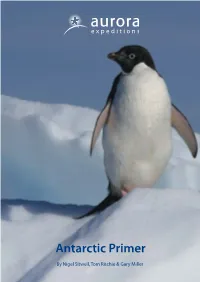
Antarctic Primer
Antarctic Primer By Nigel Sitwell, Tom Ritchie & Gary Miller By Nigel Sitwell, Tom Ritchie & Gary Miller Designed by: Olivia Young, Aurora Expeditions October 2018 Cover image © I.Tortosa Morgan Suite 12, Level 2 35 Buckingham Street Surry Hills, Sydney NSW 2010, Australia To anyone who goes to the Antarctic, there is a tremendous appeal, an unparalleled combination of grandeur, beauty, vastness, loneliness, and malevolence —all of which sound terribly melodramatic — but which truly convey the actual feeling of Antarctica. Where else in the world are all of these descriptions really true? —Captain T.L.M. Sunter, ‘The Antarctic Century Newsletter ANTARCTIC PRIMER 2018 | 3 CONTENTS I. CONSERVING ANTARCTICA Guidance for Visitors to the Antarctic Antarctica’s Historic Heritage South Georgia Biosecurity II. THE PHYSICAL ENVIRONMENT Antarctica The Southern Ocean The Continent Climate Atmospheric Phenomena The Ozone Hole Climate Change Sea Ice The Antarctic Ice Cap Icebergs A Short Glossary of Ice Terms III. THE BIOLOGICAL ENVIRONMENT Life in Antarctica Adapting to the Cold The Kingdom of Krill IV. THE WILDLIFE Antarctic Squids Antarctic Fishes Antarctic Birds Antarctic Seals Antarctic Whales 4 AURORA EXPEDITIONS | Pioneering expedition travel to the heart of nature. CONTENTS V. EXPLORERS AND SCIENTISTS The Exploration of Antarctica The Antarctic Treaty VI. PLACES YOU MAY VISIT South Shetland Islands Antarctic Peninsula Weddell Sea South Orkney Islands South Georgia The Falkland Islands South Sandwich Islands The Historic Ross Sea Sector Commonwealth Bay VII. FURTHER READING VIII. WILDLIFE CHECKLISTS ANTARCTIC PRIMER 2018 | 5 Adélie penguins in the Antarctic Peninsula I. CONSERVING ANTARCTICA Antarctica is the largest wilderness area on earth, a place that must be preserved in its present, virtually pristine state. -

The Antarctic Treaty
The Antarctic Treaty Measures adopted at the Thirty-ninth Consultative Meeting held at Santiago, Chile 23 May – 1 June 2016 Presented to Parliament by the Secretary of State for Foreign and Commonwealth Affairs by Command of Her Majesty November 2017 Cm 9542 © Crown copyright 2017 This publication is licensed under the terms of the Open Government Licence v3.0 except where otherwise stated. To view this licence, visit nationalarchives.gov.uk/doc/open-government-licence/version/3 Where we have identified any third party copyright information you will need to obtain permission from the copyright holders concerned. This publication is available at www.gov.uk/government/publications Any enquiries regarding this publication should be sent to us at Treaty Section, Foreign and Commonwealth Office, King Charles Street, London, SW1A 2AH ISBN 978-1-5286-0126-9 CCS1117441642 11/17 Printed on paper containing 75% recycled fibre content minimum Printed in the UK by the APS Group on behalf of the Controller of Her Majestyʼs Stationery Office MEASURES ADOPTED AT THE THIRTY-NINTH ANTARCTIC TREATY CONSULTATIVE MEETING Santiago, Chile 23 May – 1 June 2016 The Measures1 adopted at the Thirty-ninth Antarctic Treaty Consultative Meeting are reproduced below from the Final Report of the Meeting. In accordance with Article IX, paragraph 4, of the Antarctic Treaty, the Measures adopted at Consultative Meetings become effective upon approval by all Contracting Parties whose representatives were entitled to participate in the meeting at which they were adopted (i.e. all the Consultative Parties). The full text of the Final Report of the Meeting, including the Decisions and Resolutions adopted at that Meeting and colour copies of the maps found in this command paper, is available on the website of the Antarctic Treaty Secretariat at www.ats.aq/documents. -
Conserving in the Deep Freeze: Saving and Interpreting the Heroic Era Huts of the Ross Dependency
– 1 – internationalconservationservices Conserving in the deep freeze. Saving and interpreting the Heroic era huts of the Ross dependency in Antarctica. Australia ICOMOS 2007 Conference Cairns 19 – 21 July 2007 Abstract The Heroic Era explorer huts in the Ross Dependency of Antarctica are located in one of the most remote and environmentally harsh areas in the world. As unique tangible evidence of world exploration and human endurance, these huts are exceptionally special, but showing the signs of environmental and human impact. International Conservation Services (ICS) have been working with the Antarctic Heritage Trust, New Zealand (AHT) for the last 10 years. ICS’s main role is providing the conservation expertise required to preserve the movable heritage items, within and around four expedition bases, amounting to many thousands of items. In 2006, the AHT achieved a world first: to support a materials conservation team in Antarctica year round, to progress the preservation program. Extreme climate and logistical issues mean managerial and technical issues are challenging to resolve. Together, ICS and the AHT have developed mobile laboratories, conservation treatment protocols, material testing programs, disaster preparedness plans and preventive conservation strategies for the movable heritage items associated with these sites. This paper tells the story of what has been described as ’currently the most exciting conservation project in the world.’ Australia ICOMOS conference 19 – 21 July 2007 Page 1 – 2 – internationalconservationservices Background The historic huts At the turn of the 20th century, the Antarctic region was largely unknown beyond the whaling industry based on small outlying islands. Exploration of the area became popular at the turn of the 20th century with the race to conquer the Antarctic mainland and to discover the South Pole. -

Polar Geography the Historical Development of Mcmurdo Station
This article was downloaded by: [Texas A&M University] On: 19 August 2010 Access details: Access Details: [subscription number 915031382] Publisher Taylor & Francis Informa Ltd Registered in England and Wales Registered Number: 1072954 Registered office: Mortimer House, 37- 41 Mortimer Street, London W1T 3JH, UK Polar Geography Publication details, including instructions for authors and subscription information: http://www.informaworld.com/smpp/title~content=t781223423 The historical development of McMurdo station, Antarctica, an environmental perspective Andrew G. Kleina; Mahlon C. Kennicutt IIb; Gary A. Wolffb; Steve T. Sweetb; Tiffany Bloxoma; Dianna A. Gielstraa; Marietta Cleckleyc a Department of Geography, Texas A&M University, College Station, TX, USA b Geochemical and Environmental Research Group, Texas A&M, College Station, TX, USA c Uniondale High School, Uniondale, New York, USA To cite this Article Klein, Andrew G. , Kennicutt II, Mahlon C. , Wolff, Gary A. , Sweet, Steve T. , Bloxom, Tiffany , Gielstra, Dianna A. and Cleckley, Marietta(2008) 'The historical development of McMurdo station, Antarctica, an environmental perspective', Polar Geography, 31: 3, 119 — 144 To link to this Article: DOI: 10.1080/10889370802579856 URL: http://dx.doi.org/10.1080/10889370802579856 PLEASE SCROLL DOWN FOR ARTICLE Full terms and conditions of use: http://www.informaworld.com/terms-and-conditions-of-access.pdf This article may be used for research, teaching and private study purposes. Any substantial or systematic reproduction, re-distribution, re-selling, loan or sub-licensing, systematic supply or distribution in any form to anyone is expressly forbidden. The publisher does not give any warranty express or implied or make any representation that the contents will be complete or accurate or up to date. -

Continental Field Manual 3 Field Planning Checklist: All Field Teams Day 1: Arrive at Mcmurdo Station O Arrival Brief; Receive Room Keys and Station Information
PROGRAM INFO USAP Operational Risk Management Consequences Probability none (0) Trivial (1) Minor (2) Major (4) Death (8) Certain (16) 0 16 32 64 128 Probable (8) 0 8 16 32 64 Even Chance (4) 0 4 8 16 32 Possible (2) 0 2 4 8 16 Unlikely (1) 0 1 2 4 8 No Chance 0% 0 0 0 0 0 None No degree of possible harm Incident may take place but injury or illness is not likely or it Trivial will be extremely minor Mild cuts and scrapes, mild contusion, minor burns, minor Minor sprain/strain, etc. Amputation, shock, broken bones, torn ligaments/tendons, Major severe burns, head trauma, etc. Injuries result in death or could result in death if not treated Death in a reasonable time. USAP 6-Step Risk Assessment USAP 6-Step Risk Assessment 1) Goals Define work activities and outcomes. 2) Hazards Identify subjective and objective hazards. Mitigate RISK exposure. Can the probability and 3) Safety Measures consequences be decreased enough to proceed? Develop a plan, establish roles, and use clear 4) Plan communication, be prepared with a backup plan. 5) Execute Reassess throughout activity. 6) Debrief What could be improved for the next time? USAP Continental Field Manual 3 Field Planning Checklist: All Field Teams Day 1: Arrive at McMurdo Station o Arrival brief; receive room keys and station information. PROGRAM INFO o Meet point of contact (POC). o Find dorm room and settle in. o Retrieve bags from Building 140. o Check in with Crary Lab staff between 10 am and 5 pm for building keys and lab or office space (if not provided by POC). -

The Collembola of Antarctica1
Pacific Insects Monograph 25: 57-74 20 March 1971 THE COLLEMBOLA OF ANTARCTICA1 By K. A. J. Wise2 Abstract: Subsequent to an earlier paper on Antarctic Collembola, further references and specimen locality records are given, and a new classification is used. Named species and definite distributions are combined in a definitive list of the Collembola of Antarctica. One new synonymy. Hypogastrura viatica (=H. antarctica), is recorded. Collections additional to those reported by Wise (1967) are recorded here, together with further information on some of the species, including one new synonymy. References in the synonymic lists are only those additional to the ones published in my previous paper. As in that paper, S. Orkney Is. and S. Sandwich Is. records are included here, but are excluded from the list of species in Antarctica. In addition to the Bishop Museum collections, specimens from collections of other institutions are recorded as follows: U.S. National Museum, Smithsonian Institution (USNM), British Museum (Nat. Hist.) (BMNH), British Antarctic Survey Biological Unit (BAS), and Canterbury University Antarctic Biology Unit (CUABU). The arrangement of figures and legends are as in Wise (1967). In specimen data a figure at the beginning of a group is the number of micro-slide specimens; a figure at the end, after the col lector's name, is the collector's site number. Classification Classification of the Antarctic species previously (Wise 1967) followed that of Salmon (1964) which radically changed some of the earlier classifications, separating some of the Suborder Arthropleona as distinct families in a new suborder, Neoarthropleona. Since then, Massoud (1967) has published a sound revision of the Neanuridae, in which he has sunk the Suborder Neoarthro pleona establishing the families recorded therein by Salmon as subfamilies or tribes in the Family Neanuridae. -
Program Information
PROGRAM INFO Program Information National Science Foundation Introduction The purpose of the United States Antarctic Program (USAP) Field Manual is to provide an overview of USAP field logistics, operations, and safety. It contains information relevant to field deployments and living and working in an Antarctic field camp and is intended to en- hance your success in the field. It is your responsibility to be familiar with the skills and techniques covered in this manual. This is intended to be a reference manual and it should be taken into the field with you. Valuable knowledge is provided. Safety, environ- mental stewardship, and your health are of paramount importance. Continued vigilance and action in these areas are essential to main- tain a safe and productive environment for work in Antarctica. The harsh conditions encountered in the field setting, coupled with relatively short deployments and important scientific objectives, re- quire effective leadership and constant risk management from all team members. Reducing the risk of injury and illness depends on a combination of systematic risk assessment, hazard elimination or control, appropriate use of personal protective equipment, and safe work practices. This manual is designed to be used in conjunction with the USAP Field Practices Manual located on www.usap.gov. The Field Prac- tices Manual provides pre-deployment, planning information that is useful during the Support Information Packet (SIP) process. Use of these manuals and adherence to the guidelines set forth will en- hance both your safety and productivity while working in Antarctica. We wish you a very safe and productive field season. Kelly Falkner – Director, Division of Polar Programs Scott Borg – Section Head, Antarctic Infrastructure and Logistics Eric Saltzman – Section Head, Antarctic Sciences USAP Continental Field Manual 1 First Aid Emergency Response Checklist o Survey the scene. -

Balleny Paper
XXIII ATCM/WP31 May, 1999 Original: English Agenda Item 7f) CEP II Agenda Item 5e) Proposed Balleny Island Specially Protected Area Submitted by New Zealand Error! Reference source not found. Proposed Balleny Island Specially Protected Area Summary New Zealand proposes that consideration be given to Specially Protected Area No.4 concerning Sabrina Island in the Balleny Islands being enlarged to include other Balleny Islands, together with a marine area surrounding the islands. A copy of the draft management plan is provided for information and consultation. The designation of an enlarged SPA is considered necessary to protect the unique and special ecological, scientific and aesthetic values of the area and to establish an archipelagic SPA in the Ross Sea region. Background At the Fourth Antarctic Treaty Consultative Meeting in Santiago in 1966, a small island in the Balleny Islands was designated as Specially Protected Area No. 4. Sabrina Island was accorded this status in recognition that the Balleny Islands are the most northerly Antarctic land in the Ross Sea region and support fauna and flora which reflect many circumpolar distributions at this latitude. The Balleny Islands (together with Scott Island) are the only truly marine or oceanic islands (rather than continental islands) on this side of Antarctica making them distinctive from any neighbouring areas. Located 250km off the coast of Antarctica in the northern Ross Sea, the Balleny Islands are a rare “oasis” of land in the Southern Ocean and their position is far enough north to be directly in the path of circumpolar ocean currents. Consequently their presence is likely to create upwellings, which tend to bring nutrient-rich deep water closer to the surface, which in turn makes the area biologically very productive. -
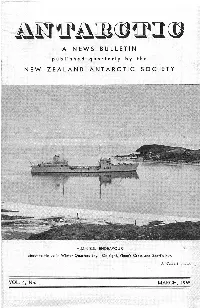
Mm^Umamm a N E W S B U L L E T I N
mm^umamm A N E W S B U L L E T I N p u b l i s h e d q u a r t e r l y b y t h e NEW ZEALAND ANTARCTIC SOCIETY ■ H.M.N.Z.S. ENDEAVOUR about to tie up in Winter Quarters Bay. On right, Vince's Cross and Scott's hut. J. Calvert photo. MARCH, 1965 AUSTRALIA Winter and Summer bases Scott- S u m m e r b a s e o n l y t H a l l e f t "cton NEW ZEALAND Transferred base Wilkes UStcAust Temporarily non -operational. .KSyowa TASMANIA , Campbell I. (N-l) , ^ V - r . ^ ^ N . AT // \$ 5«|* Pasar'C ^rd(i/.sA . *"Vp»tuk , N |(I/.«.AJ i - S c o t t ( U . 5 J i t - A N T A R. M^ciJ ^>cwj a fi/V wX " < S M a u d **$P -Marion I. ttM DRAWN BY DEPARTMENT OF LANDS 1 SURVEY WELLINGTON, NEW ZEALAND, MAR.I9l»4- 1 " . " E D I T I O N m ilHl^IBS^IKB^k (Successor to "Antarctic News Bulletin") MARCH, 1965 Editor: L. B. Quartermain, M.A., 1 Ariki Road, Wellington, E.2, New Zealand. Business Communications, Subscriptions, etc., to: Secretary, New Zealand Antarctic Society, P.O. Box 2110, Wellington, N.Z. CONTENTS EXPEDITIONS New Zealand The Central Nimrod Glacier Geological Expedition: M. G. Laird Victoria University Research in Ice-free Areas: W. M. Prebble The D-region Project: J. B. Gregory France United States First Leg of Traverse Australia Belgium-Holland U.S.S.R South Africa Argentina United Kingdom Chile Japan Sub-Antarctic Islands British South Georgia Expedition Big Ben Conquered Special Articles: Hallett Closed Antarctic Stations—I. -
Origin and Evolution of the Sub-Antarctic Islands: the Foundation
Papersnd a Proceedings of the Royal Society of Tasmania, Volume 141 (1), 2007 35 ORIGIN AND EVOLUTION OF THE SUB-ANTARCTIC ISLANDS: THE FOUNDATION by Patrick G. Quilty (with 23 text-figures and two tables) Quilty, P.G. 2007 (23:xi): Origin and evolution of the sub-Antarctic islands: the foundation.Papers and Proceedings of the Royal Society of Tasmania 141 (1): 35-58. https://doi.org/10.26749/rstpp.141.1.35 ISSN 0080-4703. School of Earth Sciences, University of Tasmania, Private Bag 79, Hobart, Tasmania 7001, Australia. Email: P.Quil ty@utas.edu.au Sub-Antarctic islands have a diversity of origins in detail but most are volcanic and very young suggesting that they are short-lived and that the distribution would have been very differenta few million years ago. 'They contrast with the common tourist brochure concept of oceanic islands. As the Antarctic Plate is virtually static, the islands seldom show signs of association with long-lived linear island chains and most thus stand alone. Longer-lived islands are either on submarine plateaux or are continental remnants of the dispersion of Gondwana. The islands are classified in relation to raised sea-floor, transform fault, triple junction, subduction zone, submarine plateau, submerged continent or continental. Many are difficult of access and poorly known geologically. Their geological history controls their many other roles such as sites as observatories, or for study of colonisation, evolution and speciation rates. Key Words: Sub-Antarctic islands, geological evolution, Macquarie Island, Balleny Islands, Scott Island, Campbell Island, Antipodes Island, Auckland Islands, Enderby Island, Peter I Island, Islas Diego Ramirez, South Georgia, South Sandwich Islands, Bouvetoya, Gough Island, Marion Island, Prince Edward Island, Iles Crozet, Amsterdam Island, St Paul Island, Kerguelen Plateau, Iles Kerguelen, Heard Island, McDonald Island. -

First Record of Lithodid Crabs from Antarctic Waters Off the Balleny Islands
Polar Biol (2005) 28: 334–337 DOI 10.1007/s00300-004-0686-1 SHORT NOTE Sven Thatje Æ Anne-Nina Lo¨rz First record of lithodid crabs from Antarctic waters off the Balleny Islands Received: 14 July 2004 / Revised: 27 September 2004 / Accepted: 29 September 2004 / Published online: 10 November 2004 Ó Springer-Verlag 2004 Abstract Four specimens of Neolithodes brodiei Dawson physiological life history features, in order to explain and Yaldwyn (1970) have been obtained for the first their ability to sustain polar conditions (Thatje 2004). time from bottom trawls deployed in Antarctic waters Among other life history adaptations in adult Lithod- off the Balleny Islands (about 67°S) in March 2004. idae, such as prolonged brooding off embryos, ex- The Lithodidae constitute the only anomuran crab tended hatching periods, slow growth and delayed age family so far known to be able to thrive under high- at maturity (Thatje 2004; Thatje et al. 2004), their Antarctic conditions, and lithodids in the Ross Sea larval lecithotrophy and energy saving traits to abbre- have previously only been recorded off Scott Island. viate larval development have been shown to be espe- The new record of N. brodiei, commonly found in cially important for lithodid survival in high latitudes waters off New Zealand, clearly extends its geographic (Anger et al. 2004; Thatje et al. 2004). Larval lecitho- range into the Southern Ocean. The significance of this trophy allows to uncouple from the mismatch of pro- finding with respect to the biodiversity and distribution longed developmental times and short periods of of the Lithodidae from the Southern Ocean is briefly planktonic food availability which, under polar condi- discussed.