Lumen Magnificat
Total Page:16
File Type:pdf, Size:1020Kb
Load more
Recommended publications
-

Biography Thomaskantor Gotthold Schwarz As of March 2018
Thomaskantor Gotthold Schwarz Gotthold Schwarz is the 17 th Thomaskantor after Johann Sebastian Bach. On 9 June 2016 he has been appointed as Thomaskantor and has been officially inaugurated on 20 August 2016. Born in Zwickau as a son of a cantor he gained his musical education at the “Hochschule für Kirchenmusik Dresden” (University for Church Music Dresden) and also at the “Hochschule für Musik und Theater „Felix Mendelssohn Bartholdy“ Leipzig” (University of Music and Theatre „Felix Mendelssohn Bartholdy“ Leipzig) after having been a member of Thomanerchor Leipzig for s short time in his childhood. He studied singing with Gerda Schriever, playing the organ with former St. Thomas Organist Hannes Kästner and Wolfgang Schetelich, as well as conducting with Max Pommer and Hans-Joachim Rotzsch. Furthermore he has worked with, amongst others, Hermann Christian Polster, Peter Schreier and Helmuth Rilling in masterclasses and academies. Gotthold Schwarz, who began to work as vocal trainer for the Thomanerchor Leipzig in 1979, stood in for the Thomaskantor for several times since the 1990's. On this position he led the motets, performances of cantatas and oratorios with the Thomanerchor Leipzig; moreover he was entrusted with other duties as an interim officiating cantor. Together with the world-famous boys’ choir he has been on numerous tours in Germany, Europe and overseas (Japan, China, USA, Canada), several together with the Gewandhausorchester Leipzig. Furthermore Gotthold Schwarz is initiator and leader of “Concerto vocale”, “Saxon Baroque Orchestra”, “Leipziger Cantorey” and “Bach Consort Leipzig”. In recognition of his special merits the versatiled singer and conductor was awarded with the Cross of Merit of the Federal Republic of Germany (1 st class) on 4 October 2017. -

'Dream Job: Next Exit?'
Understanding Bach, 9, 9–24 © Bach Network UK 2014 ‘Dream Job: Next Exit?’: A Comparative Examination of Selected Career Choices by J. S. Bach and J. F. Fasch BARBARA M. REUL Much has been written about J. S. Bach’s climb up the career ladder from church musician and Kapellmeister in Thuringia to securing the prestigious Thomaskantorat in Leipzig.1 Why was the latter position so attractive to Bach and ‘with him the highest-ranking German Kapellmeister of his generation (Telemann and Graupner)’? After all, had their application been successful ‘these directors of famous court orchestras [would have been required to] end their working relationships with professional musicians [take up employment] at a civic school for boys and [wear] “a dusty Cantor frock”’, as Michael Maul noted recently.2 There was another important German-born contemporary of J. S. Bach, who had made the town’s shortlist in July 1722—Johann Friedrich Fasch (1688–1758). Like Georg Philipp Telemann (1681–1767), civic music director of Hamburg, and Christoph Graupner (1683–1760), Kapellmeister at the court of Hessen-Darmstadt, Fasch eventually withdrew his application, in favour of continuing as the newly- appointed Kapellmeister of Anhalt-Zerbst. In contrast, Bach, who was based in nearby Anhalt-Köthen, had apparently shown no interest in this particular vacancy across the river Elbe. In this article I will assess the two composers’ positions at three points in their professional careers: in 1710, when Fasch left Leipzig and went in search of a career, while Bach settled down in Weimar; in 1722, when the position of Thomaskantor became vacant, and both Fasch and Bach were potential candidates to replace Johann Kuhnau; and in 1730, when they were forced to re-evaluate their respective long-term career choices. -
Introduction
Copyright © Thomas Braatz, 20071 Introduction This paper proposes to trace the origin and rather quick demise of the Andreas Stübel Theory, a theory which purportedly attempted to designate a librettist who supplied Johann Sebastian Bach with texts and worked with him when the latter composed the greater portion of the 2nd ‘chorale-cantata’ cycle in Leipzig from 1724 to early 1725. It was Hans- Joachim Schulze who first proposed this theory in 1998 after which it encountered a mixed reception with Christoph Wolff lending it some support in his Bach biography2 and in his notes for the Koopman Bach-Cantata recording series3, but with Martin Geck4 viewing it rather less enthusiastically as a theory that resembled a ball thrown onto the roulette wheel and having the same chance of winning a jackpot. 1 This document may be freely copied and distributed providing that distribution is made in full and the author’s copyright notice is retained. 2 Christoph Wolff, Johann Sebastian Bach: The Learned Musician (Norton, 2000), (first published as a paperback in 2001), p. 278. 3 Christoph Wolff, ‘The Leipzig church cantatas: the chorale cantata cycle (II:1724-1725)’ in The Complete Cantatas volumes 10 and 11 as recorded by Ton Koopman and published by Erato Disques (Paris, France, 2001). 4 Martin Geck, Bach: Leben und Werk, (Hamburg, 2000), p. 400. 1 Andreas Stübel Andreas Stübel (also known as Stiefel = ‘boot’) was born as the son of an innkeeper in Dresden on December 15, 1653. In Dresden he first attended the Latin School located there. Then, in 1668, he attended the Prince’s School (“Fürstenschule”) in Meißen. -
T H O M a N E R C H
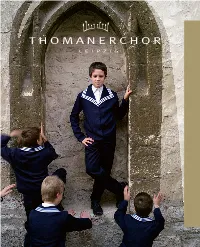
Thomanerchor LeIPZIG DerThomaner chor Der Thomaner chor ts n te on C F o able T Ta b l e o f c o n T e n T s Greeting from “Thomaskantor” Biller (Cantor of the St Thomas Boys Choir) ......................... 04 The “Thomanerchor Leipzig” St Thomas Boys Choir Now Performing: The Thomanerchor Leipzig ............................................................................. 06 Musical Presence in Historical Places ........................................................................................ 07 The Thomaner: Choir and School, a Tradition of Unity for 800 Years .......................................... 08 The Alumnat – a World of Its Own .............................................................................................. 09 “Keyboard Polisher”, or Responsibility in Detail ........................................................................ 10 “Once a Thomaner, always a Thomaner” ................................................................................... 11 Soli Deo Gloria .......................................................................................................................... 12 Everyday Life in the Choir: Singing Is “Only” a Part ................................................................... 13 A Brief History of the St Thomas Boys Choir ............................................................................... 14 Leisure Time Always on the Move .................................................................................................................. 16 ... By the Way -

La Petite Bande Olv
2007-2008 BLAUWE ZAAL DO 24 APRIL 2008 La Petite Bande olv. Sigiswald Kuijken 2007-2008 Bach wo 14 november 2007 KOOR & ORKEST COLLEGIUM VOCALE GENT OLV. PHILIppE HERREWEGHE za 15 december 2007 FREIBURGER BAROckORCHESTER & COLLEGIUM VOCALE GENT OLV. MASAAKI SUZUKI do 24 april 2008 LA PETITE BANDE OLV. SIGISWALD KUIJKEN Bach LA PETITE BANDE SIGISWALD KUIJKEN muzikale leiding SIRI THORNHILL sopraan PETRA NOskAIOVÁ mezzo CHRISTOPH GENZ tenor JAN VAN DER CRAbbEN bas JOHANN SEBASTIAN BACH (1685-1750) Cantate ‘Es ist euch gut, dass ich hingehe’, BWV108 20’ Pictogrammen DeSingel AUDIO gelieve uw GSM uit te schakelen Cantate ‘Wahrlich, wahrlich, ich sage euch’, BWV86 18’ Cantate ‘Sie werden euch in den Bann tun’, BWV44 22’ pauze De inleidingen kan u achteraf beluisteren via www.desingel.be Selecteer hiervoor voorstelling/concert/tentoonstelling van uw keuze. Himmelfahrtsoratorium REAGEER ‘Lobet Gott in seinen Reichen’, BWV11 32’ & WIN Op www.desingel.be kan u uw visie, opinie, commentaar, appreciatie, … betreffende het programma van deSingel met andere toeschouwers delen. Selecteer hiervoor voorstelling/ concert/tentoonstelling van uw keuze. Neemt u deel aan dit forum, dan maakt u meteen kans om tickets te winnen. Bij elk concert worden cd’s te koop aangeboden door ’t KLAverVIER, Kasteeldreef 6, Schilde, 03 384 29 70 > www.tklavervier.be foyer deSingel enkel open bij avondvoorstellingen in rode en/of blauwe zaal open vanaf 18.40 uur kleine koude of warme gerechten te bestellen vóór 19.20 uur broodjes tot net vóór aanvang van de voorstellingen -

Grosser Saal Klangwolke Brucknerhaus Präsentiert Von Der Linz Ag Linz
ZWISCHEN CREDO Vollendeter Genuss TRADITION BEKENNTNIS braucht ein & GLAUBE perfektes MODERNE Zusammenspiel RELIGION Als führendes Energie- und Infrastrukturunternehmen im oberösterreichischen Zentralraum sind wir ein starker Partner für Wirtschaft, Kunst und Kultur und die Menschen in der Region. Die LINZ AG wünscht allen Besucherinnen und Besuchern beste Unterhaltung. bezahlte Anzeige LINZ AG_Brucknerfest 190x245.indd 1 02.05.18 10:32 6 Vorworte 12 Saison 2018/19 16 Abos 2018/19 22 Das Große Abonnement 32 Sonntagsmatineen 44 Internationale Orchester 50 Bruckner Orchester Linz 56 Kost-Proben 60 Das besondere Konzert 66 Oratorien 128 Hier & Jetzt 72 Chorkonzerte 134 Moderierte Foyer-Konzerte INHALTS- 78 Liederabende 138 Musikalischer Adventkalender 84 Streichquartette 146 BrucknerBeats 90 Kammermusik 150 Russische Dienstage 96 Stars von morgen 154 Musik der Völker 102 Klavierrecitals 160 Jazz VERZEICHNIS 108 Orgelkonzerte 168 Jazzbrunch 114 Orgelmusik zur Teatime 172 Gemischter Satz 118 WortKlang 176 Kinder.Jugend 124 Ars Antiqua Austria 196 Serenaden 204 Kooperationen 216 Kalendarium 236 Saalpläne 242 Karten & Service 4 5 Linz hat sich schon längst als interessanter heimischen, aber auch internationalen Künst- Der Veröffentlichung des neuen Saisonpro- Musik wird heutzutage bevorzugt über diverse und innovativer Kulturstandort auch auf in- lerinnen und Künstlern es ermöglichen, ihr gramms des Brucknerhauses Linz sehen Medien, vom Radio bis zum Internet, gehört. ternationaler Ebene Anerkennung verschafft. Potenzial abzurufen und sich zu entfalten. Für unzählige Kulturinteressierte jedes Jahr er- Dennoch hat die klassische Form des Konzerts Ein wichtiger Meilenstein auf diesem Weg war alle Kulturinteressierten jeglichen Alters bietet wartungsvoll entgegen. Heuer dürfte die nichts von ihrer Attraktivität eingebüßt. Denn bislang auf jeden Fall die Errichtung des Bruck- das ausgewogene und abwechslungsreiche Spannung besonders groß sein, weil es die das Live-Erlebnis bleibt einzigartig – dank der nerhauses Linz. -
Bach and Money: Sources of Salary and Supplemental Income in Leipzig from 1723 to 1750*
Understanding Bach, 12, 111–125 © Bach Network UK 2017 Young Scholars’ Forum Bach and Money: Sources of Salary and Supplemental Income in Leipzig * from 1723 to 1750 NOELLE HEBER It was his post as Music Director and Cantor at the Thomasschule that primarily marked Johann Sebastian Bach’s twenty-seven years in Leipzig. The tension around the unstable income of this occupation drove Bach to write his famous letter to Georg Erdmann in 1730, in which he expressed a desire to seek employment elsewhere.1 The difference between his base salary of 100 Thaler and his estimated total income of 700 Thaler was derived from legacies and foundations, funerals, weddings, and instrumental maintenance in the churches, although many payment amounts fluctuated, depending on certain factors such as the number of funerals that occurred each year. Despite his ongoing frustration at this financial instability, it seems that Bach never attempted to leave Leipzig. There are many speculations concerning his motivation to stay, but one could also ask if there was a financial draw to settling in Leipzig, considering his active pursuit of independent work, which included organ inspections, guest performances, private music lessons, publication of his compositions, instrumental rentals and sales, and, from 1729 to 1741, direction of the collegium musicum. This article provides a new and detailed survey of these sources of revenue, beginning with the supplemental income that augmented his salary and continuing with his freelance work. This exploration will further show that Leipzig seems to have been a strategic location for Bach to pursue and expand his independent work. -

The Sources of the Christmas Interpolations in J. S. Bach's Magnificat in E-Flat Major (BWV 243A)*
The Sources of the Christmas Interpolations in J. S. Bach's Magnificat in E-flat Major (BWV 243a)* By Robert M. Cammarota Apart from changes in tonality and instrumentation, the two versions of J. S. Bach's Magnificat differ from each other mainly in the presence offour Christmas interpolations in the earlier E-flat major setting (BWV 243a).' These include newly composed settings of the first strophe of Luther's lied "Vom Himmel hoch, da komm ich her" (1539); the last four verses of "Freut euch und jubiliert," a celebrated lied whose origin is unknown; "Gloria in excelsis Deo" (Luke 2:14); and the last four verses and Alleluia of "Virga Jesse floruit," attributed to Paul Eber (1570).2 The custom of troping the Magnificat at vespers on major feasts, particu larly Christmas, Easter, and Pentecost, was cultivated in German-speaking lands of central and eastern Europe from the 14th through the 17th centu ries; it continued to be observed in Leipzig during the first quarter of the 18th century. The procedure involved the interpolation of hymns and popu lar songs (lieder) appropriate to the feast into a polyphonic or, later, a con certed setting of the Magnificat. The texts of these interpolations were in Latin, German, or macaronic Latin-German. Although the origin oftroping the Magnificat is unknown, the practice has been traced back to the mid-14th century. The earliest examples of Magnifi cat tropes occur in the Seckauer Cantional of 1345.' These include "Magnifi cat Pater ingenitus a quo sunt omnia" and "Magnificat Stella nova radiat. "4 Both are designated for the Feast of the Nativity.' The tropes to the Magnificat were known by different names during the 16th, 17th, and early 18th centuries. -

Vespers 2020 Music Guide
MILLIKIN UNIVERSITY® 2 0 2 0 ALL IS BRIGHT MUSIC GUIDE VESPERS MEANS ‘EVENING’ AND IS ONE OF THE SEVEN CANONICAL HOURS OF PRAYER. MILLIKIN UNIVERSITY | SCHOOL OF MUSIC BELL CAROL (2017 All Choirs) William Mathias “AlltheBellsonEarthShallRing”wastheVespersthemeinMathias’compositionwastheperfect openingTheprocessionendeavorstorevealtoaudiencemembersthatbellsaregiftssounds(musicifyou will)oeredtothemangerIndeedtheremainderoftheprogramdisplayedbellsinbothcelebratoryand reflectivemomentsThepiecewascomposedforSirDavidWillcocksthechoirmasterwhobroughtsomuch attentiontotheLessonsandCarolsofKing’sCollegeCambridge ALLELUIA(2018 University Choir) Fredrik Sixten “SingAlleluia”wasthethemeofVespersinandSixten’sreflectivesettingcameearlyintheprogram givingthiswordusuallyconsideredfestiveinmoodasenseofadventhope LAUDATE DOMINUM (2015 Millikin Women) Gyöngyösi Levente LaudateDominumhasservedmanycomposersinincludingMozartwhouseditinhiswellknownSolemn VespersContemporaryHungariancomposerGyöngyösicombinesanincessantmantraonasinglenotewith complexrhythmsforthissettingofPs(“OPraisetheLordallyenations”)Harmonicdensityincreasesand joinstherhythmicdrivetothefinalAlleluiawheretheadditionofatambourineaddsafinalcelebratorynote MAGNIFICAT(2017 Collegiate Chorale) Bryan Kelly EvensongtheAnglicanversionofVespersalwaysincludesasettingoftheMagnificatEventhough thisiscomposedforEnglishearsBryanKelly’senthusiasmforLatinAmericanmusicisclearlyevident inthissettingfromthes GLORIA PATRIMAGNIFICAT (2019 All Choirs) John Rutter ThefinalmovementofRutter’sMagnificatgathersmanyofthework’sthemesintoatriumphantfinale -

Kirchenmusik Evangelische Kirche Zum Erlöser - Konstantin-Basilika Juli Bis Dezember 2016
Kirchenmusik Evangelische Kirche zum Erlöser - Konstantin-Basilika Juli bis Dezember 2016 1 I E EDITORIAL SEITE 3 Sehr geehrte Freundinnen und Freunde der Kirchenmusik, ORGELSOMMER 2016 - ÜBERSICHT SEITE 4 vielen Dank für Ihr Interesse an den kirchenmusika- VERANSTALTUNGEN SEITE 5 lischen Veranstaltungen des Jahres 2016 in der Ev. Kirchengemeinde Trier. Diese sind von großer Vielfalt MUSIKALISCH GESTALTETE GOTTESDIENSTE SEITE 29 geprägt und reichen von musikalisch besonders ge- stalteten Gottesdiensten durch unsere gemeindli- chen Gruppen (Caspar-Olevian-Chor, Kinderchor, Po- IHRE HILFE ZÄHLT SEITE 31 saunenchor, Blockfl ötenkreis) über Kammerkonzerte und Chorkonzerte des Trierer Bachchores sowie aus- DISPOSITION DER SCHUKE-ORGEL SEITE 32 wärtiger Gastchöre bis zu zahlreichen Orgelkonzerten. DISPOSITION DER EULE-ORGEL SEITE 33 Von der Programmgestaltung her steht der Kompo- nist Max Reger (1873 – 1916) anlässlich seines 100. CD-EINSPIELUNGEN SEITE 34 Todestages in diesem Jahr besonders im Mittelpunkt. Dies wird in der Basilika in mehreren Konzerten deut- lich, die Teil einer ökumenischen Veranstaltungsreihe ORGELPFEIFEN-PATENSCHAFTEN SEITE 37 zum Reger-Jahr sind unter dem Motto „Keine Note zuviel!“ Diese Konzertreihe, in deren Rahmen alle großen Orgelwerke Regers, aber auch Chor- und Kammermusik des Kompo- AUF EINEN BLICK SEITE 38 nisten erklingen, wird veranstaltet in Kooperation von Hoher Domkirche Trier und der Ev. Kirchenmusik an der Konstantin-Basilika. Am 31.10. (Reformationstag) beginnt das Gedenkjahr „500 Jahre Reformation“. Die Ev. Kirche im Rheinland begeht dieses unter dem Motto „Ich bin vergnügt, erlöst, befreit“ – ein Satz aus einem Psalmgedicht von Hanns Dieter Hüsch. Auch, wenn wesentliche mu- sikalische Höhepunkte des Reformationsjubiläums erst in 2017 stattfi nden, so setzt doch der Beginn am diesjährigen Reformationstag ein besonderes Zeichen mit der „Nacht der off enen Kirche“ (siehe Seite 21). -

Program of Our 10Th Anniversary Year, a Year of Exploration and Variety in Celebration of Ten Years of Choral Music Making
San Francisco Lyric Chorus Robert Gurney, Music Director Board of Directors Helene Whitson, President Bill Whitson, Treasurer Wylie Sheldon, Secretary David Baker, Director Anna Barr, Director Andrea Ogarrio, Director Welcome to the Summer 006 Concert of the San Francisco Lyric Chorus. Since its formation in 1995, the Chorus has offered diverse and innovative music to the community through a gathering of singers who believe in a commonality of spirit and sharing. The début concert featured music by Gabriel Fauré and Louis Vierne. The Chorus has been involved in several premieres, including Bay Area composer Brad Osness’ Lamentations, Ohio composer Robert Witt’s Four Motets to the Blessed Virgin Mary (West Coast premiere) New York composer William Hawley’s The Snow That Never Drifts (San Francisco premiere) San Francisco composer Kirke Mechem’s Christmas the Morn, Blessed Are They, To Music (San Francisco premieres), and selections from his opera, The Newport Rivals, and our 10th Anniversary Commission work, Lee R. Kesselman’s This Grand Show Is Eternal. We come to the final program of our 10th Anniversary Year, a year of exploration and variety in celebration of ten years of choral music making. We began with our Fall 005 program, as we presented An English Christmas, which honored the 500th birth of the great Thomas Tallis with a performance of his Missa puer natus est nobis and his lovely anthem, If Ye Love Me. We also presented joyous and gentle 0th-century Christmas compositions by British composers Ralph Vaughan Williams, Benjamin Britten, Gustav Holst, and William Mathias. Our exciting Spring 006 program, American Spiritual Landscapes, featured the San Francisco Lyric Chorus’ gift to the choral world—our 10th Anniversary Commission work—This Grand Show Is Eternal, by Illinois composer, Lee R. -
Magnificat JS Bach
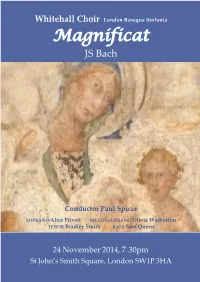
Whitehall Choir London Baroque Sinfonia Magnificat JS Bach Conductor Paul Spicer SOPRANO Alice Privett MEZZO-SOPRANO Olivia Warburton TENOR Bradley Smith BASS Sam Queen 24 November 2014, 7. 30pm St John’s Smith Square, London SW1P 3HA In accordance with the requirements of Westminster City Council persons shall not be permitted to sit or stand in any gangway. The taking of photographs and use of recording equipment is strictly forbidden without formal consent from St John’s. Smoking is not permitted anywhere in St John’s. Refreshments are permitted only in the restaurant in the Crypt. Please ensure that all digital watch alarms, pagers and mobile phones are switched off. During the interval and after the concert the restaurant is open for licensed refreshments. Box Office Tel: 020 7222 1061 www.sjss.org.uk/ St John’s Smith Square Charitable Trust, registered charity no: 1045390. Registered in England. Company no: 3028678. ACKNOWLEDGEMENTS The Choir is very grateful for the support it continues to receive from the Department for Business, Innovation and Skills (BIS). The Choir would like to thank Philip Pratley, the Concert Manager, and all tonight’s volunteer helpers. We are grateful to Hertfordshire Libraries’ Performing Arts service for the supply of hire music used in this concert. The image on the front of the programme is from a photograph taken by choir member Ruth Eastman of the Madonna fresco in the Papal Palace in Avignon. WHITEHALL CHOIR - FORTHCOMING EVENTS (For further details visit www.whitehallchoir.org.uk.) Tuesday, 16