The Doctor in Literature
Total Page:16
File Type:pdf, Size:1020Kb
Load more
Recommended publications
-

My Life at Shaare Zedek
From 1906 until 1916 I was a nurse at the Salomon Heine Hospital in Hamburg. (Salomon Heine was the uncle of Heinrich Heine who wrote a poem about this hospital.) The first time that Jewish nurses sat for examinations by the German authorities and received a German State Diploma was in 1913. One of my colleagues and I were the first Jewish nurses who received a State Diploma in Germany. We both passed the examinations with “very good”, and the German doctors especially praised our theoretical and practical knowledge. In 1916, during the first world war, I left the hospital and started out on my way to the then called Palestine. I arrived in the country in December of that year. The following events influenced my decision to come here. Dr. Wallach went on a trip to Europe when the hospital urgently needed a head nurse. He inspected several hospitals and, among them, the Salomon Heine Hospital in Hamburg, which impressed him especially because its structure was similar to that of his own hospital. Dr. Wallach turned to the head nurse to ask if she could spare a nurse who would be willing to serve as head nurse for him. Four nurses of the hospital had already been put at the disposal of the State. She thought that Schwester Selma might like to serve her war service in Palestine. Dr. Wallach came to this country at the end of the 19th century, a native 5 of Cologne. His coming was prompted by sheer idealism and also by his religious attitude. -
The Legacy of INTERPOL Crime Data to Cross-National Criminology1
INTERNATIONAL JOURNAL OF COMPARATIVE AND APPLIED CRIMINAL JUSTICE FALL 2009, VOL. 33, NO. 2 The Legacy of INTERPOL Crime Data to Cross-National Criminology1 ROSEMARY BARBERET2 John Jay College of Criminal Justice, CUNY INTERPOL crime data constitute the oldest and most continuous cross-national data series available to criminologists. Recently, INTERPOL has decided to forego its data collection efforts. This paper, based on a systematic and extensive literature review, will examine how criminologists and other social scientists have used INTERPOL data to examine criti- cal issues in the description and explanation of cross-national crime. It will end with a critical reflection on the contribution of INTERPOL data to our knowledge base, as well as the possibilities that exist for using other data sources to continue research in this area. INTRODUCTION Crime data from INTERPOL are the oldest dataset of cross-national indica- tors of crime maintained by an intergovernmental organization. Thanks to these data, criminologists have created a literature that aims to explain national as well as cross-national differences and trends in crime rates. Created in 1923, the International Criminal Police Commission (ICPC, later abbreviated to ICPC-INTERPOL and now known as INTERPOL) was founded to facilitate police cooperation among countries, even where diplomatic ties do not exist. INTERPOL's International Crime Statistics were first published in 1950. In 2006, INTERPOL decided to cease collecting and disseminating crime data, and 2005 was the last -

ISIS Agent, Sterling Archer, Launches His Pirate King Theme FX Cartoon Series Archer Gets Its First Hip Hop Video Courtesy of Brooklyn Duo, Drop It Steady
ISIS agent, Sterling Archer, launches his Pirate King Theme FX Cartoon Series Archer Gets Its First Hip Hop Video courtesy of Brooklyn duo, Drop it Steady Fans of the FX cartoon series Archer do not need to be told of its genius. The show was created by many of the same writers who brought you the Fox series Arrested Development. Similar to its predecessor, Archer has built up a strong and loyal fanbase. As with most popular cartoons nowadays, hip-hop artists tend to flock to the animated world and Archer now has it's hip-hop spin off. Brooklyn-based music duo, Drop It Steady, created a fun little song and video sampling the show. The duo drew their inspiration from a series sub plot wherein Archer became a "pirate king" after his fiancée was murdered on their wedding day in front of him. For Archer fans, the song and video will definitely touch a nerve as Drop it Steady turns the story of being a pirate king into a forum for discussing recent break ups. Video & Music Download: http://www.mediafire.com/?bapupbzlw1tzt5a Official Website: http://www.dropitsteady.com Drop it Steady on Facebook: http://www.facebook.com/dropitsteady About Drop it Steady: Some say their music played a vital role in the Arab Spring of 2011. Others say the organizers of Occupy Wall Street were listening to their demo when they began to discuss their movement. Though it has yet to be verified, word that the first two tracks off of their upcoming EP, The Most Interesting EP In The World, were recorded at the ceremony for Prince William and Katie Middleton and are spreading through the internets like wild fire. -

©2016 Jacob B. Archer ALL RIGHTS RESERVED
©2016 Jacob B. Archer ALL RIGHTS RESERVED THE CARE OF ART AND ARTIFACTS SUBJECTED TO THE LAW ENFORCEMENT PROCESS by JACOB B. ARCHER A thesis submitted to the Graduate SchoolNew Brunswick Rutgers, The State University of New Jersey in partial fulfillment of the requirements For the degree of Master of Arts Graduate Program in Art History written under the direction of Cynthia Jacob, J.D., Ph.D. and approved by ________________________________ ________________________________ ________________________________ New Brunswick, New Jersey [May 2016] ABSTRACT OF THE THESIS THE CARE OF ART AND ARTIFACTS SUBJECTED TO THE LAW ENFORCEMENT PROCESS By JACOB B. ARCHER Thesis Director Cynthia Jacob, J.D., Ph.D. This thesis is intended to serve as a guide for law enforcement officers on how to care for art and artifacts subjected to the law enforcement process. Law enforcement officers may encounter art and artifacts in various ways, such as through seizure, unexpected finds, and planned recovery operations. Law enforcement officers have a duty to properly care for property, to include cultural property objects such as art and artifacts, while in their custody and control, but art and artifacts often require care beyond the routine handling generally afforded to common property items. This thesis will offer suggestions for the law enforcement officer on how to recognize art and artifacts in the field and how to subsequently handle and care for same. These suggestions are meant to be integrated into existing law enforcement policies and procedures so as to realistically account for the time, skill, and financial resources associated with law enforcement officers and their respective agencies, all the while maintaining adherence to generally accepted evidence collection practices. -

April 26, 2021 5:00 PM
BULLITT COUNTY PUBLIC SCHOOLS 1040 HIGHWAY 44 EAST SHEPHERDSVILLE, KY 40165 REGULAR MEETING OF THE BULLITT COUNTY BOARD OF EDUCATION April 26, 2021 5:00 PM MINUTES OF RECORD The Bullitt County Board of Education met at the Frank R. Hatfield Administrative Center, 1040 Highway 44 East, Shepherdsville, KY 40165, at 5:00 PM on April 26, 2021, with the following members present: Attendance Taken at 4:51 PM: (1) Ms. Linda Belcher (2) Mrs. Nita Neal (3) Mrs. Debby Atherton (4) Mrs. Lisa Hodges (5) Mr. Darrell Coleman CALL TO ORDER The April 26, 2021, regular meeting of the Bullitt County Board of Education was called to order at 5:00 p.m. by Board Chairperson Debby Atherton. ADOPT THE AGENDA 2021-062- Motion made by Nita Neal, seconded by Linda Belcher, to adopt the agenda with the following changes: 1. Add to Presentations 3.(d.)(3.) - Cody Webb also entered the Dual Credit program and graduated from JCTC's Aviation Maintenance Technology Program. 2. Add to Presentations 3.(d.)(4.) – FRED Awards – Tammie Collins 3. Add to Consent Items - Contracts 5.(g.)(6.) - C&H Audio Visual Services Contract for Graduation 2021 4. Add to Consent Items - Donations/Grants - Two Grants All members voted YES. PRESENTATIONS Board member Lisa Hodges led the audience in The Pledge of Allegiance and reviewed the Board Team Commitments. Ms. Becky Sexton, Assistant Superintendent for Support Services, reminded anyone wishing to address the Board to please register. Ms. Sexton congratulated and presented Certificates of Recognition to the following students: CGES, BMS & BCHS Archery Teams ● Two Cedar Grove Elementary School student archery team members earned State Champion Awards at the 2021 National Archery in the Schools Program (NASP) State Competition: o Trey Rountree - State Champion in Bullseye o Jayden Kearney - State Champion in 3D ● Chase Simpson from Bernheim Middle School was recognized as the Kentucky NASP Middle School State 3D Champion. -

The Nation's Matron: Hattie Jacques and British Post-War Popular Culture
The Nation’s Matron: Hattie Jacques and British post-war popular culture Estella Tincknell Abstract: Hattie Jacques was a key figure in British post-war popular cinema and culture, condensing a range of contradictions around power, desire, femininity and class through her performances as a comedienne, primarily in the Carry On series of films between 1958 and 1973. Her recurrent casting as ‘Matron’ in five of the hospital-set films in the series has fixed Jacques within the British popular imagination as an archetypal figure. The contested discourses around nursing and the centrality of the NHS to British post-war politics, culture and identity, are explored here in relation to Jacques’s complex star meanings as a ‘fat woman’, ‘spinster’ and authority figure within British popular comedy broadly and the Carry On films specifically. The article argues that Jacques’s star meanings have contributed to nostalgia for a supposedly more equitable society symbolised by socialised medicine and the feminine authority of the matron. Keywords: Hattie Jacques; Matron; Carry On films; ITMA; Hancock’s Half Hour; Sykes; star persona; post-war British cinema; British popular culture; transgression; carnivalesque; comedy; femininity; nursing; class; spinster. 1 Hattie Jacques (1922 – 1980) was a gifted comedienne and actor who is now largely remembered for her roles as an overweight, strict and often lovelorn ‘battle-axe’ in the British Carry On series of low- budget comedy films between 1958 and 1973. A key figure in British post-war popular cinema and culture, Hattie Jacques’s star meanings are condensed around the contradictions she articulated between power, desire, femininity and class. -

Howtoarcher Sample.Pdf
Archer How To How THE ULTIMATE GUIDE TO ESPIONAGE AND STYLE AND WOMEN AND ALSO COCKTAILS EVER WRITTEN By Sterling Archer CONTENTS Foreword ix Section Two: Preface xi How to Drink Introduction xv Cocktail Recipes 73 Section Three: Section One: How to Style How to Spy Valets 95 General Tradecraft 3 Clothes 99 Unarmed Combat 15 Shoes 105 Weaponry 21 Personal Grooming 109 Gadgets 27 Physical Fitness 113 Stellar Navigation 35 Tactical Driving 37 Section Four: Other Vehicles 39 How to Dine Poison 43 Dining Out 119 Casinos 47 Dining In 123 Surveillance 57 Recipes 125 Interrogation 59 Section Five: Interrogation Resistance 61 How to Women Escape and Evasion 65 Amateurs 133 Wilderness Survival 67 For the Ladies 137 Cobras 69 Professionals 139 The Archer Sutra 143 viii Contents Section Six: How to Pay for it Personal Finance 149 Appendix A: Maps 153 Appendix B: First Aid 157 Appendix C: Archer's World Factbook 159 FOREWORD Afterword 167 Acknowledgements 169 Selected Bibliography 171 About the Author 173 When Harper Collins first approached me to write the fore- word to Sterling’s little book, I must admit that I was more than a bit taken aback. Not quite aghast, but definitely shocked. For one thing, Sterling has never been much of a reader. In fact, to the best of my knowledge, the only things he ever read growing up were pornographic comic books (we used to call them “Tijuana bibles,” but I’m sure that’s no longer considered polite, what with all these immigrants driving around every- where in their lowriders, listening to raps and shooting all the jobs). -
The Booklet That Accompanied the Exhibition, With
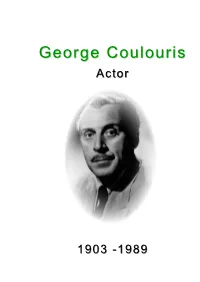
GGeeoorrggee CCoouulloouurriiss AAccttoorr 11990033 --11998899 George Coulouris - Biographical Notes 1903 1st October: born in Ordsall, son of Nicholas & Abigail Coulouris c1908 – c1910: attended a local private Dame School c1910 – 1916: attended Pendleton Grammar School on High Street c1916 – c1918: living at 137 New Park Road and father had a restaurant in Salisbury Buildings, 199 Trafford Road 1916 – 1921: attended Manchester Grammar School c1919 – c1923: father gave up the restaurant Portrait of George aged four to become a merchant with offices in Salisbury Buildings. George worked here for a while before going to drama school. During this same period the family had moved to Oakhurst, Church Road, Urmston c1923 – c1925: attended London’s Central School of Speech and Drama 1926 May: first professional stage appearance, in the Rusholme (Manchester) Repertory Theatre’s production of Outward Bound 1926 October: London debut in Henry V at the Old Vic 1929 9th Dec: Broadway debut in The Novice and the Duke 1933: First Hollywood film Christopher Bean 1937: played Mark Antony in Orson Welles’ Mercury Theatre production of Julius Caesar 1941: appeared in the film Citizen Kane 1950 Jan: returned to England to play Tartuffe at the Bristol Old Vic and the Lyric Hammersmith 1951: first British film Appointment With Venus 1974: played Dr Constantine to Albert Finney’s Poirot in Murder On The Orient Express. Also played Dr Roth, alongside Robert Powell, in Mahler 1989 25th April: died in Hampstead John Koulouris William Redfern m: c1861 Louisa Bailey b: 1832 Prestbury b: 1842 Macclesfield Knutsford Nicholas m: 10 Aug 1902 Abigail Redfern Mary Ann John b: c1873 Stretford b: 1864 b: c1866 b: c1861 Greece Sutton-in-Macclesfield Macclesfield Macclesfield d: 1935 d: 1926 Urmston George Alexander m: 10 May 1930 Louise Franklin (1) b: Oct 1903 New York Salford d: April 1989 d: 1976 m: 1977 Elizabeth Donaldson (2) George Franklin Mary Louise b: 1937 b: 1939 Where George Coulouris was born Above: Trafford Road with Hulton Street going off to the right. -

Are Online Consultations a Prescription for Trouble? the Nchu Arted Waters of Cybermedecine Kelly K
Brooklyn Law Review Volume 66 | Issue 1 Article 6 9-1-2000 Are Online Consultations a Prescription for Trouble? The nchU arted Waters of Cybermedecine Kelly K. Gelein Follow this and additional works at: https://brooklynworks.brooklaw.edu/blr Recommended Citation Kelly K. Gelein, Are Online Consultations a Prescription for Trouble? The Uncharted Waters of Cybermedecine, 66 Brook. L. Rev. 209 (2017). Available at: https://brooklynworks.brooklaw.edu/blr/vol66/iss1/6 This Note is brought to you for free and open access by the Law Journals at BrooklynWorks. It has been accepted for inclusion in Brooklyn Law Review by an authorized editor of BrooklynWorks. NOTE ARE ONLINE CONSULTATIONS A PRESCRIPTION FOR TROUBLE? THE UNCHARTED WATERS OF CYBERMEDICINE INTRODUCTION Dr. Leandro Pasos was an orthopedic surgeon who strug- gled to make a living and needed a job.' Upon reading a Seat- tle newspaper, an unusual advertisement caught his eye: Doc- tors with active licenses could earn up to $10,000 a month for conducting "fully automated online medical reviews."2 The ad was placed by Performance Drugs Inc., a company that mar- keted Viagra on the Internet. In response to the increased public demand for this drug, the company needed doctors to write prescriptions.3 For a salary of $5,000 a month, Dr. Pasos agreed to review questionnaires submitted over the Internet by prospective Viagra patients and to authorize prescriptions. However, last May, the Washington Medical Quality Assurance Commission cited Dr. Pasos for unprofessional conduct, and he was fined $500. Dr. Pasos was sanctioned by the Quality As- surance Commission because he was an orthopedic surgeon specializing in complications of bones and joints, rather than in ' See 'Cybernedicine' Raises Ethical Questions, THE NEWS & OBSERVER (Raleigh, NC), June 28, 1999, at A7, available in 1999 WL 2757600. -

John Ford O La Elocuencia Del Gesto Shigehiko Hasumi Traducción Ana Useros
70 MINERVA 19.12 Rodaje de Misión de audaces [The Horse Soldiers], 1959 John Ford o la elocuencia del gesto SHIGEHIKO HASUMI TRADUCCIÓN ANA USEROS Cuando Jean-Luc Godard le preguntó a John Ford en una entrevista qué fue lo que le llevó a Hollywood, el autor responsable de la reinvención del western respondió con tan sólo dos sílabas: «Un tren». John Martin Feeney –verdadero nombre de Ford– se trasladó en 1913 a Los Ángeles para trabajar junto a su hermano Francis Ford, actor, guionista y cineasta en Universal. Ford fue el decimotercer hijo de una familia de inmigrantes irlandeses y, aunque inicialmente enfocó su carrera profesional al mundo de la publicidad, localizó pronto su verdadera vocación. Al frente de más de medio centenar de películas, entre mudas y sonoras, obtuvo en vida cuatro premios Oscar. A pesar de que se le recuerda por su impronta en el género western, su filmografía abarca el cine de aventuras, el drama, la comedia dramática o el biopic. Este texto del crítico japonés Shigehiko Hasumi está dedicado a los tres mejores directores de la historia del cine, según Orson Welles: «John Ford, John Ford y John Ford». 07minv19_ford.indd 70 03/01/12 13:44 CBA 71 EL SENADOR Y LA SACA DEL CORREO recido entre Doctor Bull y El hombre que mató El arrojar colectivo, aunque raras veces a Liberty Valance es pues más que mera- ocurre, crea situaciones típicamente for- Un tren avanza hacia nosotros, arrastrado mente superficial. dianas. En Qué verde era mi valle (1941), los por una locomotora de vapor, y se detiene miembros de la familia echan sus salarios lentamente en el extremo del andén de una en el inmenso delantal de la madre. -

The Physician at the Movies Doctors in the Movies Peter E
The physician at the movies Doctors in the movies Peter E. Dans, MD octors have not been featured very much in recent mov- dirt,” the doctor tells people to scrub everything down, includ- ies, and when they appear have been mostly portrayed ing themselves, and vaccinates everyone in the town, using a harshly.D This is in sharp contrast to earlier times.Richard church as his clinic. Jimmy now grown (Joel McCrea), says he Malmsheimer estimated in 1988 that doctors were characters wants to be a doctor. Dr. Watt replies, “Be a specialist; don’t in half of about eight hundred films made in 1949 and 1950 be an old country hack like me. I wanted to do research work but in only twenty-five cases were they portrayed as bad per- in neuropathology but I couldn’t afford it.” sons.1 Revisit with me two previously lost 1930s RKO films in A few years later, Letty’s (Dorothy Jordan) drunken boy- which doctors are the central characters. Like Meet Doctor friend Bill (James Bush), the son of the banker, crashes his Christian, both are unalloyed paeans to the selfless country car after she had reluctantly agreed to have sex with him. Dr. doctor who goes out in all kinds of weather and gets paid in Watt administers first aid to the young man’s broken arm, then potatoes, thus setting the stage for paying primary care doc- sends him to the nearest hospital where Jimmy is interning tors peanuts compared to their specialist brethren. Dennis and Dr. Babcock, a general surgeon (Sam Hinds), comes from Millay, the programming director at Turner Classic Movies New York to do the surgery. -

Um Período Maneirista Na Obra De John Ford
Um período maneirista na obra de John Ford Jorge Carrega FCT/CIAC-Universidade do Algarve jorgecarrega@hotmail.com Resumo: Partindo de uma contextualização histórica, este artigo pretende efetuar uma análise formal da obra de John Ford com o objetivo de identificar as origens de uma estética anticlássica, que marcou a filmografía do realizador entre finais das décadas de 1920 e 1940, propondo a existencia de um período maneirista na obra daquele que foi um dos maiores cineastas do cinema clássico de Hollywood. Palavras-chave: John Ford, cinema de Hollywood, maneirismo, expressionismo. Resumen: Desde un contexto histórico, este artículo pretende realizar un análisis formal de la obra de John Ford, con el fin de identificar los orígenes de una estética anticlássica, que marca la filmografía del director entre finales de las décadas de 1920 y 1940, y proponer la existência de un período manierista en la obra de uno de los grandes nombres del cine clásico de Hollywood. Palabras clave: John Ford, cine de Hollywood, manierismo, expresionismo. Revista Comunicación, Nº10, Vol.1, año 2012, PP.775-786 ISSN 1989-600X 775 Um período maneirista na obra de John Ford 1. Introdução John Ford é unanimemente considerado um dos maiores cineastas da história do cinema e o seu nome é hoje sinónimo do western. Contudo, a obra de Ford é mais complexa do que a sua lenda parece afirmar. Aquele que muitos consideram o cineasta clássico por excelência, ou o post-Griffith, Griffith, para utilizar a expressão de Ethan Morden (Morden, 1989: 281), assinou ao longo da sua carreira um curioso ciclo de obras que denunciam um maneirismo latente, resultado da tensão inevitável entre o modelo estético e formal imposto pelo sistema de produção dos estúdios de Hollywood e a pulsão criativa do próprio realizador.