Democratic Consolidation in Georgia After the “Rose Revolution”?
Total Page:16
File Type:pdf, Size:1020Kb
Load more
Recommended publications
-

NORMAN A. GRAEBNER (Charlottesville, VA, U.S.A.)
NORMAN A. GRAEBNER (Charlottesville, VA, U.S.A.) GORBACHEV AND REAGAN Outside Geneva's Chateau Fleur d'Eau on a wintry 19 November 1985, a coatless Ronald Reagan awaited the ap- proaching Mikhail Gorbachev. The American President, as the official host of this first day of the Geneva summit, had set the stage for his first meeting with the Soviet leader with great care. He led Gorbachev and their two interpreters to a small meeting room with a fire crackling in the fireplace for a pri- vate conversation. The people in the neighboring conference room, Reagan began, had given them 15 minutes "to meet in this one-on-one.... They've programmed us-they've written your talking points, they've written my talking points. We can do that, or we can stay here as long as we want and get to know each other...." The private conversation lasted an hour. During a break in the afternoon session Reagan steered Gorbachev to the chateau's summerhouse for a tete-a-tete before the fire. At the end the two leaders achieved little, yet both re- garded the summit a success. Separated by twenty years, they recognized in each other a warmth and sincerity that promised future success. Reagan observed that Gorbachev scarcely re- sembled his predecessors in his intelligence, knowledge and openness. Soviet Foreign Minister Eduard Shevardnadze noted, "[W]e had the impression that [the President] is a man who keeps his word and that he's someone you can deal with ... and reach accord." The two leaders, pursuing complementary agendas, had approached the Geneva summit along highly' dis- similar paths. -
Javakheti After the Rose Revolution: Progress and Regress in the Pursuit of National Unity in Georgia
Javakheti after the Rose Revolution: Progress and Regress in the Pursuit of National Unity in Georgia Hedvig Lohm ECMI Working Paper #38 April 2007 EUROPEAN CENTRE FOR MINORITY ISSUES (ECMI) ECMI Headquarters: Schiffbruecke 12 (Kompagnietor) D-24939 Flensburg Germany +49-(0)461-14 14 9-0 fax +49-(0)461-14 14 9-19 Internet: http://www.ecmi.de ECMI Working Paper #38 European Centre for Minority Issues (ECMI) Director: Dr. Marc Weller Copyright 2007 European Centre for Minority Issues (ECMI) Published in April 2007 by the European Centre for Minority Issues (ECMI) ISSN: 1435-9812 2 Table of Contents I. INTRODUCTION .............................................................................................................4 II. JAVAKHETI IN SOCIO-ECONOMIC TERMS ...........................................................5 1. The Current Socio-Economic Situation .............................................................................6 2. Transformation of Agriculture ...........................................................................................8 3. Socio-Economic Dependency on Russia .......................................................................... 10 III. DIFFERENT ACTORS IN JAVAKHETI ................................................................... 12 1. Tbilisi influence on Javakheti .......................................................................................... 12 2. Role of Armenia and Russia ............................................................................................. 13 3. International -

Peter Nasmyth's Georgia
PICTURE STORY Peter Nasmyth’s Georgia January 2009 Peter Nasmyth’s Georgia Today's Georgia can only be understood if it is seen in the light of the events of the past two decades. The very difficult transformation the country went through after it declared its independence in 1991, and the conflicts in Abkhazia and South Ossetia which plagued the country since then, still largely shape its present day policies. And nowhere is this better described than in Nasmyth's "Georgia" which is a collection of personal stories of the author and author's friends in Georgia over the years. In his words: I collected stories of people, very specific ones, through which I tell the bigger story of Georgia over time… I never wanted to write about the political forces here, rather the forces that make the politics. This will always give a book a longer life. [Interview with Peter Nasmyth, Tbilisi, October 2008] In the next few pages you will get a guided tour of this excellent book. It is written and it reads like a novel, yet it is full of facts that give a complete account of Georgia's modern day history. The descriptions are so colourful that reading this book is the next best thing to visiting Georgia yourself. What makes the book special is also that the author has updated the book and added new chapters two times after it was first published in 1998. Here we discuss the 2006 edition which covers the modern history of Georgia up to the events of the Rose Revolution. -

The Security of the Caspian Sea Region
16. The Georgian–Abkhazian conflict Alexander Krylov I. Introduction The Abkhaz have long populated the western Caucasus. They currently number about 100 000 people, speak one of the languages of the Abkhazo-Adygeyan (west Caucasian) language group, and live in the coastal areas on the southern slopes of the Caucasian ridge and along the Black Sea coast. Together with closely related peoples of the western Caucasus (for example, the Abazins, Adygeyans and Kabardians (or Circassians)) they play an important role in the Caucasian ethno-cultural community and consider themselves an integral part of its future. At the same time, the people living in coastal areas on the southern slopes of the Caucasian ridge have achieved broader communication with Asia Minor and the Mediterranean civilizations than any other people of the Caucasus. The geographical position of Abkhazia on the Black Sea coast has made its people a major factor in the historical process of the western Caucasus, acting as an economic and cultural bridge with the outside world. Georgians and Abkhaz have been neighbours from time immemorial. The Georgians currently number about 4 million people. The process of national consolidation of the Georgian nation is still far from complete: it includes some 20 subgroups, and the Megrelians (sometimes called Mingrelians) and Svans who live in western Georgia are so different in language and culture from other Georgians that it would be more correct to consider them as separate peoples. Some scholars, Hewitt, for example,1 suggest calling the Georgian nation not ‘Georgians’ but by their own name, Kartvelians, which includes the Georgians, Megrelians and Svans.2 To call all the different Kartvelian groups ‘Georgians’ obscures the true ethnic situation. -
The South Caucasus: Where the Us and Turkey Succeeded Together
THE SOUTH CAUCASUS: WHERE THE US AND TURKEY SUCCEEDED TOGETHER As Americans and Turks discuss the ups and downs in their relationship, the strategically important South Caucasus is one area, where, working together, Turkey and the United States have helped bring about historic changes. More can be done to realize the region’s promise should the US and Turkey deepen their partnership with Azerbaijan and Georgia and build on the policies that have proven to be successful. This success has been based on forward-looking pragmatism and recognition of common interests. Acknowledging the achievements in the South Caucasus and learning from them can contribute to future progress in the US-Turkey relationship. Elin Suleymanov∗ ∗ Elin Suleymanov is Senior Counselor with the Government of Azerbaijan. The views and opinions are his own and do not imply an endorsement by the employer. ormerly a Soviet backyard, the South Caucasus is increasingly emerging as a vital part of the extended European space. Sandwiched between the Black and the Caspian seas, the Caucasus F also stands as a key juncture of Eurasia. Living up to its historic reputation, the South Caucasus, especially the Republic of Azerbaijan, is now literally at the crossroads of the East-West and North – South transport corridors. Additionally, the Caucasus has been included concurrently into a rather vague “European Neighborhood” and an even vaguer “Greater Middle East.” This represents both the world’s growing realization of the region’s importance and the lack of a clear immediate plan to address the rising significance of the Caucasus. Not that the Caucasus has lacked visionaries. -
The Red Scare- Soviet Union
JCC: The Red Scare- Soviet Union Chair: Bridget Arnold Vice-Chair: 1 Table of Contents 3. Letter from Chair 4. Committee Background 7. Topic A: Race to the Moon 15. Topic B: Developing Tensions is the West 24. Positions 2 Letter from the Chair: Dear Fellow Comrades, Hello, and welcome to LYMUN VII! I am extremely excited to be chairing (the better side) of the JCC: The Red Scare. My name is Bridget Arnold, I am currently a Senior at Lyons Township and I have participated in Model UN since my Freshman year. Outside of MUN, I participate in various clubs such as Mock Trial and PSI and in general have a huge fascination with politics. In anticipation of the conference, you are expected to write one position paper outlining your person’s beliefs on the topics that you have been given. Both topics will be discussed in order but only one position paper is required. All delegates should maintain their character’s policy within the committee and should avoid slipping into their own personal beliefs. During committee, I will not only be looking for delegates who speak a lot but those who work well with other delegates, contribute to discussions, and exemplify knowledge about the topic in their speeches. With that being said, I encourage all delegates to speak at least once in this committee. Any experience with public speaking will benefit your skills as a public speaker now and in the future. Writing directives and crisis notes with your own original ideas are also crucial for success in this cabinet. -

Colour Protest in Post-War Georgia – Chronology of Rose Revolution
ACTA UNIVERSITATIS DANUBIUS Vol. 11, no. 2/2018 Colour Protest in Post-War Georgia – Chronology of Rose Revolution Nino Machurishvili1 Abstract: The aim of this paper is to review political and material deprivation as a basis for social protest during the pre – revolution period in Georgia, within the framework of Relative Deprivation theory. The linkage between relative deprivation and the Gini coefficient, as well type of existing political regime and Soviet past is considered. The originality of this paper is conditioned by the new approach to Colour Revolutions, forgotten concept of Relative Deprivation is revisited and applied to the Rose Revolution in order to explain, why individuals decided to join demonstrations, as previous studies are considered a precondition for comprehending social protest against rigged elections, either the lack of democracy. This research is based on a qualitative research methodology, the basic methodological approach being the method of the case study. Among with in – depth interviews based on projective techniques with respondents grouped according to their attitudes towards Rose Revolution, quantitative data of World Bank and Freedom House coefficients are also reviewed. Empirical analysis of interviews proves the existence of political and material deprivation between social groups for the research period. This research shows the methodological value of Relative Deprivation to explain social movement motivation for the Rose Revolution in Georgia. Keywords: Colour Revolutions; Relative Deprivation; Social Inequality; Hybrid Regime Introduction 1.1. Relative Deprivation and Individual Decision to Protest This paper contributes to better understanding of causes Colour Revolutions in Post – Soviet space. It specifically deals with the case of Rose Revolution – peaceful change of Government in Georgia in 2003. -

Annual Reports 2008–2009 2009–2010
THE AMERICAN SCHOOL OF CLASSICAL STUDIES AT ATHENS Annual Reports 2008–2009 through 2009–2010 VISION The American School of Classical Studies at Athens strives to maintain and enhance its position as the preeminent center for the study of the Greek world from antiquity to the present day. MISSION The American School of Classical Studies at Athens (ASCSA) advances knowledge of Greece in all periods, as well as other areas of the classical world, by training young scholars, sponsoring and promoting archaeological fieldwork, providing resources for scholarly work, and disseminating research. The ASCSA is also charged by the Hellenic Ministry of Culture and Tourism with primary responsibility for all American archaeological research, and seeks to support the investigation, preservation, and presentation of Greece’s cultural heritage. PHILOSOPHY The study of Greece from antiquity to the present day is critical for understanding the civilizations, history and culture of the Mediterranean, Europe, and Western Asia. The ASCSA supports a multidisciplinary approach to Hellenic studies, encompassing the fields of archaeology, anthropology, the archaeological sciences, topography, architecture, epigraphy, numismatics, history, art, language, literature, philosophy, religion, and cultural studies. As an institution in Greece sponsored by a consortium of institutions of higher education in North America, the ASCSA makes its resources available to qualified scholars, promotes the highest standards of research and archaeological fieldwork, and shares the results of its work. Front cover: 2008–09 Members ascend the akropolis of Orchomenos on Trip III and stand atop its tower (October 2008). Back cover: Visits to the sites and monuments of Athens and Attica are a central part of the School’s academic program in the winter months. -
Detente Or Razryadka? the Kissinger-Dobrynin Telephone Transcripts and Relaxing American-Soviet Tensions, 1969-1977
Claremont Colleges Scholarship @ Claremont CGU Theses & Dissertations CGU Student Scholarship 2013 Detente or Razryadka? The Kissinger-Dobrynin Telephone Transcripts and Relaxing American- Soviet Tensions, 1969-1977. Daniel S. Stackhouse Jr. Claremont Graduate University Recommended Citation Stackhouse, Daniel S. Jr.. (2013). Detente or Razryadka? The Kissinger-Dobrynin Telephone Transcripts and Relaxing American-Soviet Tensions, 1969-1977.. CGU Theses & Dissertations, 86. http://scholarship.claremont.edu/cgu_etd/86. doi: 10.5642/cguetd/86 This Open Access Dissertation is brought to you for free and open access by the CGU Student Scholarship at Scholarship @ Claremont. It has been accepted for inclusion in CGU Theses & Dissertations by an authorized administrator of Scholarship @ Claremont. For more information, please contact scholarship@cuc.claremont.edu. Détente or Razryadka? The Kissinger-Dobrynin Telephone Transcripts and Relaxing American-Soviet Tensions, 1969-1977 by Daniel S. Stackhouse, Jr. A final project submitted to the Faculty of Claremont Graduate University in partial fulfillment of the requirements for the degree of Doctor of Philosophy in History. Claremont Graduate University 2013 Copyright Daniel S. Stackhouse, Jr., 2013 All rights reserved. APPROVAL OF THE REVIEW COMMITTEE This dissertation has been duly read, reviewed, and critiqued by the Committee listed below, which hereby approves the manuscript of Daniel S. Stackhouse, Jr. as fulfilling the scope and quality requirements for meriting the degree of Doctor of Philosophy. Janet Farrell Brodie, Chair Claremont Graduate University Professor of History William Jones Claremont Graduate University Professor of History Joshua Goode Claremont Graduate University Professor of History ABSTRACT Détente or Razryadka? The Kissinger-Dobrynin Telephone Transcripts and Relaxing American-Soviet Tensions, 1969-1977 by Daniel S. -
C R E E E S the Spring Semester Has Quickly Filled with Activities and and Slavic Events
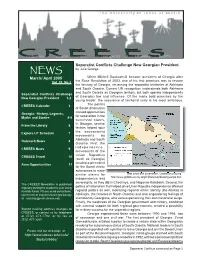
T h e U n i v e r s i t y o f T e x a s a t Au s t i n Center forR ussian East European E& urasian Studies Separatist Confl icts Challenge New Georgian President by Julie George NEWSMarch/ April 2005 When Mikheil Saakashvili became president of Georgia after Vol. 20 No.2 the Rose Revolution of 2003, one of his fi rst promises was to restore the territory of Georgia, reclaiming the separatist territories of Abkhazia and South Ossetia. Current UN recognition understands both Abkhazia and South Ossetia as Georgian territory, but both operate independently Separatist Conflicts Challenge of Georgian law and influence. Of the many bold promises by the New Georgian President 1-2 young leader, the assurance of territorial unity is his most ambitious. The politics CREEES Calendar 3 of Soviet dissolution created opportunities Georgia: History, Legends, for separatism in the Myths and Stories 4-6 successor states. In Georgia, several From the Library 6 factors helped spur the secessionist Explore UT Schedule 7 movements by Abkhazia and South Outreach News 8 Ossetia. First, the i n d e p e n d e n c e CREEES News 9 movements of the Union Republics CREEES Travel 10 (such as Georgia) created a precedent Area Opportunities 11 for the Soviet ethnic autonomies to make similar claims for Map used with permission, GlobalSecurity.orgGlobalSecurity.org independence and http://www.globalsecurity.org/military/world/war/georgia.htm sovereignty, as they did in Chechnya, and Nagorno-Karabakh. Second, the The CREEES Newsletter is pub lished regularly during the academic year using politics of nationalism that helped drive Union Republic independence affected no state funds. -
Proquest Dissertations
ADDING INSULT TO INJURY: EMOTION, FRAMING, AND COGNITIVE LIBERATION IN GEORGIA'S ROSE REVOLUTION By Kelli Hash-Gonzalez Submitted to the Faculty of the School of International Service of American University in Partial Fulfillment of l D \ , . l . I . (..Y \"-A Q \. ~ f', f'\Ct\ 0 /) the Requirements for the Degree of Doctor of Philosophy In ath /I . ~ , l,·t~I -~~L.·· .·· . /(... , ... ~··-/, Dr. Charles H. Fairbanks, Jr. ~ ··· ~~x CJW--1~ /Dr:-Miguel Carter J b w OtJDh_ Dean of the School /<; 0fsT Date 2008 American University Washington, D.C. 20016 AMERICAN UNIVERSITY UBFV\RY C\ 2>\?\ UMI Number: 3340557 Copyright 2008 by Hash-Gonzalez, Kelli All rights reserved. INFORMATION TO USERS The quality of this reproduction is dependent upon the quality of the copy submitted. Broken or indistinct print, colored or poor quality illustrations and photographs, print bleed-through, substandard margins, and improper alignment can adversely affect reproduction. In the unlikely event that the author did not send a complete manuscript and there are missing pages, these will be noted. Also, if unauthorized copyright material had to be removed, a note will indicate the deletion. ® UMI UMI Microform 3340557 Copyright 2009 by ProQuest LLC. All rights reserved. This microform edition is protected against unauthorized copying under Title 17, United States Code. ProQuest LLC 789 E. Eisenhower Parkway PO Box 1346 Ann Arbor, MI 481 06-1346 ©COPYRIGHT by Kelli Hash-Gonzalez 2008 ALL RIGHTS RESERVED This is dedicated to Kate Lomtatidze, Vera Gogokhia, and all hopeful people. ADDING INSULT TO INJURY: EMOTION, FRAMING, AND COGNITIVE LIBERATION IN GEORGIA'S ROSE REVOLUTION BY Kelli Hash-Gonzalez ABSTRACT This dissertation looks at popular mobilization during Georgia's Rose Revolution (November 2003). -

Cover Pagr 1999 Eng Small.Jpg
INTERNATIONAL CENTRE for CIVIC CULTURE Political Parties of Georgia Directory 1999 Tbilisi 1999 Publication of the Directory was possible as the result of financial support of INTERNATIONAL REPUBLICAN INSTITUTE (IRI), USA (IRI – Georgia is a grantee of USAID) Special thanks to all people who has supported the ICCC. The directory has been prepared by : Konstantine Kandelaki, Davit Kiphiani, Lela Khomeriki, Salome Tsiskarishvili, Nino Chubinidze, Koba Kiknadze. Translated by: Tamar Bregvadze, Nino Javakhishvili Cover design: Tamaz Varvavridze Layout: Davit Kiphiani ISBN 99928-52-40-0 © INTERNATIONAL CENTRE for CIVIC CULTURE, 1999 Printed in Georgia INTERNATIONAL CENTRE for CIVIC CULTURE Address: 20a, Baku St., Tbilisi, Georgia Phone: (+995 32) 953-873 E-mail: ICCC@ip.osgf.ge Internet: www.iccc.org.ge Political Parties of Georgia INTRODUCTION This directory was created prior to the October 31, 1999 parliament elections for the purpose of providing a complete spectrum of Georgian political parties. Therefore, it was decided to include here not only the parties participating in elections, but all registered political parties. According to the Ministry of Justice of Georgia, as of September 1, 1999, there are 124 political parties registered in Georgia. (79 parties were registered on September 26, 1998) In order to collect the material for this directory, ICCC distributed questionnaires to all 124 registered parties. 93 parties have been included in the directory, 31 parties failed to return the questionnaire. Some claimed they didn’t have adequate time to respond, some of the parties have not been found at the addresses given by the Ministry of Justice and others just refused.