Redefining the Myths Through Intertextuality and Carol Ann Duffy's
Total Page:16
File Type:pdf, Size:1020Kb
Load more
Recommended publications
-
OVID's METAMORPHOSES ~ PYGMALION Latin Text Sunt Tamen
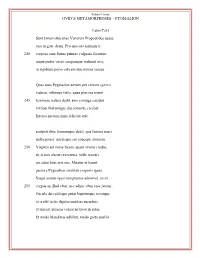
Robert Cerise OVID’S METAMORPHOSES ~ PYGMALION Latin Text Sunt tamen obscenae Venerem Propoetides ausae esse negare deam. Pro quo sua numinis ir 240 corpora cum forma primae vulgasse feruntur: utque pudor cessit sanguisque induruit oris, in rigidium parvo silicem discrimine versae. Quas quia Pygmalion aevum per crimen agentis viderat, offensus vitiis, quae plurima menti 245 femineae natura dedit, sine coniuge caelebs vivebat thalamique diu consorte carebat. Interea niveum mira feliciter arte sculpsit ebur formamque dedit, qua femina nasci nulla potest: operisque sui concepit amorem. 250 Virginis est verae facies, quam vivere credas, et, si non obstet reverentia, velle moveri: ars adeo latet arte sua. Miratur et haurit pectore Pygmalion simulati corporis ignes. Saepe manus operi temptantes admovet, an sit 255 corpus an illud ebur: nec adhuc ebur esse fatetur. Oscula dat reddique putat loquiturque tenetque, et credit tactis digitos insidere membris, et metuit, pressos veniat ne livor in artus. Et modo blanditias adhibet, modo grata puellis Robert Cerise OVID’S METAMORPHOSES ~ PYGMALION 260 munera fert illi conchas teretesque lapillos et parvas volucres et flores mille colorum liliaque pictasque pilas et ab arbore lapsas Heliadum lacrimas; ornat quoque vestibus artus, dat digitis gemmas, dat longa monilia collo: 265 aure leves bacae [pendent], redimicula pectore pendent. Cuncta decent: nec nuda minus formosa videtur. Conlocat hanc stratis concha Sidonide tinctis appellatque tori sociam, acclinataque colla mollibus in plumis, tamquam sensura, reponit. 270 Festa dies Veneris tota celeberrima Cypro venerat, et pandis inductae cornibus aurum conciderant ictae nivea cervice iuvencae, turaque fumabant: cum munere functus ad aras constitit et timide, “si di dare cuncta potestis, 275 sit coniunx, opto” non ausus “eburnea virgo” dicere Pygmalion “similis mea” dixit “eburnae.” Sensit, ut ipsa suis aderat Venus aurea festis, vota quid illa velint; et, amici numinis omen, flamma ter accensa est apicemque per aera duxit. -
How Ovid's “Pygmalion”
The Complex Relationship of Ars and Natura: How Ovid’s “Pygmalion” Employs the Power of the Artist Kelsey Littlefield ‘17 ublius Ovidius Naso, commonly known as Ovid, was a Roman poet and author who lived during the reign of P Augustus Caesar. He is renowned as poet of great variety and skill, and no work so wonderfully displays his talent as his Metamorphoses, a massive volume of mythological stories of transformation. Throughout the Metamorphoses, art and nature serve as unifying themes and are present in some capacity in each myth Ovid recounts. In particular, art and nature are prevalent in the myth of Pygmalion, a sculptor who falls in love with his ivory creation. An important contrast develops between art and nature in this story, and that contrast speaks to how the senses are woven into both. Roman literature is fond of treating the subjects of art and nature, and their contrasting figures appear again and again in the best works of the Ancient World. These two didactic terms are often used in elegiac poetry as a means of deciphering the interwoven relationships among the poet, lover, and girl (poeta, amator, and puella).1 The poet and the lover are one in the same, as the poet attempts to express the love and the experience of the beloved (i.e., the puella) to his reader. There is also, however, a sense of lament, as in all elegiac poetry, as the beloved has an unattainable quality that eventually leaves the poet/lover in despair. The girl, more specifically Pygmalion’s own beloved,2 exemplifies the erotic nature displayed in Ovid’s version of elegiac poetry and the grappling of the role that the artist plays in shaping his own art. -

Stories and Essays on Persephone and Medusa Isabelle George Rosett Scripps College
Claremont Colleges Scholarship @ Claremont Scripps Senior Theses Scripps Student Scholarship 2017 Voices of Ancient Women: Stories and Essays on Persephone and Medusa Isabelle George Rosett Scripps College Recommended Citation Rosett, Isabelle George, "Voices of Ancient Women: Stories and Essays on Persephone and Medusa" (2017). Scripps Senior Theses. 1008. http://scholarship.claremont.edu/scripps_theses/1008 This Open Access Senior Thesis is brought to you for free and open access by the Scripps Student Scholarship at Scholarship @ Claremont. It has been accepted for inclusion in Scripps Senior Theses by an authorized administrator of Scholarship @ Claremont. For more information, please contact scholarship@cuc.claremont.edu. VOICES OF ANCIENT WOMEN: STORIES AND ESSAYS ON PERSEPHONE AND MEDUSA by ISABELLE GEORGE ROSETT SUBMITTED TO SCRIPPS COLLEGE IN PARTIAL FULFILLMENT OF THE DEGREE OF BACHELOR OF ARTS PROFESSOR NOVY PROFESSOR BERENFELD APRIL 21, 2017 1 2 Dedicated: To Max, Leo, and Eli, for teaching me about surviving the things that scare me and changing the things that I can’t survive. To three generations of Heuston women and my honorary sisters Krissy and Madly, for teaching me about the ways I can be strong, for valuing me exactly as I am, and for the endless excellent desserts. To my mother, for absolutely everything (but especially for fielding literally dozens of phone calls as I struggled through this thesis). To Sam, for being the voice of reason that I happily ignore, for showing up with Gatorade the day after New Year’s shenanigans, and for the tax breaks. To my father (in spite of how utterly terrible he is at carrying on a phone conversation), for the hikes and the ski days, for quoting Yeats and Blake at the dinner table, and for telling me that every single essay I’ve ever asked him to edit “looks good” even when it was a blatant lie. -

TWO MYTHS by Fred Truck (Fred Truck [Mail Fjt] Lives in Des Moines, Iowa, and Is ACEN Systems Designer.)
TWO MYTHS by Fred Truck (Fred Truck [mail fjt] lives in Des Moines, Iowa, and is ACEN Systems Designer.) In 1912, Marcel Duchamp began a series of notes for a work of art that he began in 1915. The notes were eventually collected in a box, now known as The Green Box. The work of art he made, which he described variously as "an agricultural machine" or a "bachelor machine," and executed in terms of mechanical drafting, was The Bride Stripped Bare By Her Bachelors, Even. One of his purposes in making this revolutionary work was to put art at the service of the mind. Thus, with one stroke Duchamp opened two very fertile streams in 20th century art: conceptual art and machine art. Conceptual art is today still a very vibrant tradition in both American and European art. It has furthered the tendency, expressed and developed in other "isms" of twentieth century art, to break down the barriers between high art and whatever else exists in contemporary life. For example, conceptual art's acceptance and use of mathematics has made for some very interesting geometrical art, not to mention the Number Poems of Richard Kostelanetz. On the other hand, machine art has had its ups and downs, due largely to our changing views of machines over the course of the century. Until World War II and the atomic bomb, most people viewed the machine as the hope of the future. After Hiroshima, this view darkened...but not completely. Perhaps the most recent high machine art has experienced occurred in 1960 with Jean Tinguely's Homage to New York, although there have been successful practitioners of machine art since then, most notably Alice Aycock. -
LESSON 12 the Story of Medusa and Athena
GRADE 6: MODULE 1: UNIT 2: LESSON 12 The Story of Medusa and Athena Once upon a time, a long time ago, there lived a beautiful maiden named Medusa. Medusa lived in the city of Athens in a country named Greece—and although there were many pretty girls in the city, Medusa was considered the most lovely. Unfortunately, Medusa was very proud of her beauty and thought or spoke of little else. Each day she boasted of how pretty she was, and each day her boasts became more outrageous. On and on Medusa went about her beauty to anyone and everyone who stopped long enough to hear her—until one day when she made her first visit to the Parthenon with her friends. The Parthenon was the largest temple to the goddess Athena in all the land. It was decorated with amazing sculptures and paintings. Everyone who entered was awed by the beauty of the place and couldn’t help thinking how grateful they were to Athena, goddess of wisdom, for inspiring them and for watching over their city of Athens. Everyone, that is, except Medusa. When Medusa saw the sculptures, she whispered that she would have made a much better subject for the sculptor than Athena had. When Medusa saw the artwork, she commented that the artist had done a fine job considering the goddess’s thick eyebrows—but imagine how much more wonderful the painting would be if it was of someone as delicate as Medusa. And when Medusa reached the altar, she sighed happily and said, “My, this is a beautiful temple. -

Iconography of the Gorgons on Temple Decoration in Sicily and Western Greece
ICONOGRAPHY OF THE GORGONS ON TEMPLE DECORATION IN SICILY AND WESTERN GREECE By Katrina Marie Heller Submitted to the Faculty of The Archaeological Studies Program Department of Sociology and Archaeology In partial fulfillment of the requirements for the degree of Bachelor of Science University of Wisconsin-La Crosse 2010 Copyright 2010 by Katrina Marie Heller All Rights Reserved ii ICONOGRAPHY OF THE GORGONS ON TEMPLE DECORATION IN SICILY AND WESTERN GREECE Katrina Marie Heller, B.S. University of Wisconsin - La Crosse, 2010 This paper provides a concise analysis of the Gorgon image as it has been featured on temples throughout the Greek world. The Gorgons, also known as Medusa and her two sisters, were common decorative motifs on temples beginning in the eighth century B.C. and reaching their peak of popularity in the sixth century B.C. Their image has been found to decorate various parts of the temple across Sicily, Southern Italy, Crete, and the Greek mainland. By analyzing the city in which the image was found, where on the temple the Gorgon was depicted, as well as stylistic variations, significant differences in these images were identified. While many of the Gorgon icons were used simply as decoration, others, such as those used as antefixes or in pediments may have been utilized as apotropaic devices to ward off evil. iii Acknowledgements I would first like to thank my family and friends for all of their encouragement throughout this project. A special thanks to my parents, Kathy and Gary Heller, who constantly support me in all I do. I need to thank Dr Jim Theler and Dr Christine Hippert for all of the assistance they have provided over the past year, not only for this project but also for their help and interest in my academic future. -

Apotropaism and Liminality
Gorgo: Apotropaism and Liminality An SS/HACU Division III by Alyssa Hagen Robert Meagher, chair Spring 2007 Table of Contents List of Figures................................................................................................................ 1 Introduction.................................................................................................................... 3 Chapter 1: Gorgon and Gorgoneion.............................................................................. 5 Chapter 2: Gorgo as a Fertility Goddess....................................................................... 15 Chapter 3: Gorgo as the Guardian of Hades................................................................. 29 Chapter 4: Gorgo in Ecstatic Ritual............................................................................... 41 Chapter 5: Gorgo in the Sphere of Men......................................................................... 51 Bibliography................................................................................................................... 64 Alyssa Hagen 1 List of Figures 1.1 Attic black figure neck amphora. (J. Paul Getty Museum, Malibu 86 AE77. Image 7 from [http://www.theoi.com/Gallery/P23.12.html].) 1.2 Mistress of Animals amulet from Ulu Burun shipwreck. (Bochum, Deutsches 9 Bergbau-Museums 104. Image from [http://minervamagazine.com/issue1704/ news.html].) 1.3 Egyptian amulet of Pataikos. (Image from Virtual Egyptian Museum 10 [http://www.virtual-egyptian-museum.org].) 1.4 Etruscan roof antefix with -

Perseus, the Maiden Medusa, and the Imagery of Abduction
HESPERIA 76 (2007) PERSEUS, THE MAIDEN Pages 73-ios MEDUSA, AND THE IMAGERY OF ABDUCTION ABSTRACT on Classical the author that the of Focusing red-figure vases, argues appearance the beautiful Medusa, which has been explained previously as an evolutionary development from the monstrous Archaic type, is determined by discursive context rather than by chronology. Painters used the beautiful Gorgon to certain about Perseus's it is not clear convey messages victory, though always whether she ismeant to evoke humor or pathos. The author further shows that Medusa's death was figured as a perversion of the erotic abductions common s to many Greek myths, and points out the beautiful Gorgon affinities with as abducted maidens such Persephone, Thetis, and Helen. on Among the events depicted the Pseudo-Hesiodic shield of Herakles is scene the flight of Perseus from Medusas sisters.1 The poet renders the in unforgettably vivid terms: Tai ?? uet' ccutov Topyovec ccttatito? xe koci on (paxal eppcoovio ??peva? uocTc?eiv. etc! ?? %?copou ??auocvxo? on 1. For useful suggestions drafts ?awouaecov ??%eoK? gcxko? juey?Acoopuuay?q) of this article, I thank Hedreen, Guy Kai em ?? Laurialan Reitzammer, Albert Hen ?c^?a ?ay?co?/ ?covpoi ?pcxKovxe ?OIG) richs, and the two anonymous Hes ?7Ul?)p?UVT' ?7UK\)pTG)OVT? Kapnva. reviewers. I am also to xco peria grateful Atxjia?ov ?' apa y?* p?v?i ?' ?x?paaaov o?ovxa? and to Melissa Haynes audiences ?ypia ?Epicopivco. ?nl ?? ?Eivo?ai Kapf|voi? at and Harvard Rutgers University Topy??oi? ??ov??TO p?ya? Oo?oc. University for their advice and sug and to the of gestions, Department And after him rushed the Gorgons, unapproachable and unspeakable, at Classics Harvard University, which as longing to seize him: they trod upon the pale adamant, the shield covered the cost of the illustrations. -
Lecture 23 Okay on Monday You Talked About What It Takes to Make a Hero, Versus Hughes’S Herometer
Lecture 23 Okay on Monday you talked about what it takes to make a hero, versus Hughes’s Herometer. How did that go? Do you have a pretty good idea of what a hero is in general? Or did he talk specifically about a Greek hero? Just in general. So you know some things that are going to happen in the Heracles myth, even before we start, right? Okay, we’ll start with his name, which means what? Ankle? No, you’re thinking maybe of Oedipus on that one. The material I am lecturing to you is taken from pages 420-448 in your book. We’ll go through the material as it’s presented, basically, through the book if you want to take a look there. His name means something to do with Hera. Pain of Hera? Close. It is the glory of Hera, believe it or not. So the person or the divinity that gives him the most trouble in his life and causes him to do some very horrible things, turns out to be his patron, of sorts. What he does glorifies her, according to the name, anyhow. Now, when you have a hero, they don’t just spring from anywhere or nowhere. They generally have something in their background to indicate they’re going to do something glorious. So let’s take a look at Heracles’ heritage. Where does he ultimately come from? Who is in his background that’s illustrious? Yeah, Zeus himself is the father. If you look at the chart on Heracles’ heritage you’ll be able to see this a bit better. -

My Big Fat Greek Divorce Ten-Minute Play
MY BIG FAT GREEK DIVORCE TEN-MINUTE PLAY By Matt Thompson and Theodore Reis Copyright © MMVIII by Matt Thompson and Theodore Reis All Rights Reserved Heuer Publishing LLC, Cedar Rapids, Iowa The writing of plays is a means of livelihood. Unlawful use of a playwright’s work deprives the creator of his or her rightful income. The playwright is compensated on the full purchase price and the right of performance can only be secured through purchase of at least seven (7) copies of this work. PERFORMANCES ARE LIMITED TO ONE VENUE FOR ONE YEAR FROM DATE OF PURCHASE. The possession of this script without direct purchase from the publisher confers no right or license to produce this work publicly or in private, for gain or charity. On all programs and advertising this notice must appear: "Produced by special arrangement with Heuer Publishing LLC of Cedar Rapids, Iowa." This dramatic work is fully protected by copyright. No part of this work may be reproduced, stored in a retrieval system, or transmitted in any form or by any means, electronic, mechanical, photocopying, recording or otherwise, without permission of the publisher. Copying (by any means) or performing a copyrighted work without permission constitutes an infringement of copyright. The right of performance is not transferable and is strictly forbidden in cases where scripts are borrowed or purchased second hand from a third party. All rights including, but not limited to the professional, motion picture, radio, television, videotape, broadcast, recitation, lecturing, tabloid, publication, and reading are reserved. COPYING OR REPRODUCING ALL OR ANY PART OF THIS BOOK IN ANY MANNER IS STRICTLY FORBIDDEN BY LAW. -
Eurydice Without Orpheus
Bard College Bard Digital Commons Senior Projects Spring 2011 Bard Undergraduate Senior Projects Spring 2011 Eurydice without Orpheus Nora E. Offen Bard College, no225@bard.edu Follow this and additional works at: https://digitalcommons.bard.edu/senproj_s2011 Part of the Feminist, Gender, and Sexuality Studies Commons Recommended Citation Offen, Nora E., "Eurydice without Orpheus" (2011). Senior Projects Spring 2011. 5. https://digitalcommons.bard.edu/senproj_s2011/5 This Open Access work is protected by copyright and/or related rights. It has been provided to you by Bard College's Stevenson Library with permission from the rights-holder(s). You are free to use this work in any way that is permitted by the copyright and related rights. For other uses you need to obtain permission from the rights- holder(s) directly, unless additional rights are indicated by a Creative Commons license in the record and/or on the work itself. For more information, please contact digitalcommons@bard.edu. 1 Eurydice without Orpheus Senior Project submitted to The Division of Languages and Literature of Bard College by Nora Offen Annandale-on-Hudson, NY May 2011 2 “The love that consists in this: that two solitudes protect and border and greet each other.” For Mike Porter and Luisa Lopez. Acknowledgments I am grateful beyond words to my advisor, Joan Retallack, whose support has made work on this project possible, exhilarating, and deeply gratifying. And to my parents, Neil and Carol Offen, for providing their daughter with a house full of books, and a truly humbling depth of unconditional love. 3 Preface What follows is a poetic and critical reckoning with the Orpheus and Eurydice myth. -

By: Sarah, PJ, and Alon Welcome to Megara in Greece
Megara By: Sarah, PJ, and Alon Welcome To Megara In Greece Just remember in this presentation we all have to be loyal to our polis. About Our Polis: Megara We come from Megara which is a very respected city state. Megara used to be part of Corinth, but we fought for our own independence. Since we are from this geographical location, we Megarians have the power to bargain with armies for passage through the area and to levy tolls upon ships. Moreover, because of this textile industry, Megara reached greatness as a commercial trade center in the sixth and seventh centuries BCE. There are also other city states. For example, Sparta and Corinth are other city states but we each have our own beliefs. Overall, Megara is an amazing Polis that strives to reach great achievements. Also, my name is Artemis, Goddess of Hunting and the Moon, and my other polis members are Amazons and Chaos. Characteristics of Our Polis Megara Our Polis has a lot of characteristics. For example, we are respectful, kind, and loyal to our colleagues/ citizens of Megara. The evidence to this is when we went to war in 431 BCE we used our strengths of being respectful, kind, and loyal to empower others in the Greek war. Medusa Medusa is the woman figure of Megara. In Greek mythology Medusa was a guardian and was a monster generally described as a winged human female with a hideous face and with living venomous snakes instead of hair. If you have or don’t have knowledge of Medusa, she is known for being challenged by the hero Perseus, who used her head, which retained her ability to cast onlookers to stone as a weapon until he gave it to the goddess Athena to place on her shield.