The Pharmakos Phenomenon
Total Page:16
File Type:pdf, Size:1020Kb
Load more
Recommended publications
-

University of California Santa Cruz Dissecting
UNIVERSITY OF CALIFORNIA SANTA CRUZ DISSECTING DRAMATURGICAL BODIES: Self, Sensibility, and Gaze in Contemporary Dramaturgy A thesis submitted in partial satisfaction of the requirements for the degree of MASTER OF ARTS in THEATER ARTS by Patrick Denney This thesis of Patrick Denney is Approved by: _____________________________________ Professor Michael Chemers, PHD, Chair _____________________________________ Professor Gerald Casel, MFA _____________________________________ Professor Philippa Kelly, PHD _____________________________________ Tyrus Miller Vice Provost and Dean of Graduate Studies Table of Contents Abstract………………………………………………………………………………………………………………………………………………….iv Dedication………………………………………………………………………………………………………………………………………………v “Killing” Theater: A Survey of Popular Depictions of Dramaturgy……………………………………………………………1 Brecht’s Electrons: Positioning the Dramaturg in The Messingkauf Dialogues and Beyond…………………….5 Doctor to Dramaturg, and Back Again: Defining the Dramaturgical Gaze………………………………………………10 Pharmaturg to Dramaturg: Pharmakos and Dionysian Dramaturgy………………………………………………………18 Works Cited………………………………………………………………………………………………………………………………………….33 iii ABSTRACT: DISSECTING DRAMATURGICAL BODIES: Self, Sensibility, and Gaze in Contemporary Dramaturgy By Patrick Denney Dramaturgy is an art form that is still, after decades of existence in the American theater, misunderstood, and often feared, by many theater artists. From quasi-realistic portrayals of TV Shows such as SMASH, to the pulpy B-movie depiction of Law and Order: Criminal -

The Greek Heroes
Conditions and Terms of Use Copyright © Heritage History 2009 PREFACE Some rights reserved My Dear Children, This text was produced and distributed by Heritage History, an organization dedicated to the preservation of classical juvenile history books, and to the Some of you have already heard of the old Greeks; and promotion of the works of traditional history authors. all of you, as you grow up, will hear more and more of them. The books which Heritage History republishes are in the public domain and Those of you who are boys will, perhaps, spend a great deal of are no longer protected by the original copyright. They may therefore be reproduced time in reading Greek books; and the girls, though they may not within the United States without paying a royalty to the author. learn Greek, will be sure to come across a great many stories taken from Greek history, and to see, I may say every day, things The text and pictures used to produce this version of the work, however, are which we should not have had if it had not been for these old the property of Heritage History and are licensed to individual users with some restrictions. These restrictions are imposed for the purpose of protecting the integrity Greeks. You can hardly find a well-written book which has not of the work itself, for preventing plagiarism, and for helping to assure that in it Greek names, and words, and proverbs; you cannot walk compromised or incomplete versions of the work are not widely disseminated. through a great town without passing Greek buildings; you cannot go into a well-furnished room without seeing Greek In order to preserve information regarding the origin of this text, a copyright statues and ornaments, even Greek patterns of furniture and by the author, and a Heritage History distribution date are included at the foot of every page of text. -

Pharmakos: a Body of Filth and a Site of Radically Novel Politics1
Volume Four, Number One Pharmakos: A Body of Filth and a Site of Radically Novel Politics1 Katerina Kolozova Institute in Social Sciences and Humanities-Skopje/University American College-Skopje, Macedonia. 1. Political Sovereignty of the Prelingual In Homo Sacer, Giorgio Agamben proposes a genealogy of the concept of political sovereignty, namely of the one pertaining to the European civilization. (Agamben 1998) Beginning with Roman Antiquity, Agamben’s genealogical account of the European cultural invention of political sovereignty enables a discovery which is of critical importance for the argument we are making here. We will attempt to demonstrate that Agamben’s genealogy of the notion of political sovereignty unravels the immanently pre-discursive grounding of the latter. Namely, his analysis, specifically in Homo Sacer, shows that sovereignty is based upon the founding act of sacrifice of “bare life.” This is the primal sacrificial institution which represents initialization into and of (European) civilization. Life itself, sheer life defined by its physicality and voiceless labor of staying-in-life, has to be sacrificially killed in order to be transformed into an eikon, into an image and a linguistic sign, in order to constitute a political universe. 1 This essay is a revised excerpt from the book Lived Revolution: Solidarity with the Body in Pain as the New Political Universal published in 2010 Volume Four, Number One (2015) Katarina Kolozova 2 In every case, sacred life cannot dwell in the city of men: for the surviving devotee, the imaginary funeral functions as a vicarious fulfillment of the consecration that gives the individual back to normal life; for the emperor, the double funeral makes it possible to fasten onto the sacred life, which must be gathered and divinized in the apotheosis; for homo sacer, finally, we are confronted with a residual and irreducible bare life, which must be excluded and exposed to a death that no rite and no sacrifice can redeem. -

The Heroes PREFACE MY DEAR CHILDREN
The Heroes PREFACE MY DEAR CHILDREN, Some of you have heard already of the old Greeks; and all of you, as you grow up, will hear more and more of them. Those of you who are boys will, perhaps, spend a great deal of time in reading Greek books; and the girls, though they may not learn Greek, will be sure to come across a great many stories taken from Greek history, and to see, I may say every day, things which we should not have had if it had not been for these old Greeks. You can hardly find a well-written book which has not in it Greek names, and words, and proverbs; you cannot walk through a great town without passing Greek buildings; you cannot go into a well-furnished room without seeing Greek statues and ornaments, even Greek patterns of furniture and paper; so strangely have these old Greeks left their mark behind them upon this modern world in which we now live. And as you grow up, and read more and more, you will find that we owe to these old Greeks the beginners of all our mathematics and geometry - that is, the science and knowledge of numbers, and of the shapes of things, and of the forces which make things move and stand at rest; and the beginnings of our geography and astronomy; and of our laws, and freedom, and politics - that is, the science of how to rule a country, and make it peaceful and strong. And we owe to them, too, the beginning of our logic - that is, the study of words and of reasoning; and of our metaphysics - that is, the study of our own thoughts and souls. -

Religion and Reconciliation in Greek Cities (2010)
Religion and Reconciliation in Greek Cities AMERICAN PHILOLOGICAL ASSOCIATION american classical studies volume 54 Series Editor Kathryn J. Gutzwiller Studies in Classical History and Society Meyer Reinhold Sextus Empiricus The Transmission and Recovery of Pyrrhonism Luciano Floridi The Augustan Succession An Historical Commentary on Cassius Dio’s Roman History Books 55 56 (9 B.C. A.D. 14) Peter Michael Swan Greek Mythography in the Roman World Alan Cameron Virgil Recomposed The Mythological and Secular Centos in Antiquity Scott McGill Representing Agrippina Constructions of Female Power in the Early Roman Empire Judith Ginsburg Figuring Genre in Roman Satire Catherine Keane Homer’s Cosmic Fabrication Choice and Design in the Iliad Bruce Heiden Hyperides Funeral Oration Judson Herrman Religion and Reconciliation in Greek Cities The Sacred Laws of Selinus and Cyrene Noel Robertson Religion and Reconciliation in Greek Cities The Sacred Laws of Selinus and Cyrene NOEL ROBERTSON 1 2010 3 Oxford University Press, Inc., publishes works that further Oxford University’s objective of excellence in research, scholarship, and education. Oxford New York Auckland Cape Town Dar es Salaam Hong Kong Karachi Kuala Lumpur Madrid Melbourne Mexico City Nairobi New Delhi Shanghai Taipei Toronto With offices in Argentina Austria Brazil Chile Czech Republic France Greece Guatemala Hungary Italy Japan Poland Portugal Singapore South Korea Switzerland Thailand Turkey Ukraine Vietnam Copyright q 2010 by the American Philological Association Published by Oxford University Press, Inc. 198 Madison Avenue, New York, New York 10016 www.oup.com Oxford is a registered trademark of Oxford University Press. All rights reserved. No part of this publication may be reproduced, stored in a retrieval system, or transmitted, in any form or by any means, electronic, mechanical, photocopying, recording, or otherwise, without the prior permission of Oxford University Press. -
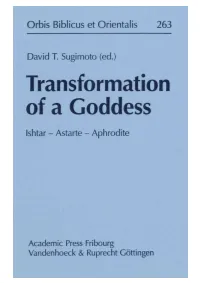
Transformation of a Goddess by David Sugimoto
Orbis Biblicus et Orientalis 263 David T. Sugimoto (ed.) Transformation of a Goddess Ishtar – Astarte – Aphrodite Academic Press Fribourg Vandenhoeck & Ruprecht Göttingen Bibliografische Information der Deutschen Bibliothek Die Deutsche Bibliothek verzeichnet diese Publikation in der Deutschen Nationalbibliografie; detaillierte bibliografische Daten sind im Internet über http://dnb.d-nb.de abrufbar. Publiziert mit freundlicher Unterstützung der PublicationSchweizerischen subsidized Akademie by theder SwissGeistes- Academy und Sozialwissenschaften of Humanities and Social Sciences InternetGesamtkatalog general aufcatalogue: Internet: Academic Press Fribourg: www.paulusedition.ch Vandenhoeck & Ruprecht, Göttingen: www.v-r.de Camera-readyText und Abbildungen text prepared wurden by vomMarcia Autor Bodenmann (University of Zurich). als formatierte PDF-Daten zur Verfügung gestellt. © 2014 by Academic Press Fribourg, Fribourg Switzerland © Vandenhoeck2014 by Academic & Ruprecht Press Fribourg Göttingen Vandenhoeck & Ruprecht Göttingen ISBN: 978-3-7278-1748-9 (Academic Press Fribourg) ISBN:ISBN: 978-3-525-54388-7978-3-7278-1749-6 (Vandenhoeck(Academic Press & Ruprecht)Fribourg) ISSN:ISBN: 1015-1850978-3-525-54389-4 (Orb. biblicus (Vandenhoeck orient.) & Ruprecht) ISSN: 1015-1850 (Orb. biblicus orient.) Contents David T. Sugimoto Preface .................................................................................................... VII List of Contributors ................................................................................ X -

The Argei: Sex, War, and Crucifixion in Rome
THE ARGEI: SEX, WAR, AND CRUCIFIXION IN ROME AND THE ANCIENT NEAR EAST Kristan Foust Ewin, B.A. Thesis Prepared for the Degree of MASTER OF ARTS UNIVERSITY OF NORTH TEXAS May 2012 APPROVED: Christopher J. Fuhrmann, Major Professor Ken Johnson, Committee Member Walt Roberts, Committee Member Richard B. McCaslin, Chair of the Department of History James D. Meernik, Acting Dean of the Toulouse Graduate School Ewin, Kristan Foust. The Argei: Sex, War, and Crucifixion in Rome and the Ancient Near East. Master of Arts (History), May 2012, 119 pp., 2 tables, 18 illustrations, bibliography, 150 titles. The purpose of the Roman Argei ceremony, during which the Vestal Virgins harvested made and paraded rush puppets only to throw them into the Tiber, is widely debated. Modern historians supply three main reasons for the purpose of the Argei: an agrarian act, a scapegoat, and finally as an offering averting deceased spirits or Lares. I suggest that the ceremony also related to war and the spectacle of displaying war casualties. I compare the ancient Near East and Rome and connect the element of war and husbandry and claim that the Argei paralleled the sacred marriage. In addition to an agricultural and purification rite, these rituals may have served as sympathetic magic for pre- and inter-war periods. As of yet, no author has proposed the Argei as a ceremony related to war. By looking at the Argei holistically I open the door for a new direction of inquiry on the Argei ceremony, fertility cults in the Near East and in Rome, and on the execution of war criminals. -

The Interpretive Spirit of Borderline Figures
The Interpretive Spirit of Borderline Figures JASON WALLIN University of Alberta The future is necessarily monstrous: the figure of the future, that is, that which can only be surprising, that for which we are not prepared…is heralded by a species of monsters. A future that would not be monstrous would not be a future; it would be a predictable, calculable and programmable tomorrow. All experience open to the future is prepared or prepares itself to welcome the future arrivant. (Derrida, 1995, 38–67) Derrida’s notion of the arrivant refers literally to ‘that which or the one who arrives’. It is a feature particular to borderlines, thresholds, and the monsters that emerge at the limin of such ‘marginal’ spaces (1993). From the Old French ariver, ‘to reach shore’ and the Latin ‘ad ripa’, to shore, the arrivant emerges a priori identification and naming. It is in this sense that Derrida (1995) suggests the arrivant as (a)kin to monstrosity, a word that etymologically evokes the presence of omens and signs of portend, demonstrations which both mark and disturb fixed conceptual categories. Marking by way of its exception, the arrivant exposes a metaphysical frame and the will to truth as the Nietzschean will to power. Journal of the Canadian Association for Curriculum Studies Volume 5 Number 1 Spring/Summer 2007 1 Journal of the Canadian Association for Curriculum Studies Such assumptions of logocentrism, or undivided truth, are disturbed and decentered by the arrivants’ fragmentary effect. That is, the arrivant as a singularity functions as an excess or ‘next case,’ often in a manner requiring the reevaluation of ‘the law’ as universally applicable. -
Athens: Its Rise and Fall 1 Athens: Its Rise and Fall
Athens: Its Rise and Fall 1 Athens: Its Rise and Fall The Project Gutenberg EBook Athens: Its Rise and Fall, Complete #14 in our series by Edward Bulwer-Lytton Copyright laws are changing all over the world. Be sure to check the copyright laws for your country before downloading or redistributing this or any other Project Gutenberg eBook. This header should be the first thing seen when viewing this Project Gutenberg file. Please do not remove it. Do not change or edit the header without written permission. Please read the "legal small print," and other information about the eBook and Project Gutenberg at the bottom of this file. Included is important information about your specific rights and restrictions in how the file may be used. You can also find out about how to make a donation to Project Gutenberg, and how to get involved. **Welcome To The World of Free Plain Vanilla Electronic Texts** **EBooks Readable By Both Humans and By Computers, Since 1971** *****These EBooks Were Prepared By Thousands of Volunteers***** Title: Athens: Its Rise and Fall, Complete Author: Edward Bulwer-Lytton Release Date: July, 2004 [EBook #6156] [Yes, we are more than one year ahead of schedule] [This file was first posted on November 19, 2002] Edition: 10 Language: English Athens: Its Rise and Fall 2 Character set encoding: ASCII *** START OF THE PROJECT GUTENBERG EBOOK ATHENS: RISE AND FALL, COMPLETE *** This eBook was produced by Tapio Riikonen and David Widger <widger@cecomet.net> ATHENS: ITS RISE AND FALL by Edward Bulwer Lytton DEDICATION. TO HENRY FYNES CLINTON, ESQ., etc., etc. -

Torresson Umn 0130E 21011.Pdf
The Curious Case of Erysichthon A Dissertation SUBMITTED TO THE FACULTY OF THE UNIVERSITY OF MINNESOTA BY Elizabeth Torresson IN PARTIAL FULFILLMENT OF THE REQUIREMENTS FOR THE DEGREE OF DOCTOR OF PHILOSOPHY Advisor: Nita Krevans December 2019 © Elizabeth Torresson 2019 Acknowledgments First, I would like to thank the department for their support and especially the members of my committee: Nita Krevans, Susanna Ferlito, Jackie Murray, Christopher Nappa, and Melissa Harl Sellew. The seeds of this dissertation were planted in my senior year of college when Jackie Murray spread to me with her contagious enthusiasm a love of Hellenistic poetry. Without her genuine concern for my success and her guidance in those early years, I would not be where I am today. I also owe a shout-out to my undergraduate professors, especially Robin Mitchell-Boyask and Daniel Tompkins, who inspired my love of Classics. At the University of Minnesota, Nita Krevans took me under her wing and offered both emotional and intellectual support at various stages along the way. Her initial suggestions, patience, and encouragement allowed this dissertation to take the turn that it did. I am also very grateful to Christopher Nappa and Melissa Harl Sellew for their unflagging encouragement and kindness over the years. It was in Melissa’s seminar that an initial piece of this dissertation was begun. My heartfelt thanks also to Susanna Ferlito, who graciously stepped in at the last minute and offered valuable feedback, and to Susan Noakes, for offering independent studies so that I could develop my interest in Italian language and literature. -
APOLLO in ASIA MINOR and in the APOCALYPSE Abstract
Title: CHAOS AND CLAIRVOYANCE: APOLLO IN ASIA MINOR AND IN THE APOCALYPSE Abstract: In the Apocalypse interpreters acknowledge several overt references to Apollo. Although one or two Apollo references have received consistent attention, no one has provided a sustained consideration of the references as a whole and why they are there. In fact, Apollo is more present across the Apocalypse than has been recognized. Typically, interpreters regard these overt instances as slights against the emperor. However, this view does not properly consider the Jewish/Christian perception of pagan gods as actual demons, Apollo’s role and prominence in the religion of Asia Minor, or the complexity of Apollo’s role in imperial propaganda and its influence where Greek religion was well-established. Using Critical Spatiality and Social Memory Theory, this study provides a more comprehensive religious interpretation of the presence of Apollo in the Apocalypse. I conclude that John progressively inverts popular religious and imperial conceptions of Apollo, portraying him as an agent of chaos and the Dragon. John strips Apollo of his positive associations, while assigning those to Christ. Additionally, John’s depiction of the god contributes to the invective against the Dragon and thus plays an important role to shape the social identity of the Christian audience away from the Dragon, the empire, and pagan religion and rather toward the one true God and the Lamb who conquers all. ASBURY THEOLOGICAL SEMINARY CHAOS AND CLAIRVOYANCE: APOLLO IN ASIA MINOR AND IN THE APOCALYPSE SUBMITTED TO THE FACULTY OF ASBURY THEOLOGICAL SEMINARY IN PARTIAL FULFILLMENT OF THE REQUIREMENTS FOR DOCTOR OF PHILOSOPHY IN BIBLICAL STUDIES BY ANDREW J. -

The Death of Zeus Kretagenes
Kernos Revue internationale et pluridisciplinaire de religion grecque antique 12 | 1999 Varia The Death of Zeus Kretagenes N. Postlethwaite Electronic version URL: http://journals.openedition.org/kernos/711 DOI: 10.4000/kernos.711 ISSN: 2034-7871 Publisher Centre international d'étude de la religion grecque antique Printed version Date of publication: 1 January 1999 Number of pages: 85-98 ISSN: 0776-3824 Electronic reference N. Postlethwaite, « The Death of Zeus Kretagenes », Kernos [Online], 12 | 1999, Online since 13 April 2011, connection on 01 May 2019. URL : http://journals.openedition.org/kernos/711 ; DOI : 10.4000/ kernos.711 Kernos Kernos, 12 (1999), p. 85-98. The Death of Zeus Kretagenes Since its inception in 1988, contributors ta Kernos have frequently been drawn ta the subject of Cretan Zeus, In its inaugural volume, J.A. Sakellarakis1 welcomed the resumption of the investigation of the Idaean cave on Psiloritis by the Archaeological Society of Athens. He was able ta daim that this investigation had made available, for the first time, evidence that the Minoans had used the cave for religious purposes from. the Early, through the Middle, and into the Late Minoa.n periods: and there was there, he dedared, "explicit and unquestionable" evidence that the "origin of the singular worship of Cretan Zeus, the god who was barn and died every year, lies in the prehistoric, Minoan deity, the young god who personified the yearly birth and death of the vegetation cyde"z. Subsequently E,F. Bloedow3 focused on another Cretan peak, Mt. Iouktas, and in particular on its peak sanctuary, which was investigated by 4 Evans in 1909 and reported by him in The Palace of Minos at Knossos .