Euskal Herriko Aurpegiak
Total Page:16
File Type:pdf, Size:1020Kb
Load more
Recommended publications
-
Who's Who in Basque Music Today
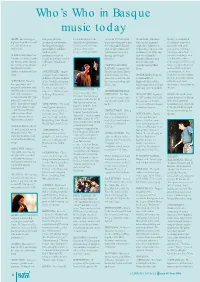
Who’s Who in Basque music today AKATZ.- Ska and reggae folk group Ganbara. recorded in 2000 at the circles. In 1998 the band DJ AXULAR.- Gipuzkoa- Epelde), accomplished big band from Bizkaia with Accompanies performers Azkoitia slaughterhouse, began spreading power pop born Axular Arizmendi accordionist associated a decade of Jamaican like Benito Lertxundi, includes six of their own fever throughout Euskadi adapts the txalaparta to invariably with local inspiration. Amaia Zubiría and Kepa songs performed live with its gifted musicians, techno music. In his second processions, and Angel Junkera, in live between 1998 and 2000. solid imaginative guitar and most recent CD he also Larrañaga, old-school ALBOKA.-Folk group that performances and on playing and elegant adds voices from the bertsolari and singer who has taken its music beyond record. In 2003 he recorded melodies. Mutriku children's choir so brilliantly combines our borders, participating a CD called "Melodías de into the mix, with traditional sensibilities and in festivals across Europe. piel." CAMPING GAZ & DIGI contributions by Mikel humor, are up to their ears Instruments include RANDOM.- Comprised of Laboa. in a beautiful, solid and alboka, accordion and the ANJE DUHALDE.- Singer- Javi Pez and Txarly Brown enriching project. Their txisu. songwriter who composes from Catalonia, the two DOCTOR DESEO.- Pop rock fresh style sets them apart. in Euskara. Former member joined forces in 1995, and band from Bilbao. They are believable, simple, ALEX UBAGO.-Donostia- of late 70s folk-rock group, have since played on and Ringleader Francis Díez authentic and, most born pop singer and Errobi, and of Akelarre. -

Connections Between Sámi and Basque Peoples
Connections between Sámi and Basque Peoples Kent Randell 2012 Siidastallan Outside of Minneapolis, Minneapolis Kent Randell (c) 2012 --- 2012 Siidastallan, Linwood Township, Minnesota Kent Randell (c) 2012 --- 2012 Siidastallan, Linwood Township, Minnesota “D----- it Jim, I’m a librarian and an armchair anthropologist??” Kent Randell (c) 2012 --- 2012 Siidastallan, Linwood Township, Minnesota Connections between Sámi and Basque Peoples Hard evidence: - mtDNA - Uniqueness of language Other things may be surprising…. or not. It is fun to imagine other connections, understanding it is not scientific Kent Randell (c) 2012 --- 2012 Siidastallan, Linwood Township, Minnesota Documentary: Suddenly Sámi by Norway’s Ellen-Astri Lundby She receives her mtDNA test, and express surprise when her results state that she is connected to Spain. This also surprised me, and spurned my interest….. Then I ended up living in Boise, Idaho, the city with the largest concentration of Basque outside of Basque Country Kent Randell (c) 2012 --- 2012 Siidastallan, Linwood Township, Minnesota What is mtDNA genealogy? The DNA of the Mitochondria in your cells. Cell energy, cell growth, cell signaling, etc. mtDNA – At Conception • The Egg cell Mitochondria’s DNA remains the same after conception. • Male does not contribute to the mtDNA • Therefore Mitochondrial mtDNA is the same as one’s mother. Kent Randell (c) 2012 --- 2012 Siidastallan, Linwood Township, Minnesota Kent Randell (c) 2012 --- 2012 Siidastallan, Linwood Township, Minnesota Kent Randell (c) 2012 --- 2012 Siidastallan, Linwood Township, Minnesota Four generation mtDNA line Sisters – Mother – Maternal Grandmother – Great-grandmother Jennie Mary Karjalainen b. Kent21 Randell March (c) 2012 1886, --- 2012 Siidastallan,parents from Kuusamo, Finland Linwood Township, Minnesota Isaac Abramson and Jennie Karjalainen wedding picture Isaac is from Northern Norway, Kvaen father and Saami mother from Haetta Kent Randell (c) 2012 --- 2012 Siidastallan, village. -

Language Contact and Identity in Roman Britain
Western University Scholarship@Western Electronic Thesis and Dissertation Repository 5-16-2016 12:00 AM Language Contact and Identity in Roman Britain Robert Jackson Woodcock The University of Western Ontario Supervisor Professor Alexander Meyer The University of Western Ontario Graduate Program in Classics A thesis submitted in partial fulfillment of the equirr ements for the degree in Master of Arts © Robert Jackson Woodcock 2016 Follow this and additional works at: https://ir.lib.uwo.ca/etd Part of the Ancient History, Greek and Roman through Late Antiquity Commons, and the Indo- European Linguistics and Philology Commons Recommended Citation Woodcock, Robert Jackson, "Language Contact and Identity in Roman Britain" (2016). Electronic Thesis and Dissertation Repository. 3775. https://ir.lib.uwo.ca/etd/3775 This Dissertation/Thesis is brought to you for free and open access by Scholarship@Western. It has been accepted for inclusion in Electronic Thesis and Dissertation Repository by an authorized administrator of Scholarship@Western. For more information, please contact wlswadmin@uwo.ca. Abstract Language is one of the most significant aspects of cultural identity. This thesis examines the evidence of languages in contact in Roman Britain in order to determine the role that language played in defining the identities of the inhabitants of this Roman province. All forms of documentary evidence from monumental stone epigraphy to ownership marks scratched onto pottery are analyzed for indications of bilingualism and language contact in Roman Britain. The language and subject matter of the Vindolanda writing tablets from a Roman army fort on the northern frontier are analyzed for indications of bilingual interactions between Roman soldiers and their native surroundings, as well as Celtic interference on the Latin that was written and spoken by the Roman army. -

Self-Determination for the Basque People
THE HUMAN RIGHT TO SELF DETERMINATION AND THE LONG WALK OF THE BASQUE COUNTRY TO A DEMOCRATIC SCENARIO ―Law is a living deed, not a brilliant honors list of past writers whose work of course compels respect but who cannot, except for a few great minds, be thought to have had such a vision of the future that they could always see beyond their own times‖. Judge Ammoun ―Separate Opinion‖ Advisory Opinion of the ICJ Jon Namibia, 1971 Introduction Let me start with some considerations. The case of the right to self determination is the case of human rights and history shows us that human rights are the cause of the oppressed, the cause of the colonized, the subalterns, and the cause of those on the other side of the borderline. Human rights have always been opposed by those in power, by the states of the capitalist world system. And so the recognized human rights are not but the consequences of long term struggles for non-recognized rights. And same pass with the right to self determination. Those who today consider this right only to be applied to colonies or occupied territories, are the same who opposed to the struggles for national liberation. Those who consider right now the right to self determination recognized in art 1 of the UN International Covenants on Civil and Political rights and Social, Cultural and Ecomic Rights are the same who opposed in the UN to the stablishment of art.1 and those who right now try to limit the right of indigenous peoples to self determination. -

The Basques of Lapurdi, Zuberoa, and Lower Navarre Their History and Their Traditions
Center for Basque Studies Basque Classics Series, No. 6 The Basques of Lapurdi, Zuberoa, and Lower Navarre Their History and Their Traditions by Philippe Veyrin Translated by Andrew Brown Center for Basque Studies University of Nevada, Reno Reno, Nevada This book was published with generous financial support obtained by the Association of Friends of the Center for Basque Studies from the Provincial Government of Bizkaia. Basque Classics Series, No. 6 Series Editors: William A. Douglass, Gregorio Monreal, and Pello Salaburu Center for Basque Studies University of Nevada, Reno Reno, Nevada 89557 http://basque.unr.edu Copyright © 2011 by the Center for Basque Studies All rights reserved. Printed in the United States of America Cover and series design © 2011 by Jose Luis Agote Cover illustration: Xiberoko maskaradak (Maskaradak of Zuberoa), drawing by Paul-Adolph Kaufman, 1906 Library of Congress Cataloging-in-Publication Data Veyrin, Philippe, 1900-1962. [Basques de Labourd, de Soule et de Basse Navarre. English] The Basques of Lapurdi, Zuberoa, and Lower Navarre : their history and their traditions / by Philippe Veyrin ; with an introduction by Sandra Ott ; translated by Andrew Brown. p. cm. Translation of: Les Basques, de Labourd, de Soule et de Basse Navarre Includes bibliographical references and index. Summary: “Classic book on the Basques of Iparralde (French Basque Country) originally published in 1942, treating Basque history and culture in the region”--Provided by publisher. ISBN 978-1-877802-99-7 (hardcover) 1. Pays Basque (France)--Description and travel. 2. Pays Basque (France)-- History. I. Title. DC611.B313V513 2011 944’.716--dc22 2011001810 Contents List of Illustrations..................................................... vii Note on Basque Orthography......................................... -
Basque Studies
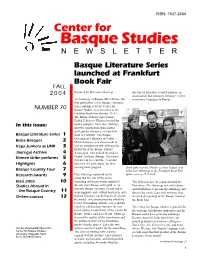
Center for BasqueISSN: Studies 1537-2464 Newsletter Center for Basque Studies N E W S L E T T E R Basque Literature Series launched at Frankfurt Book Fair FALL Reported by Mari Jose Olaziregi director of Literature across Frontiers, an 2004 organization that promotes literature written An Anthology of Basque Short Stories, the in minority languages in Europe. first publication in the Basque Literature Series published by the Center for NUMBER 70 Basque Studies, was presented at the Frankfurt Book Fair October 19–23. The Basque Editors’ Association / Euskal Editoreen Elkartea invited the In this issue: book’s compiler, Mari Jose Olaziregi, and two contributors, Iban Zaldua and Lourdes Oñederra, to launch the Basque Literature Series 1 book in Frankfurt. The Basque Government’s Minister of Culture, Boise Basques 2 Miren Azkarate, was also present to Kepa Junkera at UNR 3 give an introductory talk, followed by Olatz Osa of the Basque Editors’ Jauregui Archive 4 Association, who praised the project. Kirmen Uribe performs Euskal Telebista (Basque Television) 5 was present to record the event and Highlights 6 interview the participants for their evening news program. (from left) Lourdes Oñederra, Iban Zaldua, and Basque Country Tour 7 Mari Jose Olaziregi at the Frankfurt Book Fair. Research awards 9 Prof. Olaziregi explained to the [photo courtesy of I. Zaldua] group that the aim of the series, Ikasi 2005 10 consisting of literary works translated The following day the group attended the Studies Abroad in directly from Basque to English, is “to Fair, where Ms. Olaziregi met with editors promote Basque literature abroad and to and distributors to present the anthology and the Basque Country 11 cross linguistic and cultural borders in order discuss the series. -

Elko Jaietan 51 Urte Celebrating 51 Years of Basque Tradition Schedule of Events
2014 Elko Jaietan 51 Urte Celebrating 51 Years of Basque Tradition Schedule of Events 2014 Elko Jaietan 51 Urte 2014 Elko Basque Festival Celebrating 51 Years Friday July 4th/Ostirala 4an Uztaila 6:00 p.m. – Kickoff/Txupinazua- Elko Basque Clubhouse Enjoy the evening with your family and friends with a taste of what is to come during the weekend. There will be dancing by the Elko Ariñak dancers, a Paella contest, Basque sport exhibitions of weight lifting and wood chopping, and handball games. Stay for exceptional food, drink, bounce house, and a special performance by this year’s Udaleku group. Saturday July 5th/Larunbata 5an Uztaila 7:00 a.m. – 5K Run/Walk – Eusko Etxtea – Elko Basque Club- house $20 participation fee and you get a t-shirt Registration is at 6:15 a.m. Race starts at 7:00 a.m. For more information contact Cody Krenka at 738-6479 11:00 a.m. – Parade – Downtown Elko 1:00 p.m. - Games & Dancing – Elko County Fairgrounds $10 Adults $5 Children 12 & Under Featuring the following dance groups: Elko Ariñak, Utah’ko Triskalariak, Reno Zazpiak Bat, and Ardi Baltza. Watch traditional Basque rural sports featuring weightlifting, wood chopping, weight carrying, relay, tug o war, and more! 2 9 p.m. Dance - Eusko Etxea - Elko Basque Clubhouse $12 Admission Dance - featuring Boise’s Amuma Says No; come enjoy a fun filled evening of dancing, catching up with old friends and making new ones Sunday July 6th /Igandea 6an Uztaila Eusko Etxea - Elko Basque Clubhouse Please NO outside Food or Beverage 10:30 a.m. -
Canonical and Non-Canonical Narrative in the Basque Context
View metadata, citation and similar papers at core.ac.uk brought to you by CORE provided by Hedatuz Canonical and non-canonical narrative in the basque context Olaziregi Alustiza, María José Euskal Herriko Unib. Filologia, Geografia eta Historia Fak. Unibertsitateko ibilbidea, 5. 01006 Vitoria-Gateiz fvpolalm@vc.ehu.es BIBLID [0212-7016 (2001), 46: 1; 325-336] Artikulu honetan euskal narratibaren egungo egoeraz egiten da hausnarketa. XX. mendean sendotuz joan den generoa dugu narratibazkoa eta gaur egungo euskarazko literatur produkzioan protagonismo erabatekoa du. Horretaz hitz egiten da artikuluan, narratibaren bilakaeraz eta egungo egoeraz. Guztiaren osagarri, euskal literatur sistema, euskal literaturak Espainian nahiz atzerrian duen proiekzio eskasa eta azken urteotako eleberriaren joera nagusiak aztertzen dira. Giltza-Hitzak: Literatur kritika. Literaturaren Historia. Euskal Literatura. Literatura Konparatua. En el presente artículo se reflexiona sobre la situación actual de la literatura vasca. La narrativa es un género que ha ido fortaleciéndose durante el siglo XX y que hoy en día detenta el protagonismo absoluto en la producción de la literatura en lengua vasca. De todo ello se habla en este artículo, de la evolución de la narrativa y de su situación actual. Para completar el trabajo se estudian la escasa proyección que en España y en en el extranjero tiene el sistema de literatura vasca, la literatura vasca, y las principales tendencias de la novela en estos últimos años. Palabras Clave: Crítica Literaria. Historia de la Literatura. Literatura Vasca. Literatura Comparada. Dans cet article, on examine la situation actuelle de la littérature basque. Le roman est un genre qui s’est affirmé durant le XXe siècle et qui détient aujourd’hui la primeur absolue dans la production de la littérature en langue basque. -

Elko Jaietan 50 Urte Celebrating 50 Years of Basque Tradition
2013 Elko Jaietan 50 Urte Celebrating 50 Years of Basque Tradition 2013 Schedule of Events Elko Basque Festival Celebrating 50 Years Elko Jaietan 50 Urte Friday, July 5th 10:00 a.m. – Parade – Downtown Elko Ostirala 5an Uztaila Starting at the Crystal Theater on Commercial Street, continuing through Downtown Elko down Idaho Street, ending at the Elko County 6:00 p.m. – Kickoff/Txupinazua – Fronton Fairgrounds. come during the weekend. There will be dancing by the Elko Ariñak dancers, 1:00 p.m. – Games & Dancing – Elko County Fairgrounds Basque sport exhibition of weight lifting and wood chopping, and handball $10 Adults, $5 Children 12 & Under games. Stay for exceptional food, drink, bounce house and the North Featuring the following dance groups: Elko Ariñak, Utah’ko Triskalariak, American Basque Organizations Txerriki contest, a celebration of all things Reno Zazpiak Bat, Boise Oinkari, aGauden Bat from Chino, CA, Zazpiak- Bat from San Francisco, CA. Watch traditional Basque rural sports featuring weightlifting, wood chopping, weight carrying, bale toss, tug-o-war, and more! 9:00 p.m. – Dance – Eusko Etxea – Elko Basque Clubhouse Saturday, July 6th $12 Admission Laurnbata 6an Uztaila Dance - featuring Boise’s Amuma Says No; come 7:00 a.m. – 5K Run/Walk – Eusko Etxtea – Elko Basque Clubhouse of dancing, catching up $20 participation fee and you get a t-shirt with old friends and Registration is at 6:15 a.m. Race starts at 7:00 a.m. making new ones. For more information contact Cody Krenka at 738-6479. 8:00 a.m. – Golf Tournament – Ruby View Golf Course $30 per person a $120 per team DOES NOT INCLUDE GREENS FEES OR CART FEE Registration is at 7:00 a.m. -

Oral Tradition 22.2
CORE Metadata, citation and similar papers at core.ac.uk Provided by University of Missouri: MOspace Oral Tradition, 22/2 (2007): 33-46 Social Features Of Bertsolaritza Jon Sarasua Social Features of Bertsolaritza The Bertsolaritza Setting:1 The Basque Language Community Sung, extempore verse-making in Basque (hereafter referred to as bertsolaritza, as it is known in the Basque language) holds an important place in the culture of the Basque language, a speech community of about 600,000 people. This community is divided among four territories inside the Spanish state and three inside the French state; the population in these territories put together is around three million. The Basque language community is a small speech community and finds itself in a minority in its native land. Nevertheless, we are talking about a community that goes back a long way in history. The most recent findings by a number of scientific disciplines appear to confirm its Pre-Indo- European origin, since the community of Euskara, the Basque language, is regarded as one of the oldest in Europe. It is important to bear in mind the key characteristics in the development of our speech community: a firm determination to maintain its roots and its ability to adapt unceasingly in so many eras and contexts by preserving its essential nature in difficult balances. These key characteristics and behavior are linked to the way the present and future of bertsolaritza is understood and, in general, to the way that the evolution of the Basque language is experienced. Right now, the Basque language finds itself at an especially critical moment; on the one hand it is on the point of losing the battle for revival in some of its territories, and on the other it is going through a difficult normalization or development process. -
Las Eretas Site Is in Fact a Series of Superimposed Villages, That Is, Built on the Ruins of Previous Ones
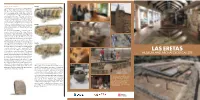
1 5 URBAN DEVELOPMENT PHASE 1 Las Eretas site is in fact a series of superimposed villages, that is, built on the ruins of previous ones. The houses of the first settlement were erected after the stone rampart and the cobbled street (Phase 1, 7th century BC). They had a rectangular floor plan and a hearth in the centre. The frame of the houses was very fragile and made of small ash posts alig- ned and anchored in the ground, and a framework of sticks covered in mud. It is believed that they had pitched roofs because there was a space between 2 the houses, which would provide access to the ram- PHASE 2 part. We know that this original settlement was bur- nt down, but whether it was intentionally or not re- mains unknown. The original peasants built a second village (Phase 2) on the ashes of the former. The design of the hou- ses was more compact and sturdy. They shared a di- viding load bearing wall with a stone base. They had 6 adobe or rammed earth walls. The roof was made of wood, straw and soil; it was single pitched and sloped from the rampart towards the street. It was divided into three sections by two sleepers that res- ted on the load bearing walls and a couple of central PHASE 3 posts. These posts have left distinctive marks on the floor. Life in this second settlement remained unal- tered throughout the 6th and 7th centuries BC. The western sector of the village was redesigned (Phase 3 7 3), possibly as a result of a partial fire. -

Female Improvisational Poets: Challenges and Achievements in the Twentieth Century
FEMALE .... improvisational - ,I: t -,· POETS ...~1 Challenges and Achievements in the Twentieth Century In December 2009, 14,500 people met at the Bilbao Exhibi tion Centre in the Basque Country to attend an improvised poetry contest.Forty-four poets took part in the 2009 literary tournament, and eight of them made it to the final. After a long day of literary competition, Maialen Lujanbio won and received the award: a big black txapela or Basque beret. That day the Basques achieved a triple triumph. First, thou sands of people had gathered for an entire day to follow a lite rary contest, and many more had attended the event via the web all over the world. Second, all these people had followed this event entirely in Basque, a language that had been prohi bited for decades during the harsh years of the Francoist dic tatorship.And third, Lujanbio had become the first woman to win the championship in the history of the Basques. After being crowned with the txapela, Lujanbio stepped up to the microphone and sung a bertso or improvised poem refe rring to the struggle of the Basques for their language and the struggle of Basque women for their rights. It was a unique moment in the history of an ancient nation that counts its past in tens of millennia: I remember the laundry that grandmothers of earlier times carried on the cushion [ on their heads J I remember the grandmother of old times and today's mothers and daughters.... • pr .. Center for Basque Studies # avisatiana University of Nevada, Reno ISBN 978-1-949805-04-8 90000 9 781949 805048 ■ .~--- t _:~A) Conference Papers Series No.