The Rector Rei Publicae of Cicero's De Republics
Total Page:16
File Type:pdf, Size:1020Kb
Load more
Recommended publications
-

Res Publica: an International Framework for Education in Democracy
RES PUBLICA: AN INTERNATIONAL FRAMEWORK FOR EDUCATION IN DEMOCRACY Revised January 2006 Civitas: An International Civic Education Exchange Program of the Center for Civic Education 5146 Douglas Fir Road / Calabasas, CA 91302 / USA 818-591-9321 / fax 818-591-9330 / cce@civiced.org 1 This project is conducted as a part of Civitas: An International Civic Education Exchange Program administered by the Center for Civic Education. The project is supported by the United States Department of Education and conducted with the assistance of the United States Information Agency and its affiliated offices in nations throughout the world. 2003 Center for Civic Education 07 06 05 1 2 3 All rights reserved. Except for use in a review, reproduction or transmittal of this work in any form or by any electronic, mechanical, or other means, now known or hereafter invented, including photocopying and recording, and use of this work in any form in any information storage or retrieval system is forbidden without prior written permission from the publisher. The U.S. Department of Education disclaims any responsibility for any opinion or conclusions contained herein. The federal government reserves a nonexclusive license to use and reproduce for government purposes, without payment, this material where the government deems it in its interest to do so. ISBN 0-89818-194-1 Res Publica: An International Framework for Education in Democracy Introduction Res Publica: An International Framework for Education in Democracy is an attempt to develop a cross- cultural and trans-national general statement of the central meanings and character of the ideas, values, principles, and institutions of democracy. -

Public Law As the Law of the Res Publica Elisabeth Zoller
CORE Metadata, citation and similar papers at core.ac.uk Provided by Indiana University Bloomington Maurer School of Law Maurer School of Law: Indiana University Digital Repository @ Maurer Law Articles by Maurer Faculty Faculty Scholarship 2008 Public Law as the Law of the Res Publica Elisabeth Zoller Follow this and additional works at: http://www.repository.law.indiana.edu/facpub Part of the Comparative and Foreign Law Commons, European Law Commons, and the Public Law and Legal Theory Commons Recommended Citation Zoller, Elisabeth, "Public Law as the Law of the Res Publica" (2008). Articles by Maurer Faculty. Paper 146. http://www.repository.law.indiana.edu/facpub/146 This Conference Proceeding is brought to you for free and open access by the Faculty Scholarship at Digital Repository @ Maurer Law. It has been accepted for inclusion in Articles by Maurer Faculty by an authorized administrator of Digital Repository @ Maurer Law. For more information, please contact wattn@indiana.edu. PUBLIC LAW AS THE LAW OF THE RES PUBLICA Elisabeth Zoller* A LECTURE GIVEN AS PART OF SUFFOLK TRANSNATIONAL LAW REVIEW'S 2008 DISTINGUISHED SPEAKER COLLOQUIUM SERIES In 1989, on the occasion of the Bicentennial of the French Revolution, I gave a talk at Suffolk University Law School on The Distinction Between Man and the Citizen in the Declaration of the Rights of Man and the Citizen of 1789.1 In retrospect, I am afraid that this may not have been one of my best talks. The truth of the matter is that I failed to give the rationale for this crucial distinction and its meaning in the Declaration of 1789. -

4 a Pocockian Moment
77 4 A Pocockian Moment My encounter with John G. A. Pocock, not in person but in bookish mode, took place more than two decades ago in rather unexpected cir- cumstances. It was in the course of my struggle with a couple of medieval English poems that I came across The Machiavellian Moment. 1 Reading it was for me a revealing experience and helpful in making out those oth- erwise intractable pieces of work. The poems in question were by Geoffrey Chaucer, The House of Fame and The Parliament of Fowls, both belonging to the medieval poetic genre called the “dream vision,” in which the poet/narrator describes in the first person singular the con- tents of a dream. Briefly put, the visionary experience comprising The House of Fame is made up largely of three sections through which the poet/narrator goes through: (1) in the first section (called the Temple of Venus) we are given an abridged version of the story of the Aeneid as the poet/narrator sees it portrayed on the walls of the temple. It should be noted for our present purposes that the Virgilian story is an exemplary instance of the topos “translatio imperii ”; (2) in the second section, the poet/narrator undergoes a version of the cosmic flight vision, in which the visionary/narrator describes his/her flight from the earth to some higher place. Its celebrated examples include the Somnium Scipionis, Boethius’s De Consolatione Philosophiae (esp. Book IV, metrum I), and Dante’s Paradiso. In Chaucer’s House of Fame, however, as we shall see later, what is supposed to be a transcendental cosmic flight was parodied so that the destination of the flight was neither the other side of the uni- verse (“on the outside of the swift air”) as in the case of Boethius, nor the 1. -

INGO GILDENHARD Cicero, Philippic 2, 44–50, 78–92, 100–119 Latin Text, Study Aids with Vocabulary, and Commentary CICERO, PHILIPPIC 2, 44–50, 78–92, 100–119
INGO GILDENHARD Cicero, Philippic 2, 44–50, 78–92, 100–119 Latin text, study aids with vocabulary, and commentary CICERO, PHILIPPIC 2, 44–50, 78–92, 100–119 Cicero, Philippic 2, 44–50, 78–92, 100–119 Latin text, study aids with vocabulary, and commentary Ingo Gildenhard https://www.openbookpublishers.com © 2018 Ingo Gildenhard The text of this work is licensed under a Creative Commons Attribution 4.0 International license (CC BY 4.0). This license allows you to share, copy, distribute and transmit the text; to adapt the text and to make commercial use of the text providing attribution is made to the author(s), but not in any way that suggests that they endorse you or your use of the work. Attribution should include the following information: Ingo Gildenhard, Cicero, Philippic 2, 44–50, 78–92, 100–119. Latin Text, Study Aids with Vocabulary, and Commentary. Cambridge, UK: Open Book Publishers, 2018. https://doi. org/10.11647/OBP.0156 Every effort has been made to identify and contact copyright holders and any omission or error will be corrected if notification is made to the publisher. In order to access detailed and updated information on the license, please visit https:// www.openbookpublishers.com/product/845#copyright Further details about CC BY licenses are available at http://creativecommons.org/licenses/ by/4.0/ All external links were active at the time of publication unless otherwise stated and have been archived via the Internet Archive Wayback Machine at https://archive.org/web Digital material and resources associated with this volume are available at https://www. -
Idealizing Humanitas in Cicero's De Oratore, Or, Why Herbert O. Morrison
Idealizing Humanitas in Cicero’s De oratore, or, why Herbert O. Morrison was wrong Taylor Putnam, 2016 Political Theory Research Workshop University of Toronto Working paper - please do not cite or circulate This paper draws primarily from material I intend to use in the introduction and first chapter of my dissertation, the latter of which will provide a more extensive account of Ciceronian humanitas against the backdrop of the waning Roman Republic. The larger dissertation project focuses on the concept of humanitas in the broader Roman context – traced through Cicero, Seneca the Younger, Tacitus, and Augustine - as a means to confront and challenge the modern understanding of “Humanity.” I greatly appreciate any and all feedback people are willing to share. Oh, my, get out of the way, please! It's burning and bursting into flames, and the - and it's falling on the mooring-mast and all the folks agree that this is terrible, this is one of the worst catastrophes in the world. […] It's–it's–it's the flames, […] oh, four- or five-hundred feet into the sky and it ... it's a terrific crash, ladies and gentlemen. It's smoke, and it's flames now ... and the frame is crashing to the ground, not quite to the mooring-mast. Oh, the humanity and all the passengers screaming around here. I told you, I can't even talk to people whose friends are on there. Ah! It's–it's–it's–it's ... o–ohhh! I–I can't talk, ladies and gentlemen. Honest, it's just laying there, a mass of smoking wreckage. -
Ennius Or Cicero? the Disreputable Diviners at Cic
ACTA CLASSICAXLIV(200/) 153-166 ISSN 0065-1141 ENNIUS OR CICERO? THE DISREPUTABLE DIVINERS AT CIC. DE DIV. 1.132 A.T. Nice University of the Witwatersrand ABSTRACT At the end of the first book of Cicero's De Divir1atior1e, Quintus remarks that, even though he believes in divination, there are some diviners whom he would not trust to give accurate predictions. These comments are followed by a quotation from Ennius' Telamo. Most modem scholars have assumed, therefore, that the previous lines also contain an echo, if not a paraphrase of Ennius' work. This supposition does not seem to be supported by the language or style employed by Cicero. The lines should rather be understood as embodying the parochial view that elite Romans had towards forms of divination that were foreign, rustic or mercenary and not practised by the Roman state. I At the end of the first book of De Divinatione ( 1.132), Quintus completes his argument in favour of divination by denying the respectability of certain kinds ofdiviners: Nunc illa testabor, non me sortilegos neque eos, qui quaestus causa hariolentur, ne psychomantia quidem, quibus Appius, amicus tuus, uti solebat, agnoscere; non habeo denique nauci Marsum augurem, non vicanos haruspices, non de circo astrologos, non Isiacos coniectores, non interpretes somniorum; non enim sunt ii aut scientia aut arte divini. 1 The lines that follow, '(sed)2 superstitiosi vates inpudentes harioli ... de his di vitiis sibi deducant drachmam, reddant cetera,' are normally attributed to Ennius. Some previous commentators considered that the Ennius quotation should begin earlier, specifically from 'non habeo denique nauci.' 3 In favour 1 I use here the Teubner edition of R. -

Public Law As the Law of the Res Publica
Maurer School of Law: Indiana University Digital Repository @ Maurer Law Articles by Maurer Faculty Faculty Scholarship 2008 Public Law as the Law of the Res Publica Elisabeth Zoller Follow this and additional works at: https://www.repository.law.indiana.edu/facpub Part of the Comparative and Foreign Law Commons, European Law Commons, and the Public Law and Legal Theory Commons Recommended Citation Zoller, Elisabeth, "Public Law as the Law of the Res Publica" (2008). Articles by Maurer Faculty. 146. https://www.repository.law.indiana.edu/facpub/146 This Conference Proceeding is brought to you for free and open access by the Faculty Scholarship at Digital Repository @ Maurer Law. It has been accepted for inclusion in Articles by Maurer Faculty by an authorized administrator of Digital Repository @ Maurer Law. For more information, please contact rvaughan@indiana.edu. PUBLIC LAW AS THE LAW OF THE RES PUBLICA Elisabeth Zoller* A LECTURE GIVEN AS PART OF SUFFOLK TRANSNATIONAL LAW REVIEW'S 2008 DISTINGUISHED SPEAKER COLLOQUIUM SERIES In 1989, on the occasion of the Bicentennial of the French Revolution, I gave a talk at Suffolk University Law School on The Distinction Between Man and the Citizen in the Declaration of the Rights of Man and the Citizen of 1789.1 In retrospect, I am afraid that this may not have been one of my best talks. The truth of the matter is that I failed to give the rationale for this crucial distinction and its meaning in the Declaration of 1789. I said that the distinction was almost invisible in this country and much less important than in the French legal system, but I did not explain why. -

Cicero's Somnium Scipionis and Chaucer's Early
“FOR I HADDE RED OF AFFRYCAN BYFORN:” CICERO’S SOMNIUM SCIPIONIS AND CHAUCER’S EARLY DREAM VISIONS Timothy A. Shonk When Marcus Tullius Cicero began his contemplative work on the perfect state, De re publica, he confronted two questions, one public and one per- sonal, that must have consumed his psychic energies: how to remain influential in the growth of the Roman state after his year of exile in Greece, and how to ensure that his words and concomitant reputation for rhetorical power endured. To answer the first question, Cicero, removed from the office of Consul and the hall of the Senate, had little choice in continuing to work to meld the classes into an ideal functioning govern- ment but to “do so from his study.”1 To this end, he developed an imagined conversation, closely modeled on Plato’s Republic, featuring personages who loomed large in Rome’s recent history: among them, Publius Cornelius Scipio Africanus the Younger, Manius Manillus, Publius Rutilus Rufus, and Quintus Mucius Scaevola. The primary speaker, Scipio the Younger, following an opening discussion of the possible explanations of the recent phenomenon of two suns in one day, begins the theme that dominates the work: the three types of government—dictatorship, aristo- cratic rule, and pure democracy of rule by the people—outlining the mer- its and demerits of each system before settling on the view that Rome comes closest to perfection in balancing the three types as best as can be imagined. The second question consuming Cicero had to be his future and his name. -
1489 Macrobius
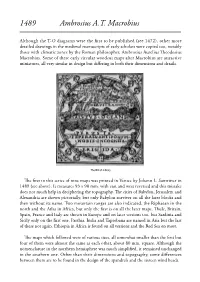
1489 Ambrosius A.T. Macrobius –––––––––––––––––––––––––––––––––––––––––––––––––––––––––––––––––––––––– Although the T-O diagrams were the first to be published (see 1472), other more detailed drawings in the medieval manuscripts of early scholars were copied too, notably those with climatic zones by the Roman philosopher, Ambrosius Aurelius !eodosius Macrobius. Some of these early circular woodcut maps after Macrobius are attractive miniatures, all very similar in design but differing in both their dimensions and details. The British Library !e first in this series of nine maps was printed in Venice by Johann L. Santritter in 1489 (see above). It measures 93 x 98 mm. with east and west reversed and this mistake does not much help in deciphering the topography. !e cities of Babylon, Jerusalem and Alexandria are shown pictorially, but only Babylon survives on all the later blocks and then without its name. Two mountain ranges are also indicated, the Riphaean in the north and the Atlas in Africa, but only the first is on all the later maps. !ule, Britain, Spain, France and Italy are shown in Europe and on later versions too, but Sardinia and Sicily only on the first one. Parthia, India and Taprobana are named in Asia but the last of these not again. Ethiopia in Africa is found on all versions and the Red Sea on most. !e maps which followed were of various sizes, all somewhat smaller than the first but four of them were almost the same as each other, about 80 mm. square. Although the nomenclature in the northern hemisphere was much simplified, it remained unchanged in the southern one. -

De Oratore I
D E O R A T O R E BO O" 1 TRA N S L A TED IN TO E N G LIS H W ITH A N IN T R O DU C TIO N B Y P E N . MOOR M . , . A . A S S I S T A N T M A S T E R A T C L I F T O N C O L L E G E filamj um a nti 1 8 BU RY S TREET W C , . L O N D O N 1 8 9 2 IN TR O D U C TIO N H T E t hre e b o o k s De Ora tore seem to have been B . C 5 5 written by Cicero in the year . It was n t o n s o f a time when, owi g the i crea ing power the fo r Triumvirs, there was little room any political activity o n o f his the part Cicero . On recall from exile in the preceding year he had conceived som e hopes o f again taking a leading part in political life but owing partly to the lukewarmness o f some and the downright faith o f o f lessness others his old supporters, which made it impossible for him to resume his o l d place at the head o f s ro the optimates, and partly to the clo er union p du ced between Pom peia s and Caesar by the conference s at Luca, he thought it more advi able to withdraw f m s a s inva ri ro public life and con ole himself, was his 1 w able custom , with literary work . -

Expulsion from the Senate of the Roman Republic, C.319–50 BC
Ex senatu eiecti sunt: Expulsion from the Senate of the Roman Republic, c.319–50 BC Lee Christopher MOORE University College London (UCL) PhD, 2013 1 Declaration I, Lee Christopher MOORE, confirm that the work presented in this thesis is my own. Where information has been derived from other sources, I confirm that this has been indicated in the thesis. 2 Thesis abstract One of the major duties performed by the censors of the Roman Republic was that of the lectio senatus, the enrolment of the Senate. As part of this process they were able to expel from that body anyone whom they deemed unequal to the honour of continued membership. Those expelled were termed ‘praeteriti’. While various aspects of this important and at-times controversial process have attracted scholarly attention, a detailed survey has never been attempted. The work is divided into two major parts. Part I comprises four chapters relating to various aspects of the lectio. Chapter 1 sees a close analysis of the term ‘praeteritus’, shedding fresh light on senatorial demographics and turnover – primarily a demonstration of the correctness of the (minority) view that as early as the third century the quaestorship conveyed automatic membership of the Senate to those who held it. It was not a Sullan innovation. In Ch.2 we calculate that during the period under investigation, c.350 members were expelled. When factoring for life expectancy, this translates to a significant mean lifetime risk of expulsion: c.10%. Also, that mean risk was front-loaded, with praetorians and consulars significantly less likely to be expelled than subpraetorian members. -

When Kings Become Philosophers: the Late Republican Origins of Cicero’S Political Philosophy
When Kings Become Philosophers: The Late Republican Origins of Cicero’s Political Philosophy By Gregory Douglas Smay A dissertation submitted in partial satisfaction of the requirements for the degree of Doctor of Philosophy in Ancient History and Mediterranean Archaeology in the Graduate Division of the University of California, Berkeley Committee in charge: Professor Erich S. Gruen, Chair Professor Carlos F. Noreña Professor Anthony A. Long Summer 2016 © Copyright by Gregory Douglas Smay 2016 All Rights Reserved Abstract When Kings Become Philosophers: The Late Republican Origins of Cicero’s Political Philosophy by Gregory Douglas Smay Doctor of Philosophy in Ancient History and Mediterranean Archaeology University of California, Berkeley Professor Erich S. Gruen, Chair This dissertation argues that Cicero’s de Republica is both a reflection of, and a commentary on, the era in which it was written to a degree not previously recognized in Ciceronian scholarship. Contra readings which treat the work primarily as a theoretical tract in the tradition of late Hellenistic philosophy, this study situates the work within its historical context in Late Republican Rome, and in particular within the personal experience of its author during this tumultuous period. This approach yields new insights into both the meaning and significance of the work and the outlook of the individual who is our single most important witness to the history of the last decades of the Roman Republic. Specifically, the dissertation argues that Cicero provides clues preserved in the extant portions of the de Republica, overlooked by modern students in the past bur clearly recognizable to readers in his own day, indicating that it was meant to be read as a work with important contemporary political resonances.