(Organization De L'unite Africane [Sic]) : Its Role in Education
Total Page:16
File Type:pdf, Size:1020Kb
Load more
Recommended publications
-

Tackling Small Arms in Central Africa Tackling Small Arms in Central Africa
paper 29 Tackling Small Arms in Central Africa Tackling Small Arms in Central Africa by Lucien Mufor Atanga Published by ©BICC, Bonn 2003 Bonn International Center for Conversion Director: Peter J. Croll An der Elisabethkirche 25 D-53113 Bonn Germany Phone: +49-228-911960 Fax: +49-228-241215 E-mail: bicc@bicc.de Internet: www.bicc.de Table of Contents Table of Contents Acknowledgements 4 1. Introduction 5 1.1 Background and Problem 5 1.2 Scope 11 1.3 Objective 12 1.4 Research Propositions/Questions 12 1.5 Significance of the study 12 1.6 Definition of Core Concepts 13 1.7 Methodology 13 2. Literature and Analysis 14 2.1 The Literature 14 2.2 Practical Disarmament in Latin America 20 2.3 Practical Disarmament in Africa 23 2.4 Some Technical Aspects of Micro-Disarmament 26 2.5 Aspects of Conceptual and Theoretical Considerations 27 3. The Way Forward? 30 3.1 Elements for Practical Micro-disarmament in the sub-region of Central Africa 30 3.2 Traditional Authorities 37 3.3 The International Community and NGOs 38 3.4 The Role of Business and MNCs 39 4. Conclusion 41 5. References 44 Acknowledgements Acknowledgements My stay at the Bonn International Centre for Conversion (BICC) as a Ford Research Fellow has been quite an enriching experience professionally. I thank both the Ford Foundation and my host institution, BICC for granting me such an opportunity. I also wish to express my appreciation to the University of Buea, Cameroon, for granting me leave of absence to take up the fellowship. -

Conceiving the Tanganyika-Zanzibar Union in the Midst of the Cold
View metadata, citation and similar papers at core.ac.uk brought to you by CORE provided by Virtual Commons - Bridgewater State University Bridgewater State University Virtual Commons - Bridgewater State University History Faculty Publications History Department 2014 Conceiving the Tanganyika-Zanzibar Union in the Midst of the Cold War: Internal and International Factors Ethan Sanders Bridgewater State University, ethan.sanders@bridgew.edu Virtual Commons Citation Sanders, Ethan (2014). Conceiving the Tanganyika-Zanzibar Union in the Midst of the Cold War: Internal and International Factors. In History Faculty Publications. Paper 42. Available at: http://vc.bridgew.edu/history_fac/42 This item is available as part of Virtual Commons, the open-access institutional repository of Bridgewater State University, Bridgewater, Massachusetts. African Review Vol. 41, No. 1, 2014: 35-70 Conceiving the Tanganyika-Zanzibar Union in the Midst of the Cold War: Internal and International Factors Ethan R. Sanders* Abstract To what extent was international pressure placed on Nyerere and Karume to unify their two states in April 1964? The argument made is that even though Americans were initially very pleased with the outcome of the Union—because they thought it would help stem the spread of communism in the region—this was not a Western-initiated plan forced upon East African leaders. Indeed, the evidence shows that Americans were largely in the dark and in fact very frustrated by their lack of influence on the situation. Instead, the Union merely served as a confluence of African and American interests. The internal factors are inspected by highlighting African concerns over outside interference, worries about domestic stability, and a desire by Karume to consolidate his power. -

In Contemporary Zanzibar Marie-Aude Fouéré
Remembering the Dark Years (1964-1975) in Contemporary Zanzibar Marie-Aude Fouéré To cite this version: Marie-Aude Fouéré. Remembering the Dark Years (1964-1975) in Contemporary Zanzibar. Encoun- ters: The International Journal for the Study of Culture and Society, 2012, pp.113-126. halshs- 00856968 HAL Id: halshs-00856968 https://halshs.archives-ouvertes.fr/halshs-00856968 Submitted on 12 Apr 2017 HAL is a multi-disciplinary open access L’archive ouverte pluridisciplinaire HAL, est archive for the deposit and dissemination of sci- destinée au dépôt et à la diffusion de documents entific research documents, whether they are pub- scientifiques de niveau recherche, publiés ou non, lished or not. The documents may come from émanant des établissements d’enseignement et de teaching and research institutions in France or recherche français ou étrangers, des laboratoires abroad, or from public or private research centers. publics ou privés. Remembering the Dark Years (1964–1975) in Contemporary Zanzibar Marie-Aude Fouéré French Institute for Research in Africa (IFRA), Nairobi, Kenya In the islands of Zanzibar (Unguja and Pemba), the memories of violence and repression perpetrated by revolutionaries and the state from 1964 to 1975 have long been banished from the public space. The official narrative of the 1964 Revolution and the first phase of the post-revolutionary periodi developed and propagated by the Revolutionary Government of Zanzibar, through a control over the production, transmission, and circulation of ideas, combined with repressive measures against dissenting voices, led people to keep their memories private. The official injunction calling for silence did not bringabout a forgetting of the past, but rather contributed to the clandestine transmission and reconstruction of fragments of individual, familial, and community memories within private circles. -

Strengthening Community Resilience in Tanzania APRIL 6, 2017
BASELINE EVALUATION OF: Katika Usalama Tunategemeana and Pamoja! Strengthening Community Resilience in Tanzania APRIL 6, 2017 Team Leader: Lead Researcher: Anthony Sarota 1 Table of Contents Acronyms ........................................................................................................................................................ 4 Acknowledgements ......................................................................................................................................... 5 Executive Summary ........................................................................................................................................ 6 1 Introduction ............................................................................................................................................. 9 1.1 Overview of the projects .................................................................................................................. 9 1.2 Objectives of the baseline evaluation report .................................................................................. 10 1.3 Scope of the Baseline Report ......................................................................................................... 10 1.4 Methodology and Limitations ........................................................................................................ 11 1.4.1 Survey Methodology ............................................................................................................... 11 1.4.2 Data protection and Quality -
Python Challenge #1 in Python, We Can Use Lists To
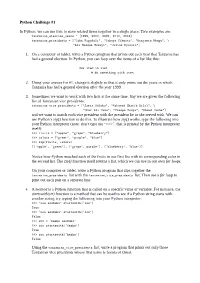
Python Challenge #1 In Python, we can use lists to store related items together in a single place. Two examples are: tanzanian_election_years = [1995, 2000, 2005, 2010, 2015] tanzanian_presidents = [“John Magu uli!, “Ja"aya #i"$ete!, “%en&a'in M"apa!, ( “)li *assan M$inyi!, “Julius +yerere!] 1. On a computer or tablet, write a Python program that prints out each year that Tanzania has had a general election. In Python, you can loop over the items of a list like this: or ite' in list, - do so'ething $ith ite' 2. Using your answer for #1, change it slightly so that it only prints out the years in which Tanzania has had a general election after the year 1999. 3. Sometimes we want to work with two lists at the same time. Say we are given the following list of Tanzanian vice presidents: tanzanian_.ice_presidents = [“/a'ia /uluhu!, “Moha'ed 0hari1 %ilal!, ( “2'ar )li Ju'a!, “3leopa Msuya!, “)1oud Ju'1e!] and we want to match each vice president with the president he or she served with. We can use Python’s zip() function to do this. To illustrate how zip() works, type the following into your Python interpreter (note: don’t type the “>>>”, that is printed by the Python interpreter itself): 444 ruits = [“apple!, “grape!, “1lue1erry!] 444 colors = [“green!, “purple!, “1lue!] 444 zip5 ruits, colors6 [57apple8, 7green86, 57grape8, purple86, 571lue1erry8, 71lue86] Notice how Python matched each of the fruits in our first list with its corresponding color in the second list. The zip() function itself returns a list, which we can use in our own for loops. -

A Peace of Timbuktu: Democratic Governance, Development And
UNIDIR/98/2 UNIDIR United Nations Institute for Disarmament Research Geneva A Peace of Timbuktu Democratic Governance, Development and African Peacemaking by Robin-Edward Poulton and Ibrahim ag Youssouf UNITED NATIONS New York and Geneva, 1998 NOTE The designations employed and the presentation of the material in this publication do not imply the expression of any opinion whatsoever on the part of the Secretariat of the United Nations concerning the legal status of any country, territory, city or area, or of its authorities, or concerning the delimitation of its frontiers or boundaries. * * * The views expressed in this paper are those of the authors and do not necessarily reflect the views of the United Nations Secretariat. UNIDIR/98/2 UNITED NATIONS PUBLICATION Sales No. GV.E.98.0.3 ISBN 92-9045-125-4 UNIDIR United Nations Institute for Disarmament Research UNIDIR is an autonomous institution within the framework of the United Nations. It was established in 1980 by the General Assembly for the purpose of undertaking independent research on disarmament and related problems, particularly international security issues. The work of the Institute aims at: 1. Providing the international community with more diversified and complete data on problems relating to international security, the armaments race, and disarmament in all fields, particularly in the nuclear field, so as to facilitate progress, through negotiations, towards greater security for all States and towards the economic and social development of all peoples; 2. Promoting informed participation by all States in disarmament efforts; 3. Assisting ongoing negotiations in disarmament and continuing efforts to ensure greater international security at a progressively lower level of armaments, particularly nuclear armaments, by means of objective and factual studies and analyses; 4. -
Background of Community-Based Conservation
Beyond Community: "Global" Conservation Networks and "Local" Organization in Tanzania and Zanzibar Item Type text; Electronic Dissertation Authors Dean, Erin Publisher The University of Arizona. Rights Copyright © is held by the author. Digital access to this material is made possible by the University Libraries, University of Arizona. Further transmission, reproduction or presentation (such as public display or performance) of protected items is prohibited except with permission of the author. Download date 30/09/2021 01:23:33 Link to Item http://hdl.handle.net/10150/195624 BEYOND COMMUNITY: “GLOBAL” CONSERVATION NETWORKS AND “LOCAL” ORGANIZATION IN TANZANIA AND ZANZIBAR by Erin Dean _____________________ A Dissertation Submitted to the Faculty of the DEPARTMENT OF ANTHROPOLOGY In Partial Fulfillment of the Requirements For the Degree of DOCTOR OF PHILOSOPHY In the Graduate College THE UNIVERSITY OF ARIZONA 2007 2 THE UNIVERSITY OF ARIZONA GRADUATE COLLEGE As members of the Dissertation Committee, we certify that we have read the dissertation prepared by ERIN DEAN entitled BEYOND COMMUNITY: "GLOBAL" CONSERVATION NETWORKS AND "LOCAL" ORGANIZATION IN TANZANIA AND ZANZIBAR and recommend that it be accepted as fulfilling the dissertation requirement for the Degree of Doctor of Philosophy _______________________________________________________________________ Date: August 14, 2007 Diane Austin _______________________________________________________________________ Date: August 14, 2007 Mamadou Baro _______________________________________________________________________ -

Mamoudou Département D’Histoire Faculté Des Lettres Et Sciences Humaines Université De Douala /Cameroun Email : Mamoudou T@Yahoo.Fr
165 WILLIAM AURÉLIEN ÉTEKI MBOUMOUA,… WILLIAM AURÉLIEN ÉTEKI MBOUMOUA, LA DIPLOMATIE CAMEROUNAISE ET L’ORGANISATION DE L’UNITÉ AFRICAINE 1960 -1978 Mamoudou Département d’Histoire Faculté des Lettres et Sciences Humaines Université de Douala /Cameroun Email : mamoudou_t@yahoo.fr Résumé : Géographiquement situé en Afrique centrale, le Cameroun fut l’un des Etats fondateurs de l’Organisation de l’Unité Africaine (OUA) en 1963. En tant que acteur des relations internationales, il a eu une diplomatie dynamique influencée par l’héritage colonial, les contingences historiques et le quotient personnel de ses fils au rang desquels figure en bonne place William Éteki Mboumoua. Ce dernier qui succède à son compatriote Joseph Nzo Ekangaki à la tête de l’OUA en 1974, contribua grandement au développement et au rayonnement de l’institution panafricaine dans un contexte où le Cameroun déployait, sous la houlette de son chef de l’Etat Ahmadou Ahidjo, une diplomatie de présence et d’affirmation. Cette réflexion, qui s’adosse sur la biographie de William Éteki Mboumoua, montre la contribution d’un acteur de l’histoire à l’émergence de la diplomatie camerounaise et à la vitalité diplomatique de l’OUA. Grand commis de l’Etat, Éteki Mboumoua laissa une marque indélébile dans l’histoire de l’OUA. Fin négociateur, ce camerounais a œuvré pour la promotion économique du potentiel africain et pour la diplomatie culturelle en Afrique. Il fit montre de grandes qualités humaines et professionnelles tout au long de son mandat à la tête du secrétariat général de l’organisation panafricaine. Il quitta son poste en 1978, non sans regrets, pour regagner son pays et occuper le poste de conseiller diplomatique à la présidence de la république. -

Politics, Decolonisation, and the Cold War in Dar Es Salaam C
A Thesis Submitted for the Degree of PhD at the University of Warwick Permanent WRAP URL: http://wrap.warwick.ac.uk/87426 Copyright and reuse: This thesis is made available online and is protected by original copyright. Please scroll down to view the document itself. Please refer to the repository record for this item for information to help you to cite it. Our policy information is available from the repository home page. For more information, please contact the WRAP Team at: wrap@warwick.ac.uk warwick.ac.uk/lib-publications Politics, decolonisation, and the Cold War in Dar es Salaam c. 1965-72 by George Roberts A thesis submitted in fulfilment of the requirements for the degree of Doctor of Philosophy in History University of Warwick, Department of History, September 2016 Politics, decolonisation, and the Cold War in Dar es Salaam, c. 1965-72 Acknowledgements 4 Summary 5 Abbreviations and acronyms 6 Maps 8 Introduction 10 Rethinking the Cold War and decolonisation 12 The ‘Cold War city’ 16 Tanzanian history and the shadow of Julius Nyerere 20 A note on the sources 24 1 – From uhuru to Arusha: Tanzania and the world, 1961-67 34 Nyerere’s foreign policy 34 The Zanzibar Revolution 36 The Dar es Salaam mutiny 38 The creation of Tanzania 40 The foreign policy crises of 1964-65 43 The turn to Beijing 47 Revisiting the Arusha Declaration 50 The June 1967 government reshuffle 54 Oscar Kambona’s flight into exile 56 Conclusion 58 2 – Karibu Dar es Salaam: the political geography of a Cold War city 60 Dar es Salaam 61 Spaces 62 News 67 Propaganda -

Justice in a One-Party African State: the Tanzanian Experience
Justice in a One-Party African State: The Tanzanian Experience. A Rejoinder* By Chris M. Peter » Liberalism manifests itself in various ways. To let things slide for the sake of peace and friendship when a person has elearly gone wrong, and to refrain from principled argument because he is an old acquaintance, a fellow townsman, a schoolmate, a elose friend, a beloved one, an old colleague or old subordinate. Or to touch on the matter lightly instead of going into it thoroughly, so as to keep in good terms. The result is that both the organization and the individual are harmed. This is one type of liberalism.« Mao Ts e Tungl Introduction The artiele entitled »Justice in a One-Party African State: The Tanzanian Experience« by Professor Umesh Kumar of Faculty of Law, National University of Lesotho which appeared on 19 Verfassung und Recht in Obersee (1986) p. 255 raises some fundamental issues wh ich call for correction, elarification and comment. Due to the authoritative nature of the journal on Law and Politics in Africa, Asia and Latin America innocent and unsuspecting readers may end up quoting information which is not only incorrect, but also misleading. It is with the intention of avoiding such eventuality that we pro pose to make a short rejoinder to the artiele. Let it be elearly stated right from the outset that we are in no way contesting Professor Kumar's conelusions on democracy in Tanzania and the implication of the one-party state on administration of justice. In our weil considered opinion the very idea of one-party system has its roots in authoritarianism and is hence undemocratic. -

The Collapse of a Pastoral Economy
his research unravels the economic collapse of the Datoga pastoralists of central and 15 Göttingen Series in Tnorthern Tanzania from the 1830s to the beginning of the 21st century. The research builds Social and Cultural Anthropology from the broader literature on continental African pastoralism during the past two centuries. Overall, the literature suggests that African pastoralism is collapsing due to changing political and environmental factors. My dissertation aims to provide a case study adding to the general Samwel Shanga Mhajida trends of African pastoralism, while emphasizing the topic of competition as not only physical, but as something that is ethnically negotiated through historical and collective memories. There are two main questions that have guided this project: 1) How is ethnic space defined by The Collapse of a Pastoral Economy the Datoga and their neighbours across different historical times? And 2) what are the origins of the conflicts and violence and how have they been narrated by the state throughout history? The Datoga of Central and Northern Tanzania Examining archival sources and oral interviews it is clear that the Datoga have struggled from the 1830s to the 2000s through a competitive history of claims on territory against other neighbouring communities. The competitive encounters began with the Maasai entering the Serengeti in the 19th century, and intensified with the introduction of colonialism in Mbulu and Singida in the late 19th and 20th centuries. The fight for control of land and resources resulted in violent clashes with other groups. Often the Datoga were painted as murderers and impediments to development. Policies like the amalgamation measures of the British colonial administration in Mbulu or Ujamaa in post-colonial Tanzania aimed at confronting the “Datoga problem,” but were inadequate in neither addressing the Datoga issues of identity, nor providing a solution to their quest for land ownership and control. -

LÄNDERBERICHT Konrad-Adenauer-Stiftung E.V
LÄNDERBERICHT Konrad-Adenauer-Stiftung e.V. TANZANIA RICHARD SHABA THE STATE OF POLITICS IN TANZANIA - PROJECT MANAGER IN THIRD QUARTER REPORT 2010 DAR ES SALAAM/ TANSANIA October 2010 I. INTRODUCTION their favour; the results www.kas.de/kenia could be ‘arranged’ well TANZANIA political in advance. The new landscape changed system saw CCM mem- dramatically in the bers at the grass- third quarter of 2010 roots/branch level casting due mainly to three the preferential votes. factors: Their numbers made it difficult for the contest- ¾ CCM allowed a ants to even attempt to broader participa- ‘manipulate’ them. tion of its grass- roots members to The entry of Dr. Wilbrod vote during the pre- Slaa into the presidential liminaries race caught the ruling Chama cha Mapinduzi (CCM) and its govern- ¾ The entry of Dr. ment machinery; other Wilbrod Slaa, Sec- opposition political par- retary General of ties and even voters the opposition alike; by surprise. His en- CHADEMA party in try also triggered a new the presidential wave of political excite- ment in a country where race since the conception of citizens by the colonial and later the one-party ¾ A more visible and regimes as essentially active Prevention passive subjects and and Combating of source of labour, revenue Corruption Bureau and other resources led (PCCB) during the to their disempowerment preliminaries and the nurturing of a subject, quiescent or submissive political cul- In the past a handful of ture. CCM leaders at the grass- roots/branch level were Likewise, in a country voting during the pre- characterized by political liminaries.