Namibia, Okavango and Victoria Falls: Set Departure Trip Report
Total Page:16
File Type:pdf, Size:1020Kb
Load more
Recommended publications
-

Angolan Giraffe (Giraffa Camelopardalis Ssp
Angolan Giraffe (Giraffa camelopardalis ssp. angolensis) Appendix 1: Historical and recent geographic range and population of Angolan Giraffe G. c. angolensis Geographic Range ANGOLA Historical range in Angola Giraffe formerly occurred in the mopane and acacia savannas of southern Angola (East 1999). According to Crawford-Cabral and Verissimo (2005), the historic distribution of the species presented a discontinuous range with two, reputedly separated, populations. The western-most population extended from the upper course of the Curoca River through Otchinjau to the banks of the Kunene (synonymous Cunene) River, and through Cuamato and the Mupa area further north (Crawford-Cabral and Verissimo 2005, Dagg 1962). The intention of protecting this western population of G. c. angolensis, led to the proclamation of Mupa National Park (Crawford-Cabral and Verissimo 2005, P. Vaz Pinto pers. comm.). The eastern population occurred between the Cuito and Cuando Rivers, with larger numbers of records from the southeast corner of the former Mucusso Game Reserve (Crawford-Cabral and Verissimo 2005, Dagg 1962). By the late 1990s Giraffe were assumed to be extinct in Angola (East 1999). According to Kuedikuenda and Xavier (2009), a small population of Angolan Giraffe may still occur in Mupa National Park; however, no census data exist to substantiate this claim. As the Park was ravaged by poachers and refugees, it was generally accepted that Giraffe were locally extinct until recent re-introductions into southern Angola from Namibia (Kissama Foundation 2015, East 1999, P. Vaz Pinto pers. comm.). BOTSWANA Current range in Botswana Recent genetic analyses have revealed that the population of Giraffe in the Central Kalahari and Khutse Game Reserves in central Botswana is from the subspecies G. -
Disaggregation of Bird Families Listed on Cms Appendix Ii
Convention on the Conservation of Migratory Species of Wild Animals 2nd Meeting of the Sessional Committee of the CMS Scientific Council (ScC-SC2) Bonn, Germany, 10 – 14 July 2017 UNEP/CMS/ScC-SC2/Inf.3 DISAGGREGATION OF BIRD FAMILIES LISTED ON CMS APPENDIX II (Prepared by the Appointed Councillors for Birds) Summary: The first meeting of the Sessional Committee of the Scientific Council identified the adoption of a new standard reference for avian taxonomy as an opportunity to disaggregate the higher-level taxa listed on Appendix II and to identify those that are considered to be migratory species and that have an unfavourable conservation status. The current paper presents an initial analysis of the higher-level disaggregation using the Handbook of the Birds of the World/BirdLife International Illustrated Checklist of the Birds of the World Volumes 1 and 2 taxonomy, and identifies the challenges in completing the analysis to identify all of the migratory species and the corresponding Range States. The document has been prepared by the COP Appointed Scientific Councilors for Birds. This is a supplementary paper to COP document UNEP/CMS/COP12/Doc.25.3 on Taxonomy and Nomenclature UNEP/CMS/ScC-Sc2/Inf.3 DISAGGREGATION OF BIRD FAMILIES LISTED ON CMS APPENDIX II 1. Through Resolution 11.19, the Conference of Parties adopted as the standard reference for bird taxonomy and nomenclature for Non-Passerine species the Handbook of the Birds of the World/BirdLife International Illustrated Checklist of the Birds of the World, Volume 1: Non-Passerines, by Josep del Hoyo and Nigel J. Collar (2014); 2. -

True Shrikes), Including 31 Specieswithin Genera Are Coveredin Singlepage Overviews.Line Lanius, Coruinella and Eurocephalus
Books SHRIKES. Norbert Lefranc. 1997. Yale University Some species have bright rufous or sandy caps Press, New Haven, Connecticut. Hard cover, 192 and backs. A few, such as the Long-tailedShrike, pp. $35.00 U.S. have strikinggeographic plumage variations. Some shrikesare as small as House Sparrows. The recentflood of world-wideidentification guides for specific groups of birds, such as seabirds, In 35 pages of introductorymaterial, the author waterfowl and shorebirds, has now reached presents informationon: taxonomy,overviews of passerine groupings, and the treatment has the genera, and a brief guide to the features of the expanded to include life history information.This species accounts. The overview of the genus is a welcome addition, as many bird enthusiasts Laniuscovers: names; morphology,plumages and have expanded their interests, and wish to learn molts; origins, present distribution,migration 'and more about the birds they see. Many of these wintering areas; habitat; social organization and guides are being written in Europe and cover general behavior;food habits,larders and foraging groupswhich occur primarilyin the Old World. behavior; nests, eggs and breeding behavior; population dynamics; population changes and Shrikes covers the three genera of the family presumedcauses; and conservation.The othertwo Laniidae(true shrikes), including 31 specieswithin genera are coveredin singlepage overviews.Line Lanius, Coruinella and Eurocephalus. Twenty- drawings in the introduction supplerbent the color sevenof thesespecies are in the firstgenus, whose plates. name is the Latin word for butcher, perhaps referringto their habit of hangingprey on spines. Species accounts average three pages (range 1- 9), and include a clear range map (1/4 to 1 page), Scientistsbelieve that the family Laniidae evolved identification details, measurements, distribution in Australia as part of a great radiation that and status, molt, voice, habitat, habits, food, produced the corvids, a number of Australian breeding and references. -

Malawi Trip Report 12Th to 28Th September 2014
Malawi Trip Report 12th to 28th September 2014 Bohm’s Bee-eater by Keith Valentine Trip Report compiled by Tour Leader: Keith Valentine RBT Malawi Trip Report September 2014 2 Top 10 Birds: 1. Scarlet-tufted Sunbird 2. Pel’s Fishing Owl 3. Lesser Seedcracker 4. Thyolo Alethe 5. White-winged Apalis 6. Racket-tailed Roller 7. Blue Swallow 8. Bohm’s Flycatcher 9. Babbling Starling 10. Bohm’s Bee-eater/Yellow-throated Apalis Top 5 Mammals: 1. African Civet 2. Four-toed Elephant Shrew 3. Sable Antelope 4. Bush Pig 5. Side-striped Jackal/Greater Galago/Roan Antelope/Blotched Genet Trip Summary This was our first ever fully comprehensive tour to Malawi and was quite simply a fantastic experience in all respects. For starters, many of the accommodations are of excellent quality and are also situated in prime birding locations with a large number of the area’s major birding targets found in close proximity. The food is generally very good and the stores and lodges are for the most part stocked with decent beer and a fair selection of South African wine. However, it is the habitat diversity that is largely what makes Malawi so good from a birding point of view. Even though it is a small country, this good variety of habitat, and infrastructure that allows access to these key zones, insures that the list of specials is long and attractive. Our tour was extremely successful in locating the vast majority of the region’s most wanted birds and highlights included Red-winged Francolin, White-backed Night Heron, African Cuckoo-Hawk, Western Banded Snake -

South Africa: Magoebaskloof and Kruger National Park Custom Tour Trip Report
SOUTH AFRICA: MAGOEBASKLOOF AND KRUGER NATIONAL PARK CUSTOM TOUR TRIP REPORT 24 February – 2 March 2019 By Jason Boyce This Verreaux’s Eagle-Owl showed nicely one late afternoon, puffing up his throat and neck when calling www.birdingecotours.com info@birdingecotours.com 2 | TRIP REPORT South Africa: Magoebaskloof and Kruger National Park February 2019 Overview It’s common knowledge that South Africa has very much to offer as a birding destination, and the memory of this trip echoes those sentiments. With an itinerary set in one of South Africa’s premier birding provinces, the Limpopo Province, we were getting ready for a birding extravaganza. The forests of Magoebaskloof would be our first stop, spending a day and a half in the area and targeting forest special after forest special as well as tricky range-restricted species such as Short-clawed Lark and Gurney’s Sugarbird. Afterwards we would descend the eastern escarpment and head into Kruger National Park, where we would make our way to the northern sections. These included Punda Maria, Pafuri, and the Makuleke Concession – a mouthwatering birding itinerary that was sure to deliver. A pair of Woodland Kingfishers in the fever tree forest along the Limpopo River Detailed Report Day 1, 24th February 2019 – Transfer to Magoebaskloof We set out from Johannesburg after breakfast on a clear Sunday morning. The drive to Polokwane took us just over three hours. A number of birds along the way started our trip list; these included Hadada Ibis, Yellow-billed Kite, Southern Black Flycatcher, Village Weaver, and a few brilliant European Bee-eaters. -

Tanzania 16 - 27 April 2018 Tour Leader Tertius Gous Photographs by Tertius Gous Taken on This Tour
Tanzania 16 - 27 April 2018 Tour Leader Tertius Gous Photographs by Tertius Gous taken on this tour www.birdingafrica.com Day 0: The first day was spent birding and relaxing at our lodge near Kilimanjaro International Airport while we waited for everyone to arrive. The open Acacia savanna surrounding the lodge always provides a very productive start to the tour and notable sightings included Speckled and Blue- naped Mousebird, White-browed Coucal, Mourning Collared Dove, Little and African Palm Swift, European Roller, Grey-headed Kingfisher, African Hoopoe, Red-backed Shrike, Long-tailed Fiscal, Dark-capped Bulbul (the first of many!), Northern and Red-faced Crombec, Willow Warbler, Eastern Olivaceous Warbler, Tawny-flanked Prinia, Buff-bellied Warbler, Garden Warbler, Winding Cisticola, Spotted Flycatcher, Spotted Palm Thrush, Superb and Violet-backed Starling, Scarlet- chested and Variable Sunbird, Red-billed Firefinch, Blue-capped Cordon-bleu, Crimson-rumped Waxbill and Reichenow’s Seedeater, while Yellow-winged Bat showed well at the lodge. As a bonus, our lodge was perfectly situated for spectacular views of Mount Kilimanjaro, Africa's highest mountain and the highest free-standing mountain in the world. Days 1- 2: We spent two full days exploring the grasslands, lakes, woodlands and forests of Arusha National Park. Close to the entrance of the Park we found a breeding colony of Taveta Weavers supported by a few Golden-backed Weavers and an obliging Brown-breasted Barbet. Soon after we entered the Park an open grassy meadow produced good numbers of African Buffalo with numerous Red- billed Oxpeckers in attendance, as well as Bushbuck. Other mammals found in the grasslands and woodlands included Common Zebra, Giraffe, Warthog, Waterbuck, Kirk’s Dik-dik and numerous troops of Olive Baboons, while the forests held Harvey’s Duiker and the diminutive Suni. -

Zambezi After Breakfast, We Follow the Route of the Okavango River Into the Zambezi Where Applicable, 24Hrs Medical Evacuation Insurance Region
SOAN-CZ | Windhoek to Kasane | Scheduled Guided Tour Day 1 | Tuesday 16 ETOSHA NATIONAL PARK 30 Group size Oshakati Ondangwa Departing Windhoek we travel north through extensive cattle farming areas GROUP DAY Katima Mulilo and bushland to the Etosha National Park, famous for its vast amount of Classic: 2 - 16 guests per vehicle CLASSIC TOURING SIZE FREESELL Opuwo Rundu Kasane wildlife and unique landscape. In the late afternoon, once we have reached ETOSHA NATIONAL PARK BWABWATA NATIONAL our camp located on the outside of the National Park, we have the rest of the PARK Departure details Tsumeb day at leisure. Outjo Overnight at Mokuti Etosha Lodge. Language: Bilingual - German and English Otavi Departure Days: Otjiwarongo Day 2 | Wednesday Tour Language: Bilingual DAMARALAND ETOSHA NATIONAL PARK Okahandja The day is devoted purely to the abundant wildlife found in the Etosha Departure days: TUESDAYS National Park, which surrounds a parched salt desert known as the Etosha Gobabis November 17 Pan. The park is home to 4 of the Big Five - elephant, lion, leopard and rhino. 2020 December 1, 15 WINDHOEK Swakopmund Game viewing in the park is primarily focussed around the waterholes, some January 19 of which are spring-fed and some supplied from a borehole, ideal places to February 16 Walvis Bay Rehoboth sit and watch over 114 different game species, or for an avid birder, more than March 2,16,30 340 bird species. An extensive network of roads links the over 30 water holes April 13 SOSSUSVLEI Mariental allowing visitors the opportunity of a comprehensive game viewing safari May 11, 25 throughout the park as each different area will provide various encounters. -

Birding Tour South Africa: Western Cape Custom Tour
BIRDING TOUR SOUTH AFRICA: WESTERN CAPE CUSTOM TOUR 8-12 OCTOBER 2016 By Chris Lotz Orange-breasted Sunbird (photo John Tinkler) www.birdingecotours.com info@birdingecotours.com 2 | T R I P R E P O R T Western Cape custom tour October 2016 ITINERARY Date (2016) Location Overnight 8-Oct Cape Town to Tankwa Karoo Sothemba Lodge, Tankwa 9-Oct Full day in the Karoo Sothemba Lodge, Tankwa 10-Oct Tankwa Karoo to the Overberg Mudlark River Front Lodge 11-Oct Agulhas Plains Mudlark River Front Lodge 12-Oct Betty's Bay and Rooiels (back in Cape Town) Day 1: 8 October 2016 I fetched Robert and Elizabeth from Hotel Verde at Cape Town International Airport at 7:30 a.m., and we immediately started heading toward the amazingly endemic-rich Tankwa Karoo. But we had lots of birding to do before getting to the Karoo. En route we stopped in the famous Cape wine town of Paarl for an hour or two, as Paarl boasts some excellent birding sites and is perfectly right on the way to the Karoo. Just as we entered Paarl we were glad to be able to stop for a pale-phase Booted Eagle soaring above us – we actually ended up seeing a good number of this small eagle throughout our tour. After admiring the eagle we headed for the botanical garden within the Paarl Mountain Nature Reserve, where we got acquainted with a bunch of fynbos endemics and other goodies. This trip proved excellent for raptors. As we arrived at the botanical garden, we saw a Black Harrier hunting, then later we got amazingly close views of a perched African Goshawk – a two-accipiter morning is always a good morning! Three species of beautiful sunbirds were much in evidence: Malachite, Southern Double-collared, and Orange-breasted Sunbirds. -

National Parks of Namibia.Pdf
Namibia’s National Parks “Our national parks are one of Namibia’s most valuable assets. They are our national treasures and their tourism potential should be harnessed for the benefi t of all people.” His Excellency Hifi kepunye Pohamba Republic of Namibia President of the Republic of Namibia Ministry of Environment and Tourism Exploring Namibia’s natural treasures Sparsely populated and covering a vast area of 823 680 km2, roughly three times the size of the United King- dom, Namibia is unquestionably one of Africa’s premier nature tourism destinations. There is also no doubt that the Ministry of Environment and Tourism is custodian to some of the biggest, oldest and most spectacular parks on our planet. Despite being the most arid country in sub-Saharan Af- rica, the range of habitats is incredibly diverse. Visitors can expect to encounter coastal lagoons dense with flamingos, towering sand-dunes, and volcanic plains carpeted with spring flowers, thick forests teeming with seasonal elephant herds up to 1 000 strong and lush sub-tropical wetlands that are home to crocodile, hippopotami and buffalo. The national protected area network of the Ministry of Environment and Tourism covers 140 394 km2, 17 per cent of the country, and while the century-old Etosha National and Namib-Naukluft parks are deservedly re- garded as the flagships of Namibia’s conservation suc- cess, all the country’s protected areas have something unique to offer. The formidable Waterberg Plateau holds on its summit an ecological ‘lost world’ cut off by geology from its surrounding plains for millennia. The Fish River Canyon is Africa’s grandest, second in size only to the American Grand Canyon. -

Namaqua Birds
Bird Checklist for Namaqua National Park (as at March 2006) English (Roberts 7) English (Roberts 6) Old Rob # Global Names SA Names Afrikaans Namaqua 62 Grey Heron Grey Heron Bloureier 1 63 Blackheaded Heron Blackheaded Heron Swartkopreier 1 71 Cattle Egret Cattle Egret Veereier 1 81 Hamerkop Hamerkop Hamerkop 1 91 Sacred Ibis Sacred Ibis Skoorsteenveer 1 94 Hadeda Ibis Hadeda Hadeda 1 102 Egyptian Goose Egyptian Goose Kolgans 1 103 South African Shelduck South African Shelduck Kopereend 1 104 Yellowbilled Duck Yellowbilled Duck Geelbekeend 1 116 Spurwinged Goose Spurwinged Goose Wildemakou 1 127 Blackshouldered Kite Blackshouldered Kite Blouvalk 1 131 Verreaux's Eagle Black Eagle Witkruisarend 1 136 Booted Eagle Booted Eagle Dwergarend 1 140 Martial Eagle Martial Eagle Breëkoparend 1 143 Black-chested Snake Eagle Black-breasted Snake Eagle Swartborsslangarend 1 149 Steppe Buzzard Steppe Buzzard Bruinjakkalsvoël 1 152 Jackal Buzzard Jackal Buzzard Rooiborsjakkalsvoël 1 162 Pale Chanting Goshawk Pale Chanting Goshawk Bleeksingvalk 1 168 Black Harrier Black Harrier Witkruisvleivalk 1 169 African Harrier Hawk Gymnogene Kaalwangvalk 1 172 Lanner Falcon Lanner Falcon Edelvalk 1 181 Rock Kestrel Rock Kestrel Kransvalk 1 182 Greater Kestrel Greater Kestrel Grootrooivalk 1 190 Grey-winged Francolin Greywing Francolin Bergpatrys 1 195 Cape Spurfowl Cape Francolin Kaapse Fisant 1 200 Common Quail Common Quail Afrikaanse Kwartel 1 203 Helmeted Guineafowl Helmeted Guineafowl Gewone Tarentaal 1 232 Ludwig's Bustard Ludwig's Bustard Ludwigse Pou 1 -
Namibia & the Okavango
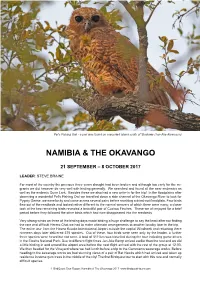
Pel’s Fishing Owl - a pair was found on a wooded island south of Shakawe (Jan-Ake Alvarsson) NAMIBIA & THE OKAVANGO 21 SEPTEMBER – 8 OCTOBER 2017 LEADER: STEVE BRAINE For most of the country the previous three years drought had been broken and although too early for the mi- grants we did however do very well with birding generally. We searched and found all the near endemics as well as the endemic Dune Lark. Besides these we also had a new write-in for the trip! In the floodplains after observing a wonderful Pel’s Fishing Owl we travelled down a side channel of the Okavango River to look for Pygmy Geese, we were lucky and came across several pairs before reaching a dried-out floodplain. Four birds flew out of the reedbeds and looked rather different to the normal weavers of which there were many, a closer look at the two remaining birds revealed a beautiful pair of Cuckoo Finches. These we all enjoyed for a brief period before they followed the other birds which had now disappeared into the reedbeds. Very strong winds on three of the birding days made birding a huge challenge to say the least after not finding the rare and difficult Herero Chat we had to make alternate arrangements at another locality later in the trip. The entire tour from the Hosea Kutako International Airport outside the capital Windhoek and returning there nineteen days later delivered 375 species. Out of these, four birds were seen only by the leader, a further three species were heard but not seen. -

Namibia, 2018
Nambia and little bits of Botswana, Zimbabwe, and Zambia, July-August 2018 Michael Kessler In 1994, my wife Elke and I did our first joint trip to Namibia, spending 3 weeks mainly in the arid western parts of the country and seeing such goodies as Brown Hyena, Caracal, Black Mongoose, Honey Badger, 3 species of sengis, and Southern African Porcupine. In 2010, we made our first family trip to Africa to KwaZulu Natal, seeing much of the large game. So now we decided to return to Namibia with the family, with the aim of exploring some new areas and searching out the less easily seen species. Time and budget limited the trip to about 2½ weeks and after some deliberation, we settled on the following sites: Sesriem + Sossusvlei for the dunes; Walvisbay for Heaviside’s Dolphin + Welwitschia; Erindi for African Wild Dog and the other game; Toko Lodge for the night drives, especially for Aardvark; Etosha only briefly for the amazing wildlife spectacle; Mahango for the Okavango specials (birds and mammals); and Victoria Falls for, well, the falls. This resulted in the following Itinerary: 25.7: Left Zurich in the evening, arriving on 26.7.: am in Jo’burg, followed by a connecting flight to Windhoek where we picked up the rental car, did some grocery shopping, and fell into our beds at Arebbusch Lodge on the southern outskirts of the city. 27.7.: Long drive to Desert Homestead Lodge at Sesriem. 28.7.: am: visit to Sossusvlei; pm: Cessna flight over the dunes, followed by a night drive back to the lodge, seeing some Bat-eared Foxes.