Takács Quartet 1879, in Berlin by the Joachim Quartet
Total Page:16
File Type:pdf, Size:1020Kb
Load more
Recommended publications
-
2021.5.17 Chamber Fest 2 R3
Monday, May 17, 2021 | 7:30 PM Gordon K. and Harriet Greenfield Hall Spring Chamber Music Festival Lillian Fuchs Chamber Music Competition Winners’ Concert II PROGRAM ANTONÍN DVOŘÁK Piano Quintet No. 2, Op. 81 (1841–1904) II. Allegro ma non tanto Eliane Menzel, Vlad Hontilă, violin Ramón Carrero Martínez, viola Clara Yeonsue Cho, cello Sıla Şentürk, piano Coached by Peter Winograd FELIX MENDELSSOHN Piano Trio in C Minor, Op. 49 <Piano Trio No. 2 in C Minor, Op. 66?> (1809–1847) I. Allegro energico e con fuoco Maïthéna Girault, violin Noah Koh, cello Jiyoon Han, piano Coached by Mark Steinberg and Nicholas Mann JOHANNES BRAHMS Clarinet Sonata No. 1 in F Minor, Op. 120, no. 1 (1833–1897) I. Allegro appassionato IV. Vivace Ki-Deok Park, clarinet Ahmed Alom Vega, piano Coached by Sylvia Rosenberg VALERIE COLEMAN Wish: Sonatine for Flute and Piano (b. 1970) Bethany McLean, flute Ching Chia Lin, piano ASTOR PIAZOLLA Le Grand Tango (1921–1992) Pedro Bonet, cello Tatuka Kutsnashvili, piano Coached by William Wol!am Students in this performance are supported by the Robert Mann Endowed Scholarship for Violin and Chamber Studies, the Samuel and Mitzi Newhouse Scholarship, the Flavio Varani Scholarship in Piano, the Viola B. Marcus Memorial Scholarship, the Rachmael Weinstock Endowed Scholarship in Violin. We are grateful to the generous donors who made these scholarships possible. For information on establishing a named scholarship at Manhattan School of Music, please contact Susan Madden, Vice President for Advancement, at 917-493-4115 or smadden@msmnyc.edu. ABOUT LILLIAN FUCHS Hailed by Harold C. Schonberg in the New York Times in 1962 as “one of the best string players in America,” Lillian Fuchs (1902–1995) joined the chamber music and viola faculties at Manhattan School of Music in 1962, where she remained for almost 30 years. -
A Comparative Analysis of the Six Duets for Violin and Viola by Michael Haydn and Wolfgang Amadeus Mozart
A COMPARATIVE ANALYSIS OF THE SIX DUETS FOR VIOLIN AND VIOLA BY MICHAEL HAYDN AND WOLFGANG AMADEUS MOZART by Euna Na Submitted to the faculty of the Jacobs School of Music in partial fulfillment of the requirements for the degree, Doctor of Music Indiana University May 2021 Accepted by the faculty of the Indiana University Jacobs School of Music, in partial fulfillment of the requirements for the degree Doctor of Music Doctoral Committee ______________________________________ Frank Samarotto, Research Director ______________________________________ Mark Kaplan, Chair ______________________________________ Emilio Colón ______________________________________ Kevork Mardirossian April 30, 2021 ii I dedicate this dissertation to the memory of my mentor Professor Ik-Hwan Bae, a devoted musician and educator. iii Table of Contents Table of Contents ............................................................................................................................ iv List of Examples .............................................................................................................................. v List of Tables .................................................................................................................................. vii Introduction ...................................................................................................................................... 1 Chapter 1: The Unaccompanied Instrumental Duet... ................................................................... 3 A General Overview -

Andreas Haefliger Piano
PERSPECTIVES 6 A N D R E A S H A E F L I G E R BEETHOVEN Piano Sonatas Nos. 10 & 30 BERIO Four Encores SCHUMANN Fantasy in C Perspectives 6 Ludwig van Beethoven 1770–1827 Sonata No.10 in G Op.14 No.2 1I Allegro 7’03 2 II Andante 5’02 3 III Scherzo: Allegro assai 3’38 Luciano Berio 1925–2003 4 Erdenklavier 2’49 5 Wasserklavier 2’28 Ludwig van Beethoven Sonata No.30 in E Op.109 6 I Vivace, ma non troppo – Adagio espressivo 4’04 7 II Prestissimo 2’26 8 III Gesangvoll, mit innigster Empfindung 12’26 Luciano Berio 9 Luftklavier 3’25 10 Feuerklavier 2’57 Robert Schumann 1810–1856 Fantasy in C Op. 17 11 I. Durchaus phantastisch und leidenschaftlich vorzutragen 13’39 12 II. Mäßig – Durchaus energisch 7’31 13 III. Langsam getragen – Durchweg leise zu halten 9’34 Andreas Haefliger piano Recorded: 14–16 October 2013, Arc en Scènes, Salle de musique, La Chaux-de-Fonds, Suisse (Schweiz, Switzerland ) Recorded by TRITONUS Musikproduktion GmbH, Stuttgart Recording produced, engineered and edited by Markus Heiland Photography: Marco Borggreve · Design: WLP Ltd. ൿ 2014 The copyright in this sound recording is owned by Andreas Haefliger Ꭿ 2014 Andreas Haefliger. www.andreashaefliger.com Marketed by Avie Records www.avie-records.com When putting together my programmes, I have always seen opportunities to illuminate the individuality of works by placing them in tonal, dramatic and historic relief. Thus, through the sequence of a recital programme, repertoire that has long been familiar to us is shown in a new light. -
Felix Mendelssohn's Career As a Composer
10-27 Sat Mat.qxp_Layout 1 10/18/18 2:07 PM Page 29 Notes on the Program By James M. Keller, Program Annotator, The Leni and Peter May Chair String Quintet in B-flat major, Op. 87 Felix Mendelssohn elix Mendelssohn’s career as a composer was not strictly that of the mainstream. As a Fand conductor was flourishing in 1845. result, certain of his works — such as the first He was considering competing job offers and last movements of this quintet — can from two crowned heads (the Kings of Prus - sometimes sound less like classic chamber sia and of Saxony), he was deriving satisfac - music than like little string symphonies, re - tion from his pet project of elevating the flecting a hierarchy in which the first violin Leipzig Conservatory into a world-class in - spends more time in the spotlight than the stitution, and he enjoyed great happiness on lower-lying “accompanying” instruments. In the home front, the more so when he and his fact, his interest in those first and last move - wife greeted the arrival of their fifth child, ments seems fixed less on the themes them - Lili. There is no way that the composer, who selves than on the harmonic and structural was only 36 years old, could have known processes used in developing them. Wilhelm when he wrote the B-flat-major Quintet that Altman, writing in the classic Cobbett’s Cyclo - it would be among his last works. He died two pedic Survey of Chamber Music , perspica - years later after a series of strokes. -
Lillian Fuchs: Violist, Teacher and Composer
Louisiana State University LSU Digital Commons LSU Doctoral Dissertations Graduate School 2011 Lillian Fuchs: violist, teacher and composer; musical and pedagogical aspects of the 16 Fantasy études for viola Teodora Dimova Peeva Louisiana State University and Agricultural and Mechanical College Follow this and additional works at: https://digitalcommons.lsu.edu/gradschool_dissertations Part of the Music Commons Recommended Citation Peeva, Teodora Dimova, "Lillian Fuchs: violist, teacher and composer; musical and pedagogical aspects of the 16 Fantasy études for viola" (2011). LSU Doctoral Dissertations. 3589. https://digitalcommons.lsu.edu/gradschool_dissertations/3589 This Dissertation is brought to you for free and open access by the Graduate School at LSU Digital Commons. It has been accepted for inclusion in LSU Doctoral Dissertations by an authorized graduate school editor of LSU Digital Commons. For more information, please contactgradetd@lsu.edu. LILLIAN FUCHS: VIOLIST, TEACHER, AND COMPOSER; MUSICAL AND PEDAGOGICAL ASPECTS OF THE 16 FANTASY ÉTUDES FOR VIOLA A Written Document Submitted to the Graduate Faculty of the Louisiana State University and Agricultural and Mechanical College in partial fulfillment of the requirements for the degree of Doctor of Musical Arts in The School of Music by Teodora Peeva B.M., University of California, 2003 M.M., Louisiana State University, 2006 May, 2011 TO THE MEMORY OF MY PARENTS ii ACKNOWLEDGMENTS To David and the entire Weill family, for your unflagging encouragement and support. To Ms. Lori Patterson, for selflessly sharing your wisdom with me and for allowing me the pleasure of knowing you. My deepest gratitude goes to the members of my doctoral committee, for your contribution of time and knowledge in assisting with the completion of this monograph and for your willingness to serve. -

DVOŘÁK's CHAMBER and PIANO MUSIC in Preparation in High-Standard Reprints
Titles DVOŘÁK'S CHAMBER AND PIANO MUSIC in preparation in high-standard reprints Serenade in D minor Op. 44 Our publishing house's lasting care for quality sheet Piano four hands BA 9565 From the Bohemian Forest Op. 68 for wind instruments, violoncello and double bass music of this most-performed classic Czech composer is Edited by Robin Tait BA 9547, BA 9548 Slavonic Dances Op. 46 and Op. 72 BA 10424 score also re ected in a new series of reprints of mostly chamber BA 10424-22 parts in slipcover and piano music from the Antonín Dvořák Complete Violin and Piano To appear in September 2016 BA 9576 Romantic Pieces Op. 75 DVOŘÁK Edition (ADCE), prepared by the best Czech editors The new Urtext edition of this masterpiece of its genre and Dvořák specialists of the day (Jarmil Burghauser, B Ä R E N R E I T E R U R T E X T is based jointly on the autograph and the ¦ rst Simrock Piano Trio / Quartet / Quintet BA 9578 Piano Trio in B- at major Op. 21 edition (1879). The editor revised the editorial decisions Antonín Čubr, Antonín Pokorný, Karel Šolc, František To appear in May 2016 made in the 1879 print, restoring some of Dvořák's Bartoš, etc.). With their combination of modern printing BA 9564 Piano Trio in F minor Op. 65 original ideas and clarifying certain inconsistencies BA 9538 Piano Trio in G minor Op. 26 in articulation. The current edition contains a critical and Bärenreiter-brand quality, the ADCE reprints re ect BA 9537 Piano Quartet in E- at major Op. -

Form, Style, and Influence in the Chamber Music of Antonin
FORM, STYLE, AND INFLUENCE IN THE CHAMBER MUSIC OF ANTONIN DVOŘÁK by MARK F. ROCKWOOD A DISSERTATION Presented to the School of Music and Dance and the Graduate School of the University of Oregon in partial fulfillment of the requirements for the degree of Doctor of Philosophy June 2017 DISSERTATION APPROVAL PAGE Student: Mark F. Rockwood Title: Form, Style, and Influence in the Chamber Music of Antonin Dvořák This dissertation has been accepted and approved in partial fulfillment of the requirements for the Doctor of Philosophy degree in the School of Music and Dance by: Stephen Rodgers Chairperson Drew Nobile Core Member David Riley Core Member Forest Pyle Institutional Representative and Scott L. Pratt Dean of the Graduate School Original approval signatures are on file with the University of Oregon Graduate School. Degree awarded June 2017 ii © 2017 Mark F. Rockwood This work is licensed under a Creative Commons Attribution-Noncommercial – Noderivs (United States) License. iii DISSERTATION ABSTRACT Mark F. Rockwood Doctor of Philosophy School of Music and Dance June 2017 Title: Form, Style, and Influence in the Chamber Music of Antonin Dvořák The last thirty years have seen a resurgence in the research of sonata form. One groundbreaking treatise in this renaissance is James Hepokoski and Warren Darcy’s 2006 monograph Elements of Sonata Theory : Norms, Types, and Deformations in the Late-Eighteenth- Century Sonata. Hepokoski and Darcy devise a set of norms in order to characterize typical happenings in a late 18 th -century sonata. Subsequently, many theorists have taken these norms (and their deformations) and extrapolate them to 19 th -century sonata forms. -

CCMA Coleman Competition (1947-2015)
THE COLEMAN COMPETITION The Coleman Board of Directors on April 8, 1946 approved a Los Angeles City College. Three winning groups performed at motion from the executive committee that Coleman should launch the Winners Concert. Alice Coleman Batchelder served as one of a contest for young ensemble players “for the purpose of fostering the judges of the inaugural competition, and wrote in the program: interest in chamber music playing among the young musicians of “The results of our first chamber music Southern California.” Mrs. William Arthur Clark, the chair of the competition have so far exceeded our most inaugural competition, noted that “So far as we are aware, this is sanguine plans that there seems little doubt the first effort that has been made in this country to stimulate, that we will make it an annual event each through public competition, small ensemble chamber music season. When we think that over fifty performance by young people.” players participated in the competition, that Notices for the First Annual Chamber Music Competition went out the groups to which they belonged came to local newspapers in October, announcing that it would be held from widely scattered areas of Southern in Culbertson Hall on the Caltech campus on April 19, 1947. A California and that each ensemble Winners Concert would take place on May 11 at the Pasadena participating gave untold hours to rehearsal Playhouse as part of Pasadena’s Twelfth Annual Spring Music we realize what a wonderful stimulus to Festival sponsored by the Civic Music Association, the Board of chamber music performance and interest it Education, and the Pasadena City Board of Directors. -
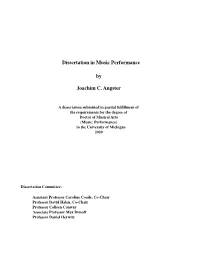
Dissertation First Pages
Dissertation in Music Performance by Joachim C. Angster A dissertation submitted in partial fulfillment of the requirements for the degree of Doctor of Musical Arts (Music: Performance) in the University of Michigan 2020 Dissertation Committee: Assistant Professor Caroline Coade, Co-Chair Professor David Halen, Co-Chair Professor Colleen Conway Associate Professor Max Dimoff Professor Daniel Herwitz Joachim C. Angster jangster@umich.edu ORCID iD: 0000-0002-2563-2819 © Joachim C. Angster 2020 ACKNOWLEDGEMENTS I would like to express my gratitude to members of my Doctoral Committee and to my teacher Professor Caroline Coade in particular, for making me a better musician. I also would like to give special thanks to my collaborators Arianna Dotto, Meridian Prall, Ji-Hyang Gwak, Taylor Flowers, and Nathaniel Pierce. Finally, I am grateful for the continuous support of my parents, and for the invaluable help of Anna Herklotz and Gabriele Dotto. ii TABLE OF CONTENTS ACKNOWLEDGEMENTS ii ABSTRACT iv FIRST DISSERTATION RECITAL: Program 1 Program Notes 2 SECOND DISSERTATION RECITAL: Program 18 Program Notes 19 THIRD DISSERTATION RECITAL: Program 27 Program Notes 28 BIBLIOGRAPHY 40 iii ABSTRACT This dissertation pertains to three viola recitals, which were respectively performed on 2 October 2019, 20 January 2020, and 9 March 2020. Each recital program embraced a specific theme involving little-performed works as well as staples from the viola repertoire, and covered a wide range of different musical styles. The first recital, performed with violinist Arianna Dotto, focused on violin and viola duo repertoire. Two pieces in the Classical and early Romantic styles by W. A. Mozart and L. -
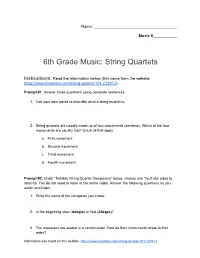
6Th Grade Music: String Quartets
Name: ______________________________________ Music 6___________ 6th Grade Music: String Quartets Instructions: Read the information below (this came from the website https://www.liveabout.com/string-quartet-101-723913). Prompt #1: Answer these questions using complete sentences. 1. Use your own words to describe what a string quartet is. 2. String quartets are usually made up of four movements (sections). Which of the four movements are usually fast? Circle all that apply a. First movement b. Second movement c. Third movement d. Fourth movement. Prompt #2: Under “Notable String Quartet Composers” below, choose one YouTube video to listen to. You do not need to listen to the entire video. Answer the following questions as you watch and listen: 1. Write the name of the composer you chose. 2. Is the beginning slow (Adagio) or fast (Allegro)? 3. The musicians are seated in a certain order. How do their instruments relate to that order? Information was found on this website: https://www.liveabout.com/string-quartet-101-723913 4. How do the musicians respond to each other while playing? Prompt #3: Under Modern String Quartet Music, find the Love Story quartet by Taylor Swift. Listen to it as you answer using complete sentences. 1. Which instrument is plucking at the beginning of the piece? (If you forgot, violins are the smallest instrument, violas are a little bigger, cellos are bigger and lean on the floor). 2. Reflect on how this version of Love Story is different from Taylor Swift’s original song. How would you describe the differences? What does this version communicate? Information was found on this website: https://www.liveabout.com/string-quartet-101-723913 String Quartet 101 All You Need to Know About the String Quartet The Jerusalem Quartet, a string quartet made of members (from left) Alexander Pavlovsky, Sergei Bresler, Kyril Zlontnikov and Ori Kam, perform Brahms’s String Quartet in A minor at the 92nd Street Y on Saturday night, October 25, 2014. -

The Ninth Season Through Brahms CHAMBER MUSIC FESTIVAL and INSTITUTE July 22–August 13, 2011 David Finckel and Wu Han, Artistic Directors
The Ninth Season Through Brahms CHAMBER MUSIC FESTIVAL AND INSTITUTE July 22–August 13, 2011 David Finckel and Wu Han, Artistic Directors Music@Menlo Through Brahms the ninth season July 22–August 13, 2011 david finckel and wu han, artistic directors Contents 2 Season Dedication 3 A Message from the Artistic Directors 4 Welcome from the Executive Director 4 Board, Administration, and Mission Statement 5 Through Brahms Program Overview 6 Essay: “Johannes Brahms: The Great Romantic” by Calum MacDonald 8 Encounters I–IV 11 Concert Programs I–VI 30 String Quartet Programs 37 Carte Blanche Concerts I–IV 50 Chamber Music Institute 52 Prelude Performances 61 Koret Young Performers Concerts 64 Café Conversations 65 Master Classes 66 Open House 67 2011 Visual Artist: John Morra 68 Listening Room 69 Music@Menlo LIVE 70 2011–2012 Winter Series 72 Artist and Faculty Biographies 85 Internship Program 86 Glossary 88 Join Music@Menlo 92 Acknowledgments 95 Ticket and Performance Information 96 Calendar Cover artwork: Mertz No. 12, 2009, by John Morra. Inside (p. 67): Paintings by John Morra. Photograph of Johannes Brahms in his studio (p. 1): © The Art Archive/Museum der Stadt Wien/ Alfredo Dagli Orti. Photograph of the grave of Johannes Brahms in the Zentralfriedhof (central cemetery), Vienna, Austria (p. 5): © Chris Stock/Lebrecht Music and Arts. Photograph of Brahms (p. 7): Courtesy of Eugene Drucker in memory of Ernest Drucker. Da-Hong Seetoo (p. 69) and Ani Kavafian (p. 75): Christian Steiner. Paul Appleby (p. 72): Ken Howard. Carey Bell (p. 73): Steve Savage. Sasha Cooke (p. 74): Nick Granito. -

Download Booklet
552139-40bk VBO Dvorak 16/8/06 9:48 PM Page 8 CD1 1 Carnival Overture, Op. 92 . 9:29 2 Humoresques, Op. 101 No. 7 Poco lento e grazioso in G flat major . 2:51 3 String Quartet No. 12 in F major, Op. 96 ‘American’ III. Molto vivace . 4:01 4 Symphony No. 8 in G major, Op. 88 III. Allegretto grazioso – Molto vivace . 5:45 5 7 Gipsy Melodies ‘Zigeunerlieder’ – song collection, Op. 55 No. 4 Songs my mother taught me . 2:47 6 Serenade for Strings in E major, Op.22 I. Moderato . 4:10 7 Slavonic Dances, Op. 46 No. 2 in E minor . 4:40 8 Piano Trio in F minor ‘Dumky’, Op. 90 III. Andante – Vivace non troppo . 5:56 9 Symphony No. 7 in D minor, Op. 70 III. Scherzo: Vivace – Poco meno messo . 7:47 0 Violin Sonatina in G major, Op. 100 II. Larghetto . 4:33 ! Slavonic Dances, Op. 72 No. 2 in E minor . 5:29 @ Rusalka, Op. 114 O, Silver Moon . 5:52 # The Noon Witch . 13:04 Total Timing . 77:10 CD2 1 Slavonic Dances, Op. 46 No. 1 in C major . 3:46 2 Stabat Mater, Op. 58 Fac ut portem Christi mortem . 5:13 3 Serenade for Wind, Op.44 I. Moderato, quasi marcia . 3:51 4 Cello Concerto in B minor, Op. 104 II. Adagio ma non troppo . 12:29 5 Piano Quintet in A major, Op. 81 III. Scherzo (Furiant) – Molto vivace . 4:06 6 Czech Suite, Op. 39 II. Polka . 4:49 7 Legends, Op.