October 2011 Online Sale Catalogue
Total Page:16
File Type:pdf, Size:1020Kb
Load more
Recommended publications
-
Elements of Innovators' Fame
Elements of Innovators’ Fame: Social Structure, Identity and Creativity Mitali Banerjee Submitted in partial fulfilment of the requirement for the degree of Doctor of Philosophy under the Executive Committee of the Graduate School of Arts and Sciences Columbia University 2017 © 2017 Mitali Banerjee All rights reserved Abstract Elements of Innovators’ Fame: Social Structure, Identity and Creativity Mitali Banerjee What makes an innovator famous? This is the principal question of this dissertation. I examine three potential drivers of the innovators’ fame – their social structure, creativity and identity. My empirical context is the early 20th century abstract artists in 1910-25. The period represents a paradigmatic shift in the history of modern art, the emergence of the abstract art movement. In chapter 2, I operationalize social structure by an innovator’s local peer network. I find that an innovator with structurally and compositionally diverse local network is likely to be more famous than the one with a homogenous local network. I find no statistical evidence for creativity as a link between social structure and fame. Instead, the evidence suggests that an innovator’s creative identity and access to promotional opportunities are the key drivers of her fame. In Chapter 3, I find that the creativity identity resulting from an innovator’s creative trajectory can lead to obscurity despite early fame and acclaim. The drastic change in the nature of a producer’s output can dilute her identity and cost her her niche. In combination with her peer network characteristics, these dynamics can mean obscurity even for talented and prolific innovators. In chapter 4, I undertake a large-scale analysis of the relationship between creativity and fame. -
Charles Ginner, A.R.A
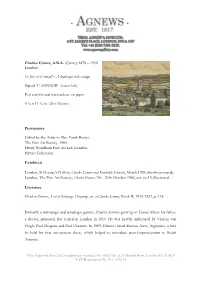
THOS. AGNEW & SONS LTD. 6 ST. JAMES’S PLACE, LONDON, SW1A 1NP Tel: +44 (0)20 7491 9219. www.agnewsgallery.com Charles Ginner, A.R.A. (Cannes 1878 – 1952 London) St. Just in Cornwall – A landscape with cottages Signed ‘C. GINNER’ (lower left) Pen and ink and watercolour on paper 9 ¾ x 11 ¾ in. (25 x 30 cm.) Provenance Gifted by the Artist to Mrs. Frank Rutter. The Fine Art Society, 1985. Henry Wyndham Fine Art Ltd, London. Private Collection. Exhibited London, St George's Gallery, Charles Ginner and Randolph Schwabe, March 1926 (details untraced). London, The Fine Art Society, Charles Ginner, 7th - 25th October 1985, cat. no.13, illustrated. Literature Charles Ginner, List of Paintings, Drawings, etc. of Charles Ginner, Book II, 1919-1924, p. 135. Primarily a townscape and landscape painter, Charles Ginner grew up in France where his father, a doctor, practised, but settled in London in 1910. He was heavily influenced by Vincent van Gogh, Paul Gauguin and Paul Cézanne. In 1909, Ginner visited Buenos Aires, Argentina, where he held his first one-person show, which helped to introduce post-Impressionism to South America. Thos Agnew & Sons Ltd, registered in England No 00267436 at 21 Bunhill Row, London EC1Y 8LP VAT Registration No 911 4479 34 THOS. AGNEW & SONS LTD. 6 ST. JAMES’S PLACE, LONDON, SW1A 1NP Tel: +44 (0)20 7491 9219. www.agnewsgallery.com He was a friend of Harold Gilman and Spencer Gore and through them was drawn into Walter Sickert’s circle, becoming a founder member of the Camden Town Group in 1911 and the London Group in 1913. -

100 Years of the London Group the English Are an Essentially
Moving with the times: 100 years of the London Group The English are an essentially conservative people, their suspicion of anything new or innovative, unless it can be seen to have an immediate usefulness or purpose, innate. The arts, whose lifeblood depends on precisely those qualities, have not been immune to its effects, as the current plight of the arts in the school curriculum makes only too plain while the history of the visual arts in England, certainly over the last two hundred years or more and probably since the Reformation, has been dogged by its influence. The response has nearly always been the determination of a small group of artists to set up new societies or artistic groupings; first and foremost, of course, there was the Royal Academy of Arts in 1768 and, in the 19thC., when that institution had slipped back into full-blown academic conservatism, there were first the Pre-Raphaelites and then, in 1886, the New English Art Club on hand to stir things up once again. Indeed the history of English Modernism could, from this point on, almost be written in terms of constant reaction and renewal through such associations of artists, culminating in that heady period, just before the First World War when the flurry of new artistic associations stirred up by the response of younger artists to the Modernist revelations of Roger Fry’s two great French Post-Impressionist exhibitions of 1910 and 1912 – the Camden Town Group, the Fitzroy Street Group and the Allied Artists’ Association in particular - in their turn reacted against the by now largely establishment New English. -

Scarica La Lista in Formato
Artinvest2000, i principali movimenti artistici. http://www.artinvest2000.com Dalla lettera A alla G ASTRATTISMO Astrattismo tendenza artistica del XX Secolo. Abbandonando la rappresentazione mimetica del mondo esterno, trova in generale le sue ragioni nella riflessione sulle specificità della ricerca formale e della percezione visiva. Parallelamente allo sviluppo di una speculazione estetica tra positivismo e spiritualismo (K. Fiedler, Origine dell'attività artistica, 1887; W. Worringer, Astrazione e empatia, 1908), molti artisti tendono alla rifondazione del proprio campo d'azione attraverso lo studio degli elementi formali che costituiscono le fondamenta sintattiche del linguaggio visivo, innescando un processo di sempre più radicale semplificazione e scomposizione delle forme. Una tendenza del genere, complicata dall'interesse per il meccanismo dei procedimenti percettivi, sposta progressivamente in secondo piano o elimina del tutto ogni preoccupazione rappresentativa. Sono soprattutto il "Sintetismo" e il decorativismo simbolista e la stilizzazione "Art nouveau" carica di suggestioni irrazionali e vitalistiche. ad alimentare il terreno culturale sul quale, attorno al 1910, si sviluppano diverse tendenze astratte nell'ambito dei movimenti d'avanguardia tedesco, russo, ceco e ungherese. Loro antecedenti immediati sono i due grandi movimenti innovatori dell'inizio del secolo, "Fauvisme" e "Cubismo". A questa duplice matrice formale si collegano i due modi principali dell'astrattismo, entrambi cresciuti nella ricerca di un ordine e di -

The London Group at Waterloo Festival 2019 SELF-SERVICE
The London Group at Waterloo Festival 2019 The London Group have organised three exhibitions for Waterloo Festival which explore the Festival’s 2019 theme ‘Transforming Being’. SELF-SERVICE, artists’ moving image, COMING GOOD: Come Hell or High Water, sculpture and METAMORPHOSIS, photography. The London Group is delighted to be taking part in Waterloo Festival and to be presenting three exhibitions. Together they offer the perfect opportunity to showcase examples of the range of its members’ artistic practices. SELF-SERVICE Artists' Moving Image The London Group & Friends What If You Created Artificial Life And It Started Worshipping You (film still) Eric Schockmel Date: 10 - 16 June 2019 / daily Mon-Sat 1-6pm, Sun 12-4pm Location: Old Crypt, St. John's Church, Waterloo 73, Waterloo Rd, South Bank, London SE1 8TY FREE Preview: Wed 12 June, 6-9pm “The age of automation will be the age of do it yourself”, Marshall McLuhan More and more we are being asked to do things ourselves. From shopping to car insurance, services that traditionally required a human representative have been redesigned so that customers complete their business interacting only with machines. Some might argue this gives us more flexibility and choice and while others see us all becoming unpaid employees, required to do the work in order to access what we need. Taking its lead from the check-out counters of supermarkets and petrol station forecourts, this exhibition brings together moving image works that respond to this idea of ‘self-service’. Works were contributed by members of the London Group, invited artists and artists chosen from an open call in response to the title. -

“Uproar!”: the Early Years of the London Group, 1913–28 Sarah Macdougall
“Uproar!”: The early years of The London Group, 1913–28 Sarah MacDougall From its explosive arrival on the British art scene in 1913 as a radical alternative to the art establishment, the early history of The London Group was one of noisy dissent. Its controversial early years reflect the upheavals associated with the introduction of British modernism and the experimental work of many of its early members. Although its first two exhibitions have been seen with hindsight as ‘triumphs of collective action’,1 ironically, the Group’s very success in bringing together such disparate artistic factions as the English ‘Cubists’ and the Camden Town painters only underlined the fragility of their union – a union that was further threatened, even before the end of the first exhibition, by the early death of Camden Town Group President, Spencer Gore. Roger Fry observed at The London Group’s formation how ‘almost all artist groups’, were, ‘like the protozoa […] fissiparous and breed by division. They show their vitality by the frequency with which they split up’. While predicting it would last only two or three years, he also acknowledged how the Group had come ‘together for the needs of life of two quite separate organisms, which give each other mutual support in an unkindly world’.2 In its first five decades this mutual support was, in truth, short-lived, as ‘Uproar’ raged on many fronts both inside and outside the Group. These fronts included the hostile press reception of the ultra-modernists; the rivalry between the Group and contemporary artists’ -

10.2 EMC Cohort 2020 Y10 Summer Holiday HW
When the Summer Holiday starts to bore you……I have the perfect antidote……………! Work hard now and you will find Year 11 less stressful. “Wonder & Dread” Alke Schmidt 2018 “Wonder & Dread” Alke Schmidt 2018 Close up- For your artist copy (don’t include the artist working on it in-front though) 10.2 SUMMER HOLIDAY HOMEWORK - Students to complete all of the work listed below; TASK A – Complete and present all your identity sketchbook work and final piece(s). No time available in Y11! TASK B – Alke Schmidt “Wonder & Dread” 2018- (page 12 in your booklets) 1. Type up your notes/annotations on this piece during the Saltaire trip into 2-3 paragraphs. Explain what media has been used, the mark-making created and what is the background and why. Try to think about what the artist is communicating. 2. Choose a section of the artwork and make a small (max A5) copy using any media- pencil, coloured pencils, collaged paper, watercolours. TASK C –portrait by David Hockney 1. Create an A5 copy of a section of one of the portraits with the blue backgrounds. Any media. You can use one of your own images/photos that you took on the day or one provided. 2. Take photographs of someone dressed / posing like the person in Hockneys’ portrait. Use one of the photographs to create your own A4 Hockney style portrait. Any media. Save (and print if possible) all your photographs. TASK C – ‘Arrival of Spring’ by David Hockney 1. Use the outline and colour version provided to create an A5 copy of the ‘Arrival of Spring’ picture by Hockney. -
The Centenary Open Installtion View, View, Installtion 2013 Is Now Over, and There Has Been a Record- Breaking Number of Entries This Year
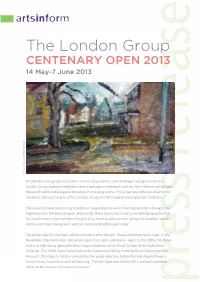
e The London Group s CENTENARY OPEN 2013 14 May-7 June 2013 a e l e , Peter Clossick , Peter r Across The Road In 1930 the roof garden of London’s famous department store Selfridges was given over to a London Group sculpture exhibition where prestigious members such as Henry Moore and Barbara Hepworth exhibited alongside the work of emerging artists. This is just one inclusive show in the s illustrious 100-year history of The London Group, the UK’s longest running artists’ collective. The London Group have a long tradition of supporting the work of emerging artists through their s flagship event, the biennial open. Historically, these shows were seen as exhibiting opportunities for visual makers who had been thought of as minority status artists: young art students, women artists and those making work without commercial gallery patronage. The golden age for the open submission came after the war. These exhibitions were huge. In the e November 1952 exhibition, 360 works came from open submission. Again in the 1980s the shows had very high status again with three large exhibitions at the Royal College of Art Gulbenkian Galleries. The 1990s Opens were held at the Concourse Gallery in the Barbican Centre with the Artsinform CoBiennialmmunicatio n1995s Ltd. Open Exhibition selected by five guest selectors, Robin Klassnik, Angela Flowers, r t. +44 (0)1273 488996 w. www.artsinJenniform.co .Lomax,uk Louisa Buck and William Ling. The last Open was held in 2011 and had a positive e. pr@artsinfoeffectrm.co.uk on the careers of its winners as ever: Pipe Passage, 151b High Stret, Lewes, East Sussex, BN7 1XU Company No: 06392254 p “Winning the Arcadia Missa Prize was an honour and great surprise. -
Interior Scene, Attributed to an Unknown
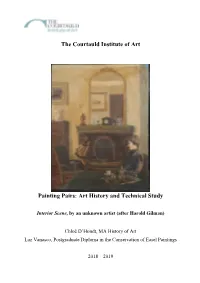
The Courtauld Institute of Art Painting Pairs: Art History and Technical Study Interior Scene, by an unknown artist (after Harold Gilman) Chloé D’Hondt, MA History of Art Luz Vanasco, Postgraduate Diploma in the Conservation of Easel Paintings 2018 – 2019 Table of contents LIST OF FIGURES ................................................................................................................. 3 INTRODUCTION TO THE PROJECT ................................................................................ 4 INTERIOR SCENE: INTRODUCTORY REMARKS ......................................................... 5 HAROLD GILMAN ................................................................................................................ 7 COMPARATIVE VISUAL ANALYSIS .............................................................................. 10 MATERIALS AND TECHNIQUE ....................................................................................... 13 HAROLD GILMAN ............................................................................................................................................. 13 INTERIOR SCENE VS. HAROLD GILMAN ........................................................................................................... 16 Support ......................................................................................................................................................... 16 Ground ........................................................................................................................................................ -

Nold, B.A.; Hon
'<,~ t~ (';~k w(~.:~~ IIL". THE LEEDS ART COLLECTIONS FUND President The Rt. Hon. the Earl of Halifax; Vice-President The Rt. Hon. the Earl of Harewood, LL.D.; Trustees C. S. Reddihough, George Black, F.R.c.s.,W. T. Oliver, M.A.; Committee Mrs. Sheila Bidgood, D. B. Feather, F.R.c.s., Mrs. Sara Gilchrist, A. Haigh, J. M. McCloy, Councillor Dr. J. R. Sherwin, Mrs. S. M. C. Tomlinson; Hon. Treasurer Martin Arnold, B.A.; Hon. Secretary Robert Rowe; Hon. Membership Secretary W. B. Black- burn; Hon. Social Secretary Mrs. M. A. Goldie. The Leeds Art Collections Fund is one of the oldest supporting bodies for the visual arts in Great Britain, a source of regular funds for buying works of art for the Leeds collections. Why not identify yourself with the Art Gallery, Temple Newsam House and Lotherton Hall, receive your Arts Calendar free, receive invitations to all functions, private views and organised visits to places of interest. The minimum subscription is g3 00 individual and g5 00 for husband and wife. Enquiries and application forms from the Hon. Secretary at Temple Newsam House, Leeds LS15 OAE. The Arts Calendar may be obtained for a subscription ofgl per annum, including postage (2 issues); single copies may be purchased at the Art Gallery, Temple Newsam House and Lotherton Hall, 50p each. Note: starting with the first issue published in 1947, the entire Leeds Arts Calendar is now available on microfilm. Write for information or send orders direct to Xerox University Microfilms, Ann Arbor, Michigan 48106, U.S.A. -

The Role of the Royal Academy in English Art 1918-1930. COWDELL, Theophilus P
The role of the Royal Academy in English art 1918-1930. COWDELL, Theophilus P. Available from Sheffield Hallam University Research Archive (SHURA) at: http://shura.shu.ac.uk/20673/ This document is the author deposited version. You are advised to consult the publisher's version if you wish to cite from it. Published version COWDELL, Theophilus P. (1980). The role of the Royal Academy in English art 1918-1930. Doctoral, Sheffield Hallam University (United Kingdom).. Copyright and re-use policy See http://shura.shu.ac.uk/information.html Sheffield Hallam University Research Archive http://shura.shu.ac.uk onemeia u-ny roiyiecnmc 100185400 4 Mill CC rJ o x n n Author Class Title Sheffield Hallam University Learning and IT Services Adsetts Centre City Campus Sheffield S1 1WB NOT FOR LOAN Return to Learning Centre of issue Fines are charged at 50p per hour Sheffield Haller* University Learning snd »T Services Adsetts Centre City Csmous Sheffield SI 1WB ^ AUG 2008 S I2 J T 1 REFERENCE ProQuest Number: 10702010 All rights reserved INFORMATION TO ALL USERS The quality of this reproduction is dependent upon the quality of the copy submitted. In the unlikely event that the author did not send a complete manuscript and there are missing pages, these will be noted. Also, if material had to be removed, a note will indicate the deletion. uest ProQuest 10702010 Published by ProQuest LLC(2017). Copyright of the Dissertation is held by the Author. All rights reserved. This work is protected against unauthorized copying under Title 17, United States Code Microform Edition © ProQuest LLC. -
Old and New in Modernist Art
Chapter 2: Old and New in Modernist Art Mr. Thomas T. Baxter presents what appears to be a figure of Christ teaching a dickey-bird to chew worms. This work is labelled "St. Francis" (D‟Asise). I cannot concede his background but the face is remarkable; it is painted with very great skill, and the frenetic modernist who rushes by the picture merely because of the demoded subject-matter will miss one of the best pieces of detail in the exhibition. (Ezra pound, writing as B. H. Dias, in The New Age for January 17, 1918--22.12.235, emphasis added) Among the many kinds of artists, it may be that there are some who are hybrid. Some, that is to say, bore deeper and deeper into the stuff of their own art; others are always making raids into the lands of others. Sickert, it may be, is among the hybrids, the raiders. But . he is probably the best painter now living in England. (Virginia Woolf, writing in 1933, The Captain's Death Bed and Other Essays, 201-202, emphasis added) In 1918, we find Ezra Pound worrying about "the frenetic modernist" who will miss something of great beauty because its subject matter, which Pound himself has mocked, is "demoded." And, as late as 1933, we find Virginia Woolf, reporting on a conversation in "Bloomsbury" about Walter Sickert, in which a consensus is reached that this derivative painter, whose work is often naturalistic in its content, and might well have been associated by Woolf with her despised Edwardians, is the best that England has to offer.