Robert Frank
Total Page:16
File Type:pdf, Size:1020Kb
Load more
Recommended publications
-

Pressemappe American Photography
Exhibition Facts Duration 24 August – 28 November 2021 Virtual Opening 23. August 2021 | 6.30 PM | on Facebook-Live & YouTube Venue Bastion Hall Curator Walter Moser Co-Curator Anna Hanreich Works ca. 180 Catalogue Available for EUR EUR 29,90 (English & German) onsite at the Museum Shop as well as via www.albertina.at Contact Albertinaplatz 1 | 1010 Vienna T +43 (01) 534 83 0 info@albertina.at www.albertina.at Opening Hours Daily 10 am – 6 pm Press contact Daniel Benyes T +43 (01) 534 83 511 | M +43 (0)699 12178720 d.benyes@albertina.at Sarah Wulbrandt T +43 (01) 534 83 512 | M +43 (0)699 10981743 s.wulbrandt@albertina.at 2 American Photography 24 August - 28 November 2021 The exhibition American Photography presents an overview of the development of US American photography between the 1930s and the 2000s. With works by 33 artists on display, it introduces the essential currents that once revolutionized the canon of classic motifs and photographic practices. The effects of this have reached far beyond the country’s borders to the present day. The main focus of the works is on offering a visual survey of the United States by depicting its people and their living environments. A microcosm frequently viewed through the lens of everyday occurrences permits us to draw conclusions about the prevalent political circumstances and social conditions in the United States, capturing the country and its inhabitants in their idiosyncrasies and contradictions. In several instances, artists having immigrated from Europe successfully perceived hitherto unknown aspects through their eyes as outsiders, thus providing new impulses. -

Limited Edition Platinum Prints of Iconic Images by Robert Capa
PRESS RELEASE Contact : Amy Wentz Ruder Finn Arts & Communications Counselors wentza@ruderfinn.com / 212-715-1551 Limited Edition Platinum Prints of Iconic Images by Robert Capa, Henri Cartier-Bresson, George Rodger and David Seymour to be Published in Unique Hand-Bound Collector’s Book Magnum Founders, In Celebration of Sixty Years Provides Collectors Once-in-a-Lifetime Opportunity to Own Part of Photographic History Santa Barbara, California, June 6, 2007 – Verso Limited Editions, a publisher of handcrafted books that celebrate the work of significant photographers, announced the September 2007 publication of Magnum Founders, In Celebration of Sixty Years . Magnum Founders will include twelve bound and one free-standing rare platinum, estate-stamped prints of iconic images by four visionary photographers who influenced the course of modern photographic history – Robert Capa, Henri Cartier-Bresson, George Rodger and David “Chim” Seymour. The collector’s book celebrates the 60 th anniversary of Magnum Photos, a photographic co- operative founded by these four men and owned by its photographer-members. Capa, Cartier- Bresson, Rodger and Seymour created Magnum in 1947 to reflect their independent natures as both people and photographers – the idiosyncratic mix of reporter and artist that continues to define Magnum today. The first copy of Magnum Founders will be privately unveiled on Thursday, June 21 at the Museum of Modern Art, New York – birthplace of Magnum Photos – during the “Magnum Festival,” a month-long series of events celebrating the art of documentary photography. Magnum Founders will also be on view to the public at the Howard Greenberg Gallery, 41 East 52 nd St., New York, beginning on Friday, June 22. -

Street Seen Teachers Guide
JAN 30–APR 25, 2010 THE PSYCHOLOGICAL GESTURE IN AMERICAN PHOTOGRAPHY, 1940–1959 TEACHERS GUIDE CONTENTS 2 Using This Teachers Guide 3 A Walk through Street Seen 10 Vocabulary 11 Cross-Curricular Activities 15 Lesson Plan 18 Further Resources cover image credit Ted Croner, Untitled (Pedestrian on Snowy Street), 1947–48. Gelatin silver print, 14 x 11 in. Howard Greenberg Gallery, New York. ©Ted Croner Estate prepared by Chelsea Kelly, School & Teacher Programs Manager, Milwaukee Art Museum STREET SEEN: The Psychological Gesture in American Photography, 1940–1959 TEACHERS GUIDE 1 USING THIS TEACHERS GUIDE This guide, intended for teachers of grades 6–12, is meant to provide background information about and classroom implementation ideas inspired by Street Seen: The Psychological Gesture in American Photography, 1940–1959, on view at the Milwaukee Art Museum through April 25, 2010. In addition to an introductory walk-through of the exhibition, this guide includes useful vocabulary, discussion questions to use in the galleries and in the classroom, lesson ideas for cross-curricular activities, a complete lesson plan, and further resources. Learn more about the exhibition at mam.org/streetseen. Let us know what you think of this guide and how you use it. Email us at teachers@mam.org. STREET SEEN: The Psychological Gesture in American Photography, 1940–1959 TEACHERS GUIDE 2 A WALK THROUGH STREET SEEN This introduction follows the organization of the exhibition; use it and the accompanying discussion questions as a guide when you walk through Street Seen with your students. Street Seen: The Psychological Gesture in American Photography, 1940–1959 showcases the work of six American artists whose work was directly influenced by World War II. -

The Magnificent Eleven: the D-Day Photographs of Robert Capa
Men of the 16th Infantry Regiment seek shelter from German machine-gun fire in shallow water behind "Czech hedgehog" beach obstacles, Easy Red sector, Omaha Beach. © Robert Capa/Magnum Photos. The Magnificent Eleven: The D-Day Photographs of Robert Capa "The war correspondent has his stake — his life — in his own The Photographer: Bob Capa hands, and he can put it on this When soldiers of the 16th Regiment of the 1st horse or that horse, or he can put it back in his pocket at the Infantry Division landed at Omaha Beach on June 6, very last minute ... I am a 1944, photographer Robert Capa, in the employ of LIFE gambler. I decided to go in with Company E in the first wave." magazine, was among them. – Robert Capa Perhaps the best known of all World War II combat photographers, the Hungarian-born Capa The ten photos selected from the eleven surviving negatives had made a name for and published by LIFE on June himself well before 19, 1944 ... climbing into a landing craft with men of Company E in the early morning hours of D-Day. He risked his life on more than one occasion during the Spanish Civil War and had taken what is considered the most eerily fascinating of all war photographs. The famous image reportedly depicts the death of Spanish Loyalist militiaman Frederico Borrell Garcia as he is struck in the chest by a Nationalist bullet on a barren Iberian hillside. Capa was known to say, "If your pictures aren't good enough, you aren't close enough." On D-Day, he came close once again. -

Street Photography
Columbia College Chicago Framing ideas street Photography Curriculum guide Aimed at middle school and high school and college age students, this resource is aligned with Illinois Learning Standards for English Language Arts Incorporating the Common Core and contains questions for looking and discussion, information on the artists and artistic traditions and classroom activities. A corresponding image set can be found HERE. The MoCP is a nonprofit, tax- exempt organization accredited by the American Alliance of Museums. The Museum is generously supported by Columbia College Chicago, the MoCP antonio Perez A Man Dressed as Charro on his Horse Waits for his Take-Out Food before the Start of the Annual Cinco de Mayo Parade Down Advisory Committee, individuals, Cermak in Chicago, September 2000. Museum purchase private and corporate foundations, and government agencies including the Illinois Arts Council, a state agency. The museum’s education work is additionally supported by After School Matters, the Lloyd A. Fry Foundation, and the National Endowment for the Arts. Special funding for this guide was provided by the Terra Foundation for American Art. 1 street Photography That crazy feeling in America when the sun is hot on the streets and the music comes out from a jukebox or from a nearby funeral, that’s what Robert Frank has captured in tremendous photographs taken as he traveled on the road around practically all forty-eight states in an old used car…Long shot of night road arrowing forlorn into immensities and flat of impossible-to- believe America in New Mexico under the prisoner’s moon… -Jack Kerouac, (from the introduction Robert Frank’s book The Americans) robert Frank robert Frank San Francisco, 1956 Political Rally, Chicago, 1956 Gift of Mr. -
On Photography, History, and Memory in Spain Hispanic Issues on Line Debates 3 (2011)
2 Remembering Capa, Spain and the Legacy of Gerda Taro, 1936–1937 Hanno Hardt Press photographs are the public memory of their times; their presence in the public sphere has contributed significantly to the pictures in our heads on which we rely for a better understanding of the world. Some photographs have a special appeal, or an extraordinary power, which makes them icons of a particular era. They stand for social or political events and evoke the spirit of a period in history. They also help define our attitudes towards people or nations and, therefore, are important sources of emotional and intellectual power. War photography, in particular, renders imagery of this kind and easily becomes a source of propaganda as well. The Spanish Civil War (1936–39) was the European testing ground for new weapons strategies by the Soviet Union and Nazi Germany. Both aided their respective sides in the struggle between a Popular Front government— supported mainly by left-wing parties, workers, and an educated middle class—and “Nationalist” forces supported by conservative interests, the military, clergy, and landowners. The conflict resulted in about 500,000 deaths, thousands of exiles, and in a dictatorship that lasted until Franco’s death in 1975. It was a time when large-scale antifascist movements such as the Republican army, the International Brigades, the Workers’ Party of Marxist Unification, and anarchist militias (the Iron Column) united in their struggle against the military rebellion led by Francisco Franco. Foreigners joined the International Brigade, organized in their respective units, e.g., the Lincoln Battalion (USA), the British Battalion (UK), the Dabrowski Battalion (Poland), the Mackenzie-Papineau Battalion (Canada), and the Naftali Botwin Company (Poland and Spain, including a Jewish unit). -

America Through Street Photography
From the Instructor Sarah wrote this piece for my section of the Genre and Audience WR X cluster. Students had undertaken semester-long research projects and, in the final assignment for the course, were asked to reimagine their academic arguments for a public audience. Deciding to write in the style of The New Republic, which is, in the publication’s own words, “tailored for smart, curi- ous, socially aware readers.” Sarah’s focus on street photography brings her research on classic American images to a non-expert audience with diverse professional and disciplinary perspectives, appealing to their interests in history and the arts while tapping into contemporary culture. — Gwen Kordonowy WR 150: The American Road 135 From the Writer When I enrolled in an experimental writing class entitled “The American Road,” I assumed that the semester would be filled with discussions about the physical American road, its attractions, and its place in American history. While the physical road was an important subject in the class, I learned that this “American Road” was expansive beyond its physical limi- tations, able to encompass topics as broad and abstract as social progress, popular television shows, and, in my case, photography. I ultimately chose to investigate the works of two American street photographers, Robert Frank and Lee Friedlander, whose approaches to photography reveal much about life in America and what it means to be an American. While both photographers frequently feature the road in their pictures, I chose to focus more on the people and culture found alongside it and how they represent America. -

University Microfilms International 300 N
THE CRITICISM OF ROBERT FRANK'S "THE AMERICANS" Item Type text; Thesis-Reproduction (electronic) Authors Alexander, Stuart Publisher The University of Arizona. Rights Copyright © is held by the author. Digital access to this material is made possible by the University Libraries, University of Arizona. Further transmission, reproduction or presentation (such as public display or performance) of protected items is prohibited except with permission of the author. Download date 23/09/2021 11:13:03 Link to Item http://hdl.handle.net/10150/277059 INFORMATION TO USERS This reproduction was made from a copy of a document sent to us for microfilming. While the most advanced technology has been used to photograph and reproduce this document, the quality of the reproduction is heavily dependent upon the quality of the material submitted. The following explanation of techniques is provided to help clarify markings or notations which may appear on this reproduction. 1. The sign or "target" for pages apparently lacking from the document photographed is "Missing Page(s)". If it was possible to obtain the missing page(s) or section, they are spliced into the film along with adjacent pages. This may have necessitated cutting through an image and duplicating adjacent pages to assure complete continuity. 2. When an image on the film is obliterated with a round black mark, it is an indication of either blurred copy because of movement during exposure, duplicate copy, or copyrighted materials that should not have been filmed. For blurred pages, a good image of the page can be found in the adjacent frame. If copyrighted materials were deleted, a target note will appear listing the pages in the adjacent frame. -
Robert Frank Published by Steidl
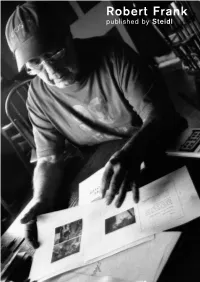
Robert Frank published by Steidl The Robert Frank Project “The Robert Frank Project” is an ambitious long term publishing programme which encompasses Robert Frank’s complete oeuvre – reprints of his classic books, reprints of some less well known small books, the publication of previously unseen projects, newly conceived bookworks, and his Complete Film Works in specially designed col- lector’s DVD sets. This ensures the legacy of this original and seminal artist and that Robert Frank’s work will be available and accessible for many years to come in a sche- me and to a standard that the artist himself has overseen. The publication of a new edition of “The Americans” on 15th May, 2008, the fiftieth anniversary of the first edition, is the fulcrum of The Robert Frank Project. It presages a major touring exhibition and accompanying catalogue from the National Gallery of Art, Washington D.C., “Looking In: Robert Frank’s The Americans”, which opens in January 2009. This brochure contains details of all the books and films which are currently available and those planned for the future. Gerhard Steidl Ute Eskildsen Laura Israel Publisher Editorial Adviser Film Works Adviser Delpire, 1958 Il Saggiatore, 1959 Grove Press, 1959 Delpire, 1993 Aperture, 1969 Christian, 1986 Scalo, 1993 Scalo, 2000 A Short Publishing History of “The Americans” by Monte Packham Robert Frank’s “The Americans” was first published in 1958 by Robert Delpire in Paris. It featured 83 of Frank’s photographs taken in America in 1955 and 1956, accompanied by writings in French about American political and social history selected by Alain Bosquet. -

MAGNUM PHOTOS and PICTO 1950-2020
70 Years of Correspondences: MAGNUM PHOTOS and PICTO 1950-2020 NEW YORK, NY / ACCESSWIRE / Oct 26, 2020 / RICHARD TAITTINGER GALLERY is pleased to announce the exhibition 70 YEARS OF CORRESPONDENCES: MAGNUM PHOTOS AND PICTO 1950-2020, curated by photography historian Carole Naggar. This exhibition is a collaboration with MAGNUM PHOTOS and PICTO and a celebration of the seventy years of partnership between two important institutions in the photo world. This exhibition consists of three parts - YESTERDAY, TODAY and TOMORROW - and is an overview of this continuous collaboration since 1950. It is presented through the work of nineteen photographers and more than 100 prints (vintage and modern). Curated by Carole Naggar October 29 - December 20, 2020 Opening: October 29, 2020, 2 p.m. - 9 p.m. MAGNUM PHOTOS was founded in Paris in 1947 by Robert Capa, Henri Cartier-Bresson, George Rodger and David 'Chim' Seymour in response to World War II and the need to observe and report on the state of the world. Today her agency has 89 international members (past and present). Founded in 1950 by Pierre and France Gassmann, PICTO produced works for Magnum's founders such as Henri Cartier-Bresson, Robert Capa and Chim, as well as other notable artists such as William Klein, Willy Ronis, Robert Doisneau and Edouard Boubat. Photography is an innovative medium that records history and change and deals with them. This exhibition celebrates leading figures in the field and offers a journey through the medium of the past 70 years that invites us to imagine its future. 70 YEARS OF CORRESPONDENCES: MAGNUM PHOTOS AND PICTO 1950-2020 will be on display at RICHARD TAITTINGER GALLERY, 154 Ludlow Street, from October 29th to December 20th, 2020. -

Robert Frank: the Americans Pdf, Epub, Ebook
ROBERT FRANK: THE AMERICANS PDF, EPUB, EBOOK Robert Frank,Jack Kerouac | 180 pages | 09 Jul 2009 | Steidl Publishers | 9783865215840 | English | Gottingen, Germany Robert Frank: The Americans PDF Book Tri-X film! On the occasion of the 50th anniversary of the book's original publication 15 May , a new edition was published by Steidl. As he has done for every edition of The Americans , Frank changed the cropping of many of the photographs, usually including more information, and two slightly different photographs were used. Much of the criticism Frank faced was as well related to his photojournalistic style, wherein the immediacy of the hand-held camera introduced technical imperfections into the resulting images. Becker has written about The Americans as social analysis:. Help Learn to edit Community portal Recent changes Upload file. Where are we going? It could seem as if Frank threw his Leica into the world and let it catch what it could, which happened, without fail, to be something exciting—fascination, pain, hilarity, disgust, longing. The show presented the work of Diane Arbus , Lee Friedlander and Garry Winogrand , who at the time were relatively little known younger-generation beneficiaries of Mr. Retrieved 5 July By Philip Gefter. Silverstein died in , Mr. Retrieved She is now known as Mary Frank. Over the next 10 years, Mr. Safe in neutral Switzerland from the Nazi threat looming across Europe, Robert Frank studied and apprenticed with graphic designers and photographers in Zurich, Basel and Geneva. Rizzo has been lighting the stages of Broadway for almost forty years. In , The Americans was finally published in the United States by Grove Press , with the text removed from the French edition due to concerns that it was too un-American in tone. -

ROBERT CAPA Spanish Civil War and Wwii BIOGRAPHY - Born in Budapest, 1913 As Andre Friedmann - Studied and Worked in Berlin - Moved to Paris in 1933
ROBERT CAPA spanish civil war and wwii BIOGRAPHY - Born in Budapest, 1913 as Andre Friedmann - Studied and worked in Berlin - Moved to Paris in 1933 - met Gerda Taro Robert Capa on a destroyer during the ship arrivals in French beach for landings and liberation of France. - 1936 - 1938: Photographed the Spanish Civil War - 1939: Capa moves to New York - World War II - travels throughout Europe - D-Day Photographs - 1947: Travels to Russia with friend / writer John Steinbeck - 1947: Forms Magnum - 1954: Travels to Vietnam to cover the First Indochina war - Dies while on assignment MAGNUM - Had been thinking about the idea for many years - Met Chim in Paris who introduced him to Cartier-Bresson - During WWII met Rodger - In 1947 officially founded the agency SPANISH CIVIL WAR - War timed with technological developments - Given assignments by Vu - Exclusively shot for the Republican side - Photographs from 1936-1938 - 1936: Travels to Spain with Gerda Taro - Barcelona - Cordoba SPAIN. Barcelona. August 1936. - Madrid SPAIN. Andalucia. September 5th, 1936. Cerro Muriano, Córdoba front. Civilians fleeing. SPAIN. Santa Eulalia. 1936. Republican soldiers during an attack. - Highly controversial - First published in Vu on September 23rd, 1936 - First doubted in 1975 - 1996 soldier identified as Federico Borrell García - Question of authenticity - do specifics matter? SPAIN. Córdoba front. Early September, 1936. Death of a loyalist militiaman. Spanish Civil War Cont’d - November of 1936 Capa travels to Madrid alone - Shows fulls horror of the war - Gerda dies in Spain in 1938 SPAIN. Madrid. Winter 1936-1937. After an Italo-German air raid. D-Day Landing - June 6, 1944 Allied troops advance through Normandy - Omaha Beach - Capa is the only press photographer present GB.