Dangerous Prisoners: Confining the Convention Army In
Total Page:16
File Type:pdf, Size:1020Kb
Load more
Recommended publications
-
Question Report
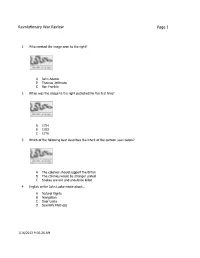
Revolutionary War Review Page 1 1 Who created the image seen to the right? A John Adams B Thomas Jefferson C Ben Franklin 2 When was the image to the right published for the first time? A 1754 B 1763 C 1776 3 Which of the following best describes the intent of the cartoon seen below? A The colonies should support the British B The colonies would be stronger united C Snakes are evil and should be killed 4 English writer John Locke wrote about... A Natural Rights B Navigation C Door Locks D Scientific Methods 1/16/2013 9:00:26 AM Revolutionary War Review Page 2 5 This young African-American became a famous poet during the years of our revolution, and even Washington became a big fan of her writing. A Phyllis Wheatley B Eliza Lucas Pinckney C Molly Pitcher D Francois de Grasse 6 What increased political awareness in the colonies during the mid-1700's? A Television Commercials B Radio Commercials C Newspapers D Public Speeches 7 Who introduce the resolution to the Continental Congress to declare independence? A Richard Henry Lee B Thomas Jefferson C John Adams D Benjamin Franklin 8 Where did Washington attack the Hessians on Christmas... after crossing the icy Delaware River? A Princeton B Saratoga C New York D Trenton 9 Who led the Patriots to victory at the Battle of Cowpens in South Carolina? A Molly Pitcher B Daniel Morgan 10 Washington and his troops spent a harsh winter here during the winter of 1777 - 1778. A Trenton B Saratoga C Valley Forge D Yorktown 11 In the 1750's, the British sent G. -
'Deprived of Their Liberty'
'DEPRIVED OF THEIR LIBERTY': ENEMY PRISONERS AND THE CULTURE OF WAR IN REVOLUTIONARY AMERICA, 1775-1783 by Trenton Cole Jones A dissertation submitted to Johns Hopkins University in conformity with the requirements for the degree of Doctor of Philosophy Baltimore, Maryland June, 2014 © 2014 Trenton Cole Jones All Rights Reserved Abstract Deprived of Their Liberty explores Americans' changing conceptions of legitimate wartime violence by analyzing how the revolutionaries treated their captured enemies, and by asking what their treatment can tell us about the American Revolution more broadly. I suggest that at the commencement of conflict, the revolutionary leadership sought to contain the violence of war according to the prevailing customs of warfare in Europe. These rules of war—or to phrase it differently, the cultural norms of war— emphasized restricting the violence of war to the battlefield and treating enemy prisoners humanely. Only six years later, however, captured British soldiers and seamen, as well as civilian loyalists, languished on board noisome prison ships in Massachusetts and New York, in the lead mines of Connecticut, the jails of Pennsylvania, and the camps of Virginia and Maryland, where they were deprived of their liberty and often their lives by the very government purporting to defend those inalienable rights. My dissertation explores this curious, and heretofore largely unrecognized, transformation in the revolutionaries' conduct of war by looking at the experience of captivity in American hands. Throughout the dissertation, I suggest three principal factors to account for the escalation of violence during the war. From the onset of hostilities, the revolutionaries encountered an obstinate enemy that denied them the status of legitimate combatants, labeling them as rebels and traitors. -
10-2 157410 Volumes 1-7 Open FA 10-2
10-2_157410_volumes_1-7_open FA 10-2 RG Volume Reel no. Title / Titre Dates no. / No. / No. de de bobine volume RG10-A-1-a 1 10996 Copy made of a surrender from the Six Nations to Caleb Benton, John Livingston and 1796-05-27 Associates, entered into 9 July 1788 RG10-A-1-a 1 10996 Copy made of a surrender from the Six Nations to Caleb Benton, John Livingston and 1796-08-31 Associates, entered into 9 July 1788 RG10-A-1-a 1 10996 Copy made of a surrender from the Six Nations to Caleb Benton, John Livingston and 1796-11-17 Associates, entered into 9 July 1788 RG10-A-1-a 1 10996 Copy made of a surrender from the Six Nations to Caleb Benton, John Livingston and 1796-12-28 Associates, entered into 9 July 1788 RG10-A-1-a 1 10996 William Dummer Powell to Peter Russell respecting Joseph Brant 1797-01-05 RG10-A-1-a 1 10996 Robert Prescott to Peter Russell respecting the Indian Department - Enclosed: Copy of Duke of 1797-04-26 Portland to Prescott, 13 December 1796, stating that the Lieutenant Governor of Upper Canada will head the Indian Department, but that the Department will continue to be paid from the military chest - Enclosed: Copy of additional instructions to Lieutenant Governor U.C., 15 December 1796, respecting the Indian Department - Enclosed: Extract, Duke of Portland to Prescott, 13 December 1796, respecting Indian Department in U.C. RG10-A-1-a 1 10996 Robert Prescott to Peter Russell sending a copy of Robert Liston's letter - Enclosed: Copy, 1797-05-18 Robert Liston to Prescott, 22 April 1797, respecting the frontier posts RG10-A-1-a -

George Washington Papers, Series 2, Letterbooks 1754-1799
George Washington Papers, Series 2, Letterbooks 1754-1799 To LUND WASHINGTON February 28, 1778. …If you should happen to draw a prize in the militia , I must provide a man, either there or here, in your room; as nothing but your having the charge of my business, and the entire confidence I repose in you, could make me tolerable easy from home for such a length of time as I have been, and am likely to be. This therefore leads me to say, that I hope no motive, however powerful, will induce you to leave my business, whilst I, in a manner, am banished from home; because I should be unhappy to see it in common hands. For this reason, altho' from accidents and misfortunes not to be averted by human foresight, I make little or nothing from my Estate, I am still willing to increase your wages, and make it worth your while to continue with me. To go on in the improvement of my Estate in the manner heretofore described to you, fulfilling my plans, and keeping my property together, are the principal objects I have in view during these troubles; and firmly believing that they will be accomplished under your management, as far as circumstances and acts of providence will allow, I feel quite easy under disappointments; which I should not do, if my business was in common hands, 38 liable to suspicions. I am, etc. 38. Extract in “Washington's Letter Book, No. 5.” Lund answered (March 18): “By your letter I should suppose you were apprehensive I intended to leave you. -
David Library of the American Revolution Guide to Microform Holdings
DAVID LIBRARY OF THE AMERICAN REVOLUTION GUIDE TO MICROFORM HOLDINGS Adams, Samuel (1722-1803). Papers, 1635-1826. 5 reels. Includes papers and correspondence of the Massachusetts patriot, organizer of resistance to British rule, signer of the Declaration of Independence, and Revolutionary statesman. Includes calendar on final reel. Originals are in the New York Public Library. [FILM 674] Adams, Dr. Samuel. Diaries, 1758-1819. 2 reels. Diaries, letters, and anatomy commonplace book of the Massachusetts physician who served in the Continental Artillery during the Revolution. Originals are in the New York Public Library. [FILM 380] Alexander, William (1726-1783). Selected papers, 1767-1782. 1 reel. William Alexander, also known as “Lord Sterling,” first served as colonel of the 1st NJ Regiment. In 1776 he was appointed brigadier general and took command of the defense of New York City as well as serving as an advisor to General Washington. He was promoted to major- general in 1777. Papers consist of correspondence, military orders and reports, and bulletins to the Continental Congress. Originals are in the New York Historical Society. [FILM 404] American Army (Continental, militia, volunteer). See: United States. National Archives. Compiled Service Records of Soldiers Who Served in the American Army During the Revolutionary War. United States. National Archives. General Index to the Compiled Military Service Records of Revolutionary War Soldiers. United States. National Archives. Records of the Adjutant General’s Office. United States. National Archives. Revolutionary War Pension and Bounty and Warrant Application Files. United States. National Archives. Revolutionary War Rolls. 1775-1783. American Periodicals Series I. 33 reels. Accompanied by a guide. -
Henry Clinton Papers, Volume Descriptions
Henry Clinton Papers William L. Clements Library Volume Descriptions The University of Michigan Finding Aid: https://quod.lib.umich.edu/c/clementsead/umich-wcl-M-42cli?view=text Major Themes and Events in the Volumes of the Chronological Series of the Henry Clinton papers Volume 1 1736-1763 • Death of George Clinton and distribution of estate • Henry Clinton's property in North America • Clinton's account of his actions in Seven Years War including his wounding at the Battle of Friedberg Volume 2 1764-1766 • Dispersal of George Clinton estate • Mary Dunckerley's account of bearing Thomas Dunckerley, illegitimate child of King George II • Clinton promoted to colonel of 12th Regiment of Foot • Matters concerning 12th Regiment of Foot Volume 3 January 1-July 23, 1767 • Clinton's marriage to Harriet Carter • Matters concerning 12th Regiment of Foot • Clinton's property in North America Volume 4 August 14, 1767-[1767] • Matters concerning 12th Regiment of Foot • Relations between British and Cherokee Indians • Death of Anne (Carle) Clinton and distribution of her estate Volume 5 January 3, 1768-[1768] • Matters concerning 12th Regiment of Foot • Clinton discusses military tactics • Finances of Mary (Clinton) Willes, sister of Henry Clinton Volume 6 January 3, 1768-[1769] • Birth of Augusta Clinton • Henry Clinton's finances and property in North America Volume 7 January 9, 1770-[1771] • Matters concerning the 12th Regiment of Foot • Inventory of Clinton's possessions • William Henry Clinton born • Inspection of ports Volume 8 January 9, 1772-May -

The Time Trial of Benedict Arnold 1 National Museum of American History
The Time Trial of Benedict Arnold 1 National Museum of American History The Time Trial of Benedict Arnold Purpose By debating the legacy of Benedict Arnold, students will build reasoning and critical thinking skills and an understanding of the complexity of historical events and historical memory. Program Summary In this presentation, offered as a public program at the National Museum of American History from December 2010-April 2011, an actor portrays a fictionalized Benedict Arnold, hero and villain of the American Revolution. Arnold, in dialogue with an audience that is facilitated by an arbiter, discusses his notable actions at the Battle of Saratoga and at Valcour Island, as well as his decision to sell the plans for West Point to the British. At the conclusion of the program, audience members consider how history should remember Arnold, as a traitor, or as a hero. This set of materials is designed to provide you an opportunity to have a similar debate with your students. Included in this resource set are a full video of the program, to be used as preparation for the classroom activity, and Arnold’s conversation with the audience divided by theme, to be used with the resources offered below for your own Time Trial of Benedict Arnold. A full version of the program is available here. [https://vimeo.com/129257467] Grade levels 5-8 Time Three 45 minute periods National Standards National Center for History in the Schools: United States History Standards; Era 3: Revolution and the New Nation (1754-1820s); Standard 2: The impact of the American Revolution on politics, economy, and society Common Core Standards for Literacy in History and Social Studies: Speaking and Listening Standards Comprehension and Collaboration, standard 1: Grades 6-8: Engage effectively in a range of collaborative discussions (one-on-one, in groups, and teacher- led) with diverse partners on grade level topics, texts, and issues, building on others’ ideas and expressing their own clearly. -

3676 Tee London Gazette, July 26' 1881
3676 TEE LONDON GAZETTE, JULY 26' 1881. Lieutenant-general the Honourable James William 'Lieutenant-Colonel Oliver Henry Atkins Nicollsv BosvilleMacdonald, C.B., Colonel 21st Hussars. Royal Artillery. Lieutenant-General William Richard Preston. Lieutenant-Colonel Augustus Edmund Warren*,. Lieutenant-General' Thomas Conyngham Kelly, Seaforth Highlanders (Ross-shire Buffs). C.B. ' Lieutenant-Colonel Robert Bennett, the Duke of Lieutenant-General Richard Walter Lacy. Cornwall's Light Infantry. Lieutenant-General Ralph Budd. j Lieutenant-Colonel James Briggs, the Manchester Lieutenant-General John Amber Cole. Regiment. To be Lieutenant-General. Lieutenant-Colonel Edmund Penrose Bingham Major-General James Henry Craig Robertson. Turner, Royal Artillery. 1 Lieutenant-Colonel Edward Andrew Stuart, the= The following- Major-Generals to be Lieu- Royal Scots (Lothian Regiment). tenant-Generals from 1st July, 188.1,. to complete Lieutenant-Colonel Ralph Gore, Royal Artillery. the Establishment allowed for the Royal Engi- Lieutenant-Colonel Somerville George Cameron neers :— Hogge, Princess Charlotte of Wales's (Berkshire Spencer Westmacott, Royal Engineers. Regiment). William Collier Menzies, Royal Engineers. Lieutenant-Colonel Hubert Le Cocq, Royal (Iate= Sir Robert Michael Laffan, K.C.M.G., Royal Bombay) Artillery. Engineers. Lieutenant-Colonel Philip Alexander Anstruther The undermentioned General Officers to be Twynam, the East Yorkshire Regimenr. Supernumerary to the Establishment, under the Lieutenant-Colonel John Sidney Hand, the Essex. provisions of Article. 24 I of the Royal War- Regiment. rant of 25th June, 1881 :->- Lieutenant-Colonel Harry McLeod, Royal (late General Robert Cornelia, Lord Napier of Mag- Madras) Artillery. dala, G.C.B., G.C.S.I., Colonel-Commandant. Lieutenant-Colonel Charles Edward Torriano, . Royal (late Bengal) Engineers. -

Maryland Historical Magazine, 1914, Volume 9, Issue No. 3
MSA scS88H^6 MARYLAND HISTORICAL MAGAZINE VOL. IX. SEPTEMBER, 1914. No. 3. GENERAL JOHN STRICKEE. JOHN STEICKEE, JE.1 General John Strieker, descended from Swiss ancestors, was the son of Colonel George Strieker of the Revolutionary Army, and was born at Frederick Town in the State of Maryland, on the 15th day of February, 1759. At the commencement, or perhaps in anticipation, of the war of independence, his father, earnest in the cause of the country, raised a company comprising many of the . youth of his neighborhood which went soon into active service. From an orderly book now in the possession of one of his descendants,2 he appears to have commanded under Smallwood, and to have been for some time stationed at Annapolis in 1776. The fate of his company was disastrous; at the battle of Long Island so great was the havoc in its ranks, in the conflict and during the retreat, that scarcely one of its members escaped death or a wound. Meanwhile the Captain had been promoted to the Lieut. Colonelcy of the German Battalion; and continued in 1 Written by John Strieker, Jr. (son of Genl. Strieker), Nov. 23d, 1837; the manuscript in possession of General Strieker's great-granddaughter, Mrs. Robert P. Brent. 1 Endorsed " Orderly Book of Smallwood's Regiment in 1776; found among the papers of Col. George Strieker, Captain in that Corps " (Small- wood's Battalion). 209 210 itASTLAlO) HISTOEICAL MAGAZIIfE. that corps until the death of the Colonel; 3 when, conceiving himself injured by the appointment of a German (Baron Arendt) it is believed he left the Army.4 His son, the subject of this notice, had been for some time with him, and served as a cadet5 until commissioned as an officer of Proctor's Artillery—17 years of age; in which ser- vice, before the termination of the war, he rose to the rank of Captain. -

FISHKILLISHKILL Mmilitaryilitary Ssupplyupply Hubhub Ooff Thethe Aamericanmerican Rrevolutionevolution
Staples® Print Solutions HUNRES_1518351_BRO01 QA6 1234 CYANMAGENTAYELLOWBLACK 06/6/2016 This material is based upon work assisted by a grant from the Department of Interior, National Park Service. Any opinions, fi ndings, and conclusions or recommendations expressed in this material are those of the author(s) and do not necessarily refl ect the views of the Department of the Interior. FFISHKILLISHKILL MMilitaryilitary SSupplyupply HHubub ooff tthehe AAmericanmerican RRevolutionevolution 11776-1783776-1783 “...the principal depot of Washington’s army, where there are magazines, hospitals, workshops, etc., which form a town of themselves...” -Thomas Anburey 1778 Friends of the Fishkill Supply Depot A Historical Overview www.fi shkillsupplydepot.org Cover Image: Spencer Collection, New York Public Library. Designed and Written by Hunter Research, Inc., 2016 “View from Fishkill looking to West Point.” Funded by the American Battlefi eld Protection Program Th e New York Public Library Digital Collections. 1820. Staples® Print Solutions HUNRES_1518351_BRO01 QA6 5678 CYANMAGENTAYELLOWBLACK 06/6/2016 Fishkill Military Supply Hub of the American Revolution In 1777, the British hatched a scheme to capture not only Fishkill but the vital Fishkill Hudson Valley, which, if successful, would sever New England from the Mid- Atlantic and paralyze the American cause. The main invasion force, under Gen- eral John Burgoyne, would push south down the Lake Champlain corridor from Distribution Hub on the Hudson Canada while General Howe’s troops in New York advanced up the Hudson. In a series of missteps, Burgoyne overestimated the progress his army could make On July 9, 1776, New York’s Provincial Congress met at White Plains creating through the forests of northern New York, and Howe deliberately embarked the State of New York and accepting the Declaration of Independence. -

Canadian Expeditionary Force 1914-1919
OFFICIAL HISTORY OF THE CANADIAN ARMY IN THE FIRST WORLD WAR CANADIAN EXPEDITIONARY FORCE 1914-1919 By COLONEL G.W.L. NICHOLSON, C.D. Army Historical Section Published by Authority of the Minister of National Defence ROGER DUHAMEL, F.R.S.C. QUEEN'S PRINTER AND CONTROLLER OF STATIONERY OTTAWA, 1964 1 CHAPTER I CANADA AT WAR The Outbreak of War On 28 JUNE 1914 an assassin's bullet struck down the Archduke Franz Ferdinand, heir to the Austro-Hungarian throne. The incident, occurring at a time when a dangerous tension strained the relations between the two armed camps into which the great powers of Europe had grouped themselves, precipitated the devastating conflict which we have come to call the first World War. The slaying took place at Sarajevo, capital city of Bosnia, a Balkan province which Austria after thirty years of occupancy had formally annexed in 1908. The plotters were allegedly agents of a Serbian secret society, and on 23 July Austria, seizing the opportunity to end the "Greater Serbia" movement which she saw as a threat to the prestige, if not the very existence, of the Dual Monarchy, presented a harsh ultimatum whose demands Serbia could not possibly accept and retain her national sovereignty. Austria hoped to crush Serbia in a purely local war, but in view of Russia's known encouragement of Serbian ambitions, she had taken the precaution of obtaining Germany's assurance of support in the event of a wider conflict. With only forty-eight hours allowed for her answer Serbia immediately appealed to Russia for help, at the same time seeking advice from France, Britain and Italy. -

Guidebook: American Revolution
Guidebook: American Revolution UPPER HUDSON Bennington Battlefield State Historic Site http://nysparks.state.ny.us/sites/info.asp?siteId=3 5181 Route 67 Hoosick Falls, NY 12090 Hours: May-Labor Day, daily 10 AM-7 PM Labor Day-Veterans Day weekends only, 10 AM-7 PM Memorial Day- Columbus Day, 1-4 p.m on Wednesday, Friday and Saturday Phone: (518) 279-1155 (Special Collections of Bailey/Howe Library at Uni Historical Description: Bennington Battlefield State Historic Site is the location of a Revolutionary War battle between the British forces of Colonel Friedrich Baum and Lieutenant Colonel Henrick von Breymann—800 Brunswickers, Canadians, Tories, British regulars, and Native Americans--against American militiamen from Massachusetts, Vermont, and New Hampshire under Brigadier General John Stark (1,500 men) and Colonel Seth Warner (330 men). This battle was fought on August 16, 1777, in a British effort to capture American storehouses in Bennington to restock their depleting provisions. Baum had entrenched his men at the bridge across the Walloomsac River, Dragoon Redoubt, and Tory Fort, which Stark successfully attacked. Colonel Warner's Vermont militia arrived in time to assist Stark's reconstituted force in repelling Breymann's relief column of some 600 men. The British forces had underestimated the strength of their enemy and failed to get the supplies they had sought, weakening General John Burgoyne's army at Saratoga. Baum and over 200 men died and 700 men surrendered. The Americans lost 30 killed and forty wounded The Site: Hessian Hill offers picturesque views and interpretative signs about the battle. Directions: Take Route 7 east to Route 22, then take Route 22 north to Route 67.