Slovak Republic 2017 International Religious Freedom Report
Total Page:16
File Type:pdf, Size:1020Kb
Load more
Recommended publications
-

European Parliament: 7Th February 2017 Redistribution of Political Balance
POLICY PAPER European issues n°420 European Parliament: 7th February 2017 redistribution of political balance Charles de Marcilly François Frigot At the mid-term of the 8th legislature, the European Parliament, in office since the elections of May 2014, is implementing a traditional “distribution” of posts of responsibility. Article 19 of the internal regulation stipulates that the Chairs of the parliamentary committees, the Deputy-Chairs, as well as the questeurs, hold their mandates for a renewable 2 and a-half year period. Moreover, internal elections within the political groups have supported their Chairs, whilst we note that there has been some slight rebalancing in terms of the coordinators’ posts. Although Italian citizens draw specific attention with the two main candidates in the battle for the top post, we should note other appointments if we are to understand the careful balance between nationalities, political groups and individual experience of the European members of Parliament. A TUMULTUOUS PRESIDENTIAL provide collective impetus to potential hesitations on the part of the Member States. In spite of the victory of the European People’s Party (EPP) in the European elections, it supported Martin As a result the election of the new President of Schulz in July 2104 who stood for a second mandate as Parliament was a lively[1] affair: the EPP candidate – President of the Parliament. In all, with the support of the Antonio Tajani – and S&D Gianni Pittella were running Liberals (ADLE), Martin Schulz won 409 votes following neck and neck in the fourth round of the relative an agreement concluded by the “grand coalition” after majority of the votes cast[2]. -

Young Women Camp Guide
YOUNG WOMEN CAMPGUIDE A GUIDE FOR ADULT AND YOUTH CAMP LEADERS CONTENTS 1 Introduction to Young Women Camp 5 Principles of Camp Leadership • Prepare Spiritually • Participate in Councils • Minister to Others • Teach the Gospel of Jesus Christ 13 Plan Camp • Choose a Camp Location and Date • Determine Camp Goals • Choose a Camp Theme • Choose Activities • Inform and Include Parents • Plan for Safety and Emergency Preparedness 25 Evaluate Camp 30 Ideas for Camp Activities NEW ZEALAND Introduction to Young Women Camp “Yea, come unto Christ, and be perfected in him” (Moroni 10:32). “A fountain of pure water” and “a thicket of small trees” (Mosiah 18:5)—Mormon used these words to describe the place where Alma hid after fleeing from King Noah. Those trees and that water became “beautiful . to the eyes” of the people who joined Alma there. Why? Because in that place, Alma and his people “came to the knowledge of their Redeemer” (Mosiah 18:30). The location of your Young Women camp—whether it is in a forest, in a park, on a beach, or in a meetinghouse—can become beautiful to the eyes of all who gather there. Like Alma and his people, young women need a place where they can gather together, separate from worldly influences, feel the Spirit of the Lord, grow in unity and love, and strengthen their faith and testimonies of Heavenly Father and Jesus Christ. 1 The Church encourages camp for young women. Under the di- rection of priesthood leaders and with consideration of the needs of families, ward and stake Young Women presidencies determine the frequency and extent of the camp program. -

A Case of Youth Activism in Matica Slovenská
65 ETHNOLOGIA ACTUALIS Vol. 15, No. 1/2015 MARTIN PRIE ČKO Between Patriotism and Far-Right Extremism: A Case of Youth Activism in Matica slovenská Between Patriotism and Far-Right Extremism: A Case of Youth Activism in Matica slovenská MARTIN PRIE ČKO Department of Ethnology and World Studies, University of SS. Cyril and Methodius in Trnava martin.priecko@ucm.sk ABSTRACT This case study discusses a youth branch of Matica slovenská, a pro-Slovak culture organization. It is based on in-depth research of the structure of the organization and it focuses on basic characteristics of functioning of this social movement such as funding, membership base, political orientation, civic engagement, patriotic activities and also the causes of negative media presentation. Presented material pointed to a thin boundary between the perception of positive manifestations of patriotism and at the same time negative (even extremist) connotations of such manifestations in Slovak society. This duplicate perception of patriotic activities is reflected not only in polarization of opinion in society but also on the level of political, media and public communication. Thus, the article is a small probe from the scene of youth activism with an ambition to point out to such a diverse perception of patriotic organizations/activities in present-day Slovak society. KEY WORDS : Matica slovenská, youth, activism, state-supported organisation, patriotism, Far-Right Introduction Young Matica (MM – Mladá Matica) represents a subsidiary branch of Slovak Matica (MS – Matica slovenská), which is a traditional cultural and enlightenment organisation with DOI: 10.1515/eas-2015-0009 © University of SS. Cyril and Methodius in Trnava. -

The Mormon Trail
Utah State University DigitalCommons@USU All USU Press Publications USU Press 2006 The Mormon Trail William E. Hill Follow this and additional works at: https://digitalcommons.usu.edu/usupress_pubs Part of the United States History Commons Recommended Citation Hill, W. E. (1996). The Mormon Trail: Yesterday and today. Logan, Utah: Utah State University Press. This Book is brought to you for free and open access by the USU Press at DigitalCommons@USU. It has been accepted for inclusion in All USU Press Publications by an authorized administrator of DigitalCommons@USU. For more information, please contact digitalcommons@usu.edu. THE MORMON TRAIL Yesterday and Today Number: 223 Orig: 26.5 x 38.5 Crop: 26.5 x 36 Scale: 100% Final: 26.5 x 36 BRIGHAM YOUNG—From Piercy’s Route from Liverpool to Great Salt Lake Valley Brigham Young was one of the early converts to helped to organize the exodus from Nauvoo in Mormonism who joined in 1832. He moved to 1846, led the first Mormon pioneers from Win- Kirtland, was a member of Zion’s Camp in ter Quarters to Salt Lake in 1847, and again led 1834, and became a member of the first Quo- the 1848 migration. He was sustained as the sec- rum of Twelve Apostles in 1835. He served as a ond president of the Mormon Church in 1847, missionary to England. After the death of became the territorial governor of Utah in 1850, Joseph Smith in 1844, he was the senior apostle and continued to lead the Mormon Church and became leader of the Mormon Church. -

International Migration in the Czech Republic and Slovakia and the Outlook for East Central Europe
International Migration in the Czech Republic and Slovakia and the Outlook for East Central Europe DUŠAN DRBOHLAV* Faculty of Science, Charles University, Prague Abstract: The contribution is devoted to the international migration issue in the Czech Republic and Slovakia (Czechoslovakia). Besides the contemporary trends, the international migration situation is briefly traced back to the communist era. The probable future scenario of international migration development - based especially on migration patterns that Western Europe has experienced - is also sketched, whilst mainly economic, social, political, demographic, psychological and geographical aspects are mentioned. Respecting a logical broader geopolitical and regional context, Poland and Hungary are also partly dealt with. Statistics are accompanied by some explanations, in order to see the various „faces“ of international migration (emigration versus immigration) as well as the different types of migration movements namely illegal/clandestine, legal guest-workers, political refugees and asylum seekers. Czech Sociological Review, 1994, Vol. 2 (No. 1: 89-106) 1. Introduction The aim of the first part of this contribution is to describe and explain recent as well as contemporary international migration patterns in the Czech Republic and Slovakia (and the former Czechoslovakia). The second part is devoted to sketching a possible future scenario of international migration development. In order to tackle this issue Poland and Hungary have also been taken into account. In spite of the general importance of theoretical concepts and frameworks of international migration (i.e. economic theoretical and historical-structural perspectives, psychosocial theories and systems and geographical approaches) the limited space at our disposal necessitates reference to other works that devote special attention to the problem of discussing theories1 [see e.g. -
Ministering to Doubters and Dissenters
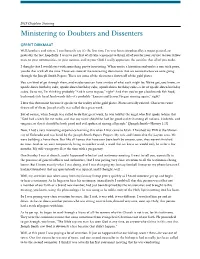
2019 Chaplain Training Ministering to Doubters and Dissenters GERRIT DIRKMAAT Well, brothers and sisters, I can honestly say it’s the first time I’ve ever been introduced by a major general, so probably the last, hopefully. I want to just first of all take a moment to thank all of you for your service to your fellow man, to your communities, to your nations, and to your God. I really appreciate the sacrifice that all of you make. I thought that I would start with something pretty interesting. When you’re a historian and you’re a one trick pony, you do that trick all the time. These are some of the interesting documents that we covered when we were going through the Joseph Smith Papers. These are some of the characters drawn off of the gold plates. You can kind of go through them, and maybe you can have an idea of what each might be. We’ve got, you know, an upside-down birthday cake, upside-down birthday cake, upside-down birthday cake—a lot of upside-down birthday cakes. So to me, I’m thinking probably “And it came to pass,” right? And then you’ve got a backwards fish head, backwards fish head, backwards fish—it’s probably “Laman and Lemuel began sinning again,” right? I love this document because it speaks to the reality of the gold plates. Plates actually existed. Characters were drawn off of them. Joseph really was called do a great work. But of course, when Joseph was called to do that great work, he was told by the angel who first spoke to him that “God had a work for me to do; and that my name should be had for good and evil among all nations, kindreds, and tongues, or that it should be both good and evil spoken of among all people” (Joseph Smith—History 1:33). -

December 14, 2018 To: General Authorities; General Auxiliary Presidencies; Area Seventies; Stake, Mission, District, and Temple
THE CHURCH OF JESUS GHRIST OF LATTER-DAY SAINTS OFFICE OF THE FIRST PRESIDENCY 47 EAST SOUTH TEMPLE STREET, SALT LAKE 0ITY, UTAH 84150-1200 December 14, 2018 To: General Authorities; General Auxiliary Presidencies; Area Seventies; Stake, Mission, District, andTemple Presidents; Bishops and Branch Presidents; Stake, District, Ward,and Branch Councils (To be read in sacrament meeting) Dear Brothers and Sisters: Age-Group Progression for Children and Youth We desire to strengthen our beloved children and youth through increased faith in Jesus Christ, deeper understanding of His gospel, and greater unity with His Church and its members. To that end, we are pleased to announce that in January 2019 children will complete Primary and begin attending Sunday School and Young Women or Aaronic Priesthood quorums as age- groups atth e beginning of January in the year they turn 12. Likewise, young women will progress between Young Women classes and young men between Aaronic Priesthood quorums as age- groups at the beginning of January in the year they turn 14 and 16. In addition, young men will be eligible for ordinationto the appropriate priesthood office in January of the year they tum 12, 14, and 16. Young women and ordained young men will be eligible for limited-use temple recommends beginning in January of the year they turn 12. Ordination to a priesthood office for young men and obtaining a limited-use temple recommend for young women and young men will continue to be individual matters, based on worthiness, readiness, and personal circumstances. Ordinations and obtaining limited-use recommends will typically take place throughout January. -
John Bytheway: 00:02 Welcome to Part Two of This Week's Podcast. with What We've Been Talking About
John Bytheway: 00:02 Welcome to part two of this week's podcast. With what we've been talking about... if we could go back to section 67 verse 13 to complete this whole thing we've been talking about, let's see, Hank, would you like to read that verse, verse 13? Hank Smith: 00:19 Yeah. 67:13, "You're not able to abide the presence of God now, neither the ministering of angels, wherefore continue inpatients until you are perfected." Dr. C. Robert L...: 00:29 Isn't that beautiful with all we've been talking about? God's admonition, not only to us individually, but the church too, and the restoration, right? Again, this infallibility narrative that we sometimes fall into, I think we need to be careful individually, and even as a church... speaking of patients, continue in patients, you know what I'm hearing from a lot of people with all the changes the church has been making? And there's been a lot in the last couple of years. Dr. C. Robert L...: 01:03 I'm hearing minister teach to some older people in my ward and I have acquaintances in ward, and these are really, really good, wonderful people. I mean, salt of the earth people, former bishops, former state Presidents, some of them are very concerned, not only about what's going on in society, but how rapidly a lot of the changes in the church are happening. Dr. C. Robert L...: 01:32 Yeah. When I teach Institute in BYU classes, a lot of my very faithful, young, single adult students, sometimes they don't think the changes are happening quick enough. -

The Origins of Old Catholicism
The Origins of Old Catholicism By Jarek Kubacki and Łukasz Liniewicz On September 24th 1889, the Old Catholic bishops of the Netherlands, Switzerland and Germany signed a common declaration. This event is considered to be the beginning of the Union of Utrecht of the Old Catholic Churches, federation of several independent national Churches united on the basis of the faith of the undivided Church of the first ten centuries. They are Catholic in faith, order and worship but reject the Papal claims of infallibility and supremacy. The Archbishop of Utrecht a holds primacy of honor among the Old Catholic Churches not dissimilar to that accorded in the Anglican Communion to the Archbishop of Canterbury. Since the year 2000 this ministry belongs to Archbishop JorisVercammen. The following churches are members of the Union of Utrecht: the Old Catholic Church of the Netherlands, the Catholic Diocese of the Old Catholics in Germany, Christian Catholic Church of Switzerland, the Old Catholic Church of Austria, the Old Catholic Church of the Czech Republic, the Polish-Catholic Church and apart from them there are also not independent communities in Croatia, France, Sweden, Denmark and Italy. Besides the Anglican churches, also the Philippine Independent Church is in full communion with the Old Catholics. The establishment of the Old Catholic churches is usually being related to the aftermath of the First Vatican Council. The Old Catholic were those Catholics that refused to accept the doctrine of Papal Infallibility and the Universal Jurisdiction. One has to remember, however, that the origins of Old Catholicism lay much earlier. We shouldn’t forget, above all, that every church which really deserves to be called by that name has its roots in the church of the first centuries. -

United We Stand, Divided We Fall: the Kremlin’S Leverage in the Visegrad Countries
UNITED WE STAND, DIVIDED WE FALL: THE KREMLIN’S LEVERAGE IN THE VISEGRAD COUNTRIES Edited by: Ivana Smoleňová and Barbora Chrzová (Prague Security Studies Institute) Authors: Ivana Smoleňová and Barbora Chrzová (Prague Security Studies Institute, Czech Republic) Iveta Várenyiová and Dušan Fischer (on behalf of the Slovak Foreign Policy Association, Slovakia) Dániel Bartha, András Deák and András Rácz (Centre for Euro-Atlantic Integration and Democracy, Hungary) Andrzej Turkowski (Centre for International Relations, Poland) Published by Prague Security Studies Institute, November 2017. PROJECT PARTNERS: SUPPORTED BY: CONTENTS INTRODUCTION 1 EXECUTIVE SUMMARY 2 CZECH REPUBLIC 7 Introduction 7 The Role of the Russian Embassy 7 The Cultural Sphere and Non-Governmental Organizations 8 The Political Sphere 9 The Extremist Sphere and Paramilitary Groups 10 The Media and Information Space 11 The Economic and Financial Domain 12 Conclusion 13 Bibliography 14 HUNGARY 15 Introduction 15 The Role of the Russian Embassy 15 The Cultural Sphere 16 NGOs, GONGOs, Policy Community and Academia 16 The Political Sphere and Extremism 17 The Media and Information Space 18 The Economic and Financial Domain 19 Conclusion 20 Bibliography 21 POLAND 22 Introduction 22 The Role of the Russian Embassy 22 Research Institutes and Academia 22 The Political Sphere 23 The Media and Information Space 24 The Cultural Sphere 24 The Economic and Financial Domain 25 Conclusion 26 Bibliography 26 SLOVAKIA 27 Introduction 27 The Role of the Russian Embassy 27 The Cultural Sphere 27 The Political Sphere 28 Paramilitary organisations 28 The Media and Information Space 29 The Economic and Financial Domain 30 Conclusion 31 Bibliography 31 CONCLUSION 33 UNITED WE STAND, DIVIDED WE FALL: THE KREMLIN’S LEVERAGE IN THE VISEGRAD COUNTRIES IN THE VISEGRAD THE KREMLIN’S LEVERAGE DIVIDED WE FALL: UNITED WE STAND, INTRODUCTION In the last couple of months, Russian interference in the internal affairs if the Kremlin’s involvement is overstated and inflated by the media. -

A Guide for Ministers of the New Apostolic Church
Bi Trans y Ga an olic bi post es w A L Ne d an A Guide for Ministers of the New Apostolic Church 1 Index Introduction Dear Minister Introduction 3 When a brother or sister in faith asks you for guidance or intercession, it’s a sign of deep Official Position of the NAC 4 trust in your ministry and you. Homosexuality and Bible 5 Many times when a person realizes that he is gay or she is lesbian, they do not know Sexual Orientatión 5 whom to trust to talk about their sexual orientation, their fears, doubts and questions related to the subject. Gender Identity 6 You may be the first confidant, and it is up to you whether your answers offer peace, Soul Care during the Coming-Out 6 restraint and guidance to the sibling in front of you, or if your answers cause sadness, Support Groups 8 disappointment or confusion. A hurtful response, an attitude of rejection or prejudice, can generate sadness, grief and even depression, and lead to leaving church and even Prayer for Same Sex Couples 8 a total loss of faith. Copyright Published by RAINBOW-NAC USA RAINBOW-NAC is a private initiative within the New Apostolic Church which provides containment of gay, lesbian, bisexual and transgender members, promoting tolerance and solidarity within the Congregations and dialoguing with ecclesiastical authorities in a framework of mutual respect. Edition 2017 © 2017, Copyright Information about RAINBOW-NAC www.rainbow-nac.org If you have any questions or need more information, you can contact Apostle Thomas Schmidt, the Regional Church Interlocutor for LGBTI* members or the RAINBOW-NAC group at the e-mail rainbow.nac.usa@gmail.com hms Hannchen Mehrzweck Stiftung schwul-lesbische Stiftung Print supported by hms Hannchen-Mehrzweck-Stiftung für queere Bewegungen 3 Official Position of the NAC (New Apostolic Church) regarding homosexuality Homosexuality and Bible The position of the Church on homosexuality is not static. -

"The New Apostolic Church and Ecumenism" Background Information
New Apostolic Church International Project Group Ecumenism "The New Apostolic Church and Ecumenism" Background Information © PG Ecumenism, July 8, 2010 Page 1 of 12 New Apostolic Church International Project Group Ecumenism Contents and Structure 1. Introductory Considerations 2. What is the Meaning of Ecumenism? 2.1. Definition 2.2. Historical Development 2.3. Ecumenical Organisations 2.3.1. General 2.3.2. World Council of Churches (WCC) 2.3.3. Council of Christian Churches in Germany (ACK) 3. The Project Group Ecumenism (PG Ecumenism) 3.1. Motivation for the Formation and Commission of PG Ecumenism 3.2. The PG's Findings to Date 3.3. Future Prospects 4. ACK Membership 4.1. Relation between WCC and ACK 4.2. Principles and Goals of the ACK 4.3. Organisation of the ACK 4.4. Requirements for ACK Membership 4.5. ACK "Guest Status" or "Advisory Participation" 4.6. Previous ACK or AGCK [Swiss National Ecumenical Council] Guest Memberships 5. Arguments for the NAC's Membership Status as a Guest in the ACK or Observer Status in the WCC 6. Suggestions for Supplementary Literature © PG Ecumenism, July 8, 2010 Page 2 of 12 New Apostolic Church International Project Group Ecumenism 1. Introductory Considerations Within the scope of our Church's public relations, we have had increasingly more contact with ministers of other Churches and denominations. At the beginning of 1990 and with the approval of Chief Apostle Richard Fehr, these contacts were strengthened with the Council of Christian Churches in Baden-Württemberg (ACK-BW) in Southern Germany, as a "pilot project" for all of Germany.