Teşekkür Kaydedilmiştir
Total Page:16
File Type:pdf, Size:1020Kb
Load more
Recommended publications
-
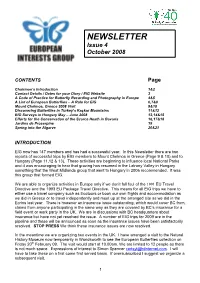
NEWSLETTER Issue 4
NEWSLETTER Issue 4 October 2008 CONTENTS Page Chairman’s Introduction 1&2 Contact Details / Dates for your Diary / EIG Website 3 A Code of Practice for Butterfly Recording and Photography in Europe 4&5 A List of European Butterflies – A Role for EIG 6,7&8 Mount Chelmos, Greece 2008 Visit 9&10 Discovering Butterflies in Turkey’s Kaçkar Mountains 11&12 EIG Surveys in Hungary May – June 2008 13,14&15 Efforts for the Conservation of the Scarce Heath in Bavaria 16,17&18 Jardins de Proserpine 19 Spring into the Algarve 20&21 INTRODUCTION EIG now has 147 members and has had a successful year. In this Newsletter there are two reports of successful trips by EIG members to Mount Chelmos in Greece (Page 9 & 10) and to Hungary (Page 11,12 & 13). These activities are beginning to influence local National Parks and it was encouraging to hear that grazing has resumed in the Latrany Valley in Hungary something that the West Midlands group that went to Hungary in 2006 recommended. It was this group that formed EIG. We are able to organize activities in Europe only if we don’t fall foul of the 1991 EU Travel Directive and the 1993 EU Package Travel Directive. This means for all EIG trips we have to either use a travel company such as Ecotours or book our own flights and accommodation as we did in Greece or to travel independently and meet up at the arranged site as we did in the Ecrins last year. There is however an insurance issue outstanding, which would cover BC from, claims from anyone participating in the same way as they are covered by BC’s insurance for a field event or work party in the UK. -

Maquetación 1
About IUCN IUCN is a membership Union composed of both government and civil society organisations. It harnesses the experience, resources and reach of its 1,300 Member organisations and the input of some 15,000 experts. IUCN is the global authority on the status of the natural world and the measures needed to safeguard it. www.iucn.org https://twitter.com/IUCN/ IUCN – The Species Survival Commission The Species Survival Commission (SSC) is the largest of IUCN’s six volunteer commissions with a global membership of more than 10,000 experts. SSC advises IUCN and its members on the wide range of technical and scientific aspects of species conservation and is dedicated to securing a future for biodiversity. SSC has significant input into the international agreements dealing with biodiversity conservation. http://www.iucn.org/theme/species/about/species-survival-commission-ssc IUCN – Global Species Programme The IUCN Species Programme supports the activities of the IUCN Species Survival Commission and individual Specialist Groups, as well as implementing global species conservation initiatives. It is an integral part of the IUCN Secretariat and is managed from IUCN’s international headquarters in Gland, Switzerland. The Species Programme includes a number of technical units covering Species Trade and Use, the IUCN Red List Unit, Freshwater Biodiversity Unit (all located in Cambridge, UK), the Global Biodiversity Assessment Initiative (located in Washington DC, USA), and the Marine Biodiversity Unit (located in Norfolk, Virginia, USA). www.iucn.org/species IUCN – Centre for Mediterranean Cooperation The Centre was opened in October 2001 with the core support of the Spanish Ministry of Agriculture, Fisheries and Environment, the regional Government of Junta de Andalucía and the Spanish Agency for International Development Cooperation (AECID). -

Invertebrate Fauna of Wadi Al-Quff Protected Area, Palestine
80 Jordan Journal of Natural History Invertebrate Fauna of Wadi Al-Quff Protected Area, Palestine Mazin Qumsiyeh Palestine Museum of Natural History and Palestine Institute of Biodiversity and Sustainability, Bethlehem University ABSTRACT We report results of a preliminary survey of the invertebrate fauna of Wadi Al-Quff area (occupied Palestine). We recorded 23 species of butterflies in 5 families. Moths were a difficult group to classify but we have at least 45 species. Dragon flies and damsel flies were noted in the Wadi Hasaka area. Four mantids in three families, two species of stick insects, one earwig species (Dermeptera) and at least seven species of Orthoptera were noted. There were at least 13 species of Hemiptera (true bugs) and 5 species of Neuroptera (netwing insects). We noted at least 13 species in ten families of the Order Diptera (the flies). We also collected/observed at least 17 species of Hymenoptera in eight families. In the Order Blattoidae (roaches), we noted two species only but the Order Coleoptera (Beetles) was very richly represented with at least 23 species in 10 families. Among parasitic arthropods we collected two species of fleas and three species of ticks (Ixodidae), one of the latter involved in transmittal of spotted fever. Five species of scorpions were noted, the largest being the Jericho or Mt. Nebo scorpion Nebo hierichonticus and the smallest being the brown scorpion Compsubuthus werneri. Two species of pseudoscorpions and two species of camel spiders were collected. A more difficult group was the regular spiders (Araneae) and we noted over two dozen species in at least 8 families. -

Nota Lepidopterologica
ZOBODAT - www.zobodat.at Zoologisch-Botanische Datenbank/Zoological-Botanical Database Digitale Literatur/Digital Literature Zeitschrift/Journal: Nota lepidopterologica Jahr/Year: 1993 Band/Volume: 16 Autor(en)/Author(s): Artikel/Article: Book reviews — Buchbesprechungen — Analyses The butterflies of the Greek island of Rôdos 163-168 ©Societas Europaea Lepidopterologica; download unter http://www.biodiversitylibrary.org/ und www.zobodat.at lepicL 1 63- 1 Nota 16(2): 68 : 30. X 1 . 1 993 ISS \ 0342-7536 Book reviews — Buchbesprechungen — Analyses The butterflies of the Greek island of Rôdos : Taxonomy, faunistics, ecology and phenology, with a tentative synthesis on the biogeography of the butterflies of Kriti (Crete). Kârpathos, Rôdos. the Eastern Aegean islands and Kipros (Cyprus) (Lepidoptera : Hesperioidea & Papilionoidea). Alain Olivier. 250 pp.. 21 Figs. 6 Pis (2 in colour). 17 Tables. 20.7 x 14.7 cm. paperback. Vlaamse Vereniging voor Ento- mologie, Antwerpen. 1993. Obtainable from : V.V.v.E., General Secre- tary, Diksmuidelaan 176. B-2600 Antwerp. Belgium. Price : 1450 BEF. This is a splendidly detailed account of the 47 butterfly species of the island and those of Rhodes and neighbouring Aegean islands, h is unusual for a faunistic work to include a detailed analysis of the taxonomy of the species concerned. However, the taxonomical status of island species is always problematical and it is therefore a valuable addition to this work. Apart from the short introduction, references and postscript, the book is split into three parts : 1. General background, covering geography, climate, geology, vegetation and lepidopterological history ; 2. Systematic part, including principles and methods, treatment of individual species, and doubtful and erroneous records ; 3. -
Uva-DARE (Digital Academic Repository)
UvA-DARE (Digital Academic Repository) Endemism in Sardinia: Evolution, ecology, and conservation in the butterfly Maniola nurag Grill, A. Publication date 2003 Link to publication Citation for published version (APA): Grill, A. (2003). Endemism in Sardinia: Evolution, ecology, and conservation in the butterfly Maniola nurag. IBED, Universiteit van Amsterdam. General rights It is not permitted to download or to forward/distribute the text or part of it without the consent of the author(s) and/or copyright holder(s), other than for strictly personal, individual use, unless the work is under an open content license (like Creative Commons). Disclaimer/Complaints regulations If you believe that digital publication of certain material infringes any of your rights or (privacy) interests, please let the Library know, stating your reasons. In case of a legitimate complaint, the Library will make the material inaccessible and/or remove it from the website. Please Ask the Library: https://uba.uva.nl/en/contact, or a letter to: Library of the University of Amsterdam, Secretariat, Singel 425, 1012 WP Amsterdam, The Netherlands. You will be contacted as soon as possible. UvA-DARE is a service provided by the library of the University of Amsterdam (https://dare.uva.nl) Download date:23 Sep 2021 VIII. Thee shape of endemics: Notess on male and female genitalia in the genus Maniola (SCHRANK,, 1801), (Lepidoptera, Nymphalidae, Satyrinae) withh Rob de Vos & Jan van Arkel Contributionss to Zoology (accepted with minor modifications) 171 1 Abstract t Butterfliess of the genus Maniola are known for their large morphological variation, att the inter- as well as intraspecific level. -

Genetics and Extreme Confinement of Three Overlooked Butterfly Species
Journal of Insect Conservation https://doi.org/10.1007/s10841-020-00281-9 ORIGINAL PAPER Genetics and extreme confnement of three overlooked butterfy species in Romania call for immediate conservation actions Bogdan Groza1 · Raluca Vodă2 · Levente Székely3 · Roger Vila4 · Vlad Dincă5,6 Received: 5 June 2020 / Accepted: 2 November 2020 © Springer Nature Switzerland AG 2020 Abstract A good knowledge of species distributions and their genetic structure is essential for numerous types of research such as population genetics, phylogeography, or conservation genetics. We document the presence of extremely local populations of three butterfy species (Iolana iolas, Satyrus ferula and Melanargia larissa) in the Romanian fauna. Satyrus ferula and M. larissa are reported for the frst time in the country, while I. iolas is rediscovered following presumed extinction. Based on mitochondrial DNA (cytochrome c oxidase subunit 1—COI sequences), we assessed the genetic structure of these populations and placed them into a broader context through comparisons with other populations from across the range of these species. Each of the three species had a single haplotype in Romania, suggesting low female efective population size possibly under genetic erosion. Two of the populations (S. ferula and M. larissa) are genetically unique, displaying endemic haplotypes in south-western Romania. The Romanian populations of the three species likely remained unnoticed due to their extremely limited extent of occurrence. Their restricted range, close to the northern limits of distribution in the Balkans, their apparent low female efective population size, the presence of endemic haplotypes, and habitat vulnerability (especially for I. iolas) highlight the need for monitoring and conservation measures for the safeguarding of these populations. -
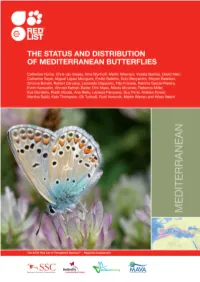
The Status and Distribution of Mediterranean Butterflies
About IUCN IUCN is a membership Union composed of both government and civil society organisations. It harnesses the experience, resources and reach of its 1,300 Member organisations and the input of some 15,000 experts. IUCN is the global authority on the status of the natural world and the measures needed to safeguard it. www.iucn.org https://twitter.com/IUCN/ IUCN – The Species Survival Commission The Species Survival Commission (SSC) is the largest of IUCN’s six volunteer commissions with a global membership of more than 10,000 experts. SSC advises IUCN and its members on the wide range of technical and scientific aspects of species conservation and is dedicated to securing a future for biodiversity. SSC has significant input into the international agreements dealing with biodiversity conservation. http://www.iucn.org/theme/species/about/species-survival-commission-ssc IUCN – Global Species Programme The IUCN Species Programme supports the activities of the IUCN Species Survival Commission and individual Specialist Groups, as well as implementing global species conservation initiatives. It is an integral part of the IUCN Secretariat and is managed from IUCN’s international headquarters in Gland, Switzerland. The Species Programme includes a number of technical units covering Species Trade and Use, the IUCN Red List Unit, Freshwater Biodiversity Unit (all located in Cambridge, UK), the Global Biodiversity Assessment Initiative (located in Washington DC, USA), and the Marine Biodiversity Unit (located in Norfolk, Virginia, USA). www.iucn.org/species IUCN – Centre for Mediterranean Cooperation The Centre was opened in October 2001 with the core support of the Spanish Ministry of Agriculture, Fisheries and Environment, the regional Government of Junta de Andalucía and the Spanish Agency for International Development Cooperation (AECID). -

2020 PANDION WILD TOURS Dear Wildlife Lovers, Rare Reptiles and Amphibians
PANDION Wi ld Tou r s WILDLIFE HOLIDAYS IN BULGARIA, GREECE AND ROMANIA 2020 PANDION WILD TOURS Dear wildlife lovers, Rare reptiles and amphibians. SPRING BIRDING TOUR Exceptional diversity of moths and butterflies, many of them extremely we will be really happy to take you on a virtual journey to Bulgaria using as a rare representatives of European lepidopterans. BULGARIA AND GREECE BULGARIA vehicle this catalogue of ours. Dragonflies: Almost all of the insects of this order are rare European spe- Our tour agency, “Pandion Wild Tours”, has endeavoured for already 23 cies. 12 DAYS TOUR years to welcome nature lovers from almost all European countries, Australia, You certainly will be happy to watch also rare European representatives 22th April – 3rd May 2020 New Zealand, South Africa, USA, Canada and Japan. We are the oldest and of Spiders, Coleoptera and many other animals. SEA BLACK most experienced company for wildlife touring in Bulgaria. At the same time you will have the chance to get acquainted with one Bulgaria is a little country but there is no other like it in Europe: with of the most ancient cultures in the world, namely the rich culture of ancient Best Time: Mid April – May such a great biodiversity within its small area! More than 250 endemic species Scythians – our ancestors, the Thracians. Ask for more tour dates. of plants exist in Bulgaria along with many more rare and beautiful European For those who do not like to travel too much, we can offer family holi- ones. A very rich bird fauna, with some of the rarest representatives of Euro- days, ornithological and botanical vacations as well as such for those of you DAY ONE pean birds. -

The Entomologist's Record and Journal of Variation
. JVASV^iX ^ N^ {/) lSNrNVIN0SHilWS*^S3ldVaan^LIBRARIES SMITHSONIAN INSTITUTION Ni <n - M ^^ <n 5 CO Z ^ ^ 2 ^—^ _j 2 -I RIES SMITHSONIAN INSTITUTION NOIinillSNI NVINOSHilWS S3iyVdan U r- ^ ^ 2 CD 4 A'^iitfwN r: > — w ? _ ISNI NVINOSHilWS SBiyVdan LIBRARIES'SMITHSONIAN INSTITUTION f^ <rt .... CO 2 2 2 s;- W to 2 C/J • 2 CO *^ 2 RIES SMITHSONIAN_INSTITUTlON NOIiniliSNI_NVINOSHilWS S3liiVyan_L; iiSNi"^NViNOSHiiNS S3iyvaan libraries smithsonian'^institution i^ 33 . z I/' ^ ^ (^ RIES SMITHSONIAN INSTITUTION NOIiniliSNI NVINOSHilWS S3lbVHan Li CO — -- — "> — IISNI NVINOSHimS S3IMVHan LIBRARIES SMITHSONIAN INSTITUTION N' 2 -J 2 _j 2 RIES SMITHSONIAN INSTITUTION NOIifllliSNI NVINOSHIIWS SSIMVyail L! MOTITI IT I f\t _NviN0SHiiws'^S3iMvaan libraries'^smithsonian^institution NOlin z \ '^ ^—s^ 5 <^ ^ ^ ^ '^ - /^w\ ^ /^^\ - ^^ ^ /^rf^\ - /^ o ^^^ — x.ii:i2Ji^ o ??'^ — \ii Z ^^^^^""-^ o ^^^^^ -» 2 _J Z -J , ; SMITHSONIAN INSTITUTION NOIXniliSNI NVINOSHillMS $3 I M VH 8 !!_ LI BR = C/> ± O) ^. ? CO I NVINOSHimS S3iaVHan libraries SMITHSONIAN INSTITUTION NOIlf CO ..-. CO 2 Z z . o .3 :/.^ C/)o Z u. ^^^ i to Z CO • z to * z > SMITHS0NIAN_1NSTITUTI0N NOIiniliSNI_NVINOSHimS S3 I d ViJ 8 n_LI B R UJ i"'NViNOSHiiws S3ibvyan libraries smithsonian"^institution Noiir r~ > z r- Z r- 2: . CO . ^ ^ ^ ^ ; SMITHSONIAN INSTITUTION NOIiniliSNI NVINOSHillNS SSiyVMail LI BR CO . •» Z r, <^ 2 z 5 ^^4ii?^^ ^' X^W o ^"^- x life ^<ji; o ^'f;0: i >^ _NVIN0SHiIlMs'^S3iyVdan^LIBRARIEs'^SMITHS0NlAN INSTITUTION NOlif Z \ ^'^ ^-rr-^ 5 CO n CO CO o z > SMITHSONIAN INSTITUTION NOIiniliSNI NVINOSHimS S3 I ^Vd 8 11 LI BR >" _ . z 3 ENTOMOLOGIST'S RECORD AND Journal of Variation Edited by P.A. SOKOLOFF fre s Assistant Editors J.A. -
How Reliable Is It?
PROTECTED AREA SITE SELECTION BASED ON ABIOTIC DATA: HOW RELIABLE IS IT? A THESIS SUBMITTED TO THE GRADUATE SCHOOL OF NATURAL AND APPLIED SCIENCES OF MIDDLE EAST TECHNICAL UNIVERSITY BY BANU KAYA ÖZDEMĠREL IN PARTIAL FULFILLMENT OF THE REQUIREMENTS FOR THE DEGREE OF DOCTOR OF PHILOSOPHY IN BIOLOGY FEBRUARY 2011 Approval of the thesis: PROTECTED AREA SITE SELECTION BASED ON ABIOTIC DATA: HOW RELIABLE IS IT? submitted by BANU KAYA ÖZDEMİREL in partial fulfillment of the requirements for the degree of Doctor of Philosophy in Department of Biological Sciences, Middle East Technical University by, Prof. Dr. Canan Özgen _____________ Dean, Graduate School of Natural and Applied Sciences Prof. Dr. Musa Doğan _____________ Head of Department, Biological Sciences, METU Assoc. Prof. Dr. C. Can Bilgin _____________ Supervisor, Department of Biological Sciences, METU Examining Committee Members: Prof. Dr. Aykut Kence ____________________ Department of Biological Sciences, METU. Assoc. Prof. Dr. C. Can Bilgin ____________________ Department of Biological Sciences, METU. Prof. Dr. Zeki Kaya ____________________ Department of Biological Sciences, METU. Prof. Dr. Nilgül Karadeniz ____________________ Department of Landscape Architecture. AU. Prof. Dr. ġebnem Düzgün ____________________ Department of Mining Engineering. METU. Date: 11.02.2011 I hereby declare that all information in this document has been obtained and presented in accordance with academic rules and ethical conduct. I also declare that, as required by these rules and conduct, I have fully cited and referenced all material and results that are not original to this work. Name, Last Name: Banu Kaya Özdemirel Signature : III ABSTRACT PROTECTED AREA SITE SELECTION BASED ON ABIOTIC DATA: HOW RELIABLE IS IT? Özdemirel Kaya, Banu Ph.D., Department of Biology Supervisor: Assoc. -

The List of the 236 Butterflies of Greece
(THE RED BOOK OF THREATENED ANIMAL IN GREECE) ΛΕΓΑΚΙΣ, ΑΝΑΣΤΑΣΙΟΣ: Ασπόνδυλα. In: ΛΕΓΑΚΙΣ Α. και Π. Μαραγκού (επιμέλεια έκδοσης), Το κόκκινο 67/1981 βιβλίο των απειλούμενων Ζώων ΠΔ : : της Ελλάδας. Ελληνική Ζωωλογική Εταιρεία. Αθήνα 2009 ΟΝΟΜΑ ΕΙΔΟΥΣ NAME OF SPECIES NUMA, C., et al (2016). The status and distributionbutterflies.IUCN, Malaga, of MediterraneanSpain. + x 32 pp. GREECE IN LAW THE CITES II Appendix CONVENTION BERNE 92/43HABITATS DIRECTIVE II ANNEX 92/43HABITATS DIRECTIVE IV ANNEX Red List status Europe (2010) of List Red European Butterflies EU27 (2010) 1 Iphiclides podalirius (Linnaeus, 1758) 2 Papilio machaon Linnaeus, 1758 3 Papilio alexanor Esper, 1800 * * * 4 Zerynthia polyxena ([Denis & Schiffermüller], 1775) * * * 5 Zerynthia cerisy (Godart, [1824]) * NT NT 6 Zerynthia cretica (Rebel, 1904) * 7 Archon apollinus (Herbst, 1798) * NT LC 8 Parnassius apollo (Linnaeus, 1758) * * * * NT NT 9 Parnassius mnemosyne (Linnaeus, 1758) * * * NT LC 10 Aporia crataegi (Linnaeus, 1758) 11 Pieris brassicae (Linnaeus, 1758) 12 Pieris rapae (Linnaeus, 1758) 13 Pieris mannii (Mayer, 1851) 14 Pieris ergane (Geyer, [1828]) * 15 Pieris napi (Linnaeus, 1758) 16 Pieris balcana Lorković, [1969] 17 Pieris krueperi Staudinger, 1860 * 18 Pontia edusa (Fabricius, 1777) 19 Pontia chloridice (Hübner, [1813]) B1ab(ii,iii)+2ab(ii,iii) EN * 20 Euchloe ausonia (Hübner, [1804]) 21 Euchloe penia (Freyer, 1851) 22 Anthocharis gruneri Herrich-Schäffer, 1851 * 23 Anthocharis cardamines (Linnaeus, 1758) 24 Anthocharis damone Boisduval, 1836 * 25 Colias crocea -

How Much Biodiversity Is in Natura 2000?
Alterra Wageningen UR Alterra Wageningen UR is the research institute for our green living environment. P.O. Box 47 We off er a combination of practical and scientifi c research in a multitude of How much Biodiversity is in Natura 2000? 6700 AA Wageningen disciplines related to the green world around us and the sustainable use of our living The Netherlands environment, such as fl ora and fauna, soil, water, the environment, geo-information The “Umbrella Eff ect” of the European Natura 2000 protected area network T +31 (0) 317 48 07 00 and remote sensing, landscape and spatial planning, man and society. www.wageningenUR.nl/en/alterra The mission of Wageningen UR (University & Research centre) is ‘To explore Technical report Alterra Report 2730B the potential of nature to improve the quality of life’. Within Wageningen UR, ISSN 1566-7197 nine specialised research institutes of the DLO Foundation have joined forces with Wageningen University to help answer the most important questions in the Theo van der Sluis, Ruud Foppen, Simon Gillings, Thomas Groen, René Henkens, Stephan Hennekens, domain of healthy food and living environment. With approximately 30 locations, 6,000 members of staff and 9,000 students, Wageningen UR is one of the leading Kim Huskens, David Noble, Fabrice Ottburg, Luca Santini, Henk Sierdsema, Andre van Kleunen, organisations in its domain worldwide. The integral approach to problems and Joop Schaminee, Chris van Swaay, Bert Toxopeus, Michiel Wallis de Vries and Lawrence Jones-Walters the cooperation between the various disciplines