Public Life of Peyton Randolph Sidney Barney
Total Page:16
File Type:pdf, Size:1020Kb
Load more
Recommended publications
-

The Smithfield Review, Volume 20, 2016
In this issue — On 2 January 1869, Olin and Preston Institute officially became Preston and Olin Institute when Judge Robert M. Hudson of the 14th Circuit Court issued a charter Includes Ten Year Index for the school, designating the new name and giving it “collegiate powers.” — page 1 The On June 12, 1919, the VPI Board of Visitors unanimously elected Julian A. Burruss to succeed Joseph D. Eggleston as president of the Blacksburg, Virginia Smithfield Review institution. As Burruss began his tenure, veterans were returning from World War I, and America had begun to move toward a post-war world. Federal programs Studies in the history of the region west of the Blue Ridge for veterans gained wide support. The Nineteenth Amendment, giving women Volume 20, 2016 suffrage, gained ratification. — page 27 A Note from the Editors ........................................................................v According to Virginia Tech historian Duncan Lyle Kinnear, “he [Conrad] seemed Olin and Preston Institute and Preston and Olin Institute: The Early to have entered upon his task with great enthusiasm. Possessed as he was with a flair Years of Virginia Polytechnic Institute and State University: Part II for writing and a ‘tongue for speaking,’ this ex-confederate secret agent brought Clara B. Cox ..................................................................................1 a new dimension of excitement to the school and to the town of Blacksburg.” — page 47 Change Amidst Tradition: The First Two Years of the Burruss Administration at VPI “The Indian Road as agreed to at Lancaster, June the 30th, 1744. The present Faith Skiles .......................................................................................27 Waggon Road from Cohongoronto above Sherrando River, through the Counties of Frederick and Augusta . -
Reading Comprehension: Declaration of Independence
Reading Comprehension: Declaration of Independence The main purpose of America's Declaration of Independence was to explain to foreign nations why the colonies had chosen to separate themselves from Great Britain. The Revolutionary War had already begun, and several major battles had already taken place. The American colonies had already cut most major ties to England and had established their own congress, currency, army, and post office. On June 7, 1776, at Independence Hall in Philadelphia, Richard Henry Lee voiced a resolution that the United States should be completely free of England's influence, and that all political ties between the two countries should be dissolved. Congress agreed and began plans to publish a formal declaration of independence and appointed a committee of five members to draft the declaration. Thomas Jefferson was chosen to draft the letter, which he did in a single day. Four other members—Roger Sherman, Robert Livingston, Benjamin Franklin, and John Adams—were part of the committee to help Jefferson. In the Declaration of Independence, Jefferson explained that a body of people has a right to change governments if that government becomes oppressive (unfair and controlling). He further explained that governments fail when they no longer have the consent of the governed. Since Parliament clearly lacked the consent of the American colonists to govern them, it was no longer legitimate. The Declaration was presented to the Continental Congress in Philadelphia, Pennsylvania, on July 2, 1776. It was approved with a few minor changes. Of the 56 signers of the Declaration of Independence, John Hancock, of Massachusetts, was the first. -

Pennsylvania Magazine of HISTORY and BIOGRAPHY
THE Pennsylvania Magazine OF HISTORY AND BIOGRAPHY A Pennsylvania Farmer at the Court of King George John Dickinson's London Letters, 1754-1756 HE modern American political scene has long been dominated by lawyers. The legal profession has contributed many more Tthan its share of presidents, senators, and congressmen; occasionally, a good lawyer even finds a berth on the Supreme Court. But the lawyer's proclivity for politics is far from new. With a few notable exceptions (such as Samuel Adams and Benjamin Franklin), the American revolutionary leadership of the 1760's and I77o's was predominantly legal in its professional affiliation. Thomas Jefferson, Patrick Henry, John Adams, James Otis, Daniel Dulany, Jr., William Henry Dray ton, and James Wilson, to offer a selection, were all practicing lawyers at one time or another. They found that their legal education served them extraordinarily well in resolving the proper relationship of their respective provinces to the mother country. Their legal training unquestionably colored their political thinking. As David Ramsay explained in 1789, "no order of men has, in all ages, been more favorable to liberty, than lawyers." When entering the political arena, Ramsay continued, lawyers operated 241 1<\1 H. TREVOR COLBOURN July with a special skill and technique: "while others judge of bad princi- ples by the actual grievances they occasion, lawyers discover them at a distance, and trace future mischiefs from gilded innovations."1 Surprisingly little attention has been given to the lawyer's role in the American Revolution, or to American legal history generally, despite the accuracy of Edmund Burke's remark that "in no country perhaps in the world is the law so general a study/'2 One explanation for this historical delinquency might well be the complexity of the lawyer's craft. -

The Early Political Career of Robert Carter Nicholas, 1728-1769
W&M ScholarWorks Dissertations, Theses, and Masters Projects Theses, Dissertations, & Master Projects 1961 The Early Political Career of Robert Carter Nicholas, 1728-1769 William J. Lescure College of William & Mary - Arts & Sciences Follow this and additional works at: https://scholarworks.wm.edu/etd Part of the United States History Commons Recommended Citation Lescure, William J., "The Early Political Career of Robert Carter Nicholas, 1728-1769" (1961). Dissertations, Theses, and Masters Projects. Paper 1539624522. https://dx.doi.org/doi:10.21220/s2-df2m-r775 This Thesis is brought to you for free and open access by the Theses, Dissertations, & Master Projects at W&M ScholarWorks. It has been accepted for inclusion in Dissertations, Theses, and Masters Projects by an authorized administrator of W&M ScholarWorks. For more information, please contact scholarworks@wm.edu. tug nmr mmmm mmm m eobot cahter kxgrous X728—1769 4 th e sis FresoBted to the Facility of the DepartmeBt of History fho Collage of William and Mary 2b firg in ia M Fartisl Fulfillment of the Requirements for the Degree Master of Arts by William las cure January 1961 " im o w > .ffeie'tllaei® i s siafrmitted in p a rtia l fu lfillm e n t o f ; ’Ik®, raq&ireiaenta fo r the degree o f ! . .• • i k t ■ :Haetearef Jlrts :" '' f' .. Agjgramd* $m m rp 19&ls * 1%; 0 . \J ijJlU u^ W ' i^ ln ^ W iM m W M o i, TS£"®7 & $ i r u n u A J %&mmm H* famer^ fh , B. ■ ^ X 4 X n ^ t i J f. -

ABSTRACT JEWETT, AMANDA AVERELL. Aristocratic
ABSTRACT JEWETT, AMANDA AVERELL. Aristocratic Gentlemanliness and Revolutionary Masculinities among Virginia’s Delegation to the Continental Congress, 1774-1776. (Under the direction of Dr. Craig Thompson Friend). There was never one type of manhood practiced in Virginia during from 1774 to 1776. Instead, different masculinities blended and overlapped to reflect changes in culture and society. While elements such as public validation and an honorable reputation persevered across gender constructions, they meant different things to different men in the early years of revolution. The American Revolution unleashed democratic, military, regional, and intellectual impulses that gave impetus to forms of manhood that helped to erode aristocratic gentlemanliness. Militant, intellectual, and southern men absorbed some ideals of aristocratic gentlemanliness like honor and public virtue, while abandoning others including submission and restraint. The Revolution and meetings with other men in the Continental Congress contributed to the dismissal of these principles as Virginians responded to changes in their political and social roles on a larger stage. Ultimately, the need for public approval ties all of these Virginians together. Validation of one’s gender and class from outside observers, be it fellow Virginian planters or delegates from other colonies, is the most permanent aspect of masculinity during these years. While other types of manhood—military, Enlightenment, and southern—broke from or changed several traits of aristocratic gentlemanliness, -

Taverns in Tidewater Virginia, 1700-1774
W&M ScholarWorks Dissertations, Theses, and Masters Projects Theses, Dissertations, & Master Projects 1968 Taverns in Tidewater Virginia, 1700-1774 Patricia Ann Gibbs College of William & Mary - Arts & Sciences Follow this and additional works at: https://scholarworks.wm.edu/etd Part of the United States History Commons Recommended Citation Gibbs, Patricia Ann, "Taverns in Tidewater Virginia, 1700-1774" (1968). Dissertations, Theses, and Masters Projects. Paper 1539624651. https://dx.doi.org/doi:10.21220/s2-7t92-8133 This Thesis is brought to you for free and open access by the Theses, Dissertations, & Master Projects at W&M ScholarWorks. It has been accepted for inclusion in Dissertations, Theses, and Masters Projects by an authorized administrator of W&M ScholarWorks. For more information, please contact scholarworks@wm.edu. TAVERNS XH TIDEWATER VIRGINIA, 1700-1774 t 4 A Thesis Presented to The Faculty of the department of History The College of William and Mary in Virginia In Partial Fulfillment Of the Requiremenfcs for the degree of Master of Arts By Patricia Ann Gibbs 1968 APPROVAL SHEET This thesis is submitted in partial fulfillment of the requirements for the degree of Master of Arts Author Approved, May 1968 Jane Carson, Ph.D. LlAftrJ ty. r ___ Edward M. Riley, Ph/b Thad W. Tate, Ph.D. 11 ACKNOWLEDGMENTS The author wishes to express appreciation to Dr* Jane Carson for her guidance, criticism, and en couragement in directing this thesis and to Dr* Edward M* Riley and Dr* Thad W. Tate# Jr*# for their careful reading and criticism of the manuscript* The writer thanks Colonial Williamsburg# Inc.# for the use of its research facilities and the staff of the Research Department for many helpful suggestions* iii TASI£ OF CONTENTS juatraxxB^n ....... -

1 the Story of the Faulkner Murals by Lester S. Gorelic, Ph.D. the Story Of
The Story of the Faulkner Murals By Lester S. Gorelic, Ph.D. The story of the Faulkner murals in the Rotunda begins on October 23, 1933. On this date, the chief architect of the National Archives, John Russell Pope, recommended the approval of a two- year competing United States Government contract to hire a noted American muralist, Barry Faulkner, to paint a mural for the Exhibit Hall in the planned National Archives Building.1 The recommendation initiated a three-year project that produced two murals, now viewed and admired by more than a million people annually who make the pilgrimage to the National Archives in Washington, DC, to view two of the Charters of Freedom documents they commemorate: the Declaration of Independence and the Constitution of the United States of America. The two-year contract provided $36,000 in costs plus $6,000 for incidental expenses.* The contract ended one year before the projected date for completion of the Archives Building’s construction, providing Faulkner with an additional year to complete the project. The contract’s only guidance of an artistic nature specified that “The work shall be in character with and appropriate to the particular design of this building.” Pope served as the contract supervisor. Louis Simon, the supervising architect for the Treasury Department, was brought in as the government representative. All work on the murals needed approval by both architects. Also, The United States Commission of Fine Arts served in an advisory capacity to the project and provided input critical to the final composition. The contract team had expertise in art, architecture, painting, and sculpture. -

Thomas Jefferson and the Origins of Newspaper Competition in Pre
Thomas Jefferson and the Origins of Newspaper Competition in Pre- Revolutionary Virginia Original research paper submitted to The History Division of the Association for Education in Journalism and Mass Communication, 2007 AEJMC Convention Roger P. Mellen George Mason University June 2007 Thomas Jefferson and the Origins of Newspaper Competition in Pre-Revolutionary Virginia “Until the beginning of our revolutionary dispute, we had but one press, and that having the whole business of the government, and no competitor for public favor, nothing disagreeable to the governor could be got into it. We procured Rind to come from Maryland to publish a free paper.” Thomas Jefferson1 Great changes came to the printing business in Virginia in 1765. About the time that Parliament passed the Stamp Act, a second printer was encouraged to open another shop in Williamsburg, marking the beginnings of competition in that field. This was an important watershed for the culture and government of the colony, for it signified a shift in the power structure. Control of public messages began to relocate from the royal government to the consumer marketplace. This was a transformation that had a major impact on civic discourse in the colony. Despite such significance, the motivations behind this change and the relevance of it have often been misunderstood. For example, it is widely accepted that Thomas Jefferson was responsible for bringing such print competition to Virginia. This connection has been constantly repeated by historians, as has early print historian Isaiah Thomas’s contention that Jefferson confirmed this in a letter written specifically from the former president to Thomas. -

University Microfilms International 300 North Zeob Road Ann Arbor, Michigan 48106 USA St
INFORMATION TO USERS This material was produced from a microfilm copy of the original document. While the moat advanced technological meant to photograph and reproduce this document have been used, the quality it heavily dependent upon the quality of the original submitted. The following explanation of techniques is provided to help you understand markings or patterns which may appear on this reproduction. 1.The sign or "target" for pages apparently lacking from the document photographed is "Misting Paga(s)". If it was possible to obtain the missing page(s) or section, they are spliced into the film along with adjacent page);. This may have necessitated cutting thru an image and duplicating adjacen pages to insure you complete continuity. 2. When an image on the film is obliterated with a large round black mark, _ is an indication that the photographer suspected that the copy may have moved during exposure and thus cause a blurred image. You will find ^ good image of the page in the adjacent frame. 3. Whan a map, drawing or chart, etc., was part of the material being photographed the photographer followed a definite method in "sectioning" the material. It is customary to begin photoing at the upper left hand corner of a large sheet and to continue photoing from left to right in equal sections with a small overlap. If necessary, sectioning |s continued again — beginning balow the first row and continuing on untjil complete. 4. The majority of users indicate that the textual content is of greatest valuir, however, a somewhat higher quality reproduction could be made from "photographs" if essential to the understanding of the dissertation. -
Character List 1776
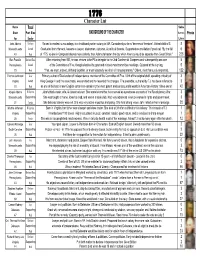
1776 Character List Name Vocal Solos State Part Size BACKGROUND OF THE CHARACTER Scenes Photo Age Gender Lines John Adams Baritone Raised in modest surroundings, in a traditional puritan colony in MA. Considered puritans "bearers of freedom". Eldest child of 3. 8 Massachusetts Lead Graduated from Harvard, became a lawyer, statesman, diplomat, & political theorist. Supported reconciliation if practical. "By the fall 6 40 Male of 1775, no one in Congress labored more ardently than Adams to hasten the day when America would be separate from Great Britain." 226 Ben Franklin Baritone/Bass After returning from GB, he was chosen to be PA's delegate to the 2nd Continental Congress and subsequently was one 5 Pennsylvania Lead of the Committee of Five, though disabled by gout and missed most committee meetings. Quipped at the signing, 5 70 Male "Yes, we must, indeed, all hang together, or most assuredly we shall all hang separately." Oldest, most famous & respected. 122 Thomas Jefferson Tenor Primary author of Declaration of Independence, member of the Committee of Five. 1/4th of the original draft, speaking critically of 3 Virginia Lead King George III and the slave trade, was omitted and he resented the changes. The preamble, authored by TJ, has been referred to 3 33 Male as one of the best known English sentences containing the most potent and consequential words in American History. Slave owner. 42 Abigail Adams M-Soprano John's third cousin, wife, & closest advisor. She wrote letters that have served as eyewitness accounts of the Revolutionary War. 3 Massachusetts Supporting She was taught at home, loved to read, and was in a book club. -

Genealogy of the Mercer-Garnett Family of Essex County, Virginia. Supposed to Be Descended from the Garnetts of Lancashire, Engl
GENEALOGY OF T HE MERCER- GARNETT FAM ILY OF ESSE" COUNTY , VI RGINIA. Supposed to be descended from the GARNETTS of LANCASHI RE, ENGLAND. C m il f O i r W t n t n o p ed rom r ginal Reco ds, and from Oral and ri te Sta eme ts f th F of M ember. o e amily. BY ’ J AM ES M ERC ER ( ARNE IT . F0 C rm » a en , 1910 . E RRATA . a e 10 note 6 t r a ns ose a r a r a s one an d two . P g , , p p g ph " “ a e 18 note 15 line 9 d ate i n a nd r ea d b e. P g , , , ” “ a 22 line 6 fr om bottom re x I I . to I ELIZ ABETH . P ge , , p fi “ “ Mus oe. a 23 lin 2 r e x I I I . to I c e e . P g , , p fi a e 28 line 20 a d d . Oct . 9 1 9 1 0 . P g , , d , “ a 30 lin 3 f r om bottom r ea 1836 for 1 863 . P ge , e , d a e 32 line 16 d ele a fter B L a nd lace a fter li ne 17 P g , , . , p “ a e 33 line 24 a dd a f ter 1872 . P g , , d ” l a 35 lin fr om bo ttom i nser t . 58 a fter Genea o . P ge , e 7 , p gy “ p “ a 40 line 6 f rom bot tom i n ser t a fter Ch m s . -

Robert Cowley: Living Free During Slavery in Eighteenth-Century Richmond, Virginia
Virginia Commonwealth University VCU Scholars Compass Theses and Dissertations Graduate School 2020 Robert Cowley: Living Free During Slavery in Eighteenth-Century Richmond, Virginia Ana F. Edwards Virginia Commonwealth University Follow this and additional works at: https://scholarscompass.vcu.edu/etd Part of the African American Studies Commons, Other American Studies Commons, Social History Commons, and the United States History Commons © The Author Downloaded from https://scholarscompass.vcu.edu/etd/6362 This Thesis is brought to you for free and open access by the Graduate School at VCU Scholars Compass. It has been accepted for inclusion in Theses and Dissertations by an authorized administrator of VCU Scholars Compass. For more information, please contact libcompass@vcu.edu. Robert Cowley: Living Free During Slavery in Eighteenth-Century Richmond, Virginia A thesis submitted in partial fulfillment of the requirements for the degree of Master of Arts from the Department of History at Virginia Commonwealth University. by Ana Frances Edwards Wilayto Bachelor of Arts, California State Polytechnic University at Pomona, 1983 Director of Record: Ryan K. Smith, Ph. D., Professor, Department of History, Virginia Commonwealth University Adviser: Nicole Myers Turner, Ph. D., Professor, Department of Religious Studies, Yale University Outside Reader: Michael L. Blakey, Ph. D., Professor, Department of Anthropology, College of William & Mary Virginia Commonwealth University Richmond, Virginia June 2020 © Ana Frances Edwards Wilayto 2020 All Rights Reserved 2 of 115 For Grandma Thelma and Grandpa Melvin, Grandma Mildred and Grandpa Paul. For Mom and Dad, Allma and Margit. For Walker, Taimir and Phil. Acknowledgements I am grateful to the professors--John Kneebone, Carolyn Eastman, John Herman, Brian Daugherty, Bernard Moitt, Ryan Smith, and Sarah Meacham--who each taught me something specific about history, historiography, academia and teaching.