Sisk Biological Resources
Total Page:16
File Type:pdf, Size:1020Kb
Load more
Recommended publications
-
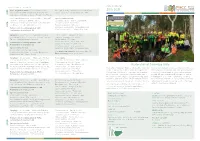
2015-2021 Restoration of Tunbridge Gully
CASE STUDY 040 PROJECT TIMELINE (DETAILED) Flora, Vegetation Studies – Proposed Weed and River and Tunbridge Gully Project area which found 2015-2021 Botanical Assessment of Hotham River Project was Juncus acutus was invading the project area. 2015 undertaken by Mattiske Consulting Pty Ltd of the Hotham Stage 1 weed control was conducted March - April 2017 Species planted include: REGIONAL GOALS across the Tunbridge Gully Project area. Eucalyptus patens – Swan River Blackbutt Boddington District High School (BDHS) students grew Eucalyptus rudis – Flooded Gum P People seedlings for the July 2016 planting event. Eucalyptus wandoo – White Gum 2016 Melaleuca rhaphiophylla – Swamp Paperbark Total amount of seedlings planted: 350 B Melaleuca cuticularis – Saltwater Paperbark Biophysical Total number of volunteers: 24 Spraying for Juncus acutus – Glyphosate 360 (frog Hakea undulata – Baby leafed hakea friendly) and Wetter. All areas of the Hotham River and Hakea lissocarpha – Honey Bush Tunbridge Gully project were sprayed. Juncus pallidus – Pale rush Juncus pauciflorus – Loose Flower Rush Total amount of seedlings planted: 520 Juncus subsecundus – Finger rush Total number of volunteers - 66 2017 Melaleuca incana – Grey honey myrtle Species planted include: Melaleuca rhaphiophylla – Swamp paperbark Allocasuarina humilis – Dwarf Sheoak One monitoring transect established in May 2017 Calothamnus quadrifidus – One Sided Bottlebrush Photo monitoring points established Casuarina obesa – Swamp Sheoak Spraying for Juncus acutus – Glyphosate 360 (frog -

Salinity-Induced Changes in Anatomy, Stomatal Counts and Photosynthetic
270 S. Afr. J. Bot. 1996,62(5): 270-276 Salinity. induced changes in anatomy, stomatal counts and photosynthetic rate of AtripZex semibaccata R. Br. A.J. de Villiers,* I. von Te ichman, M.W. van Rooyen and G.K. Theron Department of Botany. University of Pretoria, Pretoria, 0002 Republic of South Africa Reaived J April 1996: reviJed 2 Jul.\' /996 Anatomical changes in the roots and leaves of Atriplex semibaccata R. Br., induced by salinity stress, as well as photosynthetic and stomatal response to salinity. were investigated. As salinity increased, decreases were observed in rool diameter and leaf size, as well as in the number of chloroplasts in the chlorenchyma and bundle sheath cells. Development of these two cell types was also inhibited. Net leaf photosynthetic rate and leaf stomatal conductance decreased with increasing salinity, while the interceJlular CO 2 concentration increased. 80th stomatal closure and inhibition of biochemical processes probably caused the reduced leaf photosynthetic rates. The stomatal indices suggest that the trend towards an increase in number of stomata per unit leaf area with an increase in salinity was not due to decreased epidermal cell size. Keywords: Anatomy, Atriplex semibaccata, Chenopodiaceae, photosynthetic rate, salinity, stomatal counts. "To whom correspondence should be addressed Introduction des. This knowledge could aid the selection of species suited for Atriptex semibaccata R. Br. is a ruderal perennial glycophytc and reclamation purposes on saline soils. The aim of this study was a member of the Chenopodiac~ae (Shomer-Ilan et at. 1981), a to determine the changes in root and leaf anatomy, photosyn family including many species which have a high sah wierancc thetic rate and stomatal counlS of Atriplex semibaccata, induced and many members of which, although growing on salt-laden by increased soil salinity. -

Capitulo 3 Tesis
View metadata, citation and similar papers at core.ac.uk brought to you by CORE provided by Digital.CSIC 1 Flowering phenology of invasive alien plant species compared to native 2 species in three mediterranean-type ecosystems 3 4 Oscar Godoy*1,4, David M. Richardson2, Fernando Valladares1,3 & Pilar Castro-Díez4 5 6 1 Laboratorio Internacional de Cambio Global (Linc-Global). Instituto de los Recursos 7 Naturales, Centro de Ciencias Medioambientales. CSIC. Serrano 115 dpdo E-28006 8 Madrid Spain. ! 9 2 Centre for Invasion Biology, Department of Botany & Zoology, Stellenbosch 10 University, Private Bag X1, Matieland 7602, South Africa. 11 3 Departamento de Biología y Geología. Área de Biodiversidad & Conservación, 12 Universidad Rey Juan Carlos, ESCET, Tulipán s/n E-28933, Móstoles, Madrid, Spain. 13 4 Departamento Interuniversitario de Ecología. Sección de Alcalá. Edificio de Ciencias. 14 Universidad de Alcalá, E-28871, Alcalá de Henares, Madrid, Spain. 15 16 *Correspondence author: ogodoy@ccma.csic.es 17 18 19 20 21 22 23 24 25 26 27 28 29 1 1 Fenología de floración de las especies de plantas exóticas invasoras en 2 tres ecosistemas mediterráneos en comparación con las especies 3 nativas. 4 5 Resumen 6 • Antecedentes y Objetivos: La fenología de floración es un componente esencial 7 del éxito de las especies invasoras, ya que una elevada fecundidad incrementa su 8 potencial invasor. Por tanto, estudiamos la relación existente entre los patrones 9 de floración de las especies invasoras y nativas en tres regiones con clima 10 mediterráneo: California, España y la Región Sudafricana de El Cabo 11 • Métodos: 227 pares de especies invasoras-nativas fueron utilizados 12 • Resultados clave: Las especies invasoras tienen diferentes patrones de floración 13 en comparación con las especies nativas en las tres regiones. -

Mcgrath State Beach Plants 2/14/2005 7:53 PM Vascular Plants of Mcgrath State Beach, Ventura County, California by David L
Vascular Plants of McGrath State Beach, Ventura County, California By David L. Magney Scientific Name Common Name Habit Family Abronia maritima Red Sand-verbena PH Nyctaginaceae Abronia umbellata Beach Sand-verbena PH Nyctaginaceae Allenrolfea occidentalis Iodinebush S Chenopodiaceae Amaranthus albus * Prostrate Pigweed AH Amaranthaceae Amblyopappus pusillus Dwarf Coastweed PH Asteraceae Ambrosia chamissonis Beach-bur S Asteraceae Ambrosia psilostachya Western Ragweed PH Asteraceae Amsinckia spectabilis var. spectabilis Seaside Fiddleneck AH Boraginaceae Anagallis arvensis * Scarlet Pimpernel AH Primulaceae Anemopsis californica Yerba Mansa PH Saururaceae Apium graveolens * Wild Celery PH Apiaceae Artemisia biennis Biennial Wormwood BH Asteraceae Artemisia californica California Sagebrush S Asteraceae Artemisia douglasiana Douglas' Sagewort PH Asteraceae Artemisia dracunculus Wormwood PH Asteraceae Artemisia tridentata ssp. tridentata Big Sagebrush S Asteraceae Arundo donax * Giant Reed PG Poaceae Aster subulatus var. ligulatus Annual Water Aster AH Asteraceae Astragalus pycnostachyus ssp. lanosissimus Ventura Marsh Milkvetch PH Fabaceae Atriplex californica California Saltbush PH Chenopodiaceae Atriplex lentiformis ssp. breweri Big Saltbush S Chenopodiaceae Atriplex patula ssp. hastata Arrowleaf Saltbush AH Chenopodiaceae Atriplex patula Spear Saltbush AH Chenopodiaceae Atriplex semibaccata Australian Saltbush PH Chenopodiaceae Atriplex triangularis Spearscale AH Chenopodiaceae Avena barbata * Slender Oat AG Poaceae Avena fatua * Wild -

Gazetteer of Surface Waters of California
DEPARTMENT OF THE INTERIOR UNITED STATES GEOLOGICAL SURVEY GEORGE OTI8 SMITH, DIEECTOE WATER-SUPPLY PAPER 296 GAZETTEER OF SURFACE WATERS OF CALIFORNIA PART II. SAN JOAQUIN RIVER BASIN PREPARED UNDER THE DIRECTION OP JOHN C. HOYT BY B. D. WOOD In cooperation with the State Water Commission and the Conservation Commission of the State of California WASHINGTON GOVERNMENT PRINTING OFFICE 1912 NOTE. A complete list of the gaging stations maintained in the San Joaquin River basin from 1888 to July 1, 1912, is presented on pages 100-102. 2 GAZETTEER OF SURFACE WATERS IN SAN JOAQUIN RIYER BASIN, CALIFORNIA. By B. D. WOOD. INTRODUCTION. This gazetteer is the second of a series of reports on the* surf ace waters of California prepared by the United States Geological Survey under cooperative agreement with the State of California as repre sented by the State Conservation Commission, George C. Pardee, chairman; Francis Cuttle; and J. P. Baumgartner, and by the State Water Commission, Hiram W. Johnson, governor; Charles D. Marx, chairman; S. C. Graham; Harold T. Powers; and W. F. McClure. Louis R. Glavis is secretary of both commissions. The reports are to be published as Water-Supply Papers 295 to 300 and will bear the fol lowing titles: 295. Gazetteer of surface waters of California, Part I, Sacramento River basin. 296. Gazetteer of surface waters of California, Part II, San Joaquin River basin. 297. Gazetteer of surface waters of California, Part III, Great Basin and Pacific coast streams. 298. Water resources of California, Part I, Stream measurements in the Sacramento River basin. -

Foraoe Plants for ( Fltiyation on Alkali Soils
FORAOE PLANTS FOR ( FLTIYATION ON ALKALI SOILS. By JARED G. SMITH, Assistant Agrostologist. INTRODUCTION. When the excess of alkali in a soil rises to such a sum total that the cereals can not be grown, the best use to which the land can be put is the growth of forage. There is no crop, so far as known, which can be profitably grown on land that contains over 2 per cent of the combined alkalies within the first 2 inches of surface soil. Soils containing as much as 1 per cent of alkalies within the first 2 inches will not grow cereals, and the maximum for trees, vines, and root crops is much lower. There are extensive areas in the West which are thus excluded from the cate- gory of farming lands because of the excess of alkalies. Such lands are not necessarily barren, although they can not be profitably culti- vated. They are often covered by a rank growth of vegetation, indi- cating that there is an abundance of plant food in the soil, if only the plants are so tolerant of alkali as to be able to secure it. Many of the alkaii plants have considerable value as forage, and of these some few show special adaptation to the changed conditions which cultiva- tion brings. The crops which originated in humid regions will not grow on soils which are strongly impregnated with the alkalies, and so to meet the conditions one must either take the useful plants of the alkali regions of his own country or depend upon those which have been introduced from similar regions elsewhere. -

Plant Species Identity and Richness Influence Microbial Respiration of Soil Microorganisms on Various Functional Groups in Northeastern Patagonia, Argentina
Biodiversity International Journal Research Article Open Access Plant species identity and richness influence microbial respiration of soil microorganisms on various functional groups in northeastern Patagonia, Argentina Abstract Volume 2 Issue 2 - 2018 Studies on basal soil respiration (i.e., under undisturbed conditions) are very important because they can be used as indirect indicators of the biological activity Cardillo DS,1 Busso CA,1,2 Ambrosino ML,1,3 in those soils; this ecological process is recognized as the major source of carbon Torres YA,2,4 Ithurrart LS,1,2 Palomo R1 flux from the soil surface, and one of the crucial components of the carbon cycle in 1Consejo Nacional de Investigaciones Científicas y Técnicas de terrestrial ecosystems. The objectives of this study were to determine the microbial la República Argentina (CONICET), Argentina respiration of soil microorganisms at various levels of plant species richness and 2Departamento de Agronomía, Universidad Nacional del Sur developmental morphology stages in various perennial grass (Nassella longiglumis, (UNS), Argentina 3 N. tenuis, Amelichloa ambigua), and herbaceous (Atriplex semibaccata) and woody Facultad de Ciencias Exactas y Naturales, Universidad Nacional de La Pampa, Argentina (Larrea divaricata, Schinus fasciculatus) dicots grown in experimental plots during 4Comisión de Investigaciones Científicas de la Provincia de 2013 and 2014. There were 54 experimental plots. On each of 6 blocks, there was a Buenos Aires (CIC), Argentina plot (1.25x1.25m) for each of the 6 species (monocultures) and one plot each having combinations of 2, 4 or 6 species. Six hundred and twenty nine plants were reserved to Correspondence: Carlos Busso, Agonomy Department, replace dead plants in the plots [629+1944 plants from the plots (54 plots x 36 plants National Council for Scientific and Technological Research of per plot)=2573 plants in total]. -

Calavera Plant List
Calavera Preliminary Plant Checklist Note: This list is incomplete and only includes plants observed in May through August. *Indicates a non-native species. James Dillane June, 2008 CRYPTOGAMS SELAGINACEAE Spike-Moss Family Selaginella cinerascens Ashy Spike Moss POLYPODIACEAE Polypody Family Adiantum jordani California Maidenhair PTERIDACEAE Brake Fern Family Pentagramma triangularis ssp. viscosa Silverback Fern ANGIOSPERMAE (DICOTYLEDONES) AIZOACEAE Fig-Marigold Family Carpobrotus sp.* Iceplant ANACARDIACEAE Sumac Family Malosma laurina Laurel Sumac Rhus integrifolia Lemonadeberry Schinus molle* Peruvian Pepper Tree Toxicodendron diversilobum Poison Oak APIACEAE Carrot Family Apiastrum angustifolium Mock-Parsley/Wild Celery Apium graveolens* Celery Conium maculatum* Poison Hemlock Daucus pusillus Rattlesnake Weed Foeniculum vulgare* Fennel Sanicula crassicaulis Pacific Sanicle ASCLEPIADACEAE Milkweed Family Asclepias fascicularis Narrow-Leaf Milkweed Sarcostemma cynanchoides ssp. hartwegii Climbing Milkweed ASTERACEAE Sunflower Family Acourtia microcephala Sacapellote/Purple Heads Ambrosia psilostachya Ragweed Artemisia californica California Sage Artemisia douglasiana Douglas Mugwort Baccharis pilularis Coyote Brush Baccharis salicifolia Mulefat Brickellia californica California Brickellbush Carduus pycnocephalus* Italian Thistle Centauria melitensis* Tocalote, Star-thistle Chamomilla suaveolens* Pineapple Weed Chrysanthemum coronarium* Garland Chrysanthemum Cirsium occidentale var. californicum California Thistle Cirsium sp.* Thistle -

Plant Species Richness and Developmental Morphology Stage Influence Mycorrhizal Patagonia Plants Root Colonization1 D
ISSN 1067-4136, Russian Journal of Ecology, 2018, Vol. 49, No. 5, pp. 413–421. © Pleiades Publishing, Ltd., 2018. Plant Species Richness and Developmental Morphology Stage Influence Mycorrhizal Patagonia Plants Root Colonization1 D. S. Cardilloa, C.A. Bussob, c, *, **, M.L. Ambrosinoa, d, L.S. Ithurrarta, b, Y.A. Torresb, e, and R.I. Palomoc aConsejo Nacional de Investigaciones Científicas y Técnicas de la República Argentina (CONICET), Pcia, Buenos Aires, 8000 Bahía Blanca Argentina bDepartamento de Agronomía-Universidad Nacional del Sur (UNS), Pcia, Buenos Aires, 8000 Bahía Blanca Argentina cCERZOS–Consejo Nacional de Investigaciones Científicas y Tecnológicas de la República Argentina (CONICET), Pcia, Buenos Aires, 8000 Bahía Blanca Argentina dFacultad de Ciencias Exactas y Naturales, Universidad Nacional de La Pampa, Provincia de La Pampa, 6300 Santa Rosa Argentina eComisión de Investigaciones Científicas de la Provincia de Buenos Aires (CIC), Pcia, Buenos Aires, 8000 Bahía Blanca Argentina *e-mail: cebusso@criba.edu.ar **e-mail:carlosbusso1@gmail.com Received June 28, 2017 Abstract—The objectives of this study were to determine the percentage of root colonization by arbuscular mycorrhizal (AM) fungi at various levels of plant species richness and developmental morphology stages in various perennial grass, and herbaceous and woody dicots species using experimental plots during 2013 and 2014. An auger was used to obtain six replicate root + soil samples at each sampling time on each of the study parameters. Roots were washed free of soil, and percentage AM was determined. The shrub Larrea divaricata was the species which showed the lowest percentage of colonization by AM at the vegetative developmental morphology stage at the monocultures and six-species-mixtures on the experimental plots. -

Plants of Havasu National Wildlife Refuge
U.S. Fish and Wildlife Service Plants of Havasu National Wildlife Refuge The Havasu NWR plant list was developed by volunteer Baccharis salicifolia P S N John Hohstadt. As of October 2012, 216 plants have been mulefat documented at the refuge. Baccharis brachyphylla P S N Legend shortleaf baccharis *Occurance (O) *Growth Form (GF) *Exotic (E) Bebbia juncea var. aspera P S N A=Annual G=Grass Y=Yes sweetbush P=Perennial F=Forb N=No Calycoseris wrightii A F N B=Biennial S=Shrub T=Tree white tackstem Calycoseris parryi A F N Family yellow tackstem Scientific Name O* GF* E* Chaenactis carphoclinia A F N Common Name pebble pincushion Agavaceae—Lilies Family Chaenactis fremontii A F N Androstephium breviflorum P F N pincushion flower pink funnel lily Conyza canadensis A F N Hesperocallis undulata P F N Canadian horseweed desert lily Chrysothamnus Spp. P S N Aizoaceae—Fig-marigold Family rabbitbrush Sesuvium sessile A F N Encelia frutescens P S N western seapurslane button brittlebrush Encelia farinosa P S N Aizoaceae—Fig-marigold Family brittlebrush Trianthema portulacastrum A F N Dicoria canescens A F N desert horsepurslane desert twinbugs Amaranthaceae—Amaranth Family Antheropeas wallacei A F N Amaranthus retroflexus A F N woolly easterbonnets redroot amaranth Antheropeas lanosum A F N Tidestromia oblongifolia P F N white easterbonnets Arizona honeysweet Ambrosia dumosa P S N burrobush Apiaceae—Carrot Family Ambrosia eriocentra P S N Bowlesia incana P F N woolly fruit bur ragweed hoary bowlesia Geraea canescens A F N Hydrocotyle verticillata P F N hairy desertsunflower whorled marshpennywort Gnaphalium spp. -

CHENOPODIACEAE Atriplex Semibaccata Creeping Saltbush/Berry Saltbush
CHENOPODIACEAE Atriplex semibaccata Creeping saltbush/Berry saltbush Fruit Avon Catchment Council Atriplex semibaccata Creeping saltbush/Berry saltbush Plant features Growth form A short lived perennial prostrate, spreading, groundcover, up to 0.1- 0.5m high and 1.8m wide. Leaves The leaves are thin, oblong to oval, often with a blunt end, with ‘toothed’ margins and 10-20mm long. They are grey-green in CHENOPODIACEAE colour, scaly below and smooth on top. Flowers There are separate male and female flowers on the same plant. Occur in small clusters on the axil between the stem and leaves. Flowers most of year. Fruits Female flowers develop into succulent square/diamond shaped red berries, 2-5mm long and wide. Berries turn dark brown when dry. Bark Grey. Distribution Occurs naturally throughout the Avon catchment and from north of Floodfringe Geraldton to Esperance with isolated Floodway occurrences in the goldfields. Normal winter level Zone, habitat Prefered habitat of Atriplex semibaccata Grows on a variety of fresh to slightly saline soils. Occurs across the landscape including floodfringes, floodways and lake margins. Additional information Very useful understorey species for riparian revegetation. It is quite palatable to both stock and native fauna and will readily recover if not subjected to overgrazing. It is slightly waterlogging and salt tolerant and very drought tolerant. Its dense foliage covers the ground, acting as a green mulch, providing protection for both the soil and fauna. The large number of seeds are an important food source of insects, birds and small marsupials. Plants can be grown from tubestock or by direct seeding. -

San Luis Low Point Improvement Project Draft Feasibility Report
San Luis Low Point Improvement Project Draft Feasibility Report U.S. Department of the Interior Bureau of Reclamation Santa Clara Valley Water District Mid-Pacifi c Region San Jose, California April 2019 Sacramento, California San Luis Low Point Improvement Project Draft Feasibility Report U.S. Department of the Interior Bureau of Reclamation Mid-Pacific Region Santa Clara Valley Water District Sacramento, California San Jose, California April 2019 Mission Statements The Department of the Interior protects and manages the Nation's natural resources and cultural heritage; provides scientific and other information about those resources; and honors its trust responsibilities or special commitments to American Indians, Alaska Natives, and affiliated island communities. The mission of the Bureau of Reclamation is to manage, develop, and protect water and related resources in an environmentally and economically sound manner in the interest of the American public. Executive Summary Executive Summary The San Luis Low Point Improvement Project (SLLPIP) Draft Feasibility Report is a joint study by the United States (U.S.) Department of the Interior Bureau of Reclamation (Reclamation), in cooperation with the Santa Clara Valley Water District (SCVWD). The purpose of the feasibility report is to determine the potential type and extent of Federal and regional interest in a potential project to address water supply reliability and schedule certainty issues for SCVWD associated with low water levels in San Luis Reservoir. The SLLPIP alternatives analyzed in this Draft Feasibility Report would help to maintain a high quality, reliable, and cost-effective water supply for SCVWD, and would ensure that they receive their annual Central Valley Project (CVP) contract allocations at the time needed to meet their existing water supply commitments.