"The Barefoot Diva" and Other Stories Carla Martin
Total Page:16
File Type:pdf, Size:1020Kb
Load more
Recommended publications
-
The Story of Morna: Cape Verde's Music of Displacement and Return
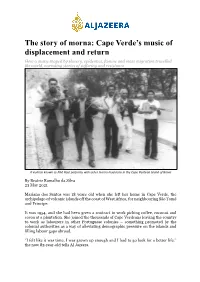
_________________________________________________________________________________________________________________ The story of morna: Cape Verde’s music of displacement and return How a music shaped by slavery, epidemics, famine and mass migration travelled the world, narrating stories of suffering and resistance. A violinist known as Nhô Raul performs with other morna musicians in the Cape Verdean Island of Brava By Beatriz Ramalho da Silva 23 May 2021 Mariana dos Santos was 18 years old when she left her home in Cape Verde, the archipelago of volcanic islands off the coast of West Africa, for neighbouring São Tomé and Principe. It was 1954, and she had been given a contract to work picking coffee, coconut and cocoa at a plantation. She joined the thousands of Cape Verdeans leaving the country to work as labourers in other Portuguese colonies – something promoted by the colonial authorities as a way of alleviating demographic pressure on the islands and filling labour gaps abroad. “I felt like it was time, I was grown up enough and I had to go look for a better life,” the now 85-year-old tells Al Jazeera. 2 On the day Mariana was set to leave, her boyfriend João accompanied her to the port with his guitar. He serenaded her until she boarded the ship. “Who showed you / That far away path? / The path / to São Tomé. / Sodade, sodade, / Sodade / …” he sang. “If you write me, / I will write you / if you forget me, / I will forget you…” The song, Sodade, was written down with some modifications by a local salesman, Armando Zeferino Soares. Years later, it would become one of the world’s most famous mornas, a Cape Verdean musical practice believed to date back to the 18th century. -

TRACEPLAY-PRESS-KIT-2017.Pdf
EDITOR “Our audience and urban creators were looking for a single platform that offers the best urban music and entertainment on all connected devices, all over the world. TracePlay is our answer to this request”. OLIVIER LAOUCHEZ CHAIRMAN, CEO AND CO-FOUNDER OF TRACE GROUP SUMMARY 1/ THE APP 03 TRACE PRESENTS TRACEPLAY 04 AN OFFER THAT FULLY INCLUDES URBAN MUSIC 2/ THE EXPERIENCE 05 LIVE TV: 9 TRACE MUSIC TV CHANNELS + 1 TV CHANNEL DEDICATED TO SPORT CELEBRITIES 06 LIVE RADIOS : 31 THEMATIC TRACE RADIOS 07 SVOD & ORIGINALS : OVER 2000 URBAN ASSETS 3/ THE OFFER 08 PRICES 09 DEVICES 10 GEOGRAPHICAL DISTRIBUTION APPENDIX: TRACEPLAY PROGRAM CATALOGUE 2017 WWW.TRACEPLAY.TV 1/ THE APP 1.1 TRACE PRESENTS TRACEPLAY TracePlay is the first subscription-based service entirely dedicated to urban and afro-urban music and entertainment. The App is available worldwide on most THE BEST RADIOS connected devices and offers an instant Afro-urban series, movies, documentaries 30 radio channels covering the various urban and unlimited access to 10 live TV chan- and concerts. and afro-urban genres. nels, 30 live radios and more than 2000 on demand programs. LIVE TV EXPLORE Watch the 9 best urban and afro-urban music channels Browse by region, topic, genre or mood and the #1 sport celebrities channel to make your choice. ON DEMAND Instant access to more than 2000 selected programs including originals. TV | RADIO | DIGITAL | EVENTS | STUDIOS | MOBILE | MAGAZINE TRACEPLAY | PRESS KIT 2017 03 1/ THE APP 1.2 AN OFFER THAT FULLY INCLUDES URBAN MUSIC TracePlay leverages Trace’s 14 years expertise in music scheduling to offer a unique music experience: all Urban, African, Latin, Tropical and Gospel music genres are available and curated on a single App for the youth who is 100% connected. -
Kuduro Meets Tecno-Brega | Norient.Com 5 Oct 2021 08:15:15
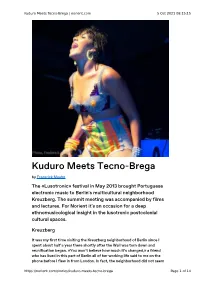
Kuduro Meets Tecno-Brega | norient.com 5 Oct 2021 08:15:15 Kuduro Meets Tecno-Brega by Frederick Moehn The «Lusotronic» festival in May 2013 brought Portuguese electronic music to Berlin's multicultural neighborhood Kreuzberg. The summit meeting was accompanied by films and lectures. For Norient it's an occasion for a deep ethnomusicological insight in the lusotronic postcolonial cultural spaces. Kreuzberg It was my first time visiting the Kreuzberg neighborhood of Berlin since I spent about half a year there shortly after the Wall was torn down and reunification began. «You won’t believe how much it’s changed,» a friend who has lived in this part of Berlin all of her working life said to me on the phone before I flew in from London. In fact, the neighborhood did not seem https://norient.com/stories/kuduro-meets-tecno-brega Page 1 of 14 Kuduro Meets Tecno-Brega | norient.com 5 Oct 2021 08:15:15 so markedly different to me. Sure, longtime residents lament the rise in real estate prices in recent years as gentrification creeps across the city; packs of foreign students and tourists crowd the neighborhood’s streets and cafes; and there are many more bars than before. But Kreuzberg still has a strong Turkish presence, and it remains a center for leftist political protest. Graffiti covers nearly every wall space, and even a couple of the caravan camps that were there when West Berlin was an island in the Eastern Bloc remain in place (squatting in empty apartment buildings, however, is no longer legal). -

SUZANNA LUBRANO Most Popular Female Zouk Artist from Cabo Verde
LATIN POP ZOUK KIZOMBA AFROLATIN SUZANNA LUBRANO Most popular female Zouk artist from Cabo Verde Number one hits 20 years in Africa and of Music Europe 11 CD´s A major + 1 DVD influence on many of today´s Gold and Kizomba artists Platinum albums in Africa Major African Music Awards SUZANNA LUBRANO 2015/2016 Introduction Suzanna Lubrano is one of the most popular female artists in Lusophone Africa. In a career spanning almost 20 years, she has scored massive hits in countries such as Angola, Mozambique and Cape Verde, and has also managed to achieve frequent successes elsewhere. She has received numerous music awards and nominations. In 2015, Suzanna Lubrano has released her latest solo-album ´Vitoria´. Most of the songs on the album are self-composed. The album contains duets with Machel Montano (Trinidad), Iyanya (Nigeria) and Vinicius D´black (Brazil), several productions by Giorgio Tuinfort (producer of songs by Michael Jackson, Rihanna, Lady Gaga and many more), and is more diverse than previous albums. Although a Cape Verdean singer, Suzanna’s music can’t be described as specifically Cape Verdean. With her exciting mix of Zouk or Kizomba, Pop Coladeira, R&B and other African and Latino music styles, the 39 year old gifted vocalist has retained her star status in the Portuguese speaking African countries throughout her career, which started in 1996 with the release of her debut album ´Sem Bo Nes Mund´. Suzanna lubrano and Giorgio Tuinfort (Michael Jackson, Rihanna, Lady Gaga) working on songs for the Vitoria album. SUZANNA LUBRANO -

Identidade E Estilo Em Lisboa: Kuduro, Juventude E Imigração Africana Identity and Style in Lisbon: Kuduro, Youth and African Immigration
Cadernos de Estudos Africanos 24 | 2012 Africanos e Afrodescendentes em Portugal: Redefinindo Práticas, Projetos e Identidades Identidade e Estilo em Lisboa: Kuduro, juventude e imigração africana Identity and style in Lisbon: Kuduro, youth and African immigration Frank Nilton Marcon Edição electrónica URL: http://journals.openedition.org/cea/706 DOI: 10.4000/cea.706 ISSN: 2182-7400 Editora Centro de Estudos Internacionais Edição impressa Paginação: 95-116 ISSN: 1645-3794 Refêrencia eletrónica Frank Nilton Marcon, « Identidade e Estilo em Lisboa: Kuduro, juventude e imigração africana », Cadernos de Estudos Africanos [Online], 24 | 2012, posto online no dia 13 dezembro 2012, consultado o 19 abril 2019. URL : http://journals.openedition.org/cea/706 ; DOI : 10.4000/cea.706 O trabalho Cadernos de Estudos Africanos está licenciado com uma Licença Creative Commons - Atribuição-NãoComercial-CompartilhaIgual 4.0 Internacional. Cadernos de Estudos Africanos (2012) 24, 95-116 © 2012 Centro de Estudos Africanos do ISCTE - Instituto Universitário de Lisboa I E L: K, çã Frank Nilton Marcon Universidade Federal de Sergipe (UFS) “racaju, ”rasil marconfrank@hotmail.com 96 IDENTIDADE E ESTILO EM LISBOA : KUDURO , JUVENTUDE E IMIGRAÇÃO AFRICANA Identidade e estilo em Lisboa: Kuduro, juventude e imigração africana O kuduro é um estilo de dança e música que chegou a Portugal através da imigra- ção africana. Recentemente, passou também a ser produzido entre jovens imigrantes ou descendentes na região metropolitana de Lisboa. Em tal contexto, formaram-se redes de produtores e consumidores de kuduro e se estabeleceram formas de sociabilidade nos bair- ros de Lisboa e dos municípios em seu entorno onde vivem as populações de imigrantes e seus descendentes oriundos de Angola, Cabo Verde, Guiné-Bissau e São Tomé e Príncipe. -

Investigação-Ação Numa Escola Básica Do Interior Da Ilha De São Vicente
Erenita Simone Monteiro Fernandes A MÚSICA TRADICIONAL CABO-VERDIANA – MORNA – NO CONTEXTO ESCOLAR Investigação-Ação numa escola básica do interior da ilha de São Vicente Mestrado em Educação Área de especialização Educação Artística Trabalho efetuado sob a orientação de Professor Doutor Carlos Almeida Professora Doutora Margarida Martins Dezembro de 2017 Dedicatória Com muita humildade dedico este trabalho à minha mãe e ao meu pai que envolveram-se no trabalho deixando-me sempre palavras amigas e de incentivo. Palavras motivantes que em momentos difíceis serviram de apoio e encorajamento para seguir adiante. iii Agradecimentos Ao Professor Doutor Carlos Almeida pela disponibilidade e incentivo durante este percurso, pelas suas recomendações e correções ao longo do desenvolvimento do trabalho. À Professora Doutora Margarida Martins pelas sugestões de atividade e recomendações para a implementação do estudo. Ao Professor Mestre Manuel Fortes pelo encorajamento e incentivo na busca de novas experiências académicas. Ao Professor Mestre Jair Pinto e Ednilson Almeida pela disponibilidade e atenção. Aos alunos da escola Olinda Silva, que participaram do estudo com dedicação. À agência turística NOBAI, pela disponibilidade em custear as despesas das visitas de estudo. Aos preciosos colaboradores do estudo, o músico Carlos Tanaia, professor Valério Miranda e artista Tito Paris pela disponibilidade imediata e apoio na realização do projeto. Ao musicólogo Vasco Martins pela amizade, disponibilidade e cedência de informações importantes para o trabalho. Aos colegas e amigos de Mestrado, Cilene, Dilma, Evanilda e Maria Piedade. À minha querida família pelo encorajamento sem medida. iv Resumo O trabalho que aqui se apresenta espelha o percurso da realização de uma intervenção educativa à luz da investigação-ação. -

Hispano-Lusophone” Community Media: Identity, Cultural Politics and Difference
“Hispano-Lusophone” Community Media: Identity, Cultural Politics and Difference Ana Stela de Almeida Cunha Miguel de Barros Rosana Martins (Editors) 17 Ana Stela de Almeida Cunha, Miguel de Barros, Rosana Martins (Eds.) ) Dirección José Luis Terrón, Universitat Autònoma de Barcelona Comité académico Carmen Echazarreta, Universitat de Girona Mònika Jiménez, Universitat Pompeu Fabra Jordi Farré, Universitat Rovira i Virgili Gustavo Cardoso, OberCom Rita Espanha, OberCom Nelson Zagalo, Universidade do Minho José Carlos Lozano, Texas A&M International University Tanius Karam, Universidad Autónoma Ciudad de México Laura Regil, Universidad Pedagógica Nacional Angel Badillo, Universidad de Salamanca Marta Martín, Universidad de Alicante Fotografía portada: Ana Stela de Almeida Cunha Ana Stela de Almeida Cunha, Miguel de Barros, Rosana Martins (Eds.) (2018): “Hispano- Lusophone” Community Media: Identity, Cultural Politics and Difference. InCom-UAB Publicacions, 17. Bellaterra: Institut de la Comunicació, Universitat Autònoma de Barcelona. ISBN 978-84-948252-1-7 Institut de la Comunicació (InCom-UAB) Universitat Autònoma de Barcelona Campus UAB - Edifici N, planta 1. Despatx N-1003 E- 08193 Bellaterra (Cerdanyola del Vallès) Barcelona. Espanya http://incom.uab.cat ISBN: 978-84-948252-1-7 2 “Hispano-Lusophone” Community Media: Identity, Cultural Politics and Difference ) Acknowledgements We would like to thank each of the authors for their valuable contributions during this manuscript’s gestation period. We are grateful for their inspiring visions of Media Studies, and for the vigour with which they conduct their investigations into this fascinating and complex field. Without them, this book would not have been a possibility. We wish to express our gratitude to the many people who have assisted us at the various stages of the project. -

Table of Contents
José N’dongala Kizombalove Methodology – teachers course Kizomba teachers course José N’dongala Kizombalove Methodology Teachers Course KIZOMBA TEACHERS1 COURSE José N’dongala Kizombalove Methodology – teachers course Kizomba teachers course José N’dongala Kizombalove Methodology Teachers Course Syllabus « José N’dongala Kizombalove Methodology » teachers course by José Garcia N’dongala. Copyright © First edition, January 2012 by José Garcia N’dongala President Zouk Style vzw/asbl (Kizombalove Academy) KIZOMBA TEACHERS COURSE 2 José N’dongala Kizombalove Methodology – teachers course Kizomba teachers course “Vision without action is a daydream. Action without vision is a nightmare” Japanese proverb “Do not dance because you feel like it. Dance because the music wants you to dance” Kizombalove proverb Kizombalove, where sensuality comes from… 3 José N’dongala Kizombalove Methodology – teachers course Kizomba teachers course All rights reserved. No part of this syllabus may be stored or reproduced in any way, electronically, mechanically or otherwise without prior written permission from the Author. 4 José N’dongala Kizombalove Methodology – teachers course Kizomba teachers course Table of contents 1 INTRODUCTION ......................................................................................................... 9 2 DANCE AND MUSIC ................................................................................................. 12 2.1 DANCING A HUMAN PHENOMENON ......................................................................... -

Popular Music, Popular Movement(S) 2018 CWRU MGSA Conference Case Western Reserve University October 5-6, 2018
Popular Music, Popular Movement(s) 2018 CWRU MGSA Conference Case Western Reserve University October 5-6, 2018 Friday, October 5 8:30-9:30: Breakfast and Coffee Dampeer Room Kelvin Smith Library, 2nd Floor 9:30-11:30: Communities in Confrontation Moderator: Paul Abdullah, Case Western Reserve University Rachel Schuck, “Carnatic Music Transplanted to America: Innovations of Youth in ‘Sustaining Sampradaya’” Samantha Skaller, “My Name is Nina Simone: Jazz, Violence, Trauma, and the Civil Rights Movement” Samantha Cooper, “That (Kosher?) Mikado: American Jewish Reception of Gilbert and Sullivan’s Comic Operetta, 1885-1940” Briana Nave, “‘No Thanks!’: Political Punk in the Capital in the Era of Trump and the Alt- Right” 1:30-3:00: Mediated Voices Moderator: Mandy Smith, Rock & Roll Hall of Fame Jasmine Henry, “Beats and Brotherhood: The DIY Hip-Hop Recording Studio as Black Public Sphere” Sarah Lindmark, “Watching Their Souls Speak: Childish Gambino, Kendrick Lamar, Beyoncé Knowles-Carter, and the Development of the Long-Form Music Video” Kyle Kostenko, “RuPaul Reconsidered: Intersections of Gender, Sexuality, and Race in ‘Supermodel (You Better Work)’” 3:00-4:00 Coffee and Refreshments 4:00-5:00: Keynote I: Mary Simonson Harkness Chapel Classroom 11200 Bellflower Rd 5:00-6:00: Reception 8:00: The Cleveland Orchestra and Franz Welser-Möst perform Mahler 2nd Symphony, “Resurrection” Saturday, October 6 8:30-9:30: Breakfast and Coffee Clark Hall, Room 206 11130 Bellflower Rd 9:30-11:30: Identities in Flux Moderator: James Aldridge, Case Western Reserve University Steph Ruozzo, “Stairway to Paradise: George Gershwin’s Climb Towards Acceptance in the Jazz Canon” Larissa A. -

O Kuduro Como Expressão Da Juventude Em Portugal: Estilos De
Recebido: 26.08.11 O kuduro como expressão Aprovado: 28.09.12 da juventude em Portugal: 1. Doutor em Antro- pologia Social, pela UFSC, professor do Departamento de estilos de vida e Ciências Sociais da Universidade Fe- deral de Sergipe e processos de identificação dos mestrados em Antropologia e em Frank Marcon1 Sociologia da mes- ma universidade. Coordenador do Resumo: O artigo em questão é fruto de uma pesquisa etnográfica realizada em Lisboa, Grupo de Estudos Culturais, Identida- no ano de 2010. O kuduro é um estilo de dança e música que surgiu em Luanda, nos anos des e Relações Inte- 1990, e que chegou a Portugal logo em seguida, por meio das relações entre os imigran- rétnicas. tes com o país de origem: a Angola. O objetivo é compreender como, ao lado de outras E-mail: frankmar- con@oi.com.br, formas de expressão cultural juvenis, em Lisboa, o kuduro, assim como o hip-hop, o rap e marconfrank@hot- o reggae, passou a fazer parte integrante do consumo e da produção cultural dos jovens mail.com da periferia. Em meio à música e à dança como formas de entretenimento, um univer- so de tensões sociais, étnicas e geracionais faz-se presente e faz emergir interessantes processos de identificação social. A escola, a rua e a Internet tornaram-se os principais espaços de socialização do kuduro, que perpassa um estilo de vida que parece constituir laços de afinidade entre imigrantes e descendentes, tendo como referência o país de origem ou mesmo uma África imaginada pela relação de solidariedade entre descenden- tes da imigração originária dos Países Africanos de Língua Portuguesa. -

The African Roots of Cuban Music,The Music of the Nyayo Era,Kenyans' Elusive Search for a Cultural Identity,How Afrobeat(S)
The African Roots of Cuban Music By Boima Tucker British sociologist Paul Gilroy suggested the history of culture in the Atlantic world is characterized by constant exchange. One of the most traceable elements of that exchange, is the musical connections between communities of African descent on either side of the ocean. These musical practices operate as sites of resistance, cultural retention, and social cohesion that allow us to understand some of the ways we all are formed by trans-continental processes. During the dawn of recorded music in the early part of the 20th century, Cuba—one of many New World sites of African and indigenous resistance to European colonisation and enslavement—would become a hotbed for musical export in the emerging industrialized system of music distribution. Folk musical traditions from across the island would come together in Havana’s studios, and then get dispersed around the entire Atlantic world. In the early part of the 20th Century, Cuban musical styles like son, mambo and guaguanco followed migrants and sailors out across the Atlantic, hitting radio waves in the ports of landing, and spreading throughout the interior of the countries they landed in. With its strong traces of West and Central African rhythms, this music would find legions of devoted followers on the African continent. Local artists would try their hand at recreating the sound, and start to mix elements of their own local traditions creating what we now know as Congolese rumba, soukous, mbalax, semba, kizomba, and highlife, etc. These styles, amongst many others on the continent, would go on to form the backbone of national identity in the post-independence period, their propagation supported with enthusiasm by the leaders of the new nations. -
THE LANGUAGE DEBATE in CAPE VERDE a Thesis Presented to The
THE LANGUAGE DEBATE IN CAPE VERDE A thesis presented to the faculty of the Center for International Studies of Ohio University In partial fulfillment of the requirements for the degree Master of Arts Patrick J. Coonan June 2007 This thesis entitled THE LANGUAGE DEBATE IN CAPE VERDE by PATRICK J. COONAN has been approved for the Center for International Studies by __________________________________________________ Ann R. Tickamyer Professor of Sociology and Anthropology __________________________________________________ Drew McDaniel Interim Director, Center for International Studies Abstract COONAN, PATRICK J., M.A., June 2007, International Development Studies THE LANGUAGE DEBATE IN CAPE VERDE (138 pp.) Director of Thesis: Ann R. Tickamyer In many countries around the world, controversy surrounds state policy on language. The West African archipelago of Cape Verde is no exception. Ever since the country’s independence from Portugal in 1975, a movement of bilingual Cape Verdeans has spearheaded planning efforts for the national language (Cape Verdean Creole) in an attempt to build the case for making that language the country’s co-official language. Nevertheless, these individuals face resistance from other Cape Verdeans who view the project as an attempt to marginalize the current official language (Portuguese) and/or certain regional dialects of Cape Verdean Creole. This study looks at texts taken from the discourse of language policy in Cape Verde in order to identify the language ideologies, i.e. “sets of beliefs about language articulated by users as a rationalization or justification of perceived language structure or use” (Silverstein, 1979, p.497), that Cape Verdeans use to support or to resist certain language policy and planning options.