“Heart of Madagascar”
Total Page:16
File Type:pdf, Size:1020Kb
Load more
Recommended publications
-

Naturalmente Madagascar
Quality Group Soc. Cons. a.r.l. Lungo Dora P. Colletta 67, 10153 Torino - info@qualitygroup.it - www.qualitygroup.it Naturalmente Madagascar Durata 19 giorni, 17 notti QUOTE A PARTIRE DA: 5290 € Esclusiva il Diamante Descrizione del tour Il viaggio ideale per chi ama l'avventura. Lungo l'itinerario si scopre il Sud-Ovest del Madagascar, scendendo in barca lungo il fiume Tsiribihina per esplorare poi gli Tsingy di Bemaraha, patrimonio mondiale dell’UNESCO, la foresta di baobab ed un mare ancora non contaminato dal turismo nella località di Salary. Si risale in seguito lungo gli altipiani in un susseguirsi di paesaggi da cartolina arrivando infine alla capitale del Madagascar. Un tour incredibilmente intrigante e suggestivo adatto alla nostra clientela più incline all'avventura e con ottimo spirito di adattamento. Luoghi visitati Antananarivo, Antsirabe, Fiume Tsiribihina, Begidro, Belo sur Tsiribinha, Morondava, Belo sur Mer, Morombe, Salary Bay, Isalo Rock Lodge, Parco Nazionale dell'Isalo, Fianarantsoa, Ranomafana, Parco di Ranomafana, Antananarivo / Tanà Itinerario Giornaliero 1 Italia / Parigi / Antananarivo CATEGORIA SISTEMAZIONE TRATTAMENTO Standard Carlton Hotel o similare Pernottamento e prima colazione Partenza dalla città prescelta con voli Air France via Parigi. Arrivo ad Antananarivo in tarda serata, disbrigo delle formalità d'ingresso e incontro con l'assistente locale. Trasferimento in hotel, pernottamento. PUNTI DI INTERESSE Antananarivo Antananarivo, oggi chiamata in genere Tana, è la capitale, nonché la più grande città del Madagascar. È anche capoluogo della provincia di Antananarivo e della regione di Analamanga. Antananarivo è anche chiamata “la città dei mille, riferendosi a 1000 tesori da scoprire. Si consiglia una visita ad un "rova", un palazzo dell'epoca reale, una passeggiata tra i parchi di animali per scoprire la fauna e la flora visibili in tutta l'isola. -

Ratsantanana
5 RATSANTANANA COMMUNE RURALE DE MANAMBINA - COMMUNE RURALE D’AMBATOLAHY - COMMUNE RURALE D’ANKOTROFOTSY - COMMUNE RURALE DE DABOLAVA - COMMUNE RURALE D’AMBOHIMANAMBOLA - COMMUNE RURALE D’ANTRANOKARANY – HELVETAS Contexte Les enjeux de l’eau et de l’assainissement sont indiscutables à Madagascar compte tenu du faible taux d’accès de la population à ces deux services de base. Maitre d’ouvrage : Helvetas intervient dans 6 Communes Rurales appartenant à 3 districts différents : Les Communes Rurales partenaires du projet • District de Miandrivazo : commune de Manambina, d’Ambatolahy, d‘Ankotrofotsy et de Dabolava ; Partenaires techniques : Bureaux d’études et investisseurs • District d’Antananarivo Avaradrano: commune d’Ambohimanambola ; gestionnaires privés (ECAbraham, Mihaingo, Entreprise Générale • District d’Ambanja : commune d’Antranokarany. Soarafitra, RANOSOA, NY RAVO, EERT, Service Eau Lova Velo SARLU), Directions Régionales de Dans ces zones, le taux d’accès à l’eau potable est inférieur à 30% et les appuis l’EAH et cadres institutionnels sont localement faibles : absence de documents de planification sectorielle et de service technique en charge du secteur EAH . Partenaires locaux : ONG Santatra pour le district C’est en partant de ce constat que Helvetas collabore avec ces 6 communes d’Ambanja, ONG AIM (Action Intercooperation Madagascar) depuis 2014 afin de : pour Miandrivazo et Antananarivo • Formaliser un Service Technique en charge des services EAH (STEAH) ; Avaradrano • Mettre en place un Plan Communal de Développement intégrant -
Contribution D'un Geometre Topographe Dans Les
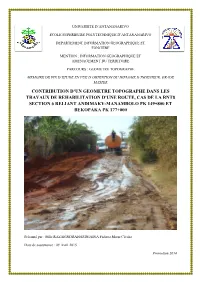
UNIVERSITE D’ANTANANARIVO ECOLE SUPERIEURE POLYTECHNIQUE D’ANTANANARIVO DEPARTEMENT INFORMATION GEOGRAPHIQUE ET FONCIERE MENTION : INFORMATION GEOGRAPHIQUE ET AMENAGEMENT DU TERRITOIRE PARCOURS : GEOMETRE TOPOGRAPHE MEMOIRE DE FIN D’ETUDE EN VUE D’OBTENTION DU DIPLOME D’INGENIEUR, GRADE MASTER CONTRIBUTION D’UN GEOMETRE TOPOGRAPHE DANS LES TRAVAUX DE REHABILITATION D’UNE ROUTE, CAS DE LA RNT8 SECTION 6 RELIANT ANDIMAKY-MANAMBOLO PK 149+800 ET BEKOPAKA PK 177+000 Présenté par : Mlle RAZAFINDRAHASINIAINA Fidisoa Marie Cécilia Date de soutenance : 09 Avril 2015 Promotion 2014 UNIVERSITE D’ANTANANARIVO ECOLE SUPERIEURE POLYTECHNIQUE D’ANTANANARIVO DEPARTEMENT INFORMATION GEOGRAPHIQUE ET FONCIERE MENTION : INFORMATION GEOGRAPHIQUE ET AMENAGEMENT DU TERRITOIRE PARCOURS : GEOMETRE TOPOGRAPHE MEMOIRE DE FIN D’ETUDE EN VUE D’OBTENTION DU DIPLOME D’INGENIEUR, GRADE MASTER Président du Jury : Dr RABARIMANANA Mamy Herisoa, Maître de conférences, enseignant à l’ESPA et Chef du département IGF Examinateurs : Dr RABETSIAHINY, Maître de conférences et enseignant chercheur à l’ESPA M. RAKOTOZAFY ROBERT, Ingénieur Géomètre Topographe et Géomètre expert Directeurs de mémoire : M. RAKOTOARISON Max Simon, Ingénieur Principal Géodésien au FTM M. MAHATOVO Henri, Ingénieur et Directeur Général du bureau d’études TECMAD Présenté par : Mlle RAZAFINDRAHASINIAINA Fidisoa Marie Cécilia Date de soutenance : 09 Avril 2015 Promotion 2014 Mémoire de fin d’études Promotion 2014 REMERCIEMENTS En premier lieu, je rends grâce à Dieu tout puissant pour son amour, sa bonté -

Côte Ouest De Madagascar
UNIVERSITE RENE DESCARTES SORBONNE PARIS V ITINERAIRES Côte Ouest de Madagascar Région de Belo-sur-Tsirihihina et vallée du Manambolo Tome II Suzanne CHAZAN - GILLIG Sous la direction du Professeur G. BALANDIER ORSTOM PARIS - MARS 1986 SOMMAIRE PAGES INTRODUCTION 1 - BELO SUR TSIRmlHINA ET LA VALLEE DU MANANBOLO DANS LES NOTES INEDITES DE A. GRANDIDIER (Année 1868-1869) 1 - Cahier nO 13 : Notes prises à Morondava et Tsimanandrafoza 6 (mars-mai 1869) p. 612 à 627 Montage de texte concernant la reine Narova et l'accueil réserve à Samat et Grandidier 2 - Cahier nO 14 :Notes prises à Morondava (janvier 1970) 10 p. 630 à 720 ... ilLe Menabe Indépendant" p. 639 à 641/ 646-647/ 660/663-664/680 à 690/691/705/714/716 à 718 1 3 - Cahier nO 15 : Notes de Tsimanandrafoza à Madzunga 25 du 21 mai au 6 juin 1869 p. 721 à 847 du manuscrit original p. 723 à 725 /800 à 802/ 806 à 816/ 836 à 846 4 - Cahier nO 16 : Voyage de Morondava à Madzunga 27 pp. 848 à 924 du manuscrit original Montage de texte sans les pages de référence. 5 - Textes inédits in-bibli. Grandidier de 1867 à 1872 36 Quelques notes concernant le commerce de la Côte Ouest p. 6 à 11/21 à 25 Manuscrit remis au Commandant De1afrange vers 1872 pour Mr. Le Play, Les divisions Sakalava, p. 25 .. 6 - Carnet n025 : Montage de texte concernant les Vazimba• 40 Pages sans nO II - LE ATAMPOHA DE 1968, NOTES ET DOCUMENTS - PREMIERE MISSION ORGANISATION GENERALE DE L'ENQUETE-SELECTION ET CLASSEMENT DE L'IN FORMATION INTRODUCTION 45 INTERVIEWS RECUEILLIS AU COURS DU ATAMPOHA DE 1968 Texte nO 1/Arrivée à Ampasy et visite des Dady 48 Texte nO 2/Avec le Fokonolona cl' Andranofotsy. -

Acteurs Et Zone D'intervention 2018 Du Meeh / Dreeh Menabe
ACTEURS ET ZONE D’INTERVENTION 2018 DU MEEH / DREEH MENABE REALISATIONS LOCALISATION Nombre N° Financement Populati SYSTEME / ACTIVITES HARD (Infrastructures/Taches) Inauguration (PTF à préciser on Région District Commune/Localité ou RPI) bénéfici aires EAU POTABLE R.T déjà fini / 01 Kiosque à Deux robinets, 39 BP, R.D et Projet C.R Anosimena/ Loc. 1 AEPP Solaire 02 BS, 05 BI, 02 Château d’Eau Inauguration RATSANTANANA, 2420 Menabe Miandrivazo Masiakampy dont l’un 54m3 et l’autre 5m3 le 06 OCT HSI 2017 R.T déjà fini / R.D et Projet 01 Kiosque à Deux robinets, BP, 01 C.R Anosimena/ Loc. 2 AEPP Solaire Inauguration RATSANTANANA, 1050 Menabe Miandrivazo Château d’Eau de 56m3 Ampihaky le 06 OCT HSI 2017 R.T déjà fini / Projet en attente de C.R Manambina/ Loc. 3 AEPP Solaire Un Château d’Eau de 54m3 RATSANTANANA, 3290 Menabe Miandrivazo R.D et Manambina HSI Inauguration Travaux Programme C.R Malaimbandy/ 07 4 AEPP Solaire Un Château d’Eau de 15m3, 07 BF 2400 Menabe Mahabo réalisés à 85% MATOY Localités de 07 Fkt Travaux réalisés à Association 100%- C.R Anosimena/ 05 5 FORAGE 09 FPMH Allemande AKE – 1800 Menabe Miandrivazo Inauguration Fokontany ONG LANONA le 06 OCT 2017 1 COMMENCE Morondava, GOUVERNEMEN 43000 6 FORAGES 100 FORAGES POSITIFS LE DEBUT DE Menabe Mahabo, 32 COMMUNES T CHINOIS HAB JUIN Miandrivazo COMMENCE REHABILITATION DE 56 23000 CINQ 7 FORAGES LE DEBUT DE JICA Menabe 44 COMMUNES FORAGES HAB DISTRICTS SEPTEMBRE Miandrivazo(EPP 08 puits modernes équipés de Ambatomena, pompe INDIA MARK III construits Morondava, Mahasoa,Antsoha) -

Candidats Belo Sur Tsiribihina Ambiky 1 Ird
NOMBRE DISTRICT COMMUNE ENTITE NOM ET PRENOM(S) CANDIDATS CANDIDATS IRD (ISIKA REHETRA MIARAKA @ ANDRY BELO SUR TSIRIBIHINAAMBIKY 1 RETSAIKY Renel RAJOELINA) BELO SUR TSIRIBIHINA AMBIKY 1 AVI (Asa Vita No Ifampitsarana) ZAFY Louis Race IRD (ISIKA REHETRA MIARAKA @ ANDRY BELO SUR TSIRIBIHINA ABOALIMENA 1 VOALA Joseph RAJOELINA) IRD (ISIKA REHETRA MIARAKA @ ANDRY BELO SUR TSIRIBIHINA ANDIMAKY MANAMBOLO 1 BOTOSOA RAJOELINA) IRD (ISIKA REHETRA MIARAKA @ ANDRY BELO SUR TSIRIBIHINA ANKALALOBE 1 ZAMANAHIRA RAJOELINA) IRD (ISIKA REHETRA MIARAKA @ ANDRY BELO SUR TSIRIBIHINA ANKOROROKY 1 MODY RAJOELINA) INDEPENDANT INDEPENDANT RANDRIANARISOA BELO SUR TSIRIBIHINA ANKOROROKY 1 DAMY DANIEL (Randrianarisoa Daniel) INDEPENDANT RAKOTOMALALA JEAN JOCELYN BELO SUR TSIRIBIHINAANTSOHA 1 ROMAIN Toff-yang (Rakotomalala Jean Jocelyn) IRD (ISIKA REHETRA MIARAKA @ ANDRY BELO SUR TSIRIBIHINAANTSOHA 1 RALISON Kamasy RAJOELINA) IRD (ISIKA REHETRA MIARAKA @ ANDRY BELO SUR TSIRIBIHINABELINTA 1 FENOLAHY RAJOELINA) INDEPENDANT INDEPENDANT MARINTOETSY BELO SUR TSIRIBIHINA BELO SUR TSIRIBIHINA 1 TSITOHERY Mahalako EMMANUEL (Marintoetsy Emmanuel) IRD (ISIKA REHETRA MIARAKA @ ANDRY BELO SUR TSIRIBIHINA BELO SUR TSIRIBIHINA 1 JACQUES Sebany RAJOELINA) BELO SUR TSIRIBIHINA BEMARIVO ANKIRONDRO 1 AVI (Asa Vita No Ifampitsarana) SAMUELSON IRD (ISIKA REHETRA MIARAKA @ ANDRY BELO SUR TSIRIBIHINA BEMARIVO ANKIRONDRO 1 MIL RAJOELINA) INDEPENDANT IRD (ISIKA REHETRA MIARAKA @ BELO SUR TSIRIBIHINABEREVO 1 RAKOTOVAO Charles ANDRY RAJOELINA) BELO SUR TSIRIBIHINA BEREVO 1 INDEPENDANT -

Fombandrazana Vezo: Ethnic Identity and Subsistence
FOMBANDRAZANA VEZO: ETHNIC IDENTITY AND SUBSISTENCE STRATEGIES AMONG COASTAL FISHERS OF WESTERN MADAGASCAR by EARL FURMAN SANDERS (Under the Direction of THEODORE GRAGSON) ABSTRACT The complex dynamic among coastal peoples of western Madagascar involves spread of cultural elements due to extensive seasonal migrations, tribes and ethnic groups merging into progressively broader ethnic groups, distinctions based on interethnic and intra-ethnic boundaries, and lumping of peoples with remotely similar subsistence patterns which has perpetuated ethnonym vagaries. This study analyzes the cultural bases of the Vezo, a group of marine fishers inhabiting the west coast of Madagascar, with the intent of presenting a clearer image of what is entailed within the ethnonym, Vezo, both with respect to subsistence strategies and cultural identity. Three broad areas of inquiry, ethnohistory, ecological niche as understood from the Eltonian definition, and geographical scope inform the field research. Access to these areas leans heavily on oral histories, which in turn is greatly facilitated by intensive participant observation and work in the native language. The analysis shows that the Vezo constitute a distinct ethnic group composed of diverse named patrilineal descent groups. This ethnic group is defined by common origins and a shared sense of common history, which along with the origins of the taboos are maintained within their oral histories. Within the ethnonym, Vezo, there are subsistence as well as other cultural distinctions, most notably the taboos. These distinctions are the bases of the ethnic boundaries separating those who belong to the Vezo cultural group and others who are referred to as Vezo (Vezom-potake and Vezo-loatse) due to geographical disposition. -

Verification Report Clean
CDM-VCR-FORM Verification and certification report form for CDM project activities (Version 01.0) Complete this form in accordance with the “Attachment: Instructions for filling out the verification and certification report form for CDM project activities” at the end of this form. VERICATION AND CERTIFICATION REPORT Title of the project activity ADES Solar and efficient stoves in Madagascar Reference number of the project activity GS 464 Version number of the verification and certification report 02 Completion date of the verification and certification report 18/08/2017 Monitoring period number and duration 2nd monitoring period of this monitoring period Duration: 1 year from 01/01/2016 to 31/12/2016 (both days included) Version number of monitoring report to which this report applies 4 Crediting period of the project activity corresponding to this monitoring period Second Crediting period Project participant(s) Myclimate Foundation and ADES – Association pour le Développement de l’Energie Solaire Host Party Madagascar Sectoral scope(s), selected Sectoral scope: Energy demand (3.1) methodology(ies), and where applicable, GS Methodology: Technologies and Practices to Displace selected standardized baseline(s) Decentralized Thermal Energy Consumption Estimated GHG emission reductions or net anthropogenic GHG removals for this 182,692 tCO 2e monitoring period in the registered PDD Certified GHG emission reductions or net anthropogenic GHG removals for this 226,182 tCO 2e monitoring period Name of DOE Bureau Veritas (India) Pvt Ltd Name, position and signature of the approver of the verification and certification report Sapana Pednekar - Quality Manager- Operations Version 01.0 Page 1 of 30 CDM-VCR-FORM SECTION A. -

Evolution De La Couverture De Forets Naturelles a Madagascar
EVOLUTION DE LA COUVERTURE DE FORETS NATURELLES A MADAGASCAR 1990-2000-2005 mars 2009 La publication de ce document a été rendue possible grâce à un support financier du Peuple Americain à travers l’USAID (United States Agency for International Development). L’analyse de la déforestation pour les années 1990 et 2000 a été fournie par Conservation International. MINISTERE DE L’ENVIRONNEMENT, DES FORETS ET DU TOURISME Le présent document est un rapport du Ministère de l’Environnement, des Forêts et du Tourisme (MEFT) sur l’état de de l’évolution de la couverture forestière naturelle à Madagascar entre 1990, 2000, et 2005. Ce rapport a été préparé par Conservation International. Par ailleurs, les personnes suivantes (par ordre alphabétique) ont apporté leur aimable contribution pour sa rédaction: Andrew Keck, James MacKinnon, Norotiana Mananjean, Sahondra Rajoelina, Pierrot Rakotoniaina, Solofo Ralaimihoatra, Bruno Ramamonjisoa, Balisama Ramaroson, Andoniaina Rambeloson, Rija Ranaivosoa, Pierre Randriamantsoa, Andriambolantsoa Rasolohery, Minoniaina L. Razafindramanga et Marc Steininger. Le traitement des imageries satellitaires a été réalisé par Balisama Ramaroson, Minoniaina L. Razafindramanga, Pierre Randriamantsoa et Rija Ranaivosoa et les cartes ont été réalisées par Andriambolantsoa Rasolohery. La réalisation de ce travail a été rendu possible grâce a une aide financière de l’United States Agency for International Development (USAID) et mobilisé à travers le projet JariAla. En effet, ce projet géré par International Resources Group (IRG) fournit des appuis stratégiques et techniques au MEFT dans la gestion du secteur forestier. Ce rapport devra être cité comme : MEFT, USAID et CI, 2009. Evolution de la couverture de forêts naturelles à Madagascar, 1990- 2000-2005. -
Impact Evaluation of the Menabe and Melaky Development Programme In
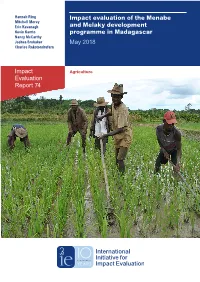
Hannah Ring Impact evaluation of the Menabe Mitchell Morey Erin Kavanagh and Melaky development Kevin Kamto programme in Madagascar Nancy McCarthy Joshua Brubaker May 2018 Charles Rakotondrafara Impact Agriculture Evaluation Report 74 About 3ie The International Initiative for Impact Evaluation (3ie) promotes evidence-informed equitable, inclusive and sustainable development. We support the generation and effective use of high- quality evidence to inform decision-making and improve the lives of people living in poverty in low- and middle-income countries. We provide guidance and support to produce, synthesise and quality assure evidence of what works, for whom, how, why and at what cost. 3ie impact evaluations 3ie-supported impact evaluations assess the difference a development intervention has made to social and economic outcomes. 3ie is committed to funding rigorous evaluations that include a theory-based design and uses the most appropriate mix of methods to capture outcomes that are useful in complex developmental contexts. About this report 3ie accepted the final version of the report, Impact evaluation of the Menabe and Melaky development programme in Madagascar, as partial fulfilment of requirements under grant TW4.2.02 awarded through the Agricultural Innovation Thematic Window. Despite best efforts in working with the authors, some figures could not be improved. We have copy- edited the content to the extent possible. The 3ie technical quality assurance team for this report comprises Diana Lopez-Avila, Deeksha Ahuja, Stuti Tripathi, an anonymous external impact evaluation design expert reviewer and an anonymous external sector expert reviewer, with overall technical supervision by Emmanuel Jimenez. The 3ie editorial production team for this report comprises Angel Kharya and Akarsh Gupta, with Beryl Leach providing overall editorial supervision. -
Annual Report Program Year 2 October 1, 2011
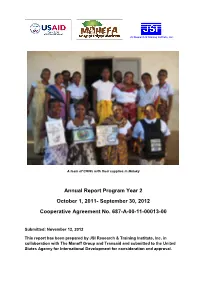
JSI Research & Training Institute, Inc. A team of CHWs with their supplies in Melaky Annual Report Program Year 2 October 1, 2011- September 30, 2012 Cooperative Agreement No. 687-A-00-11-00013-00 Submitted: November 12, 2012 This report has been prepared by JSI Research & Training Institute, Inc. in collaboration with The Manoff Group and Transaid and submitted to the United States Agency for International Development for consideration and approval. JSI Research & Training Institute, Inc. Madagascar Community-Based Integrated Health Program: “MAHEFA” Program Year 2: October 1, 2011- September 30, 2012 Cooperative Agreement No. 687-A-00-11-00013-00 Submitted to: USAID/Madagascar in Antananarivo, Madagascar. Prepared for: Dr. Jocelyne ANDRIAMIADANA, AOR Mr. Robert Kolesar, Alternate AOR USAID/Madagascar Prepared by: JSI Research & Training Institute, Inc. Community-Based Integrated Health Program: ―MAHEFA‖ JSI Research & Training Institute, Inc. Lot II K 63 Ter Ivandry-« Villa Sylvie » Antananarivo (101) Tel. (261) 034 79 261 17 This document is made possible by the generous support of the American people through the United States Agency for International Development (USAID). The contents are the responsibility of JSI Research and Training Institute, Inc. and do not necessarily reflect the views of USAID or the United States government. 2 Table of Contents List of Tables.............................................................................................................................................. 5 Acronyms and Abbreviations.................................................................................................................. -

Bulletin De Situation Acridienne Madagascar
BULLETIN DE SITUATION ACRIDIENNE MADAGASCAR Bulletin de la première décade de mars 2015 (2015-D07) SOMMAIRE CELLULE DE VEILLE ACRIDIENNE Situation éco-météorologique : page 1 Situation acridienne : page 3 Ministère de l’Agriculture Situation antiacridienne : page 7 Synthèse : page 9 Annexes : page 11 SITUATION ÉCO-MÉTÉOROLOGIQUE Durant la 1ère décade de mars, une zone dépressionnaire tropicale, accompagnée de rafales de vent de 50 km/h en moyenne, s’est formée dans le canal de Mozambique. Cette dépression est entrée sur la côte ouest de Madagascar vers le 06 mars 2015 et a traversé le pays, de Maintirano à Mananjary, sur une bande de 200 km de large. Elle a engendré des pluies importantes surtout dans le grand Nord-Ouest de la Grande-Île. Les informations pluviométriques étaient contradictoires, selon les sources : les estimations de FEWS-NET (figure 1) indiquaient que la pluviosité variait de 4 à 40 mm dans la majeure partie de la Grande-Île, sauf dans le grand Nord et Nord-Ouest, où la pluviosité était généralement supérieure à 40 mm et pouvait localement dépasser 125 mm. Dans l'Aire grégarigène, les pluies semblaient faibles (inférieures à 10 mm), sauf dans le compartiment Sud (10 à 40 mm) ; le peu de relevés transmis par le Centre National Acridien (62 % pour la décade et 34 % pour le mois, annexe 1) indiquait que, dans la majeure partie de l’Aire grégarigène, la pluviosité était faible à forte (variant de 0 à 241 mm). L'Aire de multiplication initiale Nord, les Aires transitoires de multiplication Nord et Centre ont encore été bien, voire trop, arrosées.