Science Internal AWARDS
Total Page:16
File Type:pdf, Size:1020Kb
Load more
Recommended publications
-
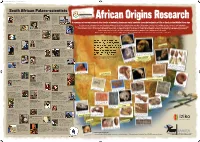
South African Palaeo-Scientists the Names Listed Below Are Just Some of South Africa’S Excellent Researchers Who Are Working Towards Understanding Our African Origins
2010 African Origins Research MAP_Layout 1 2010/04/15 11:02 AM Page 1 South African Palaeo-scientists The names listed below are just some of South Africa’s excellent researchers who are working towards understanding our African origins. UNIVERSITY OF CAPE TOWN (UCT) Dr Thalassa Matthews analyses the Dr Job Kibii focuses PALAEOBIOLOGICAL RESEARCH thousands of tiny teeth and bones of fossil on how fossil hominid Professor Anusuya Chinsamy-Turan is one microfauna to reconstruct palaeoenviron- and non-hominid of only a few specialists in the world who mental and climatic changes on the west faunal communities coast over the last 5 million years. changed over time and African Origins Research studies the microscopic structure of bones of dinosaurs, pterosaurs and mammal-like uses this to reconstruct reptiles in order to interpret various aspects ALBANY MUSEUM, past palaeoenviron- of the biology of extinct animals. GRAHAMSTOWN ments and palaeo- A summary of current research into fossils of animals, plants and early hominids from the beginning of life on Earth to the Middle Stone Age PERMIAN AGE PLANTS ecology. THE HOFMEYR SKULL Dr Rose Prevec studies the “No other country in the world can boast the oldest evidence of life on Earth extending back more than 3 billion years, the oldest multi-cellular animals, the oldest land-living plants, Professor Alan Morris described the Glossopteris flora of South Africa (the PAST HUMAN BEHAVIOUR Hofmeyer skull, a prehistoric, fossilized ancient forests that formed our coal Professor Chris Henshilwood directs the most distant ancestors of dinosaurs, the most complete record of the more than 80 million year ancestry of mammals, and, together with several other African countries, a most remarkable human skull about 36 000 years old deposits) and their end-Permian excavations at Blombos Cave where that corroborates genetic evidence that extinction. -
Psoralea Margaretiflora (Psoraleeae, Fabaceae): a New Species
A peer-reviewed open-access journal PhytoKeys 5: 31–38 (2011)Psoralea margaretiflora (Psoraleeae, Fabaceae): A new species... 31 doi: 10.3897/phytokeys.5.1585 RESEARCH ARTICLE www.phytokeys.com Launched to accelerate biodiversity research Psoralea margaretiflora (Psoraleeae, Fabaceae): A new species from the Sneeuberg Centre of Floristic Endemism, Eastern Cape, South Africa Charles H. Stirton1, V. Ralph Clark2, Nigel P. Barker2, A. Muthama Muasya1 1 Bolus Herbarium, Botany Department, University of Cape Town, Rondebosch, 7700, South Africa 2 De- partment of Botany, Rhodes University, Grahamstown, 6140, South Africa Corresponding author: Charles Stirton (chstirton@gmail.com) Academic editor: Hanno Schaefer | Received 20 May 2011 | Accepted 27 June 2011 | Published 27 July 2011 Citation: Stirton CH, Clark VR, Barker NP, Muasya AM (2011) Psoralea margaretiflora (Psoraleeae, Fabaceae): A new species from the Sneeuberg Centre of Floristic Endemism, Eastern Cape, South Africa. PhytoKeys 5: 31–38. doi: 10.3897/ phytokeys.5.1585 Abstract A new species of Psoralea is described. Psoralea margaretiflora C.H. Stirton & V.R. Clark is endemic to the Sneeuberg Centre of Floristic Endemism, Eastern Cape, South Africa. This resprouter is characterised by its small greenish-white flowers with a small trifid purple nectar patch and translucent veins; 5(–7)-pin- nate leaflets; multi-branching erect short seasonal flowering shoots; and tall habit of many stiff bare stems with the seasonal shoots massed at the apex. It is most similar to P. oligophylla Eckl. & Zeyh., a widespread species found in the Eastern Cape. The reseeder P. oligophylla differs in its lax virgate spreading habit with numerous long glaucous seasonal shoots; single stem, 1(–3)- glaucous leaflets; more numerous white flow- ers; and standard petals with a purple ring surrounding a bright yellow nectar patch. -
Animal Demography Unit to WHOM IT MAY
Animal Demography Unit Department of Biological Sciences University of Cape Town Rondebosch 7701 South Africa www.adu.org.za Tel. +27 (0)21 650 3227 les.underhill@uct.ac.za DIGITAL BIODIVERSITY•CITIZEN SCIENCE•BIODIVERSITY INFORMATICS 30 September 2015 TO WHOM IT MAY CONCERN The Second Southern African Bird Atlas (SABAP2) was launched in Namibia in May 2012. The project is an update and extension of the first Southern African Bird Atlas Project (SABAP1) which ran from 1987–1991, and included six countries of southern Africa, including Namibia. It culminated in the publication of the Atlas of Southern African Birds in 1997. The bird atlas project in Namibia is partnership between the Namibian Ministry of Environment and Tourism, the Namibia Bird Club and the Animal Demography Unit, University of Cape Town (ADU). The project plans to run indefinitely. The broad aim of the project is to determine the distribution and abundance of bird species in Namibia, and to investigate how environmental change and development have impacted bird distributions over the past quarter of a century. It also aims to promote public awareness of birds through large-scale mobilization of ‘citizen scientists’. The project entails volunteer bird- watchers recording bird species in five-minute grid cells (approx. 8 km × 9 km) called pentads. This information is then sent to the Animal Demography Unit at the University of Cape Town where the data is captured into a central database. It is important for observers to try and cover as much of the grid cells as possible in order for an accurate and comprehensive bird list to be compiled for the area. -

Medicinal Values of Seaweeds
Medicinal Values of Seaweeds Authors Abdul Kader Mohiuddin Assistant Professor, Department of Pharmacy, World University, Dhanmondi, Dhaka, Bangladesh Publication Month and Year: November 2019 Pages: 69 E-BOOK ISBN: 978-81-943354-3-6 Academic Publications C-11, 169, Sector-3, Rohini, Delhi Website: www.publishbookonline.com Email: publishbookonline@gmail.com Phone: +91-9999744933 Page | 1 Page | 2 Medicinal Values of Seaweeds Abstract The global economic effect of the five driving chronic diseases- malignancy, diabetes, psychological instability, CVD, and respiratory disease- could reach $47 trillion throughout the following 20 years, as indicated by an examination by the World Economic Forum (WEF). As per the WHO, 80% of the total people principally those of developing countries depend on plant- inferred medicines for social insurance. The indicated efficacies of seaweed inferred phytochemicals are demonstrating incredible potential in obesity, T2DM, metabolic syndrome, CVD, IBD, sexual dysfunction and a few cancers. Hence, WHO, UN-FAO, UNICEF and governments have indicated a developing enthusiasm for these offbeat nourishments with wellbeing advancing impacts. Edible marine macro-algae (seaweed) are of intrigue in view of their incentive in nutrition and medicine. Seaweeds contain a few bioactive substances like polysaccharides, proteins, lipids, polyphenols, and pigments, all of which may have useful wellbeing properties. People devour seaweed as nourishment in different structures: crude as salad and vegetable, pickle with sauce or with vinegar, relish or improved jams and furthermore cooked for vegetable soup. By cultivating seaweed, coastal people are getting an alternative livelihood just as propelling their lives. In 2005, world seaweed generation totaled 14.7 million tons which has dramatically increased (30.4 million tons) in 2015. -

Additional Biographical Notes on Plant Collectors in Southern Africa
Bothalia 15, 3 & 4: 631-654 (1985) Additional biographical notes on plant collectors in southern Africa L. E. CODD* and MARY GUNN* Keywords: biographies, plant collectors, southern Africa ABSTRACT Biographical notes on plant collectors, supplementary to those already published in Botanical Exploration of Southern Africa by Mary Gunn & L. E. Codd (1981). and including some collectors not previously recorded, are provided. INTRODUCTION * Adams, Berenice Zoe Margaret (later Mrs Mat thews) (1925- ) In our publication Botanical Exploration o f South ern Africa (G unn & Codd, 1981) many collectors’ b. Springs, Transvaal, 7 June 1925; biologist and names are listed with little or no biographical infor housewife; ed. Natal Univ., Pietermaritzburg. mation. Attempts have since been made to collect 1943-45, graduating B.Sc. Research chemist. some of the missing data and have, in several cases, Chamber of Mines Timber Research Laboratories, met with success. The information gathered is now Johannesburg, 1946-49, investigating the preserva presented and the opportunity is taken to make tion of timber and fabrics against fungal attack and some corrections to the original text. In addition, fire underground, the corrosion of steel by under several new names, not previously recorded, are ground water, and the culture of fungi. After her added. It is also apparent that some names, taken m arriage in 1949 to D r John Q uarry M atthews, she over from lists published by Tólken (1971) and in the worked for a year in the Pasteur Institute, Salisbury Index Herbariorum series on collectors, are scarcely (now Harare), Zimbabwe, as a clinical pathologist important enough to warrant inclusion. -
Fasanbi SHOWCASE
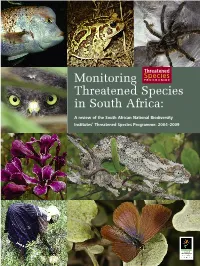
Threatened Species Monitoring PROGRAMME Threatened Species in South Africa: A review of the South African National Biodiversity Institutes’ Threatened Species Programme: 2004–2009 Acronyms ADU – Animal Demography Unit ARC – Agricultural Research Council BASH – Big Atlassing Summer Holiday BIRP – Birds in Reserves Project BMP – Biodiversity Management Plan BMP-S – Biodiversity Management Plans for Species CFR – Cape Floristic Region CITES – Convention on International Trade in Endangered Species CoCT – City of Cape Town CREW – Custodians of Rare and Endangered Wildflowers CWAC – Co-ordinated Waterbird Counts DEA – Department of Environmental Affairs DeJaVU – December January Atlassing Vacation Unlimited EIA – Environmental Impact Assessment EMI – Environmental Management Inspector GBIF – Global Biodiversity Information Facility GIS – Geographic Information Systems IAIA – International Association for Impact Assessment IAIAsa – International Association for Impact Assessment South Africa IUCN – International Union for Conservation of Nature LAMP – Long Autumn Migration Project LepSoc – Lepidopterists’ Society of Africa MCM – Marine and Coastal Management MOA – memorandum of agreement MOU – memorandum of understanding NBI – National Botanical Institute NEMA – National Environmental Management Act NEMBA – National Environmental Management Biodiversity Act NGO – non-governmental organization NORAD – Norwegian Agency for Development Co–operation QDGS – quarter-degree grid square SABAP – Southern African Bird Atlas Project SABCA – Southern African -
Improved Growth of Hydroponically Grown Rough Lemon (Citrus Jambhiri Lush) Seedlings Treated with Kelp and Vermicast Extracts
Improved growth of hydroponically grown rough lemon (Citrus jambhiri lush) seedlings treated with kelp and vermicast extracts by LINDSAY MUCHENA Submitted in partial fulfilment of the requirements for the degree MSc (Agric) Horticulture In the Department of Plant Production and Soil Sciences University of Pretoria Supervisor: Mr J.T. Vahrmeijer Co-Supervisors: Dr D. Marais Prof E.S. du Toit June 2017 Declaration I, Lindsay Muchena do hereby declare that this dissertation, which I do hereby submit for the degree of Master of Science in Horticulture at University of Pretoria, is my own work and has never been submitted by myself at any other academic institution. Except where duly acknowledged, the research work reported herein is as a result of my own investigations. L Muchena Signature: June 2017 i Acknowledgements I would like to express my deepest gratitude to: My Lord and Saviour, Lord Jesus Christ, for his divine guidance throughout my studies. Mr JT Vahrmeijer, Dr D Marais and Prof ES du Toit for their solid assistance throughout my studies. Dr NJ Taylor for assisting me with the photosynthesis equipment. My husband, Mathew Banda for helping me with manual work, data collection and moral support during experiments. Lucy Muchena, for assisting me to change nutrient solutions and for moral support throughout the course of my studies. The Citrus Research International (CRI) and Citrus academy for funding. My family and friends for their unwavering support. ii Conference contributions Oral Presentations L Muchena, JT Vahrmeijer, D Marais and ES du Toit, 2017. Improved growth of hydroponically grown rough lemon (Citrus jambhiri lush) seedlings treated with kelp and compost extracts. -

The Correspondence of Peter Macowan (1830 - 1909) and George William Clinton (1807 - 1885)
The Correspondence of Peter MacOwan (1830 - 1909) and George William Clinton (1807 - 1885) Res Botanica Missouri Botanical Garden December 13, 2015 Edited by P. M. Eckel, P.O. Box 299, Missouri Botanical Garden, St. Louis, Missouri, 63166-0299; email: mailto:patricia.eckel@mobot.org Portrait of Peter MacOwan from the Clinton Correspondence, Buffalo Museum of Science, Buffalo, New York, USA. Another portrait is noted by Sayre (1975), published by Marloth (1913). The proper citation of this electronic publication is: "Eckel, P. M., ed. 2015. Correspondence of Peter MacOwan(1830–1909) and G. W. Clinton (1807–1885). 60 pp. Res Botanica, Missouri Botanical Garden Web site.” 2 Acknowledgements I thank the following sequence of research librarians of the Buffalo Museum of Science during the decade the correspondence was transcribed: Lisa Seivert, who, with her volunteers, constructed the excellent original digital index and catalogue to these letters, her successors Rachael Brew, David Hemmingway, and Kathy Leacock. I thank John Grehan, Director of Science and Collections, Buffalo Museum of Science, Buffalo, New York, for his generous assistance in permitting me continued access to the Museum's collections. Angela Todd and Robert Kiger of the Hunt Institute for Botanical Documentation, Carnegie-Melon University, Pittsburgh, Pennsylvania, provided the illustration of George Clinton that matches a transcribed letter by Michael Shuck Bebb, used with permission. Terry Hedderson, Keeper, Bolus Herbarium, Capetown, South Africa, provided valuable references to the botany of South Africa and provided an inspirational base for the production of these letters when he visited St. Louis a few years ago. Richard Zander has provided invaluable technical assistance with computer issues, especially presentation on the Web site, manuscript review, data search, and moral support. -
The Systematic Position of the Enigmatic Thyreophoran Dinosaur Paranthodon Africanus, and the Use of Basal Exemplifiers in Phyl
1 The systematic position of the enigmatic thyreophoran dinosaur Paranthodon africanus, 2 and the use of basal exemplifiers in phylogenetic analysis 3 4 Thomas J. Raven1,2 ,3 and Susannah C. R. Maidment2 ,3 5 61Department of Earth Science & Engineering, Imperial College London, UK 72School of Environment & Technology, University of Brighton, UK 8 3Department of Earth Sciences, Natural History Museum, London, UK 9 10Corresponding author: Thomas J. Raven 11 12Email address: tom.raven13@imperial.ac.uk 13 14 15 16 17 18 19 20 21ABSTRACT 22 23The first African dinosaur to be discovered, Paranthodon africanus was found in 1845 in the 24Lower Cretaceous of South Africa. Taxonomically assigned to numerous groups since discovery, 25in 1981 it was described as a stegosaur, a group of armoured ornithischian dinosaurs 26characterised by bizarre plates and spines extending from the neck to the tail. This assignment 27that has been subsequently accepted. The type material consists of a premaxilla, maxilla, a nasal, 28and a vertebra, and contains no synapomorphies of Stegosauria. Several features of the maxilla 29and dentition are reminiscent of Ankylosauria, the sister-taxon to Stegosauria, and the premaxilla 30appears superficially similar to that of some ornithopods. The vertebral material has never been 31described, and since the last description of the specimen, there have been numerous discoveries 32of thyreophoran material potentially pertinent to establishing the taxonomic assignment of the 33specimen. An investigation of the taxonomic and systematic position of Paranthodon is therefore 34warranted. This study provides a detailed re-description, including the first description of the 35vertebra. Numerous phylogenetic analyses demonstrate that the systematic position of 36Paranthodon is highly labile and subject to change depending on which exemplifier for the clade 37Stegosauria is used. -

Safety Assessment of Brown Algae-Derived Ingredients As Used in Cosmetics
Safety Assessment of Brown Algae-Derived Ingredients as Used in Cosmetics Status: Draft Report for Panel Review Release Date: August 29, 2018 Panel Meeting Date: September 24-25, 2018 The 2018 Cosmetic Ingredient Review Expert Panel members are: Chair, Wilma F. Bergfeld, M.D., F.A.C.P.; Donald V. Belsito, M.D.; Ronald A. Hill, Ph.D.; Curtis D. Klaassen, Ph.D.; Daniel C. Liebler, Ph.D.; James G. Marks, Jr., M.D.; Ronald C. Shank, Ph.D.; Thomas J. Slaga, Ph.D.; and Paul W. Snyder, D.V.M., Ph.D. The CIR Executive Director is Bart Heldreth, Ph.D. This report was prepared by Lillian C. Becker, former Scientific Analyst/Writer and Priya Cherian, Scientific Analyst/Writer. © Cosmetic Ingredient Review 1620 L Street, NW, Suite 1200 ♢ Washington, DC 20036-4702 ♢ ph 202.331.0651 ♢ fax 202.331.0088 cirinfo@cir-safety.org Distributed for Comment Only -- Do Not Cite or Quote Commitment & Credibility since 1976 Memorandum To: CIR Expert Panel Members and Liaisons From: Priya Cherian, Scientific Analyst/Writer Date: August 29, 2018 Subject: Safety Assessment of Brown Algae as Used in Cosmetics Enclosed is the Draft Report of 83 brown algae-derived ingredients as used in cosmetics. (It is identified as broalg092018rep in this pdf.) This is the first time the Panel is reviewing this document. The ingredients in this review are extracts, powders, juices, or waters derived from one or multiple species of brown algae. Information received from the Personal Care Products Council (Council) are attached: • use concentration data of brown algae and algae-derived ingredients (broalg092018data1, broalg092018data2, broalg092018data3); • Information regarding hydrolyzed fucoidan extracted from Laminaria digitata has been included in the report. -
Groot Winterhoek Complex PAMP
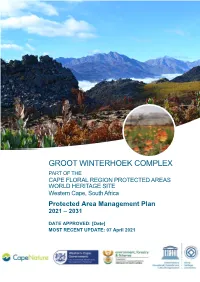
GROOT WINTERHOEK COMPLEX PART OF THE CAPE FLORAL REGION PROTECTED AREAS WORLD HERITAGE SITE Western Cape, South Africa Protected Area Management Plan 2021 – 2031 DATE APPROVED: [Date] MOST RECENT UPDATE: 07 April 2021 GROOT WINTERHOEK COMPLEX PART OF THE CAPE FLORAL REGION PROTECTED AREAS WORLD HERITAGE SITE Western Cape, South Africa Protected Area Management Plan 2021 – 2031 DATE APPROVED: [Date] MOST RECENT UPDATE: 07 April 2021 CITATION CapeNature. 2021. Groot Winterhoek Complex: Protected Area Management Plan 2021- 2031. Internal Report, CapeNature. Cape Town. GROOT WINTERHOEK COMPLEX II MANAGEMENT PLAN AUTHORISATIONS The National Minister is authorised under section 25(1) of the National World Heritage Convention Act, 1999 (Act No. 49 of 1999) to approve the management plan for a World Heritage Site, so nominated or declared under the Act. Furthermore, both the National Minister and Member of Executive Council (MEC) in a particular province, has concurrent jurisdiction to approve a management plan for a protected area submitted under section 39(2) and section 41(4) of the National Environmental Management: Protected Areas Act, 2003 (Act No. 57 of 2003). TITLE NAME SIGNATURE DATE NATIONAL MINISTER: Ms Barbara Forestry, Fisheries and Creecy the Environment PROVINCIAL MINISTER: Mr Anton Department of Environmental Affairs Bredell and Development Planning Recommended: TITLE NAME SIGNATURE DATE CHAIRPERSON OF Assoc Prof THE BOARD: Denver Western Cape Nature 8 April 2021 Hendricks Conservation Board CHIEF EXECUTIVE Dr Razeena OFFICER: Omar 7 April 2021 CapeNature Review Date: 10 years from the date of approval by the MEC or Minister. GROOT WINTERHOEK COMPLEX III MANAGEMENT PLAN ACKNOWLEDGEMENTS CapeNature would like to thank everybody who participated and had input into the formulation of the Groot Winterhoek Complex management plan. -
A Nnual Report
SANBI Biodiversity for Life i AnnualReport INSTITUTE BIODIVERSITY NATIONAL AFRICAN SOUTH SANBI Biodiversity for Life For submission in terms of the Public Finance Management Act, No. 1 of 1999 August 2011 ISSN 0121-7460 We acknowledge the photographic contributions of SANBI staff, fellow researchers and conservationists with appreciation. Copies of this report are available from: SANBI Private Bag X7, Claremont, 7735 Tel: 021 799 8800 • Fax: 021 762 3229 or Private Bag X101, Pretoria, 0001 Tel: 012 843 5000 • Fax: 012 804 3211 Visit our website at www.sanbi.org Compiled and edited by Liesa Jossel www.madeplain.co.za Designed by David Davidson www.davidsdesign.co.za Printed by Shumani Print World on recycled paper SOUTH AFRICAN NATIONAL SANBI BIODIVERSITY INSTITUTE Biodiversity for Life ANNUAL REPORT 2010|11 SOME USEFUL Acronyms ABRD Applied Biodiversity Research Division IDP Integrated Development Plan BCSD Biodiversity Conservation and Sustainable Development IYB International Year of Biodiversity BGCI Botanic Gardens Conservation International M & E Monitoring and Evaluation BGIS Biodiversity Geographic Information System MoA Memorandum of Agreement BHCD Biodiversity Human Capital Development MoU Memorandum of Understanding BHCDS Biodiversity Human Capital Development Strategy NAMBAF Namakwa Biodiversity Advisory Forum BIM Biodiversity Information Management Directorate NBA National Biodiversity Assessment BotSoc Botanical Society of South Africa NBG National Botanical Garden CAPE Cape Action for People and the Environment NDF non detriment