Conclusion–9
Total Page:16
File Type:pdf, Size:1020Kb
Load more
Recommended publications
-

Status of Research on Rattans: a Review
http://sciencevision.info Sci Vis 10 (2), 51-56 Research Review April-June, 2010 ISSN 0975-6175 Status of research on rattans: a review Lalnuntluanga1*, L. K. Jha2 and H. Lalramnghinglova1 1 Department of Environmental Science, Mizoram University, Aizawl 796009, India 1 Department of Environmental Science, North-Eastern Hill University, Shillong 793022, India Received 20 July 2010 | Accepted 28 July 2010 ABSTRACT Rattan forms one of the major biotic components in tropical and sub -tropical forest ecosys- tem. Contributions made by the researchers on the distribution, taxonomy and uses of rattan species in the world with special reference to India are reviewed here. Key words: Rattan; distribution; taxonomy; utilisation; N.E. states. INTRODUCTION Argentina, the Caribbean, Africa and South-East Asian regions. Rattan diversity is rich in Malay- The name ‘cane’ (rattan) stands collectively sia, Indonesia, Philippines, China, Bangladesh, for the climbing members of a big group of Sri Lanka, Myanmar and India. Rattan is of palms known as Lepidocaryoideae, fruit bearing great economic importance in handicraft and scales. Rattans/canes are prickly climbing palms furniture making because of its richness in fibre, with solid stems, belonging to the family Areca- with suitable toughness and easy for processing. ceae and the sub-family Calamoideae. They are The innumerable pinnate leaves, which extend scaly-fruited palms. The rattans/canes comprise up to two metres in length, with their mosaic more than fifty per cent of the total palm taxa arrangement play a major role in intercepting found in India.1 They are distributed throughout the splash effect of rains and improve the water South-East Asia, the Western Pacific and in the holding capacity of the soil. -
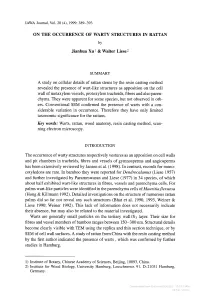
ON TUE OCCURRENCE of WARTY STRUCTURES in RATTAN Jianhua Xu 1 & Walter Liese2
IAWA Journal, Val. 20 (4),1999: 389-393 ON TUE OCCURRENCE OF WARTY STRUCTURES IN RATTAN by Jianhua Xu 1 & Walter Liese 2 SUMMARY A study on cellular details of rattan sterns by the resin casting method revealed the presence of wart-like structures as apposition on the cell wall of metaxylem vessels, protoxylem tracheids, fibres and also paren chyma. They were apparent for some species, but not observed in oth ers. Conventional SEM confirmed the presence of warts with a con siderable variation in occurrence. Therefore they have only limited taxonomic significance for the rattans. Key words: Warts, rattan, wood anatomy, resin casting method, scan ning electron microscopy. INTRODUCTION The occurrence ofwarty structures respectively vestures as an apposition on cell walls and pit chambers in tracheids, fibres and vessels of gymnosperms and angiosperms has been extensively reviewed by Jansen et al. (1998). In contrast, records for mono cotyledons are rare. In bamboo they were reported for Dendrocalamus (Liese 1957) and further investigated by Parameswaran and Liese (1977) in 34 species, of which about half exhibited wart-like structures in fibres, vessels and parenchyma cells. For pa1ms wart-1ike particles were identified in the parenchyma cells of Mauritiaflexuosa (Hong & Killmann 1992). Detailed investigations on the structure of numerous rattan palms did so far not reveal any such structures (Bhat et al. 1990, 1993, Weiner & Liese 1990; Weiner 1992). This lack of information does not necessarily indicate their absence, but may also be related to the material investigated. Warts are generally small particles on the tertiary wall/S3 layer. Their size for fibres and vessel members ofbamboo ranges between 150-300 nm. -

Rattans of Vietnam
Rattans of Vietnam: Ecology, demography and harvesting Bui My Binh Rattans of Vietnam: Ecology, demography and harvesting Bui My Binh [ 1 ] Rattans of Vietnam: Ecology, demography and harvesting Bui My Binh Rattans of Vietnam: ecology, demography and harvesting ISBN: 978-90-393-5157-4 Copyright © 2009 by Bui My Binh Back: Rattan stems are sun-dried for a couple of days Printed by Ponsen & Looijen of GVO printers & designers B.V. Designed by Kooldesign Utrecht [ 2 ] Rattans of Vietnam: Ecology, demography and harvesting Vietnamese rotans: ecologie, demografie en oogst (met een samenvatting in het Nederlands) Song Vi_t Nam: sinh thái, qu_n th_ h_c và khai thác (ph_n tóm t_t b_ng ti_ng Vi_t) Proefschrift ter verkrijging van de graad van doctor aan de Universiteit Utrecht op gezag van de rector magnificus, prof. Dr. J.C. Stoof, ingevolge het besluit van het College voor Promoties in het openbaar te verdedigen op woensdag 14 oktober 2009 des middags te 2.30 uur door Bui My Binh geboren op 17 februari 1973 te Thai Nguyen, Vietnam [ 3 ] Rattans of Vietnam: Ecology, demography and harvesting Promotor: Prof.dr. M.J.A. Werger Prof.dr. Trieu Van Hung Co-promotor: Dr. P.A Zuidema This study was financially supported by the Tropenbos International and the Netherlands Fellowship Programme (Nuffic). [ 4 ] [ 5 ] Rattans of Vietnam: Ecology, demography and harvesting [ 6 ] C Contents Chapter 1 General introduction 9 9 Chapter 2 Vietnam: Forest ecology and distribution of rattan species 17 17 Chapter 3 Determinants of growth, survival and reproduction of -
In Vitro Anthelmintic Activity of Leaf Extracts of Four Different Types of Calamus Species
Pharmacy & Pharmacology International Journal Research Article Open Access In vitro anthelmintic activity of leaf extracts of four different types of calamus species Abstract Volume 5 Issue 2 - 2017 Development of anthelmintic resistance and high cost of conventional anthelmintic Sajan Das, Rumana Akhter, Sumaiya Huque, drugs led to the evaluation of medicinal plants as an alternative source of anthelmintics. In the present study, methanol, ethanol and chloroform leaf extract Rafi Anwar, Promit Das, Kaniz Afroz Tanni of Calamus guruba, Calamus viminalis, Calamus erectus and Calamus tenuis were and Mohammad Shahriar explored for anthelmintic activity at two concentrations (50 and 100mg/ml), using Department of Pharmacy, University of Asia Pacific, Bangladesh adult earth worm Pheretima posthuma. All the leaf extracts of Calamus species tested Correspondence: Mohammad Shahriar, Department for the anthelmintic activity possess significant activity in a dose dependent manner of Pharmacy, University of Asia Pacific, Bangladesh, Tel as compared to the albendazole. The overall findings of the present study have shown +881841844259, Email shahriar@uap-bd.edu that Calamus guruba, Calamus viminalis, Calamus erectus and Calamus tenuis contain possible anthelmintic compounds. Received: January 30, 2017 | Published: April 17, 2017 Keywords: Calamus guruba, Calamus viminalis, Calamus erectus, Calamus tenuis, Anthelmintic activity, Pheretima Posthuma, Albendazole, In vitro study, hookworm infestation, entrobiasis, filariasis, taeniasis; hydatidcyst, fluke infection, helminthiasis, wonder drug, niclosamide, oxyclozanide, bithionol Introduction viminalis is known as Khorkoijja bet in Bangladesh and is widely used as handicrafts and furniture material. Ripe fruit pulps are edible. This Infections caused by various species of parasitic worms plant has also been used in traditional medicine for treatment of dog (helminths) of the gastrointestinal tract are the most widespread of bite, urogenital and gynecological infection.6 The leaf extract of C. -

Evaluation of Antidiabetic Activity of Calamus Erectus in Streptozotocin Induced Diabetic Rats
Available online a t www.pelagiaresearchlibrary.com Pelagia Research Library Asian Journal of Plant Science and Research, 2013, 3(1):47-53 ISSN : 2249-7412 CODEN (USA): AJPSKY Evaluation of antidiabetic activity of Calamus erectus in streptozotocin induced diabetic rats Mitali Ghosal and Palash Mandal* Plant Physiology and Pharmacognosy Research Laboratory, Department of Botany, University of North Bengal, Siliguri 734 013. _____________________________________________________________________________________________ ABSTRACT The present study was designed to evaluate the hypoglycemic, hypolipidemic and antioxidant activity of Calamus erectus (CE) fruit in streptozotocin (STZ) induced diabetic wistar rat. The fruit extracts of 100, 200, 300 and 400 mg/kg body weight (bw) were administrated orally to normal and STZ induced (55 mg/kg bw) diabetic (>200 mg/dl) rats. Glibenclamide (10 mg/kg) were used as a reference drug. Antioxidant effects were assayed in diabetic rats by estimating thiobarbituric acid reactive substances (TBARS), glutathione (GSH), superoxide dismutase (SOD) and catalase (CAT) levels. Daily oral treatment with 400 mg/kg fruit extract for 14 days resulted in 73.68, 20.46, 36.6 and 43.9% reduction of blood glucose, serum cholesterol, triglycerides and LDL (low-density lipoprotein) respectively whereas HDL (high-density lipoprotein) cholesterol was found to be improved 12.7% when compared with STZ treated rats. GSH, SOD and CAT activity of liver homogenate was improved 33.46, 49.36 and 52.48% respectively while the TBARS decreased 36.18% with same treatment. Decreased levels of TBARS and increase of GSH, SOD and CAT activity indicated a reduction in free radical formation in liver of diabetic rats. The present study demonstrated that CE fruit extract possess good antidiabetic potential and could improve lipid profile and oxidative stress efficiently during diabetic condition. -
Observation of Adventitious Shoot in Three Wild Palms from Assam, India
ISSN (Online): 2349 -1183; ISSN (Print): 2349 -9265 TROPICAL PLANT RESEARCH 7(1): 190–195, 2020 The Journal of the Society for Tropical Plant Research DOI: 10.22271/tpr.2020.v7.i1.024 Research article Observation of adventitious shoot in three wild palms from Assam, India Selim Mehmud* and Himu Roy Department of Botany, Cotton University, Panbazar, Guwahati-781001, Assam, India *Corresponding Author: mehmudselim@gmail.com [Accepted: 11 April 2020] Abstract: Present communication deals with field-based observation on the adventitious shoots and roots of three wild palms from Assam viz. Calamus flagellum, Calamus floribundus and Pinanga sylvestris. Adventitious shoots in different stages found restricted in the internodal zone of Calamus flagellum and C. floribundus whereas in Pinanga sylvestris confines to the nodes. Keywords: Adventitious shoot - Roots - Palms - Assam. [Cite as: Mehmud S & Roy H (2020) Observation of adventitious shoot in three wild palms from Assam, India. Tropical Plant Research 7(1): 190–195] INTRODUCTION Adaptation or specialization or peculiarities in shoot to perform specialize function like reproduction, storage, protection, support or assimilation is quiet common among different groups of angiosperm. Palms distributed throughout the tropical and subtropical regions of the world (Baker & Couvreur 2012). The presence of buds in the group is not an abnormal feature, as occurrence of vegetative bud has already been mentioned in Calamus, Ceratolobus and Plectocomiopsis (Fisher & Dransfiled 1979). Branching of Plectocomia himalayana Griff., reported only from Manipur (Bora et al. 2012) in North-east India; abnormal and lateral branching from West Bengal (Nath 2014) in three species of Arecaceae i.e. Areca catechu L. -

Field Manual for Propagation and Plantation of Cane in Arunachal Pradesh
Stages in Nursery technique Fruit Seeds after removing outer cover Mother bed preparation Sowing Seedling in mother bed ready to transplant Seedlings pricked out to poly bags Seedlings in green house Seedlings in nursery bed Seedlings ready for field planting r SFRI Information Bulletin No. 15 This manual is produced under UNDP DC(H) Cane & Bamboo Project Field Manual for Propagation & Plantation of Canes in Arunachal Pradesh K. Haridasan, Anupam Sarmah, S. N. Hegde, & L.R.Bhuyan 2002 STATE FOREST RESEARCH INSTITUTE Department of Environment & Forests Government of Arunachal Pradesh Itanagar -791 111 SFRI, Information Bulletin No. 15 Year of publication 2002 Published by the Director State Forest Research Institute Van Vihar, P. B. No. 159 Itanagar - 791 111 Email: directorsfri@hotmail.com OTHER PUBLICATIONS INFORMATION BULLETINS 1. Jhum Cultivation in Arunachal Pradesh 2. Alder - a Promising Tree for Afforestation of Jhum Fallows 3. Botanical and Vernacular names of important and common forest plants of Arunachal Pradesh 4. Pipli- an important Income Generating Eco-friendly Non-wood Forest Products 5. Medicinal Plants of Arunachal Pradesh 6. Broom Grass 7. Seed Technology 8. Micropropagation and Farming of Cymbidium Orchids as Supplemental Crop in Jhum/ Waste Lands of Arunachal Pradesh 9. Nursery Technique of local tree species 10. Toko (a multipurpose palm) 11. Orchid Research Centre, Tipi 12. Economic Development Through Medicinal Plants 13. State Forest Research Institute, Arunachal Pradesh - 2002 14. Field Manual for Propagation of bamboo in North East India JOURNALS 1. Arunachal Forest News vol. 1 to 18 (Half yearly) BOOKS 1. Orchids of Arunachal Pradesh - by Dr. S. -

Molekularsystematische Studien in Der Subtribus Thrinacinae, Mit Besonderer Berücksichtigung Der Gattung Trachycarpus H
Molekularsystematische Studien in der Subtribus Thrinacinae, mit besonderer Berücksichtigung der Gattung Trachycarpus H. Wendl. (Arecaceae) Diplomarbeit im Studienfach Biologie vorgelegt von Chris Stührk Biozentrum Klein Flottbek und Botanischer Garten Hamburg, 2006 Gutachter: Prof. Dr. Hans-Peter Mühlbach Prof. Dr. Jens G. Rohwer I Inhaltsverzeichnis Inhaltsverzeichnis I Abkürzungsverzeichnis III Abbildungsverzeichnis V Tabellenverzeichnis VII 1 Einleitung 1 1.1 Die Familie der Arecaceae 1 1.2 Subtribus Thrinacinae Becc. (1907) 6 1.3 Die Gattung Trachycarpus H. Wendl. (1861) 10 1.4 Fragestellung 18 1.5 ITS Analyse 18 1.6 AFLP, RAPD, ISSR & cpSSR 20 1.7 AFLP Analyse 20 2 Material und Methoden 22 2.1 Material 22 2.1.1 Pflanzenmaterial und Herkunft 22 2.1.2 Chemikalien und Enzyme 22 2.1.3 Behandlung von Geräten und Lösungen 22 2.1.4 DNA-Längenmarker 22 2.1.5 Oligonucleotide (ITS) 23 2.1.6 Oligonucleotide für AFLP Analyse 23 2.2 Methoden 27 2.2.1 Rasterelektronenmikroskopische Untersuchungen 27 2.2.2 Karyologische Untersuchungen 27 2.3 Molekularbiologische Untersuchungen 28 2.3.1 DNA-Isolierung 28 2.3.2 Gelelektrophorese 29 2.3.3 Konzentrationsbestimmungen von DNA-Lösungen 30 2.4.1 Polymerase-Kettenreaktion für die ITS Untersuchungen 30 2.4.2 Aufreinigung der PCR Produkte 32 2.4.3 Sequenzierungsreaktion 32 2.4.4 Fällung der Sequenzreaktion 33 2.4.5 Auftrennung der Sequenzreaktion 33 II 2.4.6 Auswertung der Sequenzen 34 2.4.7 Phylogenetische Analyse 34 2.5.1 AFLP 35 2.5.2 Restriktionsverdau 36 2.5.3 Ligation der Adapter 36 2.5.4 Präamplifikation -

Biodiversity Conservation in the Kangchenjunga Landscape Final
Plant Resources in the Protected Areas and Proposed Corridors of Darjeeling, India Abhaya Prasad Das1, Ram Bahadur Bhujel2, Dorje Lama3, 1University of North Bengal, Darjeeling, India, 2Kalimpong College, Kalimpong, India, 3St. Joseph’s College, Darjeeling, India, apdas@sancharnet.in The proposed corridors in Darjeeling are rich in flora, many of which are threatened. Substantial numbers of species are endemic to the region. Introduction Among the nine botanical provinces in the Indian sub-continent, the eastern Himalayas are unique globally because of the diversity of plants and animals found there, and this has drawn the attention of many plant and animal scientists from different corners of the world (Das 1995). The Himalayan region, influenced by various climatic factors, soil characteristics, diversified landforms, and altitudinal variations has a rich and diverse forest structure and an abundant composition of species. The district of Darjeeling is one of the most pleasant and beautiful places in India. It has a blend of nature, culture, wildlife, and adventure. Covering an area of 3,255 sq.km, the district Section 2: Biodiversity Conservation 57 is located between 26°31’ and 27°13’ N and 87°59’ and 88°53’ E. The district has three subdivisions: Kalimpong is the largest (1,057 sq.km) followed by Darjeeling (936 sq.km) and Kurseong (425 sq.km). The district shares its boundaries with Nepal to the west, Sikkim to the north, and Bhutan to the east. The climate is extremely variable with a nearly tropical climate prevailing in the foothills and terai regions and subalpine conditions in the areas above 3,000m. -

Copyright by Jason Paul Schoneman 2010
Copyright by Jason Paul Schoneman 2010 The Report Committee for Jason Paul Schoneman Certifies that this is the approved version of the following report: Overview of Uses of Palms with an Emphasis on Old World and Australasian Medicinal Uses APPROVED BY SUPERVISING COMMITTEE: Supervisor: Beryl B. Simpson Brian M. Stross Overview of Uses of Palms with an Emphasis on Old World and Australasian Medicinal Uses by Jason Paul Schoneman, B.S. Report Presented to the Faculty of the Graduate School of The University of Texas at Austin in Partial Fulfillment of the Requirements for the Degree of Master of Arts The University of Texas at Austin May 2010 Dedication This report is dedicated to Dr. Beryl B. Simpson. Her scholarship, support, and strong work ethic have aided and inspired me immensely during my time in this program. Acknowledgements I feel fortunate to have the opportunity to acknowledge the many people who have made my journey towards the completion of this degree a possibility. My advisor Beryl Simpson gave me this opportunity and I will be forever thankful to her for this, as pursuing a career as a plant biologist had been a dream of mine for years. Her unconditional support was instrumental in allowing me to broaden my knowledge of plant systematics and as a foundation for allowing me to develop further my critical thinking and writing abilities. She always guided me in my writing with a great deal of encouragement, compassion, and patience. I will miss our weekly meetings and think back fondly to the many great conversations we had. -

CONTRIBUTIONS to the FLORA of BHUTAN: Henry J. Noltie Royal Botanic Garden Edinburgh June, 2000
CONTRIBUTIONS TO THE FLORA OF BHUTAN: THE MONOCOTYLEDONS A collection of papers submitted to the University of Edinburgh for the degree of Doctor of Philosophy (by Research Publication) Henry J. Noltie Royal Botanic Garden Edinburgh June, 2000 Abstract The published work submitted for consideration for the degree of Ph.D. (by Research Publication) consists of two parts of the Flora of Bhutan, describing the monocotyledons (some 942 species) with the exception of Orchidaceae. Together with these are ten precursor papers relating to these parts of the Flora: the papers include descriptions of new species, nomenclatural discussion (including typifications) and phytogeographic information. The critical review gives the historical background for the whole Flora project, together with the methods used in my own contribution and some of my more interesting findings. An enumeration of new taxa described, and new combinations made, is given in an appendix. CONTENTS Introduction 1 What is a Flora? 2 Brief outline of Bhutan 3 Flora of Bhutan: the history of the project 5 Funding 13 Storage of data 13 Illustrations 14 Biogeography 14 Introduced and cultivated plants 17 History of exploration 18 My own work 28 Fieldwork for monocots 33 Practical uses of the Flora: examples from the monocots 35 The future 36 Conclusions 38 Acknowledgements 39 References 40 Appendix 1. Publications submitted for Ph.D. 46 Appendix 2. New taxa and combinations 48 Appendix 3. Floristic elements in Gramineae 50 Appendix 4. Contributing authors and artists 51 CRITICAL REVIEW Introduction This 'critical review' is supposed to describe the aims, objectives, methodology, results and conclusions of the published work submitted. -

HIGH MOUNTAINS and HIGH HIMAL FORESTS of NEPAL
HIGH MOUNTAINS AND HIGH HIMAL FORESTS of NEPAL Government of Nepal Ministry of Forests and Soil Conservation Department of Forest Research and Survey December 2015 Forest Resource Assessment Nepal HIGH MOUNTAINS AND HIGH HIMAL FORESTS OF NEPAL FOREST RESOURCE ASSESSMENT NEPAL DEPARTMENT OF FOREST RESEARCH AND SURVEY MINISTRY OF FORESTS AND SOIL CONSERVATION GOVERNMENT OF NEPAL Publication No. 4 December 2015 © Department of Forest Research and Survey, 2015 Any reproduction of this publication in full or in part should mention the title and credit DFRS/FRA. Citation DFRS, 2015. High Mountains and High Himal Forests of Nepal. Forest Resource Assessment (FRA) Nepal, Department of Forest Research and Survey (DFRS). Kathmandu, Nepal. Report Preparation Team Yam P. Pokharel, Shree K. Gautam, Sabitri Aryal, Rajesh Malla, Ananda Khadka, Michael D. Hawkes, Anish Joshi, Kari Korhonen, Jukka Alm, Bijaya R. Paudel, Sita Aryal, Tej B. Basnet Reviewers Prakash Mathema, Deepak K. Kharal ISBN: 978-9937-8896-4-3 Published by Department of Forest Research and Survey P.O. Box 3339 Babarmahal, Kathmandu, Nepal Tel: 977 1 4220482, Fax: 977 1 4220159 Email: info@dfrs.gov.np Website: www.dfrs.gov.np Cover photograph Foreword The Government of Nepal, with support from the Government of Finland, implemented the Forest Resource Assessment Nepal (FRA Nepal) project from 2010 to 2014 with an aim to generate forest resource information for supporting policy-making, strategic planning and international reporting. All five physiographic regions of the country were covered in this assessment. This report presents the results of the forest resource assessment of the High Mountains and High Himal physiographic regions of Nepal.