A Companion to Early Modern Rome, 1492–1692
Total Page:16
File Type:pdf, Size:1020Kb
Load more
Recommended publications
-
Hans Rottenhammer's Use of Networks in the Copper
arts Article Intermediaries and the Market: Hans Rottenhammer’s Use of Networks in the Copper Painting Market Sophia Quach McCabe Department of History of Art and Architecture, University of California, Santa Barbara, Santa Barbara, CA 93106, USA; sqmccabe@ucsb.edu Received: 1 February 2019; Accepted: 16 June 2019; Published: 24 June 2019 Abstract: In Willem van Haecht’s Gallery of Cornelis van der Geest, The Last Judgment by the German artist Hans Rottenhammer stands prominently in the foreground. Signed and dated 1598, it is one of many copper panel paintings Rottenhammer produced and sent north of the Alps during his decade-long sojourn in Venice. That the work was valued alongside those of Renaissance masters raises questions about Rottenhammer’s artistic status and how the painting reached Antwerp. This essay examines Rottenhammer’s international market as a function of his relationships with artist-friends and agents, especially those in Venice’s German merchant community. By employing digital visualization tools alongside the study of archival documents, the essay attends to the intermediary connections within a social network, and their effects on the art market. It argues for Rottenhammer’s use of—and negotiation with—intermediaries to establish an international career. Through digital platforms, such as ArcGIS and Palladio, the artist’s patronage group is shown to have shifted geographically, from multiple countries around 1600 to Germany and Antwerp after 1606, when he relocated to Augsburg. Yet, the same trusted friends and associates he had established in Italy continued to participate in Rottenhammer’s business of art. Keywords: Hans Rottenhammer; social network; intermediaries; mediation; digital humanities; digital art history; merchants; art market; copper painting; Jan Brueghel the Elder 1. -

Michelangelo's Locations
1 3 4 He also adds the central balcony and the pope’s Michelangelo modifies the facades of Palazzo dei The project was completed by Tiberio Calcagni Cupola and Basilica di San Pietro Cappella Sistina Cappella Paolina crest, surmounted by the keys and tiara, on the Conservatori by adding a portico, and Palazzo and Giacomo Della Porta. The brothers Piazza San Pietro Musei Vaticani, Città del Vaticano Musei Vaticani, Città del Vaticano facade. Michelangelo also plans a bridge across Senatorio with a staircase leading straight to the Guido Ascanio and Alessandro Sforza, who the Tiber that connects the Palace with villa Chigi first floor. He then builds Palazzo Nuovo giving commissioned the work, are buried in the two The long lasting works to build Saint Peter’s Basilica The chapel, dedicated to the Assumption, was Few steps from the Sistine Chapel, in the heart of (Farnesina). The work was never completed due a slightly trapezoidal shape to the square and big side niches of the chapel. Its elliptical-shaped as we know it today, started at the beginning of built on the upper floor of a fortified area of the Apostolic Palaces, is the Chapel of Saints Peter to the high costs, only a first part remains, known plans the marble basement in the middle of it, space with its sail vaults and its domes supported the XVI century, at the behest of Julius II, whose Vatican Apostolic Palace, under pope Sixtus and Paul also known as Pauline Chapel, which is as Arco dei Farnesi, along the beautiful Via Giulia. -
CHAPTER 8 HB 1129 - FINAL VERSION 11Mar2020
CHAPTER 8 HB 1129 - FINAL VERSION 11Mar2020... 0696h 06/16/2020 1480s 06/16/2020 1524s 2020 SESSION 20-2107 11/06 HOUSE BILL 1129 AN ACT relative to notice requirements for certain municipal public hearings, providing for optional town meeting procedures during the state of emergency declared in response to the novel coronavirus disease (Covid-19), and relative to online reporting of CARES Act disbursements. SPONSORS: Rep. Coursin, Rock. 1; Rep. Barnes, Rock. 8; Rep. Ladd, Graf. 4; Rep. Gilman, Rock. 18; Rep. Dutzy, Hills. 30 COMMITTEE: Municipal and County Government ───────────────────────────────────────────────────────────────── AMENDED ANALYSIS This bill changes the notice requirements for certain municipal public hearings by allowing notice of the hearing to be posted on the municipal website. The bill also temporarily permits legislative bodies with a fiscal year ending in June to make certain expenditures prior to the adoption of an official budget, temporarily provides for a virtual annual meeting procedure, and requires online reporting of CARES Act disbursements. - - - - - - - - - - - - - - - - - - - - - - - - - - - - - - - - - - - - - - - - - - - - - - - - - - - - - - - - - - - - - - - - - - - - - - - - - - - Explanation: Matter added to current law appears in bold italics. Matter removed from current law appears [in brackets and struckthrough.] Matter which is either (a) all new or (b) repealed and reenacted appears in regular type. CHAPTER 8 HB 1129 - FINAL VERSION 11Mar2020... 0696h 06/16/2020 1480s 06/16/2020 1524s 20-2107 11/06 STATE OF NEW HAMPSHIRE In the Year of Our Lord Two Thousand Twenty AN ACT relative to notice requirements for certain municipal public hearings, providing for optional town meeting procedures during the state of emergency declared in response to the novel coronavirus disease (Covid-19), and relative to online reporting of CARES Act disbursements. -
Falda's Map As a Work Of
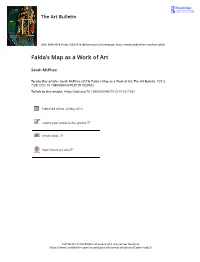
The Art Bulletin ISSN: 0004-3079 (Print) 1559-6478 (Online) Journal homepage: https://www.tandfonline.com/loi/rcab20 Falda’s Map as a Work of Art Sarah McPhee To cite this article: Sarah McPhee (2019) Falda’s Map as a Work of Art, The Art Bulletin, 101:2, 7-28, DOI: 10.1080/00043079.2019.1527632 To link to this article: https://doi.org/10.1080/00043079.2019.1527632 Published online: 20 May 2019. Submit your article to this journal Article views: 79 View Crossmark data Full Terms & Conditions of access and use can be found at https://www.tandfonline.com/action/journalInformation?journalCode=rcab20 Falda’s Map as a Work of Art sarah mcphee In The Anatomy of Melancholy, first published in the 1620s, the Oxford don Robert Burton remarks on the pleasure of maps: Methinks it would please any man to look upon a geographical map, . to behold, as it were, all the remote provinces, towns, cities of the world, and never to go forth of the limits of his study, to measure by the scale and compass their extent, distance, examine their site. .1 In the seventeenth century large and elaborate ornamental maps adorned the walls of country houses, princely galleries, and scholars’ studies. Burton’s words invoke the gallery of maps Pope Alexander VII assembled in Castel Gandolfo outside Rome in 1665 and animate Sutton Nicholls’s ink-and-wash drawing of Samuel Pepys’s library in London in 1693 (Fig. 1).2 There, in a room lined with bookcases and portraits, a map stands out, mounted on canvas and sus- pended from two cords; it is Giovanni Battista Falda’s view of Rome, published in 1676. -

Si Comunicano Le Variazioni Intervenute Nell'organizzazione Dell'istituto a Seguito Di Scorporo O Di Collocazione Sul Territorio Di Unità Operative
Organo: INAIL Documento: Circolare n. 25 del 22 marzo 1991 Oggetto: Variazione nell'organizzazione periferica dell'Istituto. - Unità istituite in Roma e provincia. - Sede di Barletta (già Bari 3) - Sede di Cagliari 2. - Sede di Cirie (già Torino 4) - Sede di Pinerolo - Sede di Massa (già Massa Carrara 2) Si comunicano le variazioni intervenute nell'organizzazione dell'Istituto a seguito di scorporo o di collocazione sul territorio di Unità operative. SEDE DI ROMA 1 Piazza delle Cinque Giornate, 3 - 00192 ROMA TEL.: 06/ 675901 FAX : 06/3225992 COD. AMM. : 24400 U.S.L. di competenza: 16-17-18-19-20 Comune di Roma - Linea prestaz. Via Salaria, 456 - 00199 - ROMA TEL.: 06/8380037 FAX: 06/8380084 COD. AMM.: 24400 - Linea rendite Via Palestro, 45 - 00185 - ROMA TEL.:06/4453686/7/8/9 FAX: 06/4940466 COD. AMM.: 24400 SEDE DI ROMA 2 Piazza delle Cinque Giornate, 3 - 00192 - ROMA TEL.: 06/675901 FAX :06/3225992 COD.AMM.:24470 USL: 5-7-24 Comuni: Roma, Mentana e Monterotondo - Linea prestaz. Via dei Monti di Pietralata, 16 - 00157 - ROMA TEL.: 06/4514820/830/851/678 FAX : 06/4514737 COD. AMM.: 24470 SEDE DI ROMA 3 Via dell'Acqua Bullicante, 312 - 00177 - ROMA TEL.: 06/2715330/1/2 FAX: 06/274308 COD.AMM.: 24440 USL: 6-9 Comune di Roma SEDE DI ROMA 4 Via Michele De Marco,18/20 ang. Via Torre Spaccata - 00169 - ROMA (ha incorporato lo Sportello Prestazioni di Via Savona) TEL.:06/2678146/149/175 FAX:06/2675944 COD. AMM.: 24441 USL: 8-10-29-32 Comuni: Roma e Ciampino Lo Sportello Prestazioni di Via Savona, 12 in Roma è stato soppresso. -
Vanadium Concentration in Some Soils of Tolfa Mountains
TENORI Dl VANADIO NEI SUOLI DEI MONTI DELLA TOLFA (CIVITAVECCHIA, ROMA) MILO KUNESHKA, ITALO MICHETTI ENEA - Dipartimento Ambiente Centro Ricerche Casaccia, Roma peCEWEO Cr=23®8 master °sTl i'' rr -mis DoomNT is imuo ^ iuREISN SALES PROHElD RT/AMB/97/23 ENEIi ENTE PER LE NUOVE TECNOLOGIE, L'ENERGIA E L'AMBIENTE Dipartimento Ambiente TENORI Dl VANADIO NEI SUOLI DEI MONTI DELLA TOLFA (CIVITAVECCHIA, ROMA) MILO KUNESHKA, ITALO MICHETTI ENEA - Dipartimento Ambiente Centro Ricerche Casaccia, Roma RT/AMB/97/23 Testo petvenuto nel luglio 1997 I contenuti tecnico-scientifici dei rapporti tecnici dell'ENEA rispecchiano I'opinione degli autori e non necessariamente quella dell'Ente. DISCLAIMER Portions of this document may be illegible electronic image products. Images are produced from the best available original document. RIASSUNTO Vengono presentati e discussi i dati sulla concentrazione di vanadio in alcuni suoli dei Monti della Tolfa. Lo studio e stato effettuato con lo scopo di valutare la eventualita di ricadute dovute alle emissioni delle centrali termoelettriche di Civitavecchia. Gli elementi studiati (V, Ti, Mn, Al, e Si), sono stati analizzati mediante attivazione neutronica strumentale. II vanadio, in quanto presente nell'olio combustibile in concentrazioni pin elevate di altri elementi, e quindi considerate significative per caratterizzare le emissioni, mentre Ti, Mn, Al e Si, per la loro prevalente origine terrigena, e quindi utili per evidenziare i contributi dovuti alia componente litologica. Dai dati ottenuti si pud stabilire, in accordo con le stime teoriche sulle ricadute atmosferiche, che nell'arco di tempo relative all'esercizio delle centrali di Civitavecchia, non si osservano apprezzabili variazioni del vanadio nei suoli dei Monti della Tolfa. -
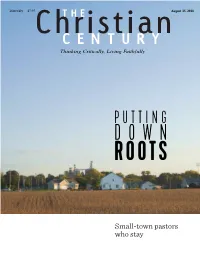
Putting Down Roots
Biweekly $7.95 August 15, 2018 Thinking Critically, Living Faithfully PUTTING DOWN ROOTS Small-town pastors who stay THE ANNUAL CHRISTIAN CENTURY LECTURE 7 p.m. | November 8 A THEOLOGY OF Reception to follow Arts Club of Chicago ACCOMPANIMENT $35.00 “I was a middle-aged lady, set in my ways, when I decided to be baptized. And when that water poured over my head, I realized the big problem with my new religion: God actually lives in other people. I couldn’t be a Christian by myself. I couldn’t choose who else was my brother or sister. “That’s a really different story from the one that’s sold to us every day, which insists each one of us is individually of Miles Sara courtesy Photo responsible for managing our own economic and political salvation.” SARA MILES Journalist and author Sara Miles served as director of ministry at St. Gregory of Nyssa Episcopal Church in San Francisco for ten years. She is an organizer for Faith in Action Bay Area, training congregations to accompany immigrants at risk of deporta- tion. Her books include Take This Bread, the story of her adult conversion to Christianity and her involvement in food min- istry at St. Gregory’s, and City of God: Faith in the Streets. To register, visit christiancentury.org/event From the publisher Peter W. Marty California law permits anyone to apply for a The wedding experience one-day permit to become a deputy commis- sioner of marriage. In states like Colorado and ear Pastor Marty: I have been asked by my Wisconsin, a couple can solemnize their own Dfriend to become ordained so I could marry wedding, which sounds plenty efficient. -

A Landscape with a Convoy on a Wooded Track Under Attack Oil on Panel 44 X 64 Cm (17⅜ X 25¼ In)
Sebastian Vrancx (Antwerp 1573 - Antwerp 1647) A Landscape with a Convoy on a Wooded Track under Attack oil on panel 44 x 64 cm (17⅜ x 25¼ in) Sebastian Vrancx was one of the first artists in the Netherlands to attempt battle scenes and A Landscape with Convoy on a Wooded Track under Attack offers an excellent example of his work. A wagon is under attack from bandits who have been hiding in the undergrowth on the right-hand side of the painting. The wagon has stopped as its driver flees for the safety of the bushes, whilst its occupants are left stranded inside. The wagon is guarded by three soldiers on horseback but in their startled state none have managed to engage their attackers. A line of bandits emerge from their hiding place and circle behind and around their victims, thus adding further to the confusion. Two figures remain in the bushes to provide covering fire and above them, perched in a tree, is one of their companions who has been keeping watch for the convoy and now helps to direct the attack. The scene is set in a softly coloured and brightly-lit landscape, which contrasts with the darker theme of the painting. Attack of Robbers, another scene of conflict, in the Hermitage, also possesses the decorative qualities and Vrancx’s typically poised figures, just as in A Landscape with a Convoy on a Wooded Track under Attack. A clear narrative, with travellers on horses attempting to ward off robbers, creates a personal and absorbing image. It once more reveals Vrancx’s delight in detailing his paintings with the dynamic qualities that make his compositions appealing on both an aesthetic and historical level. -
The Collecting, Dealing and Patronage Practices of Gaspare Roomer
ART AND BUSINESS IN SEVENTEENTH-CENTURY NAPLES: THE COLLECTING, DEALING AND PATRONAGE PRACTICES OF GASPARE ROOMER by Chantelle Lepine-Cercone A thesis submitted to the Department of Art History In conformity with the requirements for the degree of Doctor of Philosophy Queen’s University Kingston, Ontario, Canada (November, 2014) Copyright ©Chantelle Lepine-Cercone, 2014 Abstract This thesis examines the cultural influence of the seventeenth-century Flemish merchant Gaspare Roomer, who lived in Naples from 1616 until 1674. Specifically, it explores his art dealing, collecting and patronage activities, which exerted a notable influence on Neapolitan society. Using bank documents, letters, artist biographies and guidebooks, Roomer’s practices as an art dealer are studied and his importance as a major figure in the artistic exchange between Northern and Sourthern Europe is elucidated. His collection is primarily reconstructed using inventories, wills and artist biographies. Through this examination, Roomer emerges as one of Naples’ most prominent collectors of landscapes, still lifes and battle scenes, in addition to being a sophisticated collector of history paintings. The merchant’s relationship to the Spanish viceregal government of Naples is also discussed, as are his contributions to charity. Giving paintings to notable individuals and large donations to religious institutions were another way in which Roomer exacted influence. This study of Roomer’s cultural importance is comprehensive, exploring both Northern and Southern European sources. Through extensive use of primary source material, the full extent of Roomer’s art dealing, collecting and patronage practices are thoroughly examined. ii Acknowledgements I am deeply thankful to my thesis supervisor, Dr. Sebastian Schütze. -

20-A Richard Diebenkorn, Cityscape I, 1963
RICHARD DIEBENKORN [1922–1993] 20a Cityscape I, 1963 Although often derided by those who embraced the native ten- no human figure in this painting. But like it, Cityscape I compels dency toward realism, abstract painting was avidly pursued by us to think about man’s effect on the natural world. Diebenkorn artists after World War II. In the hands of talented painters such leaves us with an impression of a landscape that has been as Jackson Pollack, Robert Motherwell, and Richard Diebenkorn, civilized — but only in part. abstract art displayed a robust energy and creative dynamism Cityscape I’s large canvas has a composition organized by geo- that was equal to America’s emergence as the new major metric planes of colored rectangles and stripes. Colorful, boxy player on the international stage. Unlike the art produced under houses run along a strip of road that divides the two sides of the fascist or communist regimes, which tended to be ideological painting: a man-made environment to the left, and open, pre- and narrowly didactic, abstract art focused on art itself and the sumably undeveloped, land to the right. This road, which travels pleasure of its creation. Richard Diebenkorn was a painter who almost from the bottom of the picture to the top, should allow moved from abstraction to figurative painting and then back the viewer to scan the painting quickly, but Diebenkorn has used again. If his work has any theme it is the light and atmosphere some artistic devices to make the journey a reflective one. of the West Coast. -

Renaissance Art in Rome Giorgio Vasari: Rinascita
Niccolo’ Machiavelli (1469‐1527) • Political career (1498‐1512) • Official in Florentine Republic – Diplomat: observes Cesare Borgia – Organizes Florentine militia and military campaign against Pisa – Deposed when Medici return in 1512 – Suspected of treason he is tortured; retired to his estate Major Works: The Prince (1513): advice to Prince, how to obtain and maintain power Discourses on Livy (1517): Admiration of Roman republic and comparisons with his own time – Ability to channel civil strife into effective government – Admiration of religion of the Romans and its political consequences – Criticism of Papacy in Italy – Revisionism of Augustinian Christian paradigm Renaissance Art in Rome Giorgio Vasari: rinascita • Early Renaissance: 1420‐1500c • ‐‐1420: return of papacy (Martin V) to Rome from Avignon • High Renaissance: 1500‐1520/1527 • ‐‐ 1503: Ascension of Julius II as Pope; arrival of Bramante, Raphael and Michelangelo; 1513: Leo X • ‐‐1520: Death of Raphael; 1527 Sack of Rome • Late Renaissance (Mannerism): 1520/27‐1600 • ‐‐1563: Last session of Council of Trent on sacred images Artistic Renaissance in Rome • Patronage of popes and cardinals of humanists and artists from Florence and central/northern Italy • Focus in painting shifts from a theocentric symbolism to a humanistic realism • The recuperation of classical forms (going “ad fontes”) ‐‐Study of classical architecture and statuary; recovery of texts Vitruvius’ De architectura (1414—Poggio Bracciolini) • The application of mathematics to art/architecture and the elaboration of single point perspective –Filippo Brunellschi 1414 (develops rules of mathematical perspective) –L. B. Alberti‐‐ Della pittura (1432); De re aedificatoria (1452) • Changing status of the artist from an artisan (mechanical arts) to intellectual (liberal arts; math and theory); sense of individual genius –Paragon of the arts: painting vs. -

Girolamo Muziano, Scipione Pulzone, and the First Generation of Jesuit Art
journal of jesuit studies 6 (2019) 196-212 brill.com/jjs Girolamo Muziano, Scipione Pulzone, and the First Generation of Jesuit Art John Marciari The Morgan Library & Museum, New York jmarciari@themorgan.org Abstract While Bernini and other artists of his generation would be responsible for much of the decoration at the Chiesa del Gesù and other Jesuit churches, there was more than half a century of art commissioned by the Jesuits before Bernini came to the attention of the order. Many of the early works painted in the 1580s and 90s are no longer in the church, and some do not even survive; even a major monument like Girolamo Muzia- no’s Circumcision, the original high altarpiece, is neglected in scholarship on Jesuit art. This paper turns to the early altarpieces painted for the Gesù by Muziano and Scipione Pulzone, to discuss the pictorial and intellectual concerns that seem to have guided the painters, and also to some extent to speculate on why their works are no longer at the Gesù, and why these artists are so unfamiliar today. Keywords Jesuit art – Il Gesù – Girolamo Muziano – Scipione Pulzone – Federico Zuccaro – Counter-Reformation – Gianlorenzo Bernini Visitors to the Chiesa del Gesù in Rome, or to the recent exhibition of Jesuit art at Fairfield University,1 might naturally be led to conclude that Gianlorenzo 1 Linda Wolk-Simon, ed., The Holy Name: Art of the Gesù; Bernini and His Age, Exh. cat., Fair- field University Art Museum, Early Modern Catholicism and the Visual Arts 17 (Philadelphia: Saint Joseph’s University Press, 2018).