Consolidating the Conservation of Cross River Gorillas (Gorilla Gorilla
Total Page:16
File Type:pdf, Size:1020Kb
Load more
Recommended publications
-

EAZA Best Practice Guidelines Bonobo (Pan Paniscus)
EAZA Best Practice Guidelines Bonobo (Pan paniscus) Editors: Dr Jeroen Stevens Contact information: Royal Zoological Society of Antwerp – K. Astridplein 26 – B 2018 Antwerp, Belgium Email: Jeroen.stevens@uantwerpen.be Name of TAG: Great Ape TAG TAG Chair: Dr. María Teresa Abelló Poveda – Barcelona Zoo mabello@bsmsa.cat Edition: First edition - 2020 1 2 EAZA Best Practice Guidelines disclaimer Copyright (February 2020) by EAZA Executive Office, Amsterdam. All rights reserved. No part of this publication may be reproduced in hard copy, machine-readable or other forms without advance written permission from the European Association of Zoos and Aquaria (EAZA). Members of the European Association of Zoos and Aquaria (EAZA) may copy this information for their own use as needed. The information contained in these EAZA Best Practice Guidelines has been obtained from numerous sources believed to be reliable. EAZA and the EAZA APE TAG make a diligent effort to provide a complete and accurate representation of the data in its reports, publications, and services. However, EAZA does not guarantee the accuracy, adequacy, or completeness of any information. EAZA disclaims all liability for errors or omissions that may exist and shall not be liable for any incidental, consequential, or other damages (whether resulting from negligence or otherwise) including, without limitation, exemplary damages or lost profits arising out of or in connection with the use of this publication. Because the technical information provided in the EAZA Best Practice Guidelines can easily be misread or misinterpreted unless properly analysed, EAZA strongly recommends that users of this information consult with the editors in all matters related to data analysis and interpretation. -

Gorilla Beringei (Eastern Gorilla) 07/09/2016, 02:26
Gorilla beringei (Eastern Gorilla) 07/09/2016, 02:26 Kingdom Phylum Class Order Family Animalia ChordataMammaliaPrimatesHominidae Scientific Gorilla beringei Name: Species Matschie, 1903 Authority: Infra- specific See Gorilla beringei ssp. beringei Taxa See Gorilla beringei ssp. graueri Assessed: Common Name(s): English –Eastern Gorilla French –Gorille de l'Est Spanish–Gorilla Oriental TaxonomicMittermeier, R.A., Rylands, A.B. and Wilson D.E. 2013. Handbook of the Mammals of the World: Volume Source(s): 3 Primates. Lynx Edicions, Barcelona. This species appeared in the 1996 Red List as a subspecies of Gorilla gorilla. Since 2001, the Eastern Taxonomic Gorilla has been considered a separate species (Gorilla beringei) with two subspecies: Grauer’s Gorilla Notes: (Gorilla beringei graueri) and the Mountain Gorilla (Gorilla beringei beringei) following Groves (2001). Assessment Information [top] Red List Category & Criteria: Critically Endangered A4bcd ver 3.1 Year Published: 2016 Date Assessed: 2016-04-01 Assessor(s): Plumptre, A., Robbins, M. & Williamson, E.A. Reviewer(s): Mittermeier, R.A. & Rylands, A.B. Contributor(s): Butynski, T.M. & Gray, M. Justification: Eastern Gorillas (Gorilla beringei) live in the mountainous forests of eastern Democratic Republic of Congo, northwest Rwanda and southwest Uganda. This region was the epicentre of Africa's "world war", to which Gorillas have also fallen victim. The Mountain Gorilla subspecies (Gorilla beringei beringei), has been listed as Critically Endangered since 1996. Although a drastic reduction of the Grauer’s Gorilla subspecies (Gorilla beringei graueri), has long been suspected, quantitative evidence of the decline has been lacking (Robbins and Williamson 2008). During the past 20 years, Grauer’s Gorillas have been severely affected by human activities, most notably poaching for bushmeat associated with artisanal mining camps and for commercial trade (Plumptre et al. -

Africanprogramme for Onchocerctasts Control (Apoc)
RESERVED FOR PROTECT LOGO/HEADING COUNTRYAIOTF: CAMEROON Proiect Name: CDTI SW 2 Approval vearz 1999 Launchins vegr: 2000 Renortins Period: From: JANUARY 2008 To: DECEMBER 2008 (Month/Year) ( Mont!{eq) Proiectvearofthisrenort: (circleone) I 2 3 4 5 6 7(8) 9 l0 Date submitted: NGDO qartner: "l"""uivFzoog Sightsavers International South West 2 CDTI Project Report 2008 - Year 8. ANNUAL PROJECT TECHNICAL REPORT SUBMITTED TO TECHNICAL CONSULTATTVE COMMITTEE (TCC) DEADLINE FOR SUBMISSION: To APOC Management by 3l January for March TCC meeting To APOC Management by 31 Julv for September TCC meeting AFRICANPROGRAMME FOR ONCHOCERCTASTS CONTROL (APOC) I I RECU LE I S F[,;, ?ur], APOC iDIR ANNUAL I'II().I Ii(]'I"IIICHNICAL REPORT 't'o TECHNICAL CONSU l.',l'A]'tvE CoMMITTEE (TCC) ENDORSEMENT Please confirm you have read this report by signing in the appropriat space. OFFICERS to sign the rePort: Country: CAMEROON National Coordinator Name: Dr. Ntep Marcelline S l) u b Date: . ..?:.+/ c Ail 9ou R Regional Delegate Name: Dr. Chu + C( z z a tu Signature: n rJ ( Date 6t @ RY oF I DE LA NGDO Representative Name: Dr. Oye Joseph E Signature: .... Date:' g 2 JAN. u0g Regional Oncho Coordinator Name: Mr. Ebongo Signature: Date: 51-.12-Z This report has been prepared by Name : Mr. Ebongo Peter Designation:.OPC SWII Signature: *1.- ,l 1l Table of contents Acronyms .v Definitions vi FOLLOW UP ON TCC RECOMMENDATIONS. 7 Executive Summary.. 8 SECTION I : Background information......... 9 1.1. GrrueRruINFoRMATroN.................... 9 1.1.1 Description of the project...... 9 Location..... 9 1. 1. 2. -

Bonobos (Pan Paniscus) Show an Attentional Bias Toward Conspecifics’ Emotions
Bonobos (Pan paniscus) show an attentional bias toward conspecifics’ emotions Mariska E. Kreta,1, Linda Jaasmab, Thomas Biondac, and Jasper G. Wijnend aInstitute of Psychology, Cognitive Psychology Unit, Leiden University, 2333 AK Leiden, The Netherlands; bLeiden Institute for Brain and Cognition, 2300 RC Leiden, The Netherlands; cApenheul Primate Park, 7313 HK Apeldoorn, The Netherlands; and dPsychology Department, University of Amsterdam, 1018 XA Amsterdam, The Netherlands Edited by Susan T. Fiske, Princeton University, Princeton, NJ, and approved February 2, 2016 (received for review November 8, 2015) In social animals, the fast detection of group members’ emotional perspective, it is most adaptive to be able to quickly attend to rel- expressions promotes swift and adequate responses, which is cru- evant stimuli, whether those are threats in the environment or an cial for the maintenance of social bonds and ultimately for group affiliative signal from an individual who could provide support and survival. The dot-probe task is a well-established paradigm in psy- care (24, 25). chology, measuring emotional attention through reaction times. Most primates spend their lives in social groups. To prevent Humans tend to be biased toward emotional images, especially conflicts, they keep close track of others’ behaviors, emotions, and when the emotion is of a threatening nature. Bonobos have rich, social debts. For example, chimpanzees remember who groomed social emotional lives and are known for their soft and friendly char- whom for long periods of time (26). In the chimpanzee, but also in acter. In the present study, we investigated (i) whether bonobos, the rarely studied bonobo, grooming is a major social activity and similar to humans, have an attentional bias toward emotional scenes a means by which animals living in proximity may bond and re- ii compared with conspecifics showing a neutral expression, and ( ) inforce social structures. -

Orangutan…Taxonomy…And…Nomenclature
«««« ORANGUTAN…TAXONOMY…AND…NOMENCLATURE« « Craig«D em itros« « The«taxonom y«of«the«orangutan«has«been«confusing«and«is«still«the«subject«of« m uch«debate.«Q uestions«at«the«specific«and«subspecific«level«are«still«being« investigated«(Courtenay«et«al.«1988).«The«follow ing«taxonom ic«inform ation«is« taken«prim arily«from «G roves,«1971.« « H IG H ER«LEVEL«TAXO N O M Y:« O rder:«Prim ates« Suborder:«A nthropoidea« Superfam ily:«H om inoidea« Fam ily:«Pongidae«(Includes«extant«genera«Pan,…Gorilla…and…Pongo).« « H ISTO RICA L«TAXO N O M Y«AT«TH E«G EN U S«A N D «G EN U S«SPECIES«LEVEL:«« G enus« Pongo«Lacepede,«1799.« O urangus«Zim m erm an,«1777«(N am e«invalidated).« « G enus«species«(Pongo…pygm aeus«H oppius,«1763).« Sim ia…pygm aeus«H oppius,«1763.««Type«locality«Sum atra.« Sim ia…satyrus«Linnaeus,«1766.« O urangus…outangus«Zim m erm an,«1777.« Pongo…borneo«Lacepede,«1799.««Type«locality«Borneo.« Sim ia…Agrais«Schreber,«1779.««Type«locality«Borneo.« Pongo…W urm bii«Tiedem ann,«1808.««Type«locality«Borneo.« Pongo…Abelii«Lesson,«1827.««Type«locality«Sum atra.« Sim ia…M orio«O w en,«1836.««Type«locality«Borneo.« Pithecus…bicolor«I.«G eoffroy,«1841.««Type«locality«Sum atra.« Sim ia…Gargantica«Pearson,«1841.««Type«locality«Sum atra.« Pithecus…brookei«Blyth,«1853.««Type«locality«Saraw ak.« Pithecus…ow enii«Blyth,«1853.««Type«locality«Saraw ak.« Pithecus…curtus«Blyth,«1855.««Type«locality«Saraw ak.« Satyrus…Knekias«M eyer,«1856.««Type«locality«Borneo.« Pithecus…W allichii«G ray,«1870.««Type«locality«Borneo.« Pithecus…sum atranus«Selenka,«1896.««Type«locality«Sum atra.« Pongo…pygm aeus«Rothschild,«1904.««First«use«of«this«com bination.« Ptihecus…w allacei«Elliot,«1913.««Type«locality«Borneo.« « CURRENT…TAXONOMY« « The«current«and«m ost«accepted«taxonom y«of«the«G enus«Pongo«includes«one« species«Pongo…pygm aeus«and«tw o«subspecies«P.p.…pygm aeus«(the«Bornean« subspecies)«and«P.p.…abelii«(the«Sum atran«subspecies)«(Bem m el«1968;«Jones« 1969;«G roves«1971;«Jacobshagen«1979;«Seuarez«et«al.«1979«and«G roves«1993).« 5« « . -
Cross-River Gorillas
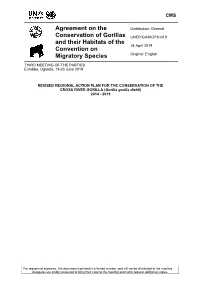
CMS Agreement on the Distribution: General Conservation of Gorillas UNEP/GA/MOP3/Inf.9 and their Habitats of the 24 April 2019 Convention on Migratory Species Original: English THIRD MEETING OF THE PARTIES Entebbe, Uganda, 18-20 June 2019 REVISED REGIONAL ACTION PLAN FOR THE CONSERVATION OF THE CROSS RIVER GORILLA (Gorilla gorilla diehli) 2014 - 2019 For reasons of economy, this document is printed in a limited number, and will not be distributed at the meeting. Delegates are kindly requested to bring their copy to the meeting and not to request additional copies. FewerToday, thethan total population of Cross River gorillas may number fewer than 300 individuals 300 left Revised Regional Action Plan for the Conservation of the Cross River Gorilla (Gorilla gorilla diehli) 2014–2019 HopeUnderstanding the status of the changing threats across the Cross River gorilla landscape will provide key information for guiding our collectiveSurvival conservation activities cross river gorilla action plan cover_2013.indd 1 2/3/14 10:27 AM Camera trap image of a Cross River gorilla at Afi Mountain Cross River Gorilla (Gorilla gorilla diehli) This plan outlines measures that should ensure that Cross River gorilla numbers are able to increase at key core sites, allowing them to extend into areas where they have been absent for many years. cross river gorilla action plan cover_2013.indd 2 2/3/14 10:27 AM Revised Regional Action Plan for the Conservation of the Cross River Gorilla (Gorilla gorilla diehli) 2014-2019 Revised Regional Action Plan for the Conservation of the Cross River Gorilla (Gorilla gorilla diehli) 2014-2019 Compiled and edited by Andrew Dunn1, 16, Richard Bergl2, 16, Dirck Byler3, Samuel Eben-Ebai4, Denis Ndeloh Etiendem5, Roger Fotso6, Romanus Ikfuingei6, Inaoyom Imong1, 7, 16, Chris Jameson6, Liz Macfie8, 16, Bethan Mor- gan9, 16, Anthony Nchanji6, Aaron Nicholas10, Louis Nkembi11, Fidelis Omeni12, John Oates13, 16, Amy Pokemp- ner14, Sarah Sawyer15 and Elizabeth A. -

Options for a National Culture Symbol of Cameroon: Can the Bamenda Grassfields Traditional Dress Fit?
EAS Journal of Humanities and Cultural Studies Abbreviated Key Title: EAS J Humanit Cult Stud ISSN: 2663-0958 (Print) & ISSN: 2663-6743 (Online) Published By East African Scholars Publisher, Kenya Volume-2 | Issue-1| Jan-Feb-2020 | DOI: 10.36349/easjhcs.2020.v02i01.003 Research Article Options for a National Culture Symbol of Cameroon: Can the Bamenda Grassfields Traditional Dress Fit? Venantius Kum NGWOH Ph.D* Department of History Faculty of Arts University of Buea, Cameroon Abstract: The national symbols of Cameroon like flag, anthem, coat of arms and seal do not Article History in any way reveal her cultural background because of the political inclination of these signs. Received: 14.01.2020 In global sporting events and gatherings like World Cup and international conferences Accepted: 28.12.2020 respectively, participants who appear in traditional costume usually easily reveal their Published: 17.02.2020 nationalities. The Ghanaian Kente, Kenyan Kitenge, Nigerian Yoruba outfit, Moroccan Journal homepage: Djellaba or Indian Dhoti serve as national cultural insignia of their respective countries. The https://www.easpublisher.com/easjhcs reason why Cameroon is referred in tourist circles as a cultural mosaic is that she harbours numerous strands of culture including indigenous, Gaullist or Francophone and Anglo- Quick Response Code Saxon or Anglophone. Although aspects of indigenous culture, which have been grouped into four spheres, namely Fang-Beti, Grassfields, Sawa and Sudano-Sahelian, are dotted all over the country in multiple ways, Cameroon cannot still boast of a national culture emblem. The purpose of this article is to define the major components of a Cameroonian national culture and further identify which of them can be used as an acceptable domestic cultural device. -

Shelter Cluster Dashboard NWSW052021
Shelter Cluster NW/SW Cameroon Key Figures Individuals Partners Subdivisions Cameroon 03 23,143 assisted 05 Individual Reached Trend Nigeria Furu Awa Ako Misaje Fungom DONGA MANTUNG MENCHUM Nkambe Bum NORD-OUEST Menchum Nwa Valley Wum Ndu Fundong Noni 11% BOYO Nkum Bafut Njinikom Oku Kumbo Belo BUI Mbven of yearly Target Njikwa Akwaya Jakiri MEZAM Babessi Tubah Reached MOMO Mbeggwi Ngie Bamenda 2 Bamenda 3 Ndop Widikum Bamenda 1 Menka NGO KETUNJIA Bali Balikumbat MANYU Santa Batibo Wabane Eyumodjock Upper Bayang LEBIALEM Mamfé Alou OUEST Jan Feb Mar Apr May Jun Jul Aug Sep Oct Nov Dec Fontem Nguti KOUPÉ HNO/HRP 2021 (NW/SW Regions) Toko MANENGOUBA Bangem Mundemba SUD-OUEST NDIAN Konye Tombel 1,351,318 Isangele Dikome value Kumba 2 Ekondo Titi Kombo Kombo PEOPLE OF CONCERN Abedimo Etindi MEME Number of PoC Reached per Subdivision Idabato Kumba 1 Bamuso 1 - 100 Kumba 3 101 - 2,000 LITTORAL 2,001 - 13,000 785,091 Mbongé Muyuka PEOPLE IN NEED West Coast Buéa FAKO Tiko Limbé 2 Limbé 1 221,642 Limbé 3 [ Kilometers PEOPLE TARGETED 0 15 30 *Note : Sources: HNO 2021 PiN includes IDP, Returnees and Host Communi�es The boundaries and names shown and the designations used on this map do not imply official endorsement or acceptance by the United Nations Key Achievement Indicators PoC Reached - AGD Breakdouwn 296 # of Households assisted with Children 27% 26% emergency shelter 1,480 Adults 21% 22% # of households assisted with core 3,769 Elderly 2% 2% relief items including prevention of COVID-19 21,618 female male 41 # of households assisted with cash for rental subsidies 41 Households Reached Individuals Reached Cartegories of beneficiaries reported People Reached by region Distribution of Shelter NFI kits integrated with COVID 19 KITS in Matoh town. -
CAMEROON Perspectives on Food Security October 2020 to May 2021 Food Security Improved in the Far North, but Worsened in the Northwest and Southwest
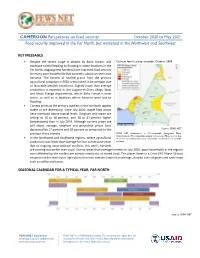
CAMEROON Perspectives on food security October 2020 to May 2021 Food security improved in the Far North, but worsened in the Northwest and Southwest KEY MESSAGES • Despite the recent surge in attacks by Boko Haram, and Current food security situation, October 2020 excessive rainfall leading to flooding in some locations in the Far North, ongoing new harvests have improved food security for many poor households that currently subsist on their own harvests. The harvest of rainfed grains from the primary agricultural campaign in 2020 is estimated to be average, due to favorable weather conditions. Slightly lower than average production is expected in the Logone-et-Chari, Mayo Sava, and Mayo Tsanga departments, where Boko Haram is most active, as well as in locations where harvests were lost to flooding. • Current prices at the primary markets in the Far North appear stable or are decreasing. Since July 2020, staple food prices have increased above typical levels. Sorghum and maize are selling at 46 to 60 percent, and 30 to 47 percent higher (respectively) than in July 2019. Although current prices are still above average, sorghum and groundnut prices have decreased by 17 percent and 18 percent as compared to the Source: FEWS NET previous three months. FEWS NET classification is IPC-compatible (Integrated Phase Classification). IPC-compatible analysis follows key IPC protocols but • In the Northwest and Southwest regions, where agricultural does not necessarily reflect the consensus of national food security production was lower than average for four consecutive years partners. due to ongoing socio-political conflicts, this year's harvests are running out earlier than usual. -
MINMAP South-West Region
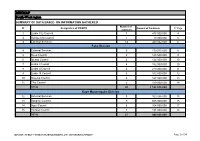
MINMAP South-West region SUMMARY OF DATA BASED ON INFORMATION GATHERED Number of N° Designation of PO/DPO Amount of Contracts N° Page contracts 1 Limbe City Council 7 475 000 000 4 2 Kumba City Council 1 10 000 000 5 3 External Services 14 440 032 000 6 Fako Division 4 External Services 9 179 015 000 8 5 Buea Council 5 125 500 000 9 6 Idenau Council 4 124 000 000 10 7 Limbe I Council 4 152 000 000 10 8 Limbe II Council 4 219 000 000 11 9 Limbe III Council 6 102 500 000 12 10 Muyuka Council 6 127 000 000 13 11 Tiko Council 5 159 000 000 14 TOTAL 43 1 188 015 000 Kupe Muanenguba Division 12 External Services 5 100 036 000 15 13 Bangem Council 9 605 000 000 15 14 Nguti Council 6 104 000 000 17 15 Tombel Council 7 131 000 000 18 TOTAL 27 940 036 000 MINMAP / PUBLIC CONTRACTS PROGRAMMING AND MONITORING DIVISION Page 1 of 34 MINMAP South-West region SUMMARY OF DATA BASED ON INFORMATION GATHERED Lebialem Division 16 External Services 5 134 567 000 19 17 Alou Council 9 144 000 000 19 18 Menji Council 3 181 000 000 20 19 Wabane Council 9 168 611 000 21 TOTAL 26 628 178 000 Manyu Division 18 External Services 5 98 141 000 22 19 Akwaya Council 6 119 500 000 22 20 Eyomojock Council 6 119 000 000 23 21 Mamfe Council 5 232 000 000 24 22 Tinto Council 6 108 000 000 25 TOTAL 28 676 641 000 Meme Division 22 External Services 5 85 600 000 26 23 Mbonge Council 7 149 000 000 26 24 Konye Council 1 27 000 000 27 25 Kumba I Council 3 65 000 000 27 26 Kumba II Council 5 83 000 000 28 27 Kumba III Council 3 84 000 000 28 TOTAL 24 493 600 000 MINMAP / PUBLIC CONTRACTS -
First Phase Report
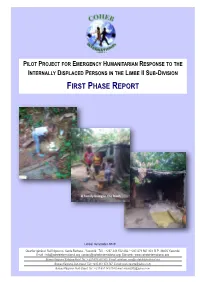
Page 1 PILOT PROJECT FOR EMERGENCY HUMANITARIAN RESPONSE TO THE INTERNALLY DISPLACED PERSONS IN THE LIMBE II SUB-DIVISION FIRST PHASE REPORT A family living in the bush Limbé, December 2018 Quartier général: Rail Ngousso- Santa Barbara - Yaoundé Tél. : +237-243 572 456 / +237-679 967 303 B.P. 33805 Yaoundé Email : info@cohebinternational.org contact@cohebinternational.org Site web : www.cohebinternational.org Bureau Régional Extrême-Nord: Tél.: +237-674 900 303 E-mail: abraham.sara@cohebinternational.org Bureau Régional Sud-Ouest: Tél.: +237-651 973 747 E-mail: njato.george@yahoo.com Bureau Régional Nord-Ouest: Tél.: +237-697 143 004 E-mail: ndula2002@yahoo.com Emergency response to Limbe II IDPs - December 2018 Page 2 TABLE OF CONTENT PRESENTATION OF COHEB INT’L ................................................................. 3 SOME OF OUR EMERGENCY ACTIVITIES ......................................................... 4 CONTEXT OF THE PROJECT .......................................................................... 5 OBJECTIVE OF THE PROJECT ........................................................................ 6 EXECUTION OF THE PROJECT .................................................................... 7-9 CONCLUSION ............................................................................................ 10 ANNEX 1: IDP’S SETTLEMENT CAMP MUKUNDANGE LIMBE II SUB-DIVISION......................................................... 11 ANNEX 2: COHEB PROJECT OFFICE SOKOLO, LIMBE II OUR AGRO-FORESTRY TRANSFORMATION FACTORY AND LOGISTICS -

Country Travel Risk Summaries
COUNTRY RISK SUMMARIES Powered by FocusPoint International, Inc. Report for Week Ending September 19, 2021 Latest Updates: Afghanistan, Burkina Faso, Cameroon, India, Israel, Mali, Mexico, Myanmar, Nigeria, Pakistan, Philippines, Russia, Saudi Arabia, Somalia, South Sudan, Sudan, Syria, Turkey, Ukraine and Yemen. ▪ Afghanistan: On September 14, thousands held a protest in Kandahar during afternoon hours local time to denounce a Taliban decision to evict residents in Firqa area. No further details were immediately available. ▪ Burkina Faso: On September 13, at least four people were killed and several others ijured after suspected Islamist militants ambushed a gendarme patrol escorting mining workers between Sakoani and Matiacoali in Est Region. Several gendarmes were missing following the attack. ▪ Cameroon: On September 14, at least seven soldiers were killed in clashes with separatist fighters in kikaikelaki, Northwest region. Another two soldiers were killed in an ambush in Chounghi on September 11. ▪ India: On September 16, at least six people were killed, including one each in Kendrapara and Subarnapur districts, and around 20,522 others evacuated, while 7,500 houses were damaged across Odisha state over the last three days, due to floods triggered by heavy rainfall. Disaster teams were sent to Balasore, Bhadrak and Kendrapara districts. Further floods were expected along the Mahanadi River and its tributaries. ▪ Israel: On September 13, at least two people were injured after being stabbed near Jerusalem Central Bus Station during afternoon hours local time. No further details were immediately available, but the assailant was shot dead by security forces. ▪ Mali: On September 13, at least five government soldiers and three Islamist militants were killed in clashes near Manidje in Kolongo commune, Macina cercle, Segou region, during morning hours local time.