Hand Crafted Bespoke Tailoring
Total Page:16
File Type:pdf, Size:1020Kb
Load more
Recommended publications
-
This Document Is the Interim Report for IDB Contract No
Development of the Industrial Park Model to Improve Trade Opportunities for Haiti – HA-T1074-SN2 FINAL REPORT submitted to September 20, 2010 99 Nagog Hill Road, Acton, Massachusetts 01720 USA Tel: +1-978-263-7738 e-mail: info@koiosllc.com Web site: www.koiosllc.com Table of Contents Executive Summary i I. Introduction 1 A. Background and History 1 B. Haiti’s Current Economic Situation 2 C. Purpose and Objectives of this Study 3 II. Overview of Garment Industry Trends 5 A. The Levelling Playing Field 5 B. Competitive Advantages in the Post-MFA World 7 III. Haiti’s Place in the Post-MFA World 11 A. The Structure of Haiti’s Garment Production 11 B. The Way Forward for Hait’s Garment Industry 14 1. Trade Preference Levels 14 2. How Will Haiti Fit Into Global Supply Chains? 22 3. Beyond HELP 24 C. The Competitive Case for Haiti and the North 27 1. A New Vision for Haiti – Moving on from CMT 27 2. Why the North? 30 D. Garment Manufacturers’ Requirements in North Haiti 32 1. Land 32 2. Pre-built Factory Sheds 33 3. Water and Water Treatment 34 4. Electricity 36 5. Road Transport 37 6. Business Facilitation and Services 37 E. Park Development Guidelines 37 IV. Site Identification, Evaluation, and Selection 43 A. Site Selection Factors and Methodology 43 B. Site Selection 47 1. Regional Context Summary 47 2. Infrastructure Constraints 48 3. Evaluation and Selection Process 50 4. Site Selection Methodology 52 5. Site Ranking and Descriptions 54 C. Development Costs 59 1. -
Tailoring Series TECHNIQUES for TAILORING UNDERLINING a TAILORED GARMENT—Underlining Is a Second Layer of Fabric. It Is Cut By
tailoring series TECHNIQUES FOR TAILORING UNDERLINING A TAILORED GARMENT—Underlining is a second layer of fabric. It is cut by the garment pattern pieces and staystitched to the wrong side of the corresponding outer sections before any seams are joined. The two layers are then handled as one. As a general guide, most suit jackets and coats look more pro- fessional when underlined. Underlining is especially recommended for lightweight wool materials, loosely woven materials and light- colored materials. For additional information on selecting fabrics for underlining and applying the underlining, see Lining a Shirt 01' Dress HE 72, N. C. Agricultural Extension Service. STAYSTITCHING—Staystitch all outer garment pieces before construction begins. If garment is underlined, stays-titching is done when the two layers of fabric are sewn together. Staystitch 1/3 in. outside seamline (on the seam allowance). Stay- stitch “ with matching cotton thread on all curved *areas that may stretch during construction such as necklines, side seams, shoulder seams, armholes, and side seams of skirt. Use directional stitching always to prevent stretching of fabric and to prevent one layer of fabric from riding. The direction to stitch is indicated by small arrows on the pattern on the seamlines. INTERFACINGS—Select a high quality hair canvas for the front and collar of coats and jackets. The percentage of wool indicates the quality—the higher the wool content of the canvas the better the quality. Since a high percentage of wool makes the hair canvas fairly dark in color, it cannot be used successfully under light-colored fabrics. In these cases use an interfacing lighter in color and lower in wool content. -

Instructions
Lekala 4932 Dress With Straps Dress With Straps - Sewing Pattern #4932 Recommendations on fabric: natural/mixed fabric suitable for dresses. You will also need: fusible interfacing; 11 buttons. Seam allowances: Seam allowance for hem of garment – 2 cm; other seams – 1 cm. Note on seam allowances: - If the pattern has double contour the seam allowances are included. They are 1 cm unless specified otherwise. - If the pattern has single contour, the seam allowances are NOT included and need to be added when laying out the pattern. Note on length of fabric: Attention! The amount of fabric needed for your pattern is not included. It will depend on the selected pattern size, the width, and design of the fabric you plan to use. First, print all the paper patterns and lay them out at the width of fabric you plan to use (usually from 90 to 150 cm). Measure how much fabric you will need. Don't forget to account for pieces that need to be cut multiple times and pieces that are cut on the fold. CUTTING: Note on cutting: On the pattern pieces, “beam” means straight of grain. Lay out your pieces accordingly. Some pieces will be cut on the fold. This is noted on the pattern piece. Mark all notches and other design features such as pleats etc. from the pattern onto your fabric. When sewing the garment, pay attention to notches, they must match up. Main fabric: 1. Upper center back - cut 2 2. Upper side back - cut 2 3. Lower back – cut 1 on fold 4. -

Aware: Royal Academy of the Arts Art Fashion Identity
London College of Fashion Aware: Royal Academy of the Arts Art Fashion Identity International Symposium London College of Fashion is delighted London College of Fashion is committed This two-day symposium is exemplary to be a partner in this exciting and to extending the influence of fashion, of the relationship that the college challenging exhibition, and to be able be it economically, socially or politically, continuously strives to develop between to provide contributions from some of and we explore fashion in many its own internally mandated activities the college’s leading researchers, artists contexts. This exhibition encapsulates and programs with broader discourses and designers. vital characteristics of today’s fashion and practices within the fields of art and education, and it supports my belief that design. With the recent appointment The relationship between art and fashion has the potential to bring about of London College of Fashion Curator, fashion, through conceptual and practical social change when considered in contexts Magdalene Keaney, and significant expression, is at the London College of of identity, individuality, technology and developments to the Fashion Space Fashion’s core. We were immensely proud the environment. Gallery at London College of Fashion to endorse the development of ‘Aware’ we now intend to increase public from its original concept by Lucy Orta, We see this in the work of Professor awareness of how fashion has, is, and London College of Fashion Professor of Helen Storey, whose ‘Wonderland’ project will continue to permeate new territories. Art, Fashion and Environment, together brings together art and science to find real The opportunity to work with the Royal with curator Gabi Scardi. -
Fabrication and Analysis of Dielectric-Elastomer Minimum-Energy Structures for Highly-Deformable Soft Robotic Systems
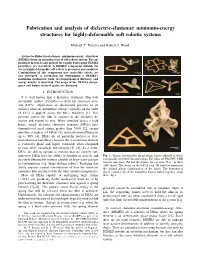
Fabrication and analysis of dielectric-elastomer minimum-energy structures for highly-deformable soft robotic systems Michael T. Petralia and Robert J. Wood Abstract— Dielectric-elastomer minimum-energy structures (DEMES) form an emerging class of soft robotic system. The ap- propriate materials and method for rapidly fabricating DEMES prototypes are described. A DEMES component suitable for use in highly-deformable soft robots is presented and analyzed. Combinations of this component into snake-like robots are also presented. A calculation for determining a DEMES’s maximum mechanical work, electromechanical efficiency, and energy density is described. The scope of the DEMES design- space and future research paths are discussed. I. INTRODUCTION It is well-known that a dielectric elastomer film with stretchable surface electrodes—a dielectric elastomer actu- ator (DEA)—experiences an electrostatic pressure on its surfaces when an appropriate voltage (typically on the order of kV’s) is applied across the film’s thickness [1]. This pressure causes the film to contract in the thickness di- rection and expand its area. When stretched across a rigid frame, simple dielectric elastomer actuators (DEAs) have demonstrated areal strains greater than 380% [2], energy densities as high as 3.4 MJ/m3 [3], and maximum efficiencies up to 90% [4]. DEAs are of particular interest as elec- tromechanical transducers because the transduction element is extremely pliant and highly extensible when compared to most other transducer technologies [5], [6]. As a result, DEAs are able to operate in systems that are entirely soft; moreover, DEAs have the ability to function as actively and Fig. 1: Various inextensible, pliant planar frames adhered to 500% passively deformable systems capable of large-scale changes isotropically stretched elastomer films. -
To Complete the Pattern Join Bodice #1 to #2 at Circle Front Bodice #1
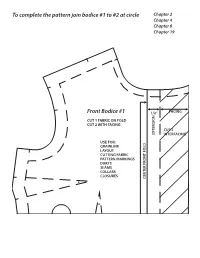
To complete the pattern join bodice #1 to #2 at circle Chapter 2 Chapter 4 Chapter 6 Chapter 19 Front Bodice #1 1/2” FACING N CUT 1 FABRIC ON FOLD CUT 2 WITH FACING CUT 2 EXTENSIO INTERFACING USE FOR: GRAINLINE LAYOUT CUTTING FABRIC PATTERN MARKINGS DARTS SEAMS COLLARS CLOSURES CENTER FRONT FOLD To completeTo the pattern join bodice #1 to #2 at circle TO COMPLETE THE PATTERN JOIN BODICE #1 TO #2 AT CIRCLE STITCH TO MATCHPOINTS FOR DART TUCK FRONT BODICE #2 Front Bodice #2 Chapter 2 Chapter 4 Chapter 6 Chapter 19 STITCH TO MATCHPOINTS FOR DART TUCKS To complete the pattern join bodice #3 to #4 at circle Chapter 2 Chapter 4 Chapter 6 Back Bodice #3 CUT 2 FABRIC USE FOR: CK SEAM GRAINLINE LAYOUT CUTTING FABRIC CK FOLD PATTERN MARKINGS DARTS SEAMS COLLARS CENTER BA CUT HERE FOR CENTER BA To completeTo the pattern join bodice #3 to #4 at circle STITCH TO MATCHPOINTS FOR DART TUCKS Back Bodice #4 Chapter 2 Chapter 4 Chapter 6 Chapter 4 Chapter 11 Chapter 14 Chapter 17 MATCHPOINT Front Skirt #5 CUT 1 FABRIC USE FOR: V SHAPED SEAM WAISTBAND WAIST FACING BIAS WAIST FINISH CURVED/ALINE HEM BIAS FALSE HEM CENTER FRONT FOLD Chapter 4 Chapter 11 Chapter 14 Front Yoke #6 CUT 1 FABRIC CUT 1 INTERFACING USE FOR: V SHAPE SEAM WAISTBAND WAIST FACING BIAS WAIST FINISH C. F. FOLD C. F. MATCHPOINT Chapter 4 Chapter 6 Chapter 10 Chapter 11 Chapter 14 Chapter 17 MARK DART POINT HERE Back Skirt #7 CUT 2 FABRIC USE FOR: SEAMS ZIPPERS WAISTBAND WAIST FACING BIAS WAIST FINISH CURVED ALINE HEM BIAS FALSE HEM Chapter 4 CUT ON FOLD Chapter 12 Chapter 17 H TC NO WHEN -
Surprise Humbug Tutorial You Will Need: 1 Rectangle of Stitched Linen Some 5Mm Ribbon Some Interfacing Some Matching Beads (Optional) Some Felt
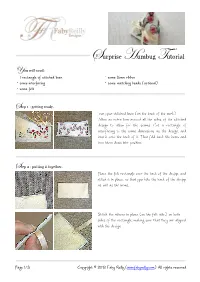
Surprise Humbug Tutorial You will need: 1 rectangle of stitched linen some 5mm ribbon some interfacing some matching beads (optional) some felt Step 1 : getting ready. Iron your stitched linen (on the back of the work). Allow an extra 1cm around all the sides of the stitched design to allow for the seams. Cut a rectangle of interfacing to the same dimensions as the design, and iron it onto the back of it. Then fold back the hems and iron them down into position. Step 2 : putting it together. Place the felt rectangle over the back of the design, and stitch it in place, so that you hide the back of the design as well as the hems. Stitch the ribbons in place (on the felt side), on both sides of the rectangle, making sure that they are aligned with the design. Page 1/3 Copyright © 2012 Faby Reilly (www.fabyreilly.com) All rights reserved Surprise Humbug Tutorial Roll up your rectangle so that the “ribbon” sides are touching. Start stitching them together, taking care to leave a large enough opening (roughly 2/3 up from the bottom of the design). Whip-stitch** your way up towards the top, around the corner and down until you can stitch no more. You can (if you so wish) add beads to your seam as you go. Then work on the opposite side, shaping it so that you get a humbug. Step 3 : adding the finishing touches. The ribbons should be facing each other, ready to be tied into a pretty bow. Your surprise humbug is now to be filled with a “surprise” of your choice. -
Soft Electronic Platforms Combining Elastomeric Stretchability and Biodegradability
RESEARCH ARTICLE www.advsustainsys.com Soft Electronic Platforms Combining Elastomeric Stretchability and Biodegradability Martin Held, Alexander Pichler, Joshua Chabeda, Natalie Lam, Philip Hindenberg, Carlos Romero-Nieto, and Gerardo Hernandez-Sosa* of these devices would, on the one hand, Soft and stretchable electronic devices are expected to offer technological help to reduce the high amount of global advances in the field of robotics, human–machine interfacing, and healthcare. electronic and plastic waste.[8] On the other Employing biodegradable elastomers, hydrogels, and nontoxic conductors hand, it would enable implantable tempo- would add significant value to and minimize the ecological impact of such rary sensors or prosthetics, which would not have to be removed after the therapy, disposable and transient electronic applications. Here, the biodegradable and making a second surgery redundant.[9,10] photo-crosslinkable elastomer poly(glycerol sebacic) acrylate (PGSA) is charac- An increasing number of biodegradable terized for its use in soft and stretchable electronics. Its mechanical proper- electronic elements,[11–13] such as transis- ties are investigated in terms of their chemical composition and compared to tors,[14] capacitors,[15] or light-emitting elec- [16–18] commonly used gelatin hydrogels. Furthermore, these materials are combined trochemical cells (LECs) have been reported in recent years. However, they with interconnects made of liquid Galinstan in order to create functional sub- have been commonly fabricated on rigid or strates with certified biodegradability under ISO standards. The combination foil substrates,[19] which lack stretchability. of these materials produces elastic circuit boards that act as soft platforms for Materials exhibiting evident biodegrada- body-mounted sensors or biodegradable stretchable light-emitting devices. -

Savile-Row-Inside-Out.Pdf
Savile Row: Inside Out 1 Savile Row BeSpoke aSSociation he Savile Row Bespoke Association is dedicated to protecting and promoting Tthe practices and traditions that have made Savile Row the acknowledged home of the best bespoke tailoring and a byword for unequalled quality around the world. The SRBA comprises of fifteen member and associate houses, who work together to protect and champion the understanding of bespoke tailoring and to promote the ingenious craftsmen that comprise the community of Savile Row. The SRBA sets the standards that define a Savile Row bespoke tailor, and all members of the Association must conform to the key agreed definitions of a bespoke suit and much more besides. A Master Cutter must oversee the work of every tailor employed by a member house and all garments must be constructed within a one hundred yard radius of Savile Row. Likewise, every member must offer the customer a choice of at least 2,000 cloths and rigorous technical requirements are expected. For example, jacket foreparts must be entirely hand canvassed, buttonholes sewn, sleeves attached and linings felled all by hand. It takes an average 50 plus hours to produce a suit in our Savile Row cutting rooms and workshops. #savilerowbespoke www.savilerowbespoke.com 2 1 Savile Row: inSide out Savile Row: Inside Out looks inside the extraordinary world of bespoke tailoring; an exclusive opportunity to step behind the scenes and celebrate the tailor’s art, the finest cloth and the unequalled expertise that is British Bespoke. A real cutter will be making a real suit in our pop-up cutting room in front of a collection of the work – both ‘before’ and ‘after’ to show the astonishing level of craftsmanship you can expect to find at Savile Row’s leading houses. -

London Home of Menswear
LONDON IS THE HOME OF MENSWEAR TEN ICONIC STYLES BRITAIN GAVE THE WORLD TEN ICONIC STYLES BRITAIN GAVE THE WORLD The home of the world’s oldest milliner and the birthplace of THE THREE PIECE SUIT DANDY the brogue shoe; London has evolved into the leading centre of innovation and craftsmanship in men’s fashion. We have given the In October 1666, Charles II introduced a ‘new At the beginning of the 19th century George world the three-piece suit, the trench coat and the bowler hat. fashion’. He adopted a long waistcoat to be worn (Beau) Brummell established a new mode of with a knee-length coat and similar-length shirt. dress for men that observed a sartorial code Since 1666, the areas of Mayfair, Piccadilly and St. James have Samuel Pepys, the son of a tailor recorded in his that advocated a simplified form of tailcoat, a become synonymous with quality, refinement and craftsmanship diary that Charles had adopted ‘a long cassocke linen shirt, an elaborately knotted cravat and full after being colonised by generations of hatters, shoemakers, shirt- close to the body, of black cloth, and pinked with length ‘pantaloons’ rather than knee breeches and makers, jewellers and perfumers. white silk under it, and a coat over it’. This marked stockings. An arbiter of fashion and a close friend the birth of the English suiting tradition and over of the Prince Regent, Brummell had high standards Today the influence of this exclusive enclave of quality menswear time the waistcoat lost its sleeves and got shorter of cleanliness and it is claimed that he took five has spread across London and beyond. -

Branding the Iconic Ideals of Vivienne Westwood, Barack Obama, and Pope Francis
PUNK, OBAMACARE, AND A JESUIT: BRANDING THE ICONIC IDEALS OF VIVIENNE WESTWOOD, BARACK OBAMA, AND POPE FRANCIS AIDAN MOIR A DISSERTATION SUBMITTED TO THE FACULTY OF GRADUATE STUDIES IN PARTIAL FULFILLMENT OF THE REQUIREMENTS FOR THE DEGREE OF DOCTOR OF PHILOSOPHY GRADUATE PROGRAM IN COMMUNICATION & CULTURE YORK UNIVERSITY TORONTO, ONTARIO April 2021 © Aidan Moir, 2021 Abstract Practices of branding, promotion, and persona have become dominant influences structuring identity formation in popular culture. Creating an iconic brand identity is now an essential practice required for politicians, celebrities, global leaders, and other public figures to establish their image within a competitive media landscape shaped by consumer society. This dissertation analyzes the construction and circulation of Vivienne Westwood, Barack Obama, and Pope Francis as iconic brand identities in contemporary media and consumer culture. The content analysis and close textual analysis of select media coverage and other relevant material on key moments, events, and cultural texts associated with each figure deconstructs the media representation of Westwood, Obama, and Pope Francis. The brand identities of Westwood, Pope Francis, and Obama ultimately exhibit a unique form of iconic symbolic power, and exploring the complex dynamics shaping their public image demonstrates how they have achieved and maintained positions of authority. Although Westwood, Obama, and Pope Francis initially were each positioned as outsiders to the institutions of fashion, politics, and religion that they now represent, the media played a key role in mainstreaming their image for public consumption. Their iconic brand identities symbolize the influence of consumption in shaping how issues of public good circulate within public discourse, particularly in regard to the economy, health care, social inequality, and the environment. -

FORBES GREATEST INVESTING STORIES First Time Nor the Last
Forbes ® Greatest Investing Stories Forbes ® Greatest Investing Stories Richard Phalon John Wiley & Sons, Inc. New York • Chichester • Weinheim • Brisbane • Singapore • Toronto Copyright © 2001 by Forbes Inc. All rights reserved. Forbes is a registered trademark of Forbes Inc. Its use is pursuant to a license agreement with Forbes Inc. Published by John Wiley & Sons, Inc. No part of this publication may be reproduced, stored in a retrieval system or transmitted in any form or by any means, electronic, mechanical, photocopying, recording, scanning, or otherwise, except as permitted under Sections 107 or 108 of the 1976 United States Copyright Act, without either the prior written permis- sion of the Publisher, or authorization through payment of the appropriate per- copy fee to the Copyright Clearance Center, 222 Rosewood Drive, Danvers, MA 01923, (978) 750-8400, fax (978) 750-4744. Requests to the Publisher for permis- sion should be addressed to the Permissions Department, John Wiley & Sons, Inc., 605 Third Avenue, New York, NY 10158-0012, (212) 850-6011, fax (212) 850-6008, E-Mail: PERMREQ@WILEY.COM. This publication is designed to provide accurate and authoritative information in regard to the subject matter covered. It is sold with the understanding that the publisher is not engaged in rendering professional services. If professional advice or other expert assistance is required, the services of a competent professional per- son should be sought. PICTURE CREDITS: Page xiv: ©Bettman/Corbis; Page 26: Courtesy Third Avenue Funds, New York, NY; Page 50: T. Rowe Price, Baltimore, MD; Page 74: Courtesy Janus, Denver, CO; Page 96: ©Bettman/Corbis; Page 126: ©John Abbott; Page 148: Brown Brothers, Sterling, PA; Page 174: Courtesy Muriel Siebert & Co., Inc.; Page 190: Courtesy Baker Library, Harvard Business School, Boston, MA; Page 206: ©Jim Bush This title is also available in print as ISBN 0-471-35624-7.