A Burial Mound at Shakhoura (Bahrain)
Total Page:16
File Type:pdf, Size:1020Kb
Load more
Recommended publications
-

The Dilmun Bioarchaeology Project: a First Look at the Peter B. Cornwall Collection at the Phoebe A
UC Berkeley Postprints Title The Dilmun Bioarchaeology Project: A First Look at the Peter B. Cornwall Collection at the Phoebe A. Hearst Museum of Anthropology Permalink https://escholarship.org/uc/item/2z06r9bj Journal Arabian Archaeology and Epigraphy, 23(1) ISSN 09057196 Authors Porter, Benjamin W Boutin, Alexis T Publication Date 2012 DOI 10.1111/j.1600-0471.2011.00347.x Peer reviewed eScholarship.org Powered by the California Digital Library University of California Arab. arch. epig. 2012: 23: 35–49 (2012) Printed in Singapore. All rights reserved The Dilmun Bioarchaeology Project: a first look at the Peter B. Cornwall Collection at the Phoebe A. Hearst Museum of Anthropology This article presents an overview of the Peter B. Cornwall collection in the Phoebe A. Arabia Hearst Museum of Anthropology at the University of California, Berkeley. Cornwall Benjamin W. Porter conducted an archaeological survey and excavation project in eastern Saudi Arabia 240 Barrows Hall, #1940, and Bahrain in 1940 and 1941. At least twenty-four burial features were excavated in Department of Near Eastern Bahrain from five different tumuli fields, and surface survey and artefact collection Studies, University of California, took place on at least sixteen sites in Saudi Arabia and Bahrain. The skeletal evidence, Berkeley, CA 94720 USA objects and faunal remains were subsequently accessioned by the Hearst Museum. e-mail: bwporter@berkeley.edu The authors recently formed the Dilmun Bioarchaeology Project to investigate this collection. This article provides background information on Cornwall?s expedition Alexis T. Boutin and an overview of the collection. Additionally, skeletal evidence and associated Stevenson Hall 2054A, Depart- objects from two tumuli in Bahrain, D1 and G20, are presented to illustrate the ment of Anthropology, Sonoma collection?s potential contribution. -
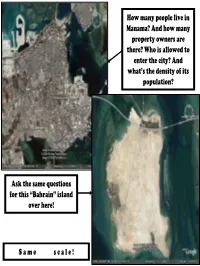
How Many People Live in Manama? and How Many Property Owners Are There? Who Is Allowed to Enter the City? and What’S the Density of Its Population?
How many people live in Manama? And how many property owners are there? Who is allowed to enter the city? And what’s the density of its population? Ask the same questions for this “Bahrain” island over here! S a m e s c a l e ! They call this a private That’s OK. But just be … and did the property (owned by a reminded that it’s twice owner of it member of the ruling family) as big as Sadad village… pay for it?! This is Malkiyya. How many times of Malkiyya’s population can this area accommodate? But sorry… Not for sale! Owned by a ruling family member! Legal?!! What’s this?! It’s the King’s favorite property! It’s the size of Malkiyya, Karzakkan, Sadad and Shahrakkan together! What’s in there? Here you go… That’s right… An island! Look for the yacht… And note the size of it… A golf course… A horse track… … and the main facility Just to the near South of Bilaj Al-Jaza’er A’ALI Shahrakkan & part of Zallaq… The entire area is owned by Al-Khalifa Compare the size and color of the two areas! Southern part of Bahrain. Thinking of going there is trespassing! And hey! What’s that spot?! That’s THAT! Nasser Bin Hamad’s manor! How did he get it?!!! In the middle of nowhere… Rumaitha Palace (Hamad Bin Issa manor “one of them”) UOB F1 “Small” mansion! A little bit a bigger one. Compare the size of it against UOB and F1 track Constitution of Bahrain Article 11 [Natural Resources] All natural wealth and resources are State property. -

Two Deserts Alma Van De Burgwal Architectural Design Department Gerrit Rietveld Academie 2020 I Scooped the Moon Into a Bowl and Gave It Back to the Water
Two Deserts Alma van de Burgwal Architectural Design Department Gerrit Rietveld Academie 2020 I scooped the moon into a bowl and gave it back to the water 1 F. Anton von Schiefner, Tibetan Tales ‘High in the mountains, a family of gibbons was playing in the trees. Derived from Indian Sources, translated from the German by W. R. S. Ralston While they were playing, one of them looked down into a well and saw the (London: Kegan Paul, Trench, Trübner, moon at its bottom. He called all his friends to show them the moon in the well. and Company, 1906), no. 45, p. 353. With great concern the gibbons investigated what was in front of their eyes. An older gibbon ran over, looked into the well and said, “Goodness me! The moon really is in the water!” “The moon is supposed to be in the sky, not inside a well.” thought the gibbons. “The moon must have fallen into the well.” “We need to get the moon out of the well”, they decided. They found a bucket and formed a long chain holding onto each other’s tails to reach down into the well1.’(fig.1) 2 3 Part 1 Mirrage 2 Present in Bahrain between July 2019 At the coastline of North Bahrain lie two islands called ‘Nurana’ (fig.2). and December 2019 for the purpose of an internship. Both of them mainly consist of sand, some dunes and rocks, which get hit by the last rays of sunlight in such a way that a mirage occurs. In my first week in Bahrain2 my colleagues took me there for a night swim. -
Downloaded from Brill.Com09/30/2021 08:34:39PM Via Free Access 484 Bibliography
Bibliography Aghaie, K. S. 2004. The Martyrs of Karbala. Shi‘i Symbols and Rituals in Modern Iran. Seattle: University of Washington Press. Aghaie, K. S. 2005. Introduction: Gendered Aspects of the Emergence and Historical Development of Shi‘i Symbols and Rituals. (In), Aghaie, K. S. (ed.), The Women of Karbala. Austin: University of Texas Press, pp. 1–21. Ali, Z. 1994. Islamic Art in Southeast Asia 830 AD–1570 AD. Kuala Lumpur: Ministry of Education Malaysia. Allan, J. W. 2012. The Art and Architecture of Twelver Shi‘ism: Iraq, Iran and the Indian Sub- Continent. London: Azimuth Editions. Allan, J. W. 2013. Foreword. Anthropology of the Contemporary Middle East and Central Eurasia 1 (2): ix–xiii. Bauden, F. 2011. Inscriptions Arabes d’Éthiopie. Annales Islamologiques 45: 285–306. Belgrave, J. 1973. Welcome to Bahrain (8th edition). London: The Augustan Press. Bent, J. T. 1984 (1890). The Bahrein Islands in the Persian Gulf. Proceedings of the Royal Geographical Society 12: 1–19. Reprinted in, Rice, M. (ed.), Dilmun Discovered. London: Longman, pp. 69–87. Bent, M. V. (Brisch, G. [ed.]). 2010. The Travel Chronicles of Mrs J. Theodore Bent. Volume III: Southern Arabia and Persia. Oxford: Archaeopress. Betteridge, A. H. 1992. Specialists in Miraculous Action: Some Shrines in Shiraz. (In), Morinis, A. (ed.), Sacred Journeys. The Anthropology of Pilgrimage. Westport: Greenwood Press, pp. 189–209. Bibby, G. 1996. Looking for Dilmun. London: Stacey International. Bittar, T. 2003. Pierres et Stucs Épigraphiés. Paris: Réunions des Musées Nationaux. Blair, S. 1998. Islamic Inscriptions. Edinburgh: Edinburgh University Press. Boucharlat, R., and Salles, J-F. -

Cloud Drift Lifts Tylos Plastic Industries Cup Rashid Equestrian and Horseracing Club Hosts Action-Packed, Eight-Race Card with Eight Trophies Won
SATURDAY, FEBRUARY 27, 2021 12 Cloud Drift lifts Tylos Plastic Industries Cup Rashid Equestrian and Horseracing Club hosts action-packed, eight-race card with eight trophies won Jockey Abdulla Faisal• claims hat-trick of victories, including both Tylos Plastic Industries Cups Trainers Allan Smith,• Haider Ebrahim and James Naylor each win two races TDT | Manama loud Drift headlined the winners yesterday at CRashid Equestrian and Horseracing Club (REHC), taking HH Shaikh Isa bin Salman watches the races from the stands HH Shaikh Isa bin Salman with the winners of the final race, during the trophy presentation the eighth and final race to lift the Tylos Plastic Industries Cup. ner of a Tylos Plastic Industries by Hussain Aldailami and sad- The Gunners Racing four- Cup was Duwaliya, who was dled by Paddy Mathers, and year-old, trained by Allan Smith competing in the day’s fourth BETTER Caledonian Crusade in third for and saddled by jockey Abdulla race, held over seven furlongs trainer Jaber Ramadhan while Faisal, won the lion’s share of the with a BD2,000 prize. saddled by John Egan. BD5,000 prize, after complet- Owned by HH Shaikh Hamad KNOW Elsewhere in the meeting yes- ing the eight-furlong event for bin Abdulla bin Isa Al Khalifa terday, each of the five other imported horses in one minute and trained by James Naylor, races offered a Bank of Bahrain 35.713 seconds. Duwaliya won in 1:27.103, giving and Kuwait (BBK) Cup. REHC High Committee chair- jockey Abdulla Faisal another Each of the three In race six, held over a six-fur- man His Highness Shaikh Isa victory. -

The Transnational Indian Community in Manama, Bahrain
City of Strangers: The Transnational Indian Community in Manama, Bahrain Item Type text; Electronic Dissertation Authors Gardner, Andrew M. Publisher The University of Arizona. Rights Copyright © is held by the author. Digital access to this material is made possible by the University Libraries, University of Arizona. Further transmission, reproduction or presentation (such as public display or performance) of protected items is prohibited except with permission of the author. Download date 02/10/2021 14:12:59 Link to Item http://hdl.handle.net/10150/195849 CITY OF STRANGERS: THE TRANSNATIONAL INDIAN COMMUNITY IN MANAMA, BAHRAIN By Andrew Michael Gardner ____________________________ Copyright © Andrew Michael Gardner 2005 A Dissertation Submitted to the Faculty of the DEPARTMENT OF ANTHROPOLOGY In Partial Fulfillment of the Requirements For the Degree of DOCTOR OF PHILOSPHY In the Graduate College THE UNIVERSITY OF ARIZONA 2 0 0 5 2 THE UNIVERSITY OF ARIZONA GRADUATE COLLEGE As members of the Dissertation Committee, we certify that we have read the dissertation prepared by Andrew M. Gardner entitled City of Strangers: The Transnational Indian Community in Manama, Bahrain and recommended that it be accepted as fulfilling the dissertation requirement for the degree of Doctor of Philosophy __________________________________________________ Date: ______________ Linda Green __________________________________________________ Date: ______________ Tim Finan __________________________________________________ Date: ______________ Mark Nichter __________________________________________________ Date: ______________ Michael Bonine Final approval and acceptance of this dissertation is contingent upon the candidate’s submission of the final copies of the dissertation to the Graduate College. I hereby certify that I have read this dissertation prepared under my direction and recommend that it be accepted as fulfilling the dissertation requirement. -
Bahranian Ngos Shadow Report to CEDAW
Bahraini NGOs shadow Report to CEDAW 2014 1 Index Page INTRODUCTION 5 METHODOLOGY 5 Executive Summary 6 PRIORITY ISSUES FOR BAHRAINIAN WOMEN 11 Rights and freedoms 11 1-1 Institutional Violence 11 1-2 Legislation 14 Women and political Participation 15 2-1 Women Political participation 15 2-2 Women and decision making 18 Personal affairs 19 3-1 Family law (Ghafareysection) 20 3-2 Family law 36/2009 (section one) 20 3-2-1 Age of marriage 21 3-2-2 Guardianship 21 3-2-3 Polygamy 22 3-2-4 Maternal house and “obedience house” 22 3-2-5 Divorce/divorce without informing \g the wife 23 3-2-6Arbitrary divorce with no compensation to divorcee 23 Violence 25 4-1 Domestic violence 25 Work 27 5-1 Non implementation of labor law 27 5-2 Discrimination in employment 28 5-3 Women workers in the trade unions 29 2 5-4 Domestic workers 29 5-6 Workers in nurseries 30 5-7 Wife work 31 Trafficking in women 31 Nationality 38 Stereotype gender roles 40 Reservations 42 Implementation and dissemination of CEDAW 43 REFERENCES 44 ANNEXES Page Annex one: Women testimonies on institutional violence Fatima Abou Edris Naziha Saeed Aqila El Maqabi Annex two: list of fired female workers 53 – 70 Annex three: Report of the Migrant Workers Protection Association 71 - 75 Annex four: Statistics on Protection from human trafficking (Arabs) 76 - 77 Annex five: Statistics on Protection from human trafficking (foreigners) 78 -85 3 Tables Page Table 1 Number and 5 of women candidates/elected to the Council of Representatives and local councils 17 (2002 -2006 – 2010, 2011 complementary -
Development Mosque
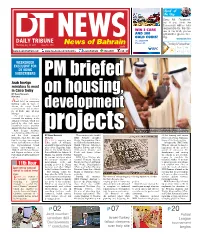
Sorry Mr. President, but if you think the Democrats will be held responsible for the fail- WIN 3 CARS ure of the ACA, you’ve AND 300 got another guess com- GOLD COINS! ing. @SenSanders Tel: 17228888 bfc.com.bh Thursday, July 27, 2017 Issue No. 7455 Today’s Weather 200 Fils Max Min www.newsofbahrain.com www.facebook.com/nobonline newsofbahrain 38444680 nob_bh 43 °C 31°C WEEKENDER JO3307_BFC_BAH_BOB_Centenary_Bonanza_Campaign_ad_67x40mm.indd25/05/2017 15:45 1 EXCLUSIVE FOR DT NEWS SUBSCRIBERS PM briefed Arab foreign ministers to meet in Cairo today DT News Network Manama on housing, rab foreign ministers will hold an emergency meetingA today in Cairo to discuss the recent Israeli encroachments and measures in Al-Quds and Al-Aqsa development Mosque. The Arab League Council convened the meeting, at the demand of Jordan, which was backed by other Arab states. Incumbent session president Algeria will chair the meeting Prime Minister HRH Prince Khalifa bin Salman Al Khalifa Arab League Assistant being briefed by ministers at Gudaibiya Palace yesterday Secretary-General for Palestine and the Arab occupied projectsDT News Network The ministers who briefed of the housing and service territories Said Abu Ali said Manama HRH Premier included projects in Duraz, Jannusan, that the meeting comes as part n a bid to urgently meet Works, Municipalities Affairs Sitra and the Northern City. of pan-Arab efforts to confront the needs of villagers, and Urban Planning Minister, Subsequently, HRH Prime the unprecedented Israeli especiallyI in the northwestern Health Minister, Education Minister stressed the need to blatant encroachments at parts of the Kingdom, Prime Minister, Labour and Social implement all the projects Al-Quds and Al-Aqsa Mosque Minister His Royal Highness Development Minister and aimed at enhancing the and flagrant violation of the Prince Khalifa bin Salman Al Youth and Sports Affairs development and serving Palestinian people’s inalienable Khalifa was briefed yesterday Minister. -

Americans for Democracy & Human Rights in Bahrain (ADHRB)
Americans for Democracy & Human Rights in Bahrain (ADHRB) and Bahrain Center Cultural Society (BCCS) For consideration at the 27th session of the UN working group in April-May 2017 22 September 2016 1. ADHRB is a non-profit organization that fosters awareness of and support for democracy and human rights in Bahrain and the Middle East. 2. ADHRB’s reporting is based primarily on its United Nations (UN) complaint program, by which it works directly with victims of human rights violations, their family members or their lawyers on the ground in the region to document evidence of abuses and submit this evidence to the UN Special Procedures. ADHRB has repeatedly requested permission to formally visit Bahrain in order to consult with government officials, national human rights mechanisms, and our independent civil society partners on the ground, regarding issues relating to the UPR process, but has been so far denied access. As yet, the Government of Bahrain has declined to cooperate with ADHRB on any level. 3. BCCS is Bahraini cultural center and advocacy organization based in Berlin, Germany. 4. ADHRB and BCCS welcome the opportunity to contribute to the third cycle of the Universal Periodic Review (UPR) of Bahrain. This submission focuses on Bahrain’s compliance with its second-cycle recommendations to take measures to meet the aspirations of victims of discrimination and protect ethnic and religious groups from abuse. Introduction 5. In its second UPR cycle, the Government of Bahrain fully supported recommendations 115.70 (Belgium) and 115.93 (Canada) concerning efforts to meet the aspirations of the victims of discrimination and the protection of ethnic and religious communities. -
Bogdan SZAJKOWSKI*
Alternative Politics, Vol.3, No.3, 256-419, November 2011 256 TIMELINE OF THE ARAB REVOLT: DECEMBER 2010 – JUNE 2011 Bogdan SZAJKOWSKI* December 17, 2010 Tunisia - Mohamed Bouazizi, a 26-year-old unemployed, sets fire to himself in the central Tunisian town of Sidi Bouzid, protesting at the confiscation by police of his fruit and vegetable cart. He suffers third-degree burns across his entire body and is subsequently treated in the Traumatology Centre for Severe Burns in the town of Ben Arous. His self-immolation sparks demonstrations in which protesters burned tyres and chanted slogans demanding jobs. Protests soon spread to other parts of the country including the towns of al-Ragab and Maknasi in central Tunisia, and later the capital, Tunis. Videos of the Sidi Bouzid demonstrations are online soon after the protest began and the Twitter website carries extensive commentary of the protests. December 19, 2010 Tunisia - Protests spread to Kairouan (holy city located in north-central Tunisia), Sfax (city 270 km southeast of Tunis), and Ben Guerdane (town in south-eastern Tunisia, close to the border with Libya). December 20, 2010 Tunisia - Mohamed Al Nouri Al Juwayni, the Tunisian development minister, travels to Sidi Bouzid to announce a new $10m employment programme. But protests continue unabated. December 21, 2010 Tunisia - President Ben Ali carries out limited cabinet reshuffle and warns that protesters would be punished if rioting continued in the country. December 22, 2010 Tunisia - Lahseen Naji, a 22-year-old commits suicide in the midst of another demonstration over unemployment in Sidi Bouzid by climbing an electricity pylon and electrocuting himself on the cables, after shouting out ―No to misery, no to unemployment!‖ 257 Bogdan Szajkowski Ramzi Al-Abboudi, under the burden of business debt, ironically made possible by the country‘s micro-credit solidarity programme, commits suicide. -

The Kingdom of Bahrain's First Voluntary National Review (2018)
10 July 2018 English translation of the VNR report COVER PAGE The Kingdom of Bahrain’s First Voluntary National Review (2018) on the implementation of the 2030 Agenda for Sustainable Development and the Sustainable Development Goals 1 10 July 2018 Main Messages Bahrain's development process, which dates back decades, was accelerated with the launch of the comprehensive development and reform process by the King of Bahrain, His Majesty King Hamad bin Isa Al Khalifa. It was further cemented with Bahrain’s Economic Vision 2030, which has strengthened sustainability and reinforced competitiveness and justice, with the aim of doubling real household income by 2030. Under the leadership of the Prime Minister, His Royal Highness Prince Khalifa bin Salman Al Khalifa, and with the support of the Crown Prince and Deputy Supreme Commander and First Deputy Prime Minister, His Royal Highness Prince Salman bin Hamad Al Khalifa, there has been strong focus by the government towards economic, human, structural, and civil development, which enabled Bahrain to meet the Millennium Development Goals and laid down strong foundations for sustainable development. Achievements: 0% of Bahrainis live below the poverty line. The average annual economic growth in the last decade was 37.4%, and in 2017 the average per capita GDP was approximately US $22,000. Expenditure on health services, education and social protection exceeds 35% of total government expenditure. Basic education is free and compulsory. The net enrollment ratio for primary and secondary levels is 100% and 86.4% respectively, consequently eliminating illiteracy; while enrollment in kindergartens is 82%. The population receives free healthcare with free medical prescriptions. -

A Primitive System of Communication Adopted from the Late Indus World?
Arab. arch. epig. 2016: 27: 2–18 (2016) Printed in Singapore. All rights reserved Symbols of Dilmun’s royal house – a primitive system of communication adopted from the late Indus world? This article presents evidence of a system of symbolic markings, which devel- Steffen Terp Laursen oped in Dilmun between c.1950 and 1500 BC. The symbols predominantly Moesgaard Museum, Oriental appear on pottery, tokens and seals and may originally have been inspired by department, Højbjerg, Jylland, similar systems in the post-Indus script period of the Harappan culture. There Denmark was a development over time from single symbols on pottery and tokens to more complex sequences on seals that ultimately formed irregular logograms. The sys- tem was developed as a means of communication in an illiterate society. Based on the shape of the symbols and related evidence it is argued that they all repre- sent variations on the theme of palm branches, palm trees and altars and that they are connected to the cult of Inzak. From the contexts in which the symbols appear it is demonstrated that the symbols were exclusive to Dilmun’s royal house and temple institutions. e-mail: farkstl@hum.au.dk Introduction of ‘weights on the Dilmun standard’ (Bibby 1971; Roaf The Dilmun State emerged at the very end of the third 1982) and by the discovery of Indus cubical stone millennium BC, a time when major polities across Mid- weights in Bahrain (Højlund 1994a). Concurrently, Dil- dle Asia were on the threshold of a horizon dramatically mun also adopted a stamp seal and sealing technology dubbed the ‘Eclipse of the East’, after a number of sys- from the administrative toolkit of the Indus urban temic collapses and processes of societal disintegrations bureaucracy (Laursen 2010, forthcoming).