Teaching About Indian Culture Through Its Epic Literature:" The
Total Page:16
File Type:pdf, Size:1020Kb
Load more
Recommended publications
-
The Mahabharata
^«/4 •m ^1 m^m^ The original of tiiis book is in tine Cornell University Library. There are no known copyright restrictions in the United States on the use of the text. http://www.archive.org/details/cu31924071123131 ) THE MAHABHARATA OF KlUSHNA-DWAIPAYANA VTASA TRANSLATED INTO ENGLISH PROSE. Published and distributed, chiefly gratis, BY PROTSP CHANDRA EOY. BHISHMA PARVA. CALCUTTA i BHiRATA PRESS. No, 1, Raja Gooroo Dass' Stbeet, Beadon Square, 1887. ( The righi of trmsMm is resem^. NOTICE. Having completed the Udyoga Parva I enter the Bhishma. The preparations being completed, the battle must begin. But how dan- gerous is the prospect ahead ? How many of those that were counted on the eve of the terrible conflict lived to see the overthrow of the great Knru captain ? To a KsJtatriya warrior, however, the fiercest in- cidents of battle, instead of being appalling, served only as tests of bravery that opened Heaven's gates to him. It was this belief that supported the most insignificant of combatants fighting on foot when they rushed against Bhishma, presenting their breasts to the celestial weapons shot by him, like insects rushing on a blazing fire. I am not a Kshatriya. The prespect of battle, therefore, cannot be unappalling or welcome to me. On the other hand, I frankly own that it is appall- ing. If I receive support, that support may encourage me. I am no Garuda that I would spurn the strength of number* when battling against difficulties. I am no Arjuna conscious of superhuman energy and aided by Kecava himself so that I may eHcounter any odds. -
Introduction to BI-Tagavad-Gita
TEAcI-tER'S GuidE TO INTROduCTioN TO BI-tAGAVAd-GiTA (DAModAR CLASS) INTROduCTioN TO BHAqAVAd-qiTA Compiled by: Tapasvini devi dasi Hare Krishna Sunday School Program is sponsored by: ISKCON Foundation Contents Chapter Page Introduction 1 1. History ofthe Kuru Dynasty 3 2. Birth ofthe Pandavas 10 3. The Pandavas Move to Hastinapura 16 4. Indraprastha 22 5. Life in Exile 29 6. Preparing for Battle 34 7. Quiz 41 Crossword Puzzle Answer Key 45 Worksheets 46 9ntroduction "Introduction to Bhagavad Gita" is a session that deals with the history ofthe Pandavas. It is not meant to be a study ofthe Mahabharat. That could be studied for an entire year or more. This booklet is limited to the important events which led up to the battle ofKurlLkshetra. We speak often in our classes ofKrishna and the Bhagavad Gita and the Battle ofKurukshetra. But for the new student, or student llnfamiliar with the history ofthe Pandavas, these topics don't have much significance ifthey fail to understand the reasons behind the Bhagavad Gita being spoken (on a battlefield, yet!). This session will provide the background needed for children to go on to explore the teachulgs ofBhagavad Gita. You may have a classroonl filled with childrel1 who know these events well. Or you may have a class who has never heard ofthe Pandavas. You will likely have some ofeach. The way you teach your class should be determined from what the children already know. Students familiar with Mahabharat can absorb many more details and adventures. Young children and children new to the subject should learn the basics well. -
The Mahabharata of Krishna-Dwaipayana Vyasa SALYA
The Mahabharata of Krishna-Dwaipayana Vyasa SALYA PARVA translated by Kesari Mohan Ganguli In parentheses Publications Sanskrit Series Cambridge, Ontario 2002 Salya Parva Section I Om! Having bowed down unto Narayana and Nara, the most exalted of male beings, and the goddess Saraswati, must the word Jaya be uttered. Janamejaya said, “After Karna had thus been slain in battle by Savyasachin, what did the small (unslaughtered) remnant of the Kauravas do, O regenerate one? Beholding the army of the Pandavas swelling with might and energy, what behaviour did the Kuru prince Suyodhana adopt towards the Pandavas, thinking it suitable to the hour? I desire to hear all this. Tell me, O foremost of regenerate ones, I am never satiated with listening to the grand feats of my ancestors.” Vaisampayana said, “After the fall of Karna, O king, Dhritarashtra’s son Suyodhana was plunged deep into an ocean of grief and saw despair on every side. Indulging in incessant lamentations, saying, ‘Alas, oh Karna! Alas, oh Karna!’ he proceeded with great difficulty to his camp, accompanied by the unslaughtered remnant of the kings on his side. Thinking of the slaughter of the Suta’s son, he could not obtain peace of mind, though comforted by those kings with excellent reasons inculcated by the scriptures. Regarding destiny and necessity to be all- powerful, the Kuru king firmly resolved on battle. Having duly made Salya the generalissimo of his forces, that bull among kings, O monarch, proceeded for battle, accompanied by that unslaughtered remnant of his forces. Then, O chief of Bharata’s race, a terrible battle took place between the troops of the Kurus and those of the Pandavas, resembling that between the gods and the Asuras. -

Mahabharata Tatparnirnaya
Mahabharatha Tatparya Nirnaya Chapter XIX The episodes of Lakshagriha, Bhimasena's marriage with Hidimba, Killing Bakasura, Draupadi svayamwara, Pandavas settling down in Indraprastha are described in this chapter. The details of these episodes are well-known. Therefore the special points of religious and moral conduct highlights in Tatparya Nirnaya and its commentaries will be briefly stated here. Kanika's wrong advice to Duryodhana This chapter starts with instructions of Kanika an expert in the evil policies of politics to Duryodhana. This Kanika was also known as Kalinga. Probably he hailed from Kalinga region. He was a person if Bharadvaja gotra and an adviser to Shatrujna the king of Sauvira. He told Duryodhana that when the close relatives like brothers, parents, teachers, and friends are our enemies, we should talk sweet outwardly and plan for destroying them. Heretics, robbers, theives and poor persons should be employed to kill them by poison. Outwardly we should pretend to be religiously.Rituals, sacrifices etc should be performed. Taking people into confidence by these means we should hit our enemy when the time is ripe. In this way Kanika secretly advised Duryodhana to plan against Pandavas. Duryodhana approached his father Dhritarashtra and appealed to him to send out Pandavas to some other place. Initially Dhritarashtra said Pandavas are also my sons, they are well behaved, brave, they will add to the wealth and the reputation of our kingdom, and therefore, it is not proper to send them out. However, Duryodhana insisted that they should be sent out. He said he has mastered one hundred and thirty powerful hymns that will protect him from the enemies. -

South-Indian Images of Gods and Goddesses
ASIA II MB- • ! 00/ CORNELL UNIVERSITY* LIBRARY Date Due >Sf{JviVre > -&h—2 RftPP )9 -Af v^r- tjy J A j£ **'lr *7 i !! in ^_ fc-£r Pg&diJBii'* Cornell University Library NB 1001.K92 South-indian images of gods and goddesse 3 1924 022 943 447 AGENTS FOR THE SALE OF MADRAS GOVERNMENT PUBLICATIONS. IN INDIA. A. G. Barraud & Co. (Late A. J. Combridge & Co.)> Madras. R. Cambrav & Co., Calcutta. E. M. Gopalakrishna Kone, Pudumantapam, Madura. Higginbothams (Ltd.), Mount Road, Madras. V. Kalyanarama Iyer & Co., Esplanade, Madras. G. C. Loganatham Brothers, Madras. S. Murthv & Co., Madras. G. A. Natesan & Co., Madras. The Superintendent, Nazair Kanun Hind Press, Allahabad. P. R. Rama Iyer & Co., Madras. D. B. Taraporevala Sons & Co., Bombay. Thacker & Co. (Ltd.), Bombay. Thacker, Spink & Co., Calcutta. S. Vas & Co., Madras. S.P.C.K. Press, Madras. IN THE UNITED KINGDOM. B. H. Blackwell, 50 and 51, Broad Street, Oxford. Constable & Co., 10, Orange Street, Leicester Square, London, W.C. Deighton, Bell & Co. (Ltd.), Cambridge. \ T. Fisher Unwin (Ltd.), j, Adelphi Terrace, London, W.C. Grindlay & Co., 54, Parliament Street, London, S.W. Kegan Paul, Trench, Trubner & Co. (Ltd.), 68—74, iCarter Lane, London, E.C. and 25, Museum Street, London, W.C. Henry S. King & Co., 65, Cornhill, London, E.C. X P. S. King & Son, 2 and 4, Great Smith Street, Westminster, London, S.W.- Luzac & Co., 46, Great Russell Street, London, W.C. B. Quaritch, 11, Grafton Street, New Bond Street, London, W. W. Thacker & Co.^f*Cre<d Lane, London, E.O? *' Oliver and Boyd, Tweeddale Court, Edinburgh. -
A Comprehensive Guide by Jack Watts and Conner Reynolds Texts
A Comprehensive Guide By Jack Watts and Conner Reynolds Texts: Mahabharata ● Written by Vyasa ● Its plot centers on the power struggle between the Kaurava and Pandava princes. They fight the Kurukshetra War for the throne of Hastinapura, the kingdom ruled by the Kuru clan. ● As per legend, Vyasa dictates it to Ganesha, who writes it down ● Divided into 18 parvas and 100 subparvas ● The Mahabharata is told in the form of a frame tale. Janamejaya, an ancestor of the Pandavas, is told the tale of his ancestors while he is performing a snake sacrifice ● The Genealogy of the Kuru clan ○ King Shantanu is an ancestor of Kuru and is the first king mentioned ○ He marries the goddess Ganga and has the son Bhishma ○ He then wishes to marry Satyavati, the daughter of a fisherman ○ However, Satyavati’s father will only let her marry Shantanu on one condition: Shantanu must promise that any sons of Satyavati will rule Hastinapura ○ To help his father be able to marry Satyavati, Bhishma renounces his claim to the throne and takes a vow of celibacy ○ Satyavati had married Parashara and had a son with him, Vyasa ○ Now she marries Shantanu and has another two sons, Chitrangada and Vichitravirya ○ Shantanu dies, and Chitrangada becomes king ○ Chitrangada lives a short and uneventful life, and then dies, making Vichitravirya king ○ The King of Kasi puts his three daughters up for marriage (A swayamvara), but he does not invite Vichitravirya as a possible suitor ○ Bhishma, to arrange a marriage for Vichitravirya, abducts the three daughters of Kasi: Amba, -

Vidura Speaks: a Study of the Viduranīti and Its Reception History
Vidura Speaks: A Study of the Viduranīti and its Reception History Sravani Kanamarlapudi A thesis submitted in partial fulfillment of the requirements for the degree of Master of Arts University of Washington 2019 Committee: Richard Salomon Heidi Pauwels Program Authorized to Offer Degree: Asian Languages and Literature ©Copyright 2019 Sravani Kanamarlapudi University of Washington Abstract Vidura Speaks: A Study of the Viduranīti and its Reception History Sravani Kanamarlapudi Chair of the Supervisory Committee: Richard Salomon Department of Asian Languages and Literature This thesis offers a close reading of an important yet neglected didactic text from the Indian epic Mahābhārata, namely the Viduranīti, which is a nocturnal politico-moral counsel of Vidura to Dhr̥ tarāṣṭra. Adopting the currently prevalent trend in Mahābhārata scholarship, the received epic is approached as a work of literature by treating its didactic segments as constitutive parts of the unfolding narrative, rather than simply viewing the received epic as an outcome of later didactic accretions on a supposed earlier core narrative. As such, the Viduranīti is juxtaposed thematically with the epic’s story, particularly with the epic’s portrayal of Vidura, and structurally with other didactic portions of the epic and the entire epic as a whole. The former analysis reveals that both Vidura and the Viduranīti are centered around the categories of dharma and artha, while the latter exposes similarities in the literary architectonics of the Viduranīti and other didactic tracts. Finally, a case study investigates why the Viduranīti was canonized in a modern Hindu community. Situating this textual reframing in the modern socio-historical context, I argue for the need to focus on reception histories of early South Asian texts. -
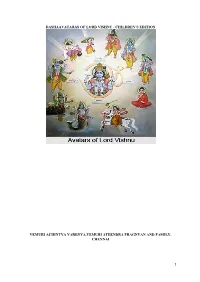
1 Dashaavataras of Lord Vishnu
DASHAAVATARAS OF LORD VISHNU - CHILDREN’S EDITION VEMURI ACHINTYA VARENYA,VEMURI ATEENDRA PRAGNYAN AND FAMILY, CHENNAI 1 FOREWORD Om EkadantayaVidmahiVakratundayaDhimahi, TannoDantiPrachodayaa Om NarayanayaVidmahiVaasudevaayaDhimahiTanno Vishnu Prachodayaa This book contains the story of all forms of Lord Vishnu respectively known as Dashaavataras, who came to save the universe from destruction. This book of Dashaavataras is written in basic English for children to understand easily. We are the students of Sri Sankara High School Adyar Branch of Chennai as the Children of Shri Vemuri Harihar Kumar and Smt. Shalini Vemuri. May we have the privilege to dedicate to His Highness of Kanchi Mutt. Ashtadapati 1-Dasha AvataaraKiirtiDhavalam This is the first part of the famous JayadevaAshtapadi which describes the dashaavataras of Vishnu in a poetic format. pralayapayodhijaledhṛtavānasivedam।vihitavahitracaritramakhedam॥ keśavādhṛtamīnaśarīrajayajagadīśahare॥a pa 1-1 O Kesava (name of Vishnu) who donned the body of a fish to save the Vedas (and the world) from the delge of the ocean (pralaya) just like a ship that saves (its passengers) from (the dangers of) the ocean. Hail to you, O lord of the Universe. kṣitirativipulataretavatiṣṭhatipṛṣṭhe।dharaṇidharaṇakiṇacakragariṣṭhe keśavadhṛtakacchaparūpajayajagadīśahare॥a pa 1-2 O Kesava, again you took the body of a tortoise to bear the weight of the mountain (Mount Mandara) on your back to save from destruction (so that ocean could be churned to get the wonders to Gods and Demons). Hail to you, O lord of the Universe. vasatidaśanaśikharedharaṇītavalagnā।śaśinikalaṅkakalevanimagnā॥ keśavadhṛtasūkararūpajayajagadīśahare॥a pa 1-3 O Kesava,You took the form of a boar (Varaha) to lift the earth from the ocean by placing the earth on your mighty tusks which showed like a moon with a blemish. -

The Hobbit Films TANJA VÄLISALO…………………………………………………………………………… 12
NORDIC JOURNAL OF SCIENCE FICTION AND FANTASY RESEARCH Volume 4, issue 3–4, 2017 journal.finfar.org The Finnish Society for Science Fiction and Fantasy Research Suomen science fiction- ja fantasiatutkimuksen seura ry Submission Guidelines Fafnir is a Gold Open Access international peer-reviewed journal. Send submissions to our editors in chief at submissions@finfar.org. Book reviews, dissertation reviews, and related queries should be sent to reviews@finfar.org. We publish academic work on science-fiction and fantasy (SFF) literature, audiovisual art, games, and fan culture. Interdisciplinary perspectives are encouraged. In addition to peer- reviewed academic articles, Fafnir invites texts ranging from short overviews, essays, interviews, conference reports, and opinion pieces as well as academic reviews for books and dissertations on any suitable SFF subject. Our journal provides an international forum for scholarly discussions on science fiction and fantasy, including current debates within the field. Open-Access Policy All content for Fafnir is immediately available through open access, and we endorse the definition of open access laid out in Bethesda Meeting on Open Access Publishing. Our content is licensed under Creative Commons Attribution-Non Commercial 3.0 Unported License. All reprint requests can be sent to the editors at Fafnir, which retains copyright. Editorial Staff Editors in Chief Bodhisattva Chattopadhyay Aino-Kaisa Koistinen Jyrki Korpua Managing Editor Jaana Hakala Advisory Board Merja Polvinen, University of Helsinki, Chair Sari Polvinen, University of Helsinki Paula Arvas, University of Helsinki Liisa Rantalaiho, University of Tampere Stefan Ekman, University of Gothenburg Adam Roberts, Royal Holloway, U. London Ingvil Hellstrand, University of Stavanger Hanna-Riikka Roine, U. -
Rajaji-Mahabharata.Pdf
MAHABHARATA retold by C. Rajagopalachari (Edited by Jay Mazo, International Gita Society) Contents 39. The Wicked Are Never Satisfied 1. Ganapati, the Scribe 40. Duryodhana Disgraced 2. Devavrata 41. Sri Krishna's Hunger 3. Bhishma's Vow 42. The Enchanted Pool 4. Amba And Bhishma 43. Domestic Service 5. Devayani And Kacha 44. Virtue Vindicated 6. The Marriage Of Devayani 45. Matsya Defended 7. Yayati 46. Prince Uttara 8. Vidura 47. Promise Fulfilled 9. Kunti Devi 48. Virata's Delusion 10. Death Of Pandu 49. Taking Counsel 11. Bhima 50. Arjuna's Charioteer 12. Karna 51. Salya Against His Nephews 13. Drona 52. Vritra 14. The Wax Palace 53. Nahusha 15. The Escape Of The Pandavas 54. Sanjaya's Mission 16. The Slaying Of Bakasura 55. Not a Needle-Point Of Territory 17. Draupadi's Swayamvaram 56. Krishna's Mission 18. Indraprastha 57. Attachment and Duty 19. The Saranga Birds 58. The Pandava Generalissimo 20. Jarasandha 59. Balarama 21. The Slaying Of Jarasandha 60. Rukmini 22. The First Honor 61. Non-Cooperation 23. Sakuni Comes In 62. Krishna Teaches 24. The Invitation 63. Yudhishthira Seeks Benediction 25. The Wager 64. The First Day's Battle 26. Draupadi's Grief 65. The Second Day 27. Dhritarashtra's Anxiety 66. The Third Day's Battle 28. Krishna's Vow 67. The Fourth Day 29. Pasupata 68. The Fifth Day 30. Affliction Is Nothing New 69. The Sixth Day 31. Agastya 70. The Seventh Day 32. Rishyasringa 71. The Eighth Day 33. Fruitless Penance 72. The Ninth Day 34. Yavakrida's End 73. -

Editors Seek the Blessings of Mahasaraswathi
OM GAM GANAPATHAYE NAMAH I MAHASARASWATHYAI NAMAH Editors seek the blessings of MahaSaraswathi Kamala Shankar (Editor-in-Chief) Laxmikant Joshi Chitra Padmanabhan Madhu Ramesh Padma Chari Arjun I Shankar Srikali Varanasi Haranath Gnana Varsha Narasimhan II Thanks to the Authors Adarsh Ravikumar Omsri Bharat Akshay Ravikumar Prerana Gundu Ashwin Mohan Priyanka Saha Anand Kanakam Pranav Raja Arvind Chari Pratap Prasad Aravind Rajagopalan Pavan Kumar Jonnalagadda Ashneel K Reddy Rohit Ramachandran Chandrashekhar Suresh Rohan Jonnalagadda Divya Lambah Samika S Kikkeri Divya Santhanam Shreesha Suresha Dr. Dharwar Achar Srinivasan Venkatachari Girish Kowligi Srinivas Pyda Gokul Kowligi Sahana Kribakaran Gopi Krishna Sruti Bharat Guruganesh Kotta Sumedh Goutam Vedanthi Harsha Koneru Srinath Nandakumar Hamsa Ramesha Sanjana Srinivas HCCC Y&E Balajyothi class S Srinivasan Kapil Gururangan Saurabh Karmarkar Karthik Gururangan Sneha Koneru Komal Sharma Sadhika Malladi Katyayini Satya Srivishnu Goutam Vedanthi Kaushik Amancherla Saransh Gupta Medha Raman Varsha Narasimhan Mahadeva Iyer Vaishnavi Jonnalagadda M L Swamy Vyleen Maheshwari Reddy Mahith Amancherla Varun Mahadevan Nikky Cherukuthota Vaishnavi Kashyap Narasimham Garudadri III Contents Forword VI Preface VIII Chairman’s Message X President’s Message XI Significance of Maha Kumbhabhishekam XII Acharya Bharadwaja 1 Acharya Kapil 3 Adi Shankara 6 Aryabhatta 9 Bhadrachala Ramadas 11 Bhaskaracharya 13 Bheeshma 15 Brahmagupta Bhillamalacarya 17 Chanakya 19 Charaka 21 Dhruva 25 Draupadi 27 Gargi -
KRISHNA Pastimes of Krishna in Vrindavana
Vrajanandana KRISHNA Pastimes of Krishna in Vrindavana Based on KRISHNA - The Supreme Personality of Godhead by His Divine Grace A.C. Bhaktivedanta Swami Prabhupada Founder-Acharya of ISKCON Adapted for children by Yaduraja Dasa Sankirtana Seva Trust Hare Krishna Hill, Chord Road, Bangalore-10 A book in English Vrajananda Krishna - Pastimes of Krishna in Vrindavana Based on: KRISHNA - The Supreme Personality of Godhead by His Divine Grace A.C. Bhaktivedanta Swami Prabhupada Founder-Acharya of ISKCON Adapted for children by Sri Yaduraja Dasa Published by Sankirtana Seva Trust, Hare Krishna Hill, Chord Road, Bangalore-10 Printed at Brilliant Printers Pvt. Ltd. Lottegollahalli, Bangalore [Total no. of Pages : 144, Size : 1/8 Crown] © 2014, Sankirtan Seva Trust All Rights Reserved ISBN : 81-8239-020-6 First Printing 2007 : 5000 Copies Second Printing 2010 (Revised) : 5000 Copies Third Printing 2011 (Revised) : 5000 Copies Fourth Printing 2014 : 1000 Copies Fifth Printing 2015 : 1000 Copies Readers interested in the subject matter of this book are invited by the International Society for Krishna Consciousness to correspond with its Secretary at the following address: International Society for Krishna Consciousness (ISKCON) Hare Krishna Hill, Chord Road, Rajajinagar, Bangalore - 560 010. Tel: 080-23471956 Mobile: 9341211119 Email: radha.krishna@hkm-group.org Website: www.iskconbangalore.org Contents Introduction ......................................................................... 5 Prologue: The Tears of Mother Earth ................................ 6 1. The Curse .................................................................... 7 2. A Visit from Narada Muni .......................................... 11 3. The Divine Plan Unfolds ........................................... 13 4. The Birth of Lord Krishna ......................................... 16 5. Goddess Durga .......................................................... 20 6. Kamsa’s Change of Heart......................................... 24 7. The Meeting of Nanda Maharaja and Vasudeva ...