1 the Association for Diplomatic Studies and Training Foreign Affairs
Total Page:16
File Type:pdf, Size:1020Kb
Load more
Recommended publications
-

Carol Migdalovitz Specialist in Middle Eastern Affairs Foreign Affairs, Trade, and Defense Division
Order Code RS21855 Updated October 16, 2007 Greece Update Carol Migdalovitz Specialist in Middle Eastern Affairs Foreign Affairs, Trade, and Defense Division Summary The conservative New Democracy party won reelection in September 2007. Kostas Karamanlis, its leader, remained prime minister and pledged to continue free-market economic reforms to enhance growth and create jobs. The government’s foreign policy focuses on the European Union (EU), relations with Turkey, reunifying Cyprus, resolving a dispute with Macedonia over its name, other Balkan issues, and relations with the United States. Greece has assisted with the war on terrorism, but is not a member of the coalition in Iraq. This report will be updated if developments warrant. See also CRS Report RL33497, Cyprus: Status of U.N. Negotiations and Related Issues, by Carol Migdalovitz. Government and Politics Prime Minister Kostas Karamanlis called for early parliamentary elections to be held on September 16, 2007, instead of in March 2008 as otherwise scheduled, believing that his government’s economic record would ensure easy reelection. In August, however, Greece experienced severe and widespread wildfires, resulting in 76 deaths and 270,000 hectares burned. The government attempted to deflect attention from what was widely viewed as its ineffective performance in combating the fires by blaming the catastrophe on terrorists, without proof, and by providing generous compensation for victims. This crisis came on top of a scandal over the state pension fund’s purchase of government bonds at inflated prices. Under these circumstances, Karamanlis’s New Democracy party’s (ND) ability to win of a slim majority of 152 seats in the unicameral 300-seat parliament and four more years in office was viewed as a victory. -
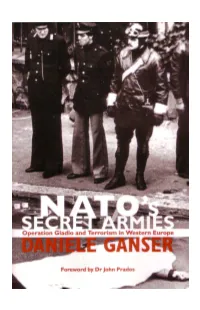
0714685003.Pdf
CONTENTS Foreword xi Acknowledgements xiv Acronyms xviii Introduction 1 1 A terrorist attack in Italy 3 2 A scandal shocks Western Europe 15 3 The silence of NATO, CIA and MI6 25 4 The secret war in Great Britain 38 5 The secret war in the United States 51 6 The secret war in Italy 63 7 The secret war in France 84 8 The secret war in Spain 103 9 The secret war in Portugal 114 10 The secret war in Belgium 125 11 The secret war in the Netherlands 148 12 The secret war in Luxemburg 165 ix 13 The secret war in Denmark 168 14 The secret war in Norway 176 15 The secret war in Germany 189 16 The secret war in Greece 212 17 The secret war in Turkey 224 Conclusion 245 Chronology 250 Notes 259 Select bibliography 301 Index 303 x FOREWORD At the height of the Cold War there was effectively a front line in Europe. Winston Churchill once called it the Iron Curtain and said it ran from Szczecin on the Baltic Sea to Trieste on the Adriatic Sea. Both sides deployed military power along this line in the expectation of a major combat. The Western European powers created the North Atlantic Treaty Organization (NATO) precisely to fight that expected war but the strength they could marshal remained limited. The Soviet Union, and after the mid-1950s the Soviet Bloc, consistently had greater numbers of troops, tanks, planes, guns, and other equipment. This is not the place to pull apart analyses of the military balance, to dissect issues of quantitative versus qualitative, or rigid versus flexible tactics. -

The Gordian Knot: American and British Policy Concerning the Cyprus Issue: 1952-1974
THE GORDIAN KNOT: AMERICAN AND BRITISH POLICY CONCERNING THE CYPRUS ISSUE: 1952-1974 Michael M. Carver A Thesis Submitted to the Graduate College of Bowling Green State University in partial fulfillment of The requirements for the degree of MASTER OF ARTS May 2006 Committee: Dr. Douglas J. Forsyth, Advisor Dr. Gary R. Hess ii ABSTRACT Douglas J. Forsyth, Advisor This study examines the role of both the United States and Great Britain during a series of crises that plagued Cyprus from the mid 1950s until the 1974 invasion by Turkey that led to the takeover of approximately one-third of the island and its partition. Initially an ancient Greek colony, Cyprus was conquered by the Ottoman Empire in the late 16th century, which allowed the native peoples to take part in the island’s governance. But the idea of Cyprus’ reunification with the Greek mainland, known as enosis, remained a significant tenet to most Greek-Cypriots. The movement to make enosis a reality gained strength following the island’s occupation in 1878 by Great Britain. Cyprus was integrated into the British imperialist agenda until the end of the Second World War when American and Soviet hegemony supplanted European colonialism. Beginning in 1955, Cyprus became a battleground between British officials and terrorists of the pro-enosis EOKA group until 1959 when the independence of Cyprus was negotiated between Britain and the governments of Greece and Turkey. The United States remained largely absent during this period, but during the 1960s and 1970s came to play an increasingly assertive role whenever intercommunal fighting between the Greek and Turkish-Cypriot populations threatened to spill over into Greece and Turkey, and endanger the southeastern flank of NATO. -

Russia's Hostile Measures in Europe
Russia’s Hostile Measures in Europe Understanding the Threat Raphael S. Cohen, Andrew Radin C O R P O R A T I O N For more information on this publication, visit www.rand.org/t/RR1793 Library of Congress Cataloging-in-Publication Data is available for this publication. ISBN: 978-1-9774-0077-2 Published by the RAND Corporation, Santa Monica, Calif. © Copyright 2019 RAND Corporation R® is a registered trademark. Limited Print and Electronic Distribution Rights This document and trademark(s) contained herein are protected by law. This representation of RAND intellectual property is provided for noncommercial use only. Unauthorized posting of this publication online is prohibited. Permission is given to duplicate this document for personal use only, as long as it is unaltered and complete. Permission is required from RAND to reproduce, or reuse in another form, any of its research documents for commercial use. For information on reprint and linking permissions, please visit www.rand.org/pubs/permissions. The RAND Corporation is a research organization that develops solutions to public policy challenges to help make communities throughout the world safer and more secure, healthier and more prosperous. RAND is nonprofit, nonpartisan, and committed to the public interest. RAND’s publications do not necessarily reflect the opinions of its research clients and sponsors. Support RAND Make a tax-deductible charitable contribution at www.rand.org/giving/contribute www.rand.org Preface This report is the collaborative and equal effort of the coauthors, who are listed in alphabetical order. The report documents research and analysis conducted through 2017 as part of a project entitled Russia, European Security, and “Measures Short of War,” sponsored by the Office of the Deputy Chief of Staff, G-3/5/7, U.S. -

Britain and the Greek Colonels: Accommodating the Junta in the Cold War by Alexandros Nafpliotis (Review)
Britain and the Greek Colonels: Accommodating the Junta in the Cold War by Alexandros Nafpliotis (review) Neovi M. Karakatsanis Journal of Modern Greek Studies, Volume 38, Number 1, May 2020, pp. 258-262 (Review) Published by Johns Hopkins University Press DOI: https://doi.org/10.1353/mgs.2020.0017 For additional information about this article https://muse.jhu.edu/article/754273 [ This content has been declared free to read by the pubisher during the COVID-19 pandemic. ] 258 Book Reviews men invert the ideologies of the secondary texts that they employ and engage in polemics against their contemporaries (Byron satirizes Robert Southey while Roidis lampoons Panagiotis Soutsos). With inspiration from Byron’s mock epic, Roidis not only was able to find the right tone for his own history (which acted as a critique of historical fiction of the period) but also “contributed to the differentiation and therefore to the generic evolution of the novel itself” (233). This chapter is a highlight of the book. Near the end of the book, however, Lika writes that “even though Pope Joan traces back her lineage to Swift and Sterne, we can swiftly and sternly state that she is a Byronic offspring after all” (235). Lika thus unnecessarily pigeonholes her own study. Roidis and the Borrowed Muse is a meticulous book that evinces deep research into, and knowledge of, the sources that inspired Roidis’s Pope Joan. As this book has cross-disciplinary potential, it would have benefitted from a more thorough background on eighteenth- and nineteenth-century British historical and literary practices for readers unfamiliar with British writing of this period. -

Britain and the Greek Security Battalions, 1943-1944
VOL. XV, Nos. 1 & 2 SPRING-SUMMER 1988 Publisher: LEANDROS PAPATHANASIOU Editorial Board: MARIOS L. EVRIVIADES ALEXANDROS KITROEFF PETER PAPPAS YIANNIS P. ROUBATIS Managing Eidtor: SUSAN ANASTASAKOS Advisory Board: MARGARET ALEXIOU KOSTIS MOSKOFF Harvard University Thessaloniki, Greece SPYROS I. ASDRACHAS Nlcos MOUZELIS University of Paris I London School of Economics LOUKAS AXELOS JAMES PETRAS Athens, Greece S.U.N.Y. at Binghamton HAGEN FLEISCHER OLE L. SMITH University of Crete University of Copenhagen ANGELIKI E. LAIOU STAVROS B. THOMADAKIS Harvard University Baruch College, C.U.N.Y. CONSTANTINE TSOUCALAS University of Athens The Journal of the Hellenic Diaspora is a quarterly review published by Pella Publishing Company, Inc., 337 West 36th Street, New York, NY 10018-6401, U.S.A., in March, June, September, and December. Copyright © 1988 by Pella Publishing Company. ISSN 0364-2976 NOTES ON CONTRIBUTORS DAVID GILMORE is professor of anthropology at the State Uni- versity of New York at Stony Brook . MOLLY GREENE is a doc- toral candidate at Princeton University . CLIFFORD P. HACKETT is a former aide to U.S. Representative Benjamin Rosenthal and Senator Paul Sarbanes. He is currently administering an exchange program between the U.S. Congress and the European Parliament and is also executive director of the American Council for Jean Monnet Studies . JOHN LOUIS HONDROS is professor of history at the College of Wooster, Ohio ... ADAMANTIA POLLIS is professor of political science at the Graduate Faculty of the New School for Social Re- search . JOHN E. REXINE is Charles A. Dana Professor of the Classics and director of the division of the humanities at Colgate Uni- versity . -

German Historical Institute London Bulletin Vol 31 (2009), No. 1
German Historical Institute London Bulletin Volume XXXI, No. 2 November 2009 CONTENTS Article Ideas of Justice in the Foundation of the German Old Age Pension System (Ulrike Haerendel) 3 Review Articles The Origins of the Protestant Past: Recent Works on the Historiography of Early Modern Germany (C. Scott Dixon) 29 Britain, Berlin, German Unification, and the Fall of the Soviet Empire (Colin Munro) 50 Book Reviews Ingrid Baumgärtner and Hartmut Kugler (eds.), Europa im Welt - bild des Mittelalters: Kartographische Konzepte (Florin Curta) 81 Michael Borgolte, Juliane Schiel, Bernd Schneide müller, and Annette Seitz (eds.), Mittelalter im Labor: Die Me diävistik testet Wege zu einer transkulturellen Europawissenschaft (Nora Berend) 88 Claudia Garnier, Die Kultur der Bitte: Herrschaft und Kommuni - kation im mittelalterlichen Reich (Jonathan R. Lyon) 92 Paul Fouracre and David Ganz (eds.), Frankland. The Franks and the World of the Early Middle Ages: Essays in Honour of Dame Jinty Nelson (Hans-Werner Goetz) 95 Ulrike Grassnick, Ratgeber des Königs: Fürstenspiegel und Herr- scher ideal im spätmittelalterlichen England (Jürgen Sarnowsky) 100 Jonathan B. Durrant, Witchcraft, Gender and Society in Early Modern Germany (Ralf-Peter Fuchs) 107 (cont.) Contents Susanne Friedrich, Drehscheibe Regensburg: Das Informations- und Kommunikationssystem des Immerwährenden Reichstages um 1700 (James van Horn Melton) 111 Johann Gustav Droysen, Historik: Texte im Umkreis der Historik (1826–1882) (Andreas Gestrich) 115 Wolfram Pyta, Hindenburg: Herrschaft -

NATO As a Value Institution: Do Democracy and Human Rights Matter?
NATO as a Value Institution: Do Democracy and Human Rights Matter? The Spanish, Greek and Turkish Cases Georg Agnalt Edell Fall 2019 Master's thesis in Peace and Conflict Studies, Department of Political Science Word count: 24.734 Preface: I wrote this thesis in order to shed some light on a subject that came to fascinate me through my time in college. Are the rules regarding democracy and human rights in NATO just words on a page or do they carry any weight in real life too? As each alliance member have had different political trajectories and histories, I thought that the importance they put into these values should also differ. By focusing on a broader range of cases than other writers have done before me, this topic also enabled me to fill a knowledge-gap, something I put great value in doing. This thesis would not have been possible without the help, love and support of my fellow students, friends and family. A special acknowledgment should also be given to Janne Haaland Matlary, whose guidance and scholarship have been invaluable in writing this thesis. Lastly I would be remiss to not acknowledge my own effort and hard work. I thank you all from the bottom of my heart. 2 Table of Contents Abstract:.....................................................................................................................................................5 1.1: Introduction:........................................................................................................................................6 1.2: NATO and cooperation:......................................................................................................................7 -

Berlin Foreign Policy Forum
Berlin Foreign Policy Forum Humboldt Carré 10–11 November 2014 Participants Ambassador Dr. Mustapha ADIB, Ambassador of Bastian BENRATH, Deutsche Journalistenschule, the Lebanese Republic, Berlin Munich Dr. Ebtesam AL-KETBI, President, Emirates Policy Andrea BERDESINSKI, Körber Network Foreign Center, Abu Dhabi Policy; Desk Officer, Policy Planning Staff, Ambassador Dr. Hussein Mahmood Fadhlalla Federal Foreign Office, Berlin ALKHATEEB, Ambassador of the Republic of Iraq, Bernt BERGER, Senior Research Fellow and Head, Berlin Asia Program, Institute for Security and Development Policy (ISDP), Stockholm Katrina ALLIKAS, Secretary-General, Latvian Transatlantic Organisation (LATO), Riga Deidre BERGER, Director, American Jewish Committee (AJC), Berlin Sultan AL QASSEMI, Columnist, Sharjah Dr. Joachim BERTELE, Head of Division, Bilateral Fawaz Meshal AL-SABAH, Munich Young Leader 2009; Director, Department for International Relations with the States of the Central, East Relations, National Security Bureau, Kuwait City and South-East Europe as well as Central Asia and the Southern Caucasus, Federal Ambassador Dr. Mazen AL-TAL, Ambassador of Chancellery, Berlin the Hashemite Kingdom of Jordan, Berlin Dr. Christoph BERTRAM, fmr. Director, German Niels ANNEN, MP, Member, Committee on Institute for International and Security Affairs Foreign Affairs, Deutscher Bundestag, Berlin (SWP), Hamburg Prof. Uzi ARAD, fmr. National Security Adviser to Ralf BESTE, Deputy Head, Policy Planning Staff, the Prime Minister, Herzliya Federal Foreign Office, Berlin Prof. Dr. Pavel BAEV, Research Director and Commodore (ret.) Chitrapu Uday BHASKAR, Research Professor, Peace Research Institute Director, Society for Policy Studies, New Delhi Oslo (PRIO) Brigadier General (ret.) Helmut BIALEK, Senior Dr. Thomas BAGGER, Head, Policy Planning Staff, Advisor, Military Liaison, Munich Security Federal Foreign Office, Berlin Conference Helga BARTH, Head of Division, Middle East, Prof. -

The Organisation Communiste Internationaliste Breaks with Trotskyism
TROTSKYISM VERSUS REVISIONISM A DOCUMENTARY HISTORY VOLUME SIX The Organisation Communiste Internationaliste breaks with Trotskyism NEW PARK PUBLICATIONS TROTSKYISM VERSUS REVISIONISM TROTSKYISM VERSUS REVISIONISM A DOCUMENTARY HISTORY edited by C. Slaughter VOLUME SIX The Organisation Comtnuniste Internationaliste breaks with Trotskyism NEW PARK PUBLICATIONS Pubtiahcd by New Park PuWic«ioMLtd.. ItSTaStomHi* Stmt, London SW4 7UG 1975 Set up, Printed and Bound by Trade Union Labour Distributed in the United States by: Labor Publication! Inc., 13S West 14 Street, New York, New York 10011 ISBN 0 902030 73 6 Printed in Great Britain by New Press (T.U.) 186a Oapham High Street, London SW4 7UG Contents FOREWORD xli CHAPTER ONE: THE BOLIVIAN REVOLUTION AND REVISIONISM Document 1 BoMa: Biter Lessons of Defeat, by Tim WohBorth August 30,1971 2 Document 2 What Happened In BoMa? by QuWermo Lore September 1971 8 Document 3 Statement by the OCI Central Committee, September 19,1971 19 Document 4 Statement by the OCI, the POR and the Organizing Committee of Eastern Europe, October 12,1971 23 CHAPTER TWO: THE SPLIT Document S Statement by the International Committee (Majority), October 24,1971 28 Document 6 Declaration of the Central Committee of the OCI, November 24,1971 45 Document r Statement by the International Committee (Majority), March 1,1972 72 CHAPTER THREE: THE FOURTH WORLD CONFERENCE Document • Report of the Fourth Conference of the International Committee, April 10-15,1972 104 Document 9 Manifesto of the Fourth Conference of the International -

Pendakis Katherine
POLITICAL GENEALOGIES OF A GENERATION: KIN, MOVEMENT AND PARTY IN THE GREEK DIASPORA KATHERINE L. PENDAKIS A DISSERTATION SUBMITTED TO THE FACULTY OF GRADUATE STUDIES IN PARTIAL FULFILMENT OF THE REQUIREMENTS FOR THE DEGREE OF DOCTOR OF PHILOSOPHY GRADUATE PROGRAM IN SOCIOLOGY YORK UNIVERSITY TORONTO, CANADA APRIL 2015 © Katherine Pendakis, 2015 ABSTRACT This dissertation is about the struggle of one generation of men in the Greek diaspora to come to terms with––and act within––political genealogies that had shaped their everyday lives since childhood and with which they remain in an ongoing relation of (dis)identification today. The Greek civil war (1946-1949) had bestowed upon these men an inheritance of polarized associations: nationalism, religiosity, order, on the one hand; anti-Greek communism, on the other. Their childhood and adolescence in the post-civil war years were shaped by state practices that polarized the Left from the Right. By the time of the dictatorship in 1967, which was the catalyst for many to leave, families in Greece had experienced decades of institutionalized marginalization. The focus here is on the intersection of this legacy with the political activities and sensibilities of those who arrived in Toronto and mobilized themselves against the Greek regime. While the anti-dictatorship movement they created was originally heterogeneous, it became concentrically organized around the Panhellenic Liberation Movement (PAK) and the leadership of Toronto-based professor Andreas Papandreou. After the fall of the dictatorship in 1974, PAK became the foundation for a new political party, the Panhellenic Socialist Movement (PASOK), with Andreas Papandreou as leader once again. -

Canada's Greek Moment: Transnational Politics, Activists, and Spies During
CANADA’S GREEK MOMENT: TRANSNATIONAL POLITICS, ACTIVISTS, AND SPIES DURING THE LONG SIXTIES CHRISTOPHER GRAFOS A DISSERTATION SUBMITTED TO THE FACULTY OF GRADUATE STUDIES IN PARTIAL FULFILLMENT OF THE REQUIREMENTS FOR THE DEGREE OF DOCTOR OF PHILOSOPHY GRADUATE PROGRAM IN HISTORY YORK UNIVERSITY TORONTO, ONTARIO DECEMBER 2016 © CHRISTOPHER GRAFOS, 2016 ABSTRACT This dissertation examines Greek immigrant homeland politics during the period of Greece’s military dictatorship, 1967 to 1974, in Toronto and Montreal. It carefully considers the internal dynamics of anti-junta activism in Canada’s Greek populations, but it also contemplates the meanings of external perceptions, particularly from the Canadian state and Canadian public discourse. The study acknowledges the dominant paradigm of Greek immigrants as unskilled workers, however, it demonstrates that this archetype is not monolithic. In many ways, it is challenged by a small number of Greeks who possessed skills to write letters to politicians, create petitions, organize public rallies, and politically mobilize others. At the same time, this dissertation carefully considers Canada’s social and political environment and shows how uniquely Canadian politics ran parallel to and informed Greek homeland politics. Transnationalism is used as an analytical tool, which challenges the meaning of local/national borders and the perception that they are sealed containers. The main argument expressed here is that environments shape movements and migrant political culture does not develop in a vacuum. Each chapter deals with specific nuances of anti-junta activism in Toronto and Montreal. Chapter One examines the organized voices of the Greek community’s anti-dictatorship movement. The chapter’s latter section looks at how the Panhellenic Liberation Movement (PAK), led by Andreas Papandreou, consolidated itself as the main mouthpiece against Greece’s authoritarian regime.