Drummond Natural Diversity Recovery Catchment Supporting Information 2011–2031
Total Page:16
File Type:pdf, Size:1020Kb
Load more
Recommended publications
-

Invasive Alien Species Fact Sheet Hydrocotyle Ranunculoides
NOBANIS – Invasive Alien Species Fact Sheet Hydrocotyle ranunculoides Authors of this fact sheet: Andreas Hussner, Heinrich-Heine-Universität Düsseldorf, Universitätsstraße 1, D-40225 Düsseldorf, Germany, e-mail: Andreas.Hussner@uni-duesseldorf.de, Luc Denys, Research Institute for Nature and Forest, Kliniekstraat 25, B-1070, Brussel, Belgium: luc.denys@inbo.be, Johan van Valkenburg, Plant Protection Service, National Reference Laboratory, Geertjesweg 15, P.O. Box 9102, 6700 HC, Wageningen, The Netherlands: j.l.c.h.van.valkenburg@minlnv.nl Bibliographical reference – how to cite this fact sheet: Hussner, A., Denys, L. and van Valkenburg, J. (2012): NOBANIS – Invasive Alien Species Fact Sheet – Hydrocotyle ranunculoides – From: Online Database of the European Network on Invasive Alien Species – NOBANIS www.nobanis.org Date of access: x/x/201x. Species description Scientific name: Hydrocotyle ranunculoides L.f., 1781, Araliaceae (formerly Apiaceae) Synonyms: Hydrocotyle natans Cirillo Common names: water-pennywort, floating pennywort, floating marsh-pennywort, (Irish) marsh pennywort, greater water pennywort (GB), hydrocotyle flottante, hydrocotyle fausse-renoncule (F), grote waternavel, Amerikaanse waternavel (NL), Großer Wassernabel (DE). Species identification H. ranunculoides is an entirely glabrous, stoloniferous, perennial aquatic plant species. Stems float in the water or creep onto the shore and the plants root freely from nodes at about 3-10 cm intervals. The alternate leaves are emergent or floating and sit above the horizontal stem on fleshly petioles of up to 40 cm long. The leaves are non-peltate, suborbicular to reniform with a cordate base, (25) 40 – 100 (180) mm in diameter, and usually broader than long. They are shallowly or deeply incised into 3-7 rounded, crenate or lobulate subequal lobes. -

Flowering Plants Eudicots Apiales, Gentianales (Except Rubiaceae)
Edited by K. Kubitzki Volume XV Flowering Plants Eudicots Apiales, Gentianales (except Rubiaceae) Joachim W. Kadereit · Volker Bittrich (Eds.) THE FAMILIES AND GENERA OF VASCULAR PLANTS Edited by K. Kubitzki For further volumes see list at the end of the book and: http://www.springer.com/series/1306 The Families and Genera of Vascular Plants Edited by K. Kubitzki Flowering Plants Á Eudicots XV Apiales, Gentianales (except Rubiaceae) Volume Editors: Joachim W. Kadereit • Volker Bittrich With 85 Figures Editors Joachim W. Kadereit Volker Bittrich Johannes Gutenberg Campinas Universita¨t Mainz Brazil Mainz Germany Series Editor Prof. Dr. Klaus Kubitzki Universita¨t Hamburg Biozentrum Klein-Flottbek und Botanischer Garten 22609 Hamburg Germany The Families and Genera of Vascular Plants ISBN 978-3-319-93604-8 ISBN 978-3-319-93605-5 (eBook) https://doi.org/10.1007/978-3-319-93605-5 Library of Congress Control Number: 2018961008 # Springer International Publishing AG, part of Springer Nature 2018 This work is subject to copyright. All rights are reserved by the Publisher, whether the whole or part of the material is concerned, specifically the rights of translation, reprinting, reuse of illustrations, recitation, broadcasting, reproduction on microfilms or in any other physical way, and transmission or information storage and retrieval, electronic adaptation, computer software, or by similar or dissimilar methodology now known or hereafter developed. The use of general descriptive names, registered names, trademarks, service marks, etc. in this publication does not imply, even in the absence of a specific statement, that such names are exempt from the relevant protective laws and regulations and therefore free for general use. -

Special Issue3.7 MB
Volume Eleven Conservation Science 2016 Western Australia Review and synthesis of knowledge of insular ecology, with emphasis on the islands of Western Australia IAN ABBOTT and ALLAN WILLS i TABLE OF CONTENTS Page ABSTRACT 1 INTRODUCTION 2 METHODS 17 Data sources 17 Personal knowledge 17 Assumptions 17 Nomenclatural conventions 17 PRELIMINARY 18 Concepts and definitions 18 Island nomenclature 18 Scope 20 INSULAR FEATURES AND THE ISLAND SYNDROME 20 Physical description 20 Biological description 23 Reduced species richness 23 Occurrence of endemic species or subspecies 23 Occurrence of unique ecosystems 27 Species characteristic of WA islands 27 Hyperabundance 30 Habitat changes 31 Behavioural changes 32 Morphological changes 33 Changes in niches 35 Genetic changes 35 CONCEPTUAL FRAMEWORK 36 Degree of exposure to wave action and salt spray 36 Normal exposure 36 Extreme exposure and tidal surge 40 Substrate 41 Topographic variation 42 Maximum elevation 43 Climate 44 Number and extent of vegetation and other types of habitat present 45 Degree of isolation from the nearest source area 49 History: Time since separation (or formation) 52 Planar area 54 Presence of breeding seals, seabirds, and turtles 59 Presence of Indigenous people 60 Activities of Europeans 63 Sampling completeness and comparability 81 Ecological interactions 83 Coups de foudres 94 LINKAGES BETWEEN THE 15 FACTORS 94 ii THE TRANSITION FROM MAINLAND TO ISLAND: KNOWNS; KNOWN UNKNOWNS; AND UNKNOWN UNKNOWNS 96 SPECIES TURNOVER 99 Landbird species 100 Seabird species 108 Waterbird -
GENOME EVOLUTION in MONOCOTS a Dissertation
GENOME EVOLUTION IN MONOCOTS A Dissertation Presented to The Faculty of the Graduate School At the University of Missouri In Partial Fulfillment Of the Requirements for the Degree Doctor of Philosophy By Kate L. Hertweck Dr. J. Chris Pires, Dissertation Advisor JULY 2011 The undersigned, appointed by the dean of the Graduate School, have examined the dissertation entitled GENOME EVOLUTION IN MONOCOTS Presented by Kate L. Hertweck A candidate for the degree of Doctor of Philosophy And hereby certify that, in their opinion, it is worthy of acceptance. Dr. J. Chris Pires Dr. Lori Eggert Dr. Candace Galen Dr. Rose‐Marie Muzika ACKNOWLEDGEMENTS I am indebted to many people for their assistance during the course of my graduate education. I would not have derived such a keen understanding of the learning process without the tutelage of Dr. Sandi Abell. Members of the Pires lab provided prolific support in improving lab techniques, computational analysis, greenhouse maintenance, and writing support. Team Monocot, including Dr. Mike Kinney, Dr. Roxi Steele, and Erica Wheeler were particularly helpful, but other lab members working on Brassicaceae (Dr. Zhiyong Xiong, Dr. Maqsood Rehman, Pat Edger, Tatiana Arias, Dustin Mayfield) all provided vital support as well. I am also grateful for the support of a high school student, Cady Anderson, and an undergraduate, Tori Docktor, for their assistance in laboratory procedures. Many people, scientist and otherwise, helped with field collections: Dr. Travis Columbus, Hester Bell, Doug and Judy McGoon, Julie Ketner, Katy Klymus, and William Alexander. Many thanks to Barb Sonderman for taking care of my greenhouse collection of many odd plants brought back from the field. -

Powerful Pollinators Encouraging Insect Pollinators in Farm Landscapes
Bilpin, Blue Mountains: NSW Powerful pollinators Encouraging insect pollinators in farm landscapes Pollinators are an essential component of agricultural production and of healthy, biodiverse landscapes. Protecting and enhancing pollinator resources on farms will help support a diverse range of pollinators. This brochure provides an introduction to encouraging insect pollinators on farms, including a guide to choosing plants that will support diverse pollinators throughout the year. The power of pollinators Pollinators – mostly insects, but also birds and mammals – assist the formation of seeds and fruit in many plant species by visiting flowers in search of food (nectar and/or pollen). Whilst foraging they transfer pollen from one flower to another, facilitating fertilization, which results in fruits and seeds. Honey bees, native bees and other native insects like hoverflies, wasps and butterflies provide essential © Amy-Marie Gilpin pollination services for native plants, Native vegetation supports pollinators by providing food and nesting sites. Nearby crops and garden flowers, fruits and vegetables. pastures will benefit from the increased abundance and diversity of pollinators in the landscape. Pollinators and food security Insect populations are in decline Backyard biodiversity Without insect pollinators, the quantity worldwide due to land clearing, Insect pollinators are a prime example and diversity of food and flowers intensive or monocultural of the importance of healthy ecosystems grown in backyard gardens would be agriculture, pesticide use, in urban gardens, parks and reserves. severely restricted. Many of the foods Insects are the ‘canaries in the coal mine’ we eat, from gardens and farms, pollution, colony disease, of our urban and rural environments. benefit from pollination. -

Inselbergs) As Centers of Diversity for Desiccation-Tolerant Vascular Plants
Plant Ecology 151: 19–28, 2000. 19 © 2000 Kluwer Academic Publishers. Printed in the Netherlands. Dedicated to Prof. Dr Karl Eduard Linsenmair (Universität Würzburg) on the occasion of his 60th birthday. Granitic and gneissic outcrops (inselbergs) as centers of diversity for desiccation-tolerant vascular plants Stefan Porembski1 & Wilhelm Barthlott2 1Universität Rostock, Institut für Biodiversitätsforschung, Allgemeine und Spezielle Botanik, Rostock, Germany (E-mail: stefan.porembski@biologie.uni-rostock.de); 2Botanisches Institut der Universität, Bonn, Germany (E-mail: barthlott@uni-bonn.de) Key words: Afrotrilepis, Borya, Desiccation tolerance, Granitic outcrops, Myrothamnus, Poikilohydry, Resurrection plants, Velloziaceae, Water stress Abstract Although desiccation tolerance is common in non-vascular plants, this adaptive trait is very rare in vascular plants. Desiccation-tolerant vascular plants occur particularly on rock outcrops in the tropics and to a lesser extent in temperate zones. They are found from sea level up to 2800 m. The diversity of desiccation-tolerant species as mea- sured by number of species is highest in East Africa, Madagascar and Brazil, where granitic and gneissic outcrops, or inselbergs, are their main habitat. Inselbergs frequently occur as isolated monoliths characterized by extreme environmental conditions (i.e., edaphic dryness, high degrees of insolation). On tropical inselbergs, desiccation- tolerant monocotyledons (i.e., Cyperaceae and Velloziaceae) dominate in mat-like communities which cover even steep slopes. Mat-forming desiccation-tolerant species may attain considerable age (hundreds of years) and size (several m in height, for pseudostemmed species). Both homoiochlorophyllous and poikilochlorophyllous species occur. In their natural habitats, both groups survive dry periods of several months and regain their photosynthetic activity within a few days after rainfall. -

Combined Phylogenetic Analyses Reveal Interfamilial Relationships and Patterns of floral Evolution in the Eudicot Order Fabales
Cladistics Cladistics 1 (2012) 1–29 10.1111/j.1096-0031.2012.00392.x Combined phylogenetic analyses reveal interfamilial relationships and patterns of floral evolution in the eudicot order Fabales M. Ange´ lica Belloa,b,c,*, Paula J. Rudallb and Julie A. Hawkinsa aSchool of Biological Sciences, Lyle Tower, the University of Reading, Reading, Berkshire RG6 6BX, UK; bJodrell Laboratory, Royal Botanic Gardens, Kew, Richmond, Surrey TW9 3DS, UK; cReal Jardı´n Bota´nico-CSIC, Plaza de Murillo 2, CP 28014 Madrid, Spain Accepted 5 January 2012 Abstract Relationships between the four families placed in the angiosperm order Fabales (Leguminosae, Polygalaceae, Quillajaceae, Surianaceae) were hitherto poorly resolved. We combine published molecular data for the chloroplast regions matK and rbcL with 66 morphological characters surveyed for 73 ingroup and two outgroup species, and use Parsimony and Bayesian approaches to explore matrices with different missing data. All combined analyses using Parsimony recovered the topology Polygalaceae (Leguminosae (Quillajaceae + Surianaceae)). Bayesian analyses with matched morphological and molecular sampling recover the same topology, but analyses based on other data recover a different Bayesian topology: ((Polygalaceae + Leguminosae) (Quillajaceae + Surianaceae)). We explore the evolution of floral characters in the context of the more consistent topology: Polygalaceae (Leguminosae (Quillajaceae + Surianaceae)). This reveals synapomorphies for (Leguminosae (Quillajaceae + Suri- anaceae)) as the presence of free filaments and marginal ⁄ ventral placentation, for (Quillajaceae + Surianaceae) as pentamery and apocarpy, and for Leguminosae the presence of an abaxial median sepal and unicarpellate gynoecium. An octamerous androecium is synapomorphic for Polygalaceae. The development of papilionate flowers, and the evolutionary context in which these phenotypes appeared in Leguminosae and Polygalaceae, shows that the morphologies are convergent rather than synapomorphic within Fabales. -

Cash for Grass Plant List Programa De “Cash for Grass” - Lista De Plantas Aprobadas Por El Condado
COUNTY OF SAN LUIS OBISPO LNG-2002 DEPARTMENT OF PLANNING & BUILDING 4/30/2019 Cash for Grass Plant List Programa de “Cash for Grass” - Lista de plantas aprobadas por el Condado All plants selected for your Cash for Grass project must be very low or low water use according to the County-Approved Plant List. Please write the quantity of plants you intend to use in the column located on the far left of the attached list. You can also view this plant list by visiting: http://ucanr.edu/sites/WUCOLS/Plant_Search/?CFID=310867094&CFTOKEN=85493361. Instructions for navigating plant list database: • Click the first drop down menu for "North Central Coastal". • Select "Arroyo Grande" and then click "Submit". • Select the check boxes for “Very Low” and “Low” water use plants. • To generate the list of plants, select “Search By Plant Type and/or Water Use” at the bottom of page. If you have any questions regarding the County-Approved Plant List or are having trouble viewing the database, please contact Riley Anderson-Barrett at 805-788-2010 or randersonbarrett@co.slo.ca.us. Todas las plantas seleccionadas para su proyecto “Cash for Grass” deben ser demuy bajo o bajo uso de agua según la Lista de Plantas Aprobadas por el Condado. Por favor escriba la cantidad de plantas que va a usar en la columna ubicada en la parte izquierda de la lista adjunta. También puede ver esta lista de plantas en: http://ucanr.edu/sites/WUCOLS/Plant_Search/?CFID=310867094&CFTOKEN=85493361. Instrucciones para navegar por la base de datos de la lista de plantas: • Haga clic en el primer menú desplegable de "North Central Coastal”. -
Flora and Vegetation Of
__________________________________________________________________________________________ FLORA AND VEGETATION OF AVIVA LEASE AREA Prepared for: URS Australia Pty Ltd on behalf of Aviva Corporation Ltd Prepared by: Mattiske Consulting Pty Ltd February 2009 MATTISKE CONSULTING PTY LTD URS0808/195/08 MATTISKE CONSULTING PTY LTD __________________________________________________________________________________________ TABLE OF CONTENTS Page 1. SUMMARY ................................................................................................................................................ 1 2. INTRODUCTION ...................................................................................................................................... 3 2.1 Location .............................................................................................................................................. 3 2.2 Climate ................................................................................................................................................ 3 2.3 Landforms and Soils ........................................................................................................................... 4 2.4 Vegetation ........................................................................................................................................... 4 2.5 Declared Rare, Priority and Threatened Species ................................................................................. 4 2.6 Threatened Ecological Communities (TEC’s) ................................................................................... -

Phylogeny and Phylogenetic Nomenclature of the Campanulidae Based on an Expanded Sample of Genes and Taxa
Systematic Botany (2010), 35(2): pp. 425–441 © Copyright 2010 by the American Society of Plant Taxonomists Phylogeny and Phylogenetic Nomenclature of the Campanulidae based on an Expanded Sample of Genes and Taxa David C. Tank 1,2,3 and Michael J. Donoghue 1 1 Peabody Museum of Natural History & Department of Ecology & Evolutionary Biology, Yale University, P. O. Box 208106, New Haven, Connecticut 06520 U. S. A. 2 Department of Forest Resources & Stillinger Herbarium, College of Natural Resources, University of Idaho, P. O. Box 441133, Moscow, Idaho 83844-1133 U. S. A. 3 Author for correspondence ( dtank@uidaho.edu ) Communicating Editor: Javier Francisco-Ortega Abstract— Previous attempts to resolve relationships among the primary lineages of Campanulidae (e.g. Apiales, Asterales, Dipsacales) have mostly been unconvincing, and the placement of a number of smaller groups (e.g. Bruniaceae, Columelliaceae, Escalloniaceae) remains uncertain. Here we build on a recent analysis of an incomplete data set that was assembled from the literature for a set of 50 campanulid taxa. To this data set we first added newly generated DNA sequence data for the same set of genes and taxa. Second, we sequenced three additional cpDNA coding regions (ca. 8,000 bp) for the same set of 50 campanulid taxa. Finally, we assembled the most comprehensive sample of cam- panulid diversity to date, including ca. 17,000 bp of cpDNA for 122 campanulid taxa and five outgroups. Simply filling in missing data in the 50-taxon data set (rendering it 94% complete) resulted in a topology that was similar to earlier studies, but with little additional resolution or confidence. -

ARAZPA YOTF Infopack.Pdf
ARAZPA 2008 Year of the Frog Campaign Information pack ARAZPA 2008 Year of the Frog Campaign Printing: The ARAZPA 2008 Year of the Frog Campaign pack was generously supported by Madman Printing Phone: +61 3 9244 0100 Email: thedoctor@madmanprinting.com.au Front cover design: Patrick Crawley, www.creepycrawleycartoons.com Mobile: 0401 316 827 Email: patrick@creepycrawleycartoons.com Front cover photo: Pseudophryne pengilleyi, Northern Corroboree Frog. Photo courtesy of Lydia Fucsko. Printed on 100% recycled stock 2 ARAZPA 2008 Year of the Frog Campaign Contents Foreword.........................................................................................................................................5 Foreword part II ………………………………………………………………………………………… ...6 Introduction.....................................................................................................................................9 Section 1: Why A Campaign?....................................................................................................11 The Connection Between Man and Nature........................................................................11 Man’s Effect on Nature ......................................................................................................11 Frogs Matter ......................................................................................................................11 The Problem ......................................................................................................................12 The Reason -
Pollination Ecology of Trachymene Incisa (Apiaceae
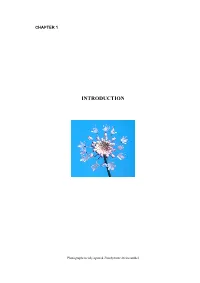
CHAPTER 1 INTRODUCTION Photograph: newly opened Trachymene incisa umbel Introduction 1-2 For each pollinator bee is in fact a little cupid that creates hot romances between plants thought to be stupid. Each bee can be considered a matchmaking agency that arranges introductions for a nominal nectar fee. From “Cupid” by Paul D. Haemig, http://www.ecology.info/cupid.html POLLINATION ECOLOGY Mutualistic interactions are among the most widespread interactions in nature, but also the least well understood compared to other interactions such as predation (Ollerton 2006). Mutualisms are relationships between species that result in reciprocal benefits. Biotic pollination, the transfer of pollen by animals from the anther to the stigma of flowers, is a mostly mutualistic interaction (see Renner 2006 for exceptions), with pollinators usually receiving pollen and/or nectar from plants in return for their pollinating service. Animal pollinators have been important since the angiosperms evolved, with evidence indicating that early members of the angiosperms were insect pollinated (Crane et al. 1995). Over 91% of the 240 000 angiosperm species worldwide are animal-pollinated (Buchmann and Nabhan 1996), distributed throughout approximately 93% of angiosperm genera (Renner and Ricklefs 1995). With vertebrates pollinating only 0.51% of species, insects are responsible for pollinating over 90% of angiosperm species (Buchmann and Nabhan 1996). The four largest orders of insects, Coleoptera, Hymenoptera, Lepidoptera and Diptera, include species that are known to pollinate flowering plants (Proctor et al. 1996). The total number of pollinator species is unknown, although estimates vary between 130 000 and Introduction 1-3 300 000 (Shepherd et al.