Theories of the Information Society, Third Edition
Total Page:16
File Type:pdf, Size:1020Kb
Load more
Recommended publications
-
Citation Analysis for the Modern Instructor: an Integrated Review of Emerging Research
CITATION ANALYSIS FOR THE MODERN INSTRUCTOR: AN INTEGRATED REVIEW OF EMERGING RESEARCH Chris Piotrowski University of West Florida USA Abstract While online instructors may be versed in conducting e-Research (Hung, 2012; Thelwall, 2009), today’s faculty are probably less familiarized with the rapidly advancing fields of bibliometrics and informetrics. One key feature of research in these areas is Citation Analysis, a rather intricate operational feature available in modern indexes such as Web of Science, Scopus, Google Scholar, and PsycINFO. This paper reviews the recent extant research on bibliometrics within the context of citation analysis. Particular focus is on empirical studies, review essays, and critical commentaries on citation-based metrics across interdisciplinary academic areas. Research that relates to the interface between citation analysis and applications in higher education is discussed. Some of the attributes and limitations of citation operations of contemporary databases that offer citation searching or cited reference data are presented. This review concludes that: a) citation-based results can vary largely and contingent on academic discipline or specialty area, b) databases, that offer citation options, rely on idiosyncratic methods, coverage, and transparency of functions, c) despite initial concerns, research from open access journals is being cited in traditional periodicals, and d) the field of bibliometrics is rather perplex with regard to functionality and research is advancing at an exponential pace. Based on these findings, online instructors would be well served to stay abreast of developments in the field. Keywords: Bibliometrics, informetrics, citation analysis, information technology, Open resource and electronic journals INTRODUCTION In an ever increasing manner, the educational field is irreparably linked to advances in information technology (Plomp, 2013). -

Love Ain't Got No Color?
Sayaka Osanami Törngren LOVE AIN'T GOT NO COLOR? – Attitude toward interracial marriage in Sweden Föreliggande doktorsavhandling har producerats inom ramen för forskning och forskarutbildning vid REMESO, Institutionen för Samhälls- och Välfärdsstudier, Linköpings universitet. Samtidigt är den en produkt av forskningen vid IMER/MIM, Malmö högskola och det nära samarbetet mellan REMESO och IMER/MIM. Den publiceras i Linköping Studies in Arts and Science. Vid filosofiska fakulteten vid Linköpings universitet bedrivs forskning och ges forskarutbildning med utgångspunkt från breda problemområden. Forskningen är organiserad i mångvetenskapliga forskningsmiljöer och forskarutbildningen huvudsakligen i forskarskolor. Denna doktorsavhand- ling kommer från REMESO vid Institutionen för Samhälls- och Välfärdsstudier, Linköping Studies in Arts and Science No. 533, 2011. Vid IMER, Internationell Migration och Etniska Relationer, vid Malmö högskola bedrivs flervetenskaplig forskning utifrån ett antal breda huvudtema inom äm- nesområdet. IMER ger tillsammans med MIM, Malmö Institute for Studies of Migration, Diversity and Welfare, ut avhandlingsserien Malmö Studies in International Migration and Ethnic Relations. Denna avhandling är No 10 i avhandlingsserien. Distribueras av: REMESO, Institutionen för Samhälls- och Välfärsstudier, ISV Linköpings universitet, Norrköping SE-60174 Norrköping Sweden Internationell Migration och Etniska Relationer, IMER och Malmö Studies of Migration, Diversity and Welfare, MIM Malmö Högskola SE-205 06 Malmö, Sweden ISSN -
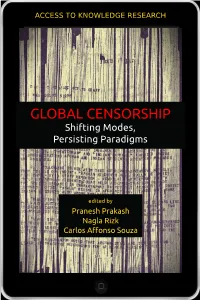
GLOBAL CENSORSHIP Shifting Modes, Persisting Paradigms
ACCESS TO KNOWLEDGE RESEARCH GLOBAL CENSORSHIP Shifting Modes, Persisting Paradigms edited by Pranesh Prakash Nagla Rizk Carlos Affonso Souza GLOBAL CENSORSHIP Shifting Modes, Persisting Paradigms edited by Pranesh Pra ash Nag!a Ri" Car!os Affonso So$"a ACCESS %O KNO'LE(GE RESEARCH SERIES COPYRIGHT PAGE © 2015 Information Society Project, Yale Law School; Access to Knowle !e for "e#elo$ment %entre, American Uni#ersity, %airo; an Instituto de Technolo!ia & Socie a e do Rio+ (his wor, is $'-lishe s'-ject to a %reati#e %ommons Attri-'tion./on%ommercial 0%%.1Y./%2 3+0 In. ternational P'-lic Licence+ %o$yri!ht in each cha$ter of this -oo, -elon!s to its res$ecti#e a'thor0s2+ Yo' are enco'ra!e to re$ro 'ce, share, an a a$t this wor,, in whole or in part, incl' in! in the form of creat . in! translations, as lon! as yo' attri-'te the wor, an the a$$ro$riate a'thor0s2, or, if for the whole -oo,, the e itors+ Te4t of the licence is a#aila-le at <https677creati#ecommons+or!7licenses7-y.nc73+07le!alco e8+ 9or $ermission to $'-lish commercial #ersions of s'ch cha$ter on a stan .alone -asis, $lease contact the a'thor, or the Information Society Project at Yale Law School for assistance in contactin! the a'thor+ 9ront co#er ima!e6 :"oc'ments sei;e from the U+S+ <m-assy in (ehran=, a $'-lic omain wor, create by em$loyees of the Central Intelli!ence A!ency / em-assy of the &nite States of America in Tehran, de$ict. -
Setting International Standards for ICT Indicators
Paris, 29-30 March 2010 Setting International Standards for ICT Indicators An Overview of the OECD Working Party on Indicators for the Information Society (WPIIS) Vincenzo Spiezia vincenzo.spiezia@oecd.org Head, ICT Indicators Unit Directorate for Science, Technology and Industry, OECD 1 Developing standards, methodology and indicators …. 1998: OECD Ministerial Conference on E-Commerce in Ottawa. 2008: Ministerial Conference on The Future of the Internet Society in Seoul. The Ministerial called for the OECD to develop international standards for the measurement of the Information Society. The mandate of the Working Party on Indicators for the Information Society (WPIIS) : “to establish a set of definitions and methodologies to facilitate the compilation of internationally comparable data for measuring various aspects of the information society, the information economy and e-commerce”. Paris, 29-30 March 2010 2 The main contributions of WPIIS 1. A general approach to information society indicators 2. Standards for industry related statistics 1. The ICT sector definition (ISIC 3.1 ISIC4) 2. The media and content sector definition (CPC 2) 3. Standards for product related statistics 1. ICT goods (HS CPC2) 2. ICT services (CPC2) 4. Definitions of e-commerce 5. Model surveys 1. ICT use by households and individuals 2. ICT use by businesses 6. The Guide to Measuring the Information Society Paris, 29-30 March 2010 3 A general framework to organize indicators ICT ICT infrastructure ICT supply demand industries who characteristics where -
The Political Structure of UK Broadcasting 1949-1999 Elstein, David
www.ssoar.info The political structure of UK broadcasting 1949-1999 Elstein, David Veröffentlichungsversion / Published Version Monographie / monograph Empfohlene Zitierung / Suggested Citation: Elstein, D. (2015). The political structure of UK broadcasting 1949-1999. (Media, Democracy & Political Process Series). Lüneburg: meson press. https://doi.org/10.14619/011 Nutzungsbedingungen: Terms of use: Dieser Text wird unter einer CC BY-SA Lizenz (Namensnennung- This document is made available under a CC BY-SA Licence Weitergabe unter gleichen Bedingungen) zur Verfügung gestellt. (Attribution-ShareAlike). For more Information see: Nähere Auskünfte zu den CC-Lizenzen finden Sie hier: https://creativecommons.org/licenses/by-sa/4.0 https://creativecommons.org/licenses/by-sa/4.0/deed.de David Elstein POLITICAL The Political Structure of UK Broadcasting 1949-1999 STRUCTURE BROADCASTING UK ELSTEIN The Political Structure of UK Broadcasting 1949-1999 Media, Democracy & Political Process Series Edited by Christian Herzog, Volker Grassmuck, Christian Heise and Orkan Torun The Political Structure of UK Broadcasting 1949-1999 David Elstein Bibliographical Information of the German National Library The German National Library lists this publication in the Deutsche National bibliografie (German National Biblio graphy); detailed bibliographic information is available online at http://dnb.dnb.de Published in 2015 by meson press, Hybrid Publishing Lab, Centre for Digital Cultures, Leuphana University of Lüneburg www.mesonpress.com Design concept: Torsten Köchlin, Silke Krieg Cover Image: Sebastian Mühleis and Christian Herzog The print edition of this book is printed by Lightning Source, Milton Keynes, United Kingdom ISBN (Print): 9783957960603 ISBN (PDF): 9783957960610 ISBN (EPUB): 9783957960627 DOI: 10.14619/011 The digital editions of this publication can be downloaded freely at: www.mesonpress.com Funded by the EU major project Innovation Incubator Lüneburg This Publication is licensed under the CCBYSA 4.0 Inter national. -

Establishing the Human Perspective of the Information Society
Establishing the human perspective of the information society Helen Partridge BA (UQ), GradDipPsych (UQ), MIT (QUT) Submitted in fulfilment of QUT Doctor of Philosophy Faculty of Information Technology Queensland University of Technology 2007 Supervisory Panel Principal Supervisor Associate Professor Sylvia Edwards Faculty of Information Technology, QUT Associate Supervisors Professor Christine Bruce Faculty of Information Technology, QUT Associate Professor Gillian Hallam Faculty of Information Technology, QUT Dr Paul Baxter Department of Employment and Training Queensland State Government ii Abstract The digital divide is a core issue of the information society. It refers to the division between those who have access to, or are comfortable using, information and communication technology (ICT) (the “haves”) and those who do not have access to, or are not comfortable using ICT (the “have-nots”). The digital divide is a complex phenomenon. The majority of studies to date have examined the digital divide from a socio-economic perspective. These studies have identified income, education and employment as the key factors in determining the division between the “haves” and the “have-nots”. Very little research has explore the psychological, social or cultural factors that contribute to digital inequality in community. The current study filled this gap by using Bandura’s social cognitive theory (SCT) to examine the psychological barriers that prevent individuals from integrating ICT into their everyday lives. SCT postulates that a person will act according to their perceived capabilities and the anticipated consequences of their actions. Four studies have explored the digital divide using SCT. Because of limitations in the research design these studies have shed only limited light onto current understanding of digital inequality in community. -
Knowledge Democracy and the Implications to Information Access
The current issue and full text archive of this journal is available at www.emeraldinsight.com/1750-497X.htm Knowledge Knowledge democracy and the democracy implications to information access Ahmad Raza and Hasan Sohaib Murad School of Business and Economics, University of Management and Technology, 37 Lahore, Pakistan Abstract Purpose – The purpose of this paper is to examine the concept of “knowledge democracy,” deploying a pluralistic, and cross disciplinary and humanistic critique. Design/methodology/approach – This is a culturally pluralistic and humanistic interpretation of globally emergent form of learning pedagogy, particularly manifested in e-learning. Findings – This paper explores the concept of knowledge democracy in the context of knowledge and information revolution. It has been argued that knowledge democratization implies freedom and equality to access information and knowledge across cultures and societies, particularly in the context of globalization. It is asserted that a democratization of the notion of knowledge would cause a paradigm shift; the way instruction and education are socially structured in different social systems. The knowledge society provides a new spirit of global sharing of values, acceptance of others and learning to live with divergent worldviews. It is contended that e-learning in particular sets a new global social opportunity to transcend regional, racial and national prejudices. Originality/value – The paper underscores the significance of pluralistic and humanistic perspective on knowledge and e-learning. Keywords Globalization, Epistemology, E-learning, Knowledge management, Information and communication technologies Paper type Conceptual paper Social forms of knowledge Historically, knowledge has been the defining attribute of human species. From the simple hunters of pre-historic times to medieval peasants to modern day information creators; all have sought to understand more deeply the structure of physical and social world. -

Communicating in the Information Society
communicatingcommunicating inin thethe ○○○○○○○○○○○○○○○○○○○○○ informationinformation societysociety edited by Bruce Girard and Seán Ó Siochrú ○○○○○○○○○○○○○○○○○○○ UNRISD UNITED NATIONS RESEARCH INSTITUTE FOR SOCIAL DEVELOPMENT Communicating in the Information Society edited by Bruce Girard and Seán Ó Siochrú UNRISD UNITED NATIONS RESEARCH INSTITUTE FOR SOCIAL DEVELOPMENT This United Nations Research Institute for Social Development (UNRISD) book has been prepared with the support of UNRISD core funds. UNRISD thanks the governments of Denmark, Finland, Mexico, the Netherlands, Norway, Sweden, Switzerland and the United Kingdom for this funding. Copyright © UNRISD. Short extracts from this publication may be reproduced unaltered without authorization on condition that the source is indicated. For rights of reproduction or translation, application should be made to UNRISD, Palais des Nations, 1211 Geneva 10, Switzerland. UNRISD welcomes such applications. The designations employed in UNRISD publications, which are in conformity with United Nations practice, and the presentation of material therein do not imply the expression of any opinion whatsoever on the part of UNRISD concerning the legal status of any country, territory, city or area or of its authorities, or concerning the delimitation of its frontiers or boundaries. The responsibility for opinions expressed rests solely with the author(s), and publication does not constitute endorsement by UNRISD. UNRISD publications are available from the Reference Centre, UNRISD, Palais des Nations, 1211 Geneva 10, Switzerland; phone +41 (0)22 9173020; fax +41 (0)22 9170650; info@unrisd.org; www.unrisd.org. ISBN 92-9085-045-0 Contents Authors iii Foreword vii Acronyms ix Introduction Seán Ó Siochrú and Bruce Girard 1 What About Gender Issues in the Information Society? Dafne Sabanes Plou 11 A Community Informatics for the Information Society William McIver, Jr. -

2005 Next Wave Festival
November 2005 2005 Next Wave Festival Mary Heilmann, Last Chance for Gas Study (detail), 2005 BAM 2005 Next Wave Festival is sponsored by: The PerformingNCOREArts Magazine Altria BAML....---- _ Brooklyn Academy of Music Alan H. Fishman William I. Campbell Chairman of the Board Vice Chairman of the Board Karen Brooks Hopkins Joseph V. Melillo President Executive Producer presents Patti Smith Horses BAM Howard Gilman Opera House Nov 30 & Dec I, 2005 at 7:30pm Vocals Patti Smith Guitar Lenny Kaye Drums Jay Dee Daugherty Bass & keyboards Tony Shanahan Guitar Tom Verlaine Bass &trumpet Flea Sou nd Emery Dobyns Head of crew Barre Duryea BAM music consultant Danny Kapilian Patti Smith and band, along with BAM, will donate a portion of the event's proceeds to Gulf Coast hurricane-relief organizations. HORSES de I'ame pour I'ame gloria: in excelsis deo gloria redondo beach birdland free money kimberly break it up land: horses land of a thousand dances la mer (de) elegie OUTSIDE SOCIETY 7 songs for our time pissing in a river beca use the night southern cross ain't it strange gandhi peoploe have the power rock and roll nigger ErogllirnnQt~e _ The guardians of history are soon rewarded with history themselves. I don't remember where we found the phrase. Perhaps we read it, or dreamed it out of the air; it seemed prescient. We wanted to honor those who gave us inspiration, and to find the many ways music can become art: rhythm and melody, drawing and poetry and film. And we hoped by word and deed to inspire. -
ISIC) Is the International Reference Classification of Productive Activities
Economic & Social Affairs @ek\ieXk`feXcJkXe[Xi[@e[ljki`Xc:cXjj`]`ZXk`fef]8cc<Zfefd`Z8Zk`m`k`\j@J@: #I\m%+ @ek\ieXk`feXcJkXe[Xi[@e[ljki`Xc :cXjj`]`ZXk`fef]8cc<Zfefd`Z 8Zk`m`k`\j@J@: #I\m%+ Series M No. 4, Rev.4 Statistical Papers asdf United Nations Published by the United Nations ISBN 978-92-1-161518-0 Sales No. E.08.XVII.25 07-66517—August 2008—2,330 ST/ESA/STAT/SER.M/4/Rev.4 Department of Economic and Social Affairs Statistics Division Statistical papers Series M No. 4/Rev.4 International Standard Industrial Classification of All Economic Activities Revision 4 asdf United Nations New York, 2008 Department of Economic and Social Affairs The Department of Economic and Social Affairs of the United Nations Secretariat is a vital interface between global policies in the economic, social and environmental spheres and national action. The Department works in three main interlinked areas: (i) it compiles, generates and analyses a wide range of economic, social and environ- mental data and information on which States Members of the United Nations draw to review common problems and to take stock of policy options; (ii) it facilitates the negotiations of Member States in many intergovernmental bodies on joint courses of action to address ongoing or emerging global challenges; and (iii) it advises interested Governments on the ways and means of translating policy frameworks developed in United Nations conferences and summits into programmes at the country level and, through technical assistance, helps build national capacities. Note The designations used and the presentation of material in this publication do not imply the expression of any opinion whatsoever on the part of the Secretariat of the United Nations concerning the legal status of any country, territory, city or area, or of its authorities, or concerning the delimitation of its frontiers or boundaries. -

Autobiographical Deformations and the Literary Lineage of Afro-Pessimism in 20Th and 21St Century African American Literature
UNIVERSITY OF CALIFORNIA, SAN DIEGO Outside Relationality: Autobiographical Deformations and the Literary Lineage of Afro-pessimism in 20th and 21st Century African American Literature A dissertation submitted in partial satisfaction of the requirements for the degree Doctor of Philosophy in Literature by Yumi Pak Committee in charge: Professor Camille F. Forbes, Chair Professor Patrick Anderson Professor Dennis R. Childs Professor Fatima El-Tayeb Professor Lisa Lowe 2012 Copyright © Yumi Pak, 2012 All rights reserved. The Dissertation of Yumi Pak is approved, and it is acceptable in quality and form for publication on microfilm and electronically: ________________________________________________________________________ ________________________________________________________________________ ________________________________________________________________________ ________________________________________________________________________ ________________________________________________________________________ Chair University of California, San Diego 2012 iii TABLE OF CONTENTS Signature Page………………………………………………………………………… iii Table of Contents……………………………………………………………………... iv List of Illustrations……………………………………………………………………. v Acknowledgements…………………………………………………………………… vi Vita……………………………………………………………………………………. xii Abstract……………………………………………………………………………….. xiii Introduction………………………………………………………………………….... 1 Chapter One – Alternative Modernity, Alternative Blackness: Lynching and the Oracular Swan-song of Jean Toomer’s Cane…………………………………………………… 30 -

Patti Smith M Train Collection Folio
Patti Smith M Train collection folio Patti Smith M Train Traduit de l’américain par Nicolas Richard Gallimard Titre original : m train © Patti Smith, 2015. © Éditions Gallimard, 2016, pour la traduction française. Couverture : Photo © Claire Alexandra Hartfiel. Artiste engagée, Patti Smith est née à Chicago en 1946. Issue d’une famille modeste, elle quitte le New Jersey pour partir travailler à New York en 1967. Elle y rencontre le photographe Robert Mapplethorpe et emménage avec lui au Chelsea Hotel. Habituée des clubs punk et rock du moment parmi lesquels le célèbre CBGB, elle crée le Patti Smith Group. Son premier single, Hey Joe / Piss Factory, paraît en 1974. Suivront les albums Horses, Radio Ethiopia, Easter – avec notamment le tube Because the Night (1978), coécrit avec Bruce Springsteen – et Wave. En 1980, elle épouse Fred « Sonic » Smith (1949-1994), guitariste du groupe MC5, et met entre parenthèses sa vie d’artiste pour se consacrer à leurs deux enfants. L’album Dream of Life (1988), conçu avec son mari, lui permet de renouer avec la scène. Elle signe alors Gone Again, Peace and Noise, Gung Ho, Land et Trampin’. Admiratrice des textes d’Arthur Rimbaud et de William Blake dont elle donne des lectures, Patti Smith reçoit la médaille de commandeur de l’Ordre des Arts et des Lettres en 2005 et entre au Rock and Roll Hall of Fame en 2007. Trois autres albums sont produits : Twelve, The Coral Sea et Outside Society. Son récit autobiographique, Just Kids (2010), a été récompensé par le National Book Award. Pour Sam Shepard e n’est pas si facile d’écrire sur rien.