On the Ring Nebulae Around Runaway Wolf-Rayet Stars
Total Page:16
File Type:pdf, Size:1020Kb
Load more
Recommended publications
-

On the Apparent Absence of Wolf–Rayet+Neutron Star Systems: the Urc Ious Case of WR124 Jesus A
East Tennessee State University Digital Commons @ East Tennessee State University ETSU Faculty Works Faculty Works 12-10-2018 On the Apparent Absence of Wolf–Rayet+Neutron Star Systems: The urC ious Case of WR124 Jesus A. Toala UNAM Campus Morelia Lidi Oskinova University of Potsdam W.R. Hamann University of Potsdam Richard Ignace East Tennessee State University, ignace@etsu.edu A.A. C. Sander University of Potsdam See next page for additional authors Follow this and additional works at: https://dc.etsu.edu/etsu-works Citation Information Toala, Jesus A.; Oskinova, Lidi; Hamann, W.R.; Ignace, Richard; Sander, A.A. C.; Todt, H.; Chu, Y.H.; Guerrero, M. A.; Hainich, R.; Hainich, R.; and Terrejon, J. M.. 2018. On the Apparent Absence of Wolf–Rayet+Neutron Star Systems: The urC ious Case of WR124. Astrophysical Journal Letters. Vol.869 https://doi.org/10.3847/2041-8213/aaf39d ISSN: 2041-8205 This Article is brought to you for free and open access by the Faculty Works at Digital Commons @ East Tennessee State University. It has been accepted for inclusion in ETSU Faculty Works by an authorized administrator of Digital Commons @ East Tennessee State University. For more information, please contact digilib@etsu.edu. On the Apparent Absence of Wolf–Rayet+Neutron Star Systems: The Curious Case of WR124 Copyright Statement © 2018. The American Astronomical Society. Reproduced by permission of the AAS. Creator(s) Jesus A. Toala, Lidi Oskinova, W.R. Hamann, Richard Ignace, A.A. C. Sander, H. Todt, Y.H. Chu, M. A. Guerrero, R. Hainich, R. Hainich, and J. M. -

N O T I C E This Document Has Been Reproduced From
N O T I C E THIS DOCUMENT HAS BEEN REPRODUCED FROM MICROFICHE. ALTHOUGH IT IS RECOGNIZED THAT CERTAIN PORTIONS ARE ILLEGIBLE, IT IS BEING RELEASED IN THE INTEREST OF MAKING AVAILABLE AS MUCH INFORMATION AS POSSIBLE P993-198422 International Collogium on Atomic Spectra and Oscillator Strengths for Astrophysical and Laboratory Plasmas (4th) Held at the National institute of Standards and Technology Gaithersburg, Maryland on September 14-17, 1992 (U.S.) National inst. of Standards and Technology (PL) Gaithersburg, MD Apr 93 US. DEPARTMENT OF COMMERCE Ndioul Techcical IMermeNON Service B•11G 2-10i1A2 2 MIST-1 /4 U.S. VZPARTMENT OF COMMERCE (REV. NATIONAL INSTITUTE OF STANDARDS AND TECHNOLOGY M GONTSOLw1N^BENN O4" COMM 4M /. MANUSCRIPT REVIEW AND APPROVAL "KIST/ p-850 ^' THIS NSTRUCTWNS: ATTACH ORIGINAL OF FORM TO ONE (1) COPY OF MANUSCIIN IT AND SEINE TO: PUBLICATIOM OATS NUMBER PRINTED PAGES April 1993 199 HE SECRETAIIY, APPROPRIATE EDITO RIAL REVIEW BOARD. ITLE AND SUBTITLE (CITE NN PULL) 4rh International Colloquium on Atomic Spectra and Oscillator Strengths for Astrophysical and Laboratory Plasmas -- POSTER PAPERS :ONTIEACT OR GRANT NUMBER TYPE OF REPORT AND/OR PERIOD COMM UTHOR(S) (LAST %,TAME, POST NNITIAL, SECOND INITIAL) PERFORM" ORGANIZATION (CHECK (IQ ONE SOX) EDITORS XXX MIST/GAITHERSBUIIG Sugar, Jack and Leckrone, B:;vid INST/BODUM JILA BOIRDE11 "ORATORY AND DIVISION NAMES (FIRST MOST AUTHOR ONLY) Physics Laboratory/Atomic Physics Division 'PONSORING ORGANIZATION NAME AND COMPLETE ADDRESS TREET, CITY. STATE. ZNh ^y((S/ ,T AiL7A - -ASO IECOMMENDsO FOR MIST PUBLICATION JOVIAMAL OF RESEMICM (MIST JRES) CIONOGRAPK (MIST MN) LETTER CIRCULAR J. PHYS. A CHEM. -
Evidence for Binary Interaction?!
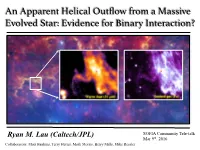
An Apparent Helical Outflow from a Massive Evolved Star: Evidence for Binary Interaction?! Ryan M. Lau (Caltech/JPL) SOFIA Community Tele-talk Mar 9th, 2016 Collaborators: Matt Hankins, Terry Herter, Mark Morris, Betsy Mills, Mike Ressler An Outline • Background:"Massive"stars"and"the"influence" of"binarity" " • This"Work:"A"dusty,"conical"helix"extending" from"a"Wolf7Rayet"Star" " • The"Future:"Exploring"Massive"Stars"with"the" James"Webb"Space"Telescope" 2" Massive Stars: Galactic Energizers and Refineries • Dominant"sources"of"opFcal"and"UV"photons" heaFng"dust" " • Exhibit"strong"winds,"high"massJloss,"and"dust" producFon"aKer"leaving"the"main"sequence" "" • Explode"as"supernovae"driving"powerful" shocks"and"enriching"the"interstellar"medium" 3" Massive Stars: Galactic Energizers and Refineries Arches"and"Quintuplet"Cluster" at"the"GalacFc"Center" Gal."N" 10"pc" Spitzer/IRAC"(3.6","5.8,"and"8.0"um)" 4" Massive Stars: Galactic Energizers and Refineries Arches"and"Quintuplet"Cluster" at"the"GalacFc"Center" Pistol"Star"and"Nebula" 1"pc" Pa"and"ConFnuum"" 10"pc" Spitzer/IRAC"(3.6","5.8,"and"8.0"um)" 5" Massive stars are not born alone… Binary"InteracCon"Pie"Chart" >70%"of"all"massive" stars"will"exchange" mass"with"companion"" Sana+"(2012)" 6" Influence of Binarity on Stellar Evolution of Massive Stars Binary"InteracCon"Pie"Chart" >70%"of"all"massive" stars"will"exchange" mass"with"companion"" Mass"exchange"will" effect"stellar"luminosity" and"massJloss"rates…" Sana+"(2012)" 7" Influence of Binarity on Stellar Evolution of Massive Stars Binary"InteracCon"Pie"Chart" -
PHAS 1102 Physics of the Universe 3 – Magnitudes and Distances
PHAS 1102 Physics of the Universe 3 – Magnitudes and distances Brightness of Stars • Luminosity – amount of energy emitted per second – not the same as how much we observe! • We observe a star’s apparent brightness – Depends on: • luminosity • distance – Brightness decreases as 1/r2 (as distance r increases) • other dimming effects – dust between us & star Defining magnitudes (1) Thus Pogson formalised the magnitude scale for brightness. This is the brightness that a star appears to have on the sky, thus it is referred to as apparent magnitude. Also – this is the brightness as it appears in our eyes. Our eyes have their own response to light, i.e. they act as a kind of filter, sensitive over a certain wavelength range. This filter is called the visual band and is centred on ~5500 Angstroms. Thus these are apparent visual magnitudes, mv Related to flux, i.e. energy received per unit area per unit time Defining magnitudes (2) For example, if star A has mv=1 and star B has mv=6, then 5 mV(B)-mV(A)=5 and their flux ratio fA/fB = 100 = 2.512 100 = 2.512mv(B)-mv(A) where !mV=1 corresponds to a flux ratio of 1001/5 = 2.512 1 flux(arbitrary units) 1 6 apparent visual magnitude, mv From flux to magnitude So if you know the magnitudes of two stars, you can calculate mv(B)-mv(A) the ratio of their fluxes using fA/fB = 2.512 Conversely, if you know their flux ratio, you can calculate the difference in magnitudes since: 2.512 = 1001/5 log (f /f ) = [m (B)-m (A)] log 2.512 10 A B V V 10 = 102/5 = 101/2.5 mV(B)-mV(A) = !mV = 2.5 log10(fA/fB) To calculate a star’s apparent visual magnitude itself, you need to know the flux for an object at mV=0, then: mS - 0 = mS = 2.5 log10(f0) - 2.5 log10(fS) => mS = - 2.5 log10(fS) + C where C is a constant (‘zero-point’), i.e. -
Orbital Elements of Double Stars
Orbital elements of double stars: ADS 1548 Marco Scardia, Jean-Louis Prieur, Luigi Pansecchi, Robert Argyle, Josefina Ling, Eric Aristidi, Alessio Zanutta, Lyu Abe, Philippe Bendjoya, Jean-Pierre Rivet, et al. To cite this version: Marco Scardia, Jean-Louis Prieur, Luigi Pansecchi, Robert Argyle, Josefina Ling, et al.. Orbital elements of double stars: ADS 1548. 2018, pp.1. hal-02357208 HAL Id: hal-02357208 https://hal.archives-ouvertes.fr/hal-02357208 Submitted on 23 Nov 2019 HAL is a multi-disciplinary open access L’archive ouverte pluridisciplinaire HAL, est archive for the deposit and dissemination of sci- destinée au dépôt et à la diffusion de documents entific research documents, whether they are pub- scientifiques de niveau recherche, publiés ou non, lished or not. The documents may come from émanant des établissements d’enseignement et de teaching and research institutions in France or recherche français ou étrangers, des laboratoires abroad, or from public or private research centers. publics ou privés. INTERNATIONAL ASTRONOMICAL UNION COMMISSION G1 (BINARY AND MULTIPLE STAR SYSTEMS) DOUBLE STARS INFORMATION CIRCULAR No. 194 (FEBRUARY 2018) NEW ORBITS ADS Name P T e Ω(2000) 2018 Author(s) α2000δ n a i ! Last ob. 2019 1548 A 819 AB 135y4 2011.06 0.548 153◦8 39◦7 000161 SCARDIA 01570+3101 2◦6587 000424 50◦5 189◦7 2017.833 49.4 0.163 et al. (*) - HDS 333 49.54 1981.14 0.60 252.6 253.8 0.542 TOKOVININ 02332-5156 7.2665 0.413 57.4 150.9 2018.073 255.7 0.519 - COU 691 61.76 1964.53 0.059 68.6 276.2 0.109 DOCOBO 03423+3141 5.8290 0.160 -

Université De Montréal Étude De L'étoile Wolf-Rayet Variable WR 46 Dans L'ultraviolet Lointain Et Les Rayons X Par Vince
Université de Montréal Étude de l’étoile Wolf-Rayet variable WR 46 dans l’ultraviolet lointain et les rayons X par Vincent Hénault-Brunet Département de physique Faculté des arts et des sciences Mémoire présenté à la Faculté des études supérieures en vue de l’obtention du grade de Maître ès sciences (M.Sc.) en physique Août, 2009 c Vincent Hénault-Brunet, 2009 ! Université de Montréal Faculté des études supérieures Ce mémoire intitulé: Étude de l’étoile Wolf-Rayet variable WR 46 dans l’ultraviolet lointain et les rayons X présenté par: Vincent Hénault-Brunet a été évalué par un jury composé des personnes suivantes: Pierre Bergeron, président-rapporteur Nicole St-Louis, directrice de recherche Claude Carignan, membre du jury Mémoire accepté le: 11 septembre 2009 i «Il me semble que ce qui est requis est un délicat équilibre entre deux tendances : celle qui nous pousse à scruter de manière inlassablement sceptique toutes les hypothèses qui nous sont soumises et celle qui nous invite à garder une grande ouverture aux idées nouvelles.» - Carl Sagan ii Sommaire L’étoile Wolf-Rayet WR 46 est connue pour sa variabilité complexe sur des échelles de temps relativement courtes de quelques heures et sur des échelles de temps plus longues de plusieurs mois. Des décalages périodiques mais intermittents en vitesse radiale ont déjà été observés dans ses raies d’émission optiques. Plusieurs périodes photométriques ont aussi été mesurées dans le passé. Des pulsations non-radiales, une modulation liée à la rotation rapide, ou encore la présence d’un compagnon de faible masse dont la présence reste à confirmer ont été proposées pour expliquer le comportement de l’étoile sur des échelles de temps de quelques heures. -
Spatial Distribution of Galactic Wolf–Rayet Stars and Implications for the Global Population
MNRAS 447, 2322–2347 (2015) doi:10.1093/mnras/stu2525 Spatial distribution of Galactic Wolf–Rayet stars and implications for the global population C. K. Rosslowe‹ andP.A.Crowther Department of Physics and Astronomy, University of Sheffield, Hicks Building, Hounsfield Road, S3 7RH, UK Accepted 2014 November 26. Received 2014 November 26; in original form 2014 September 5 ABSTRACT We construct revised near-infrared absolute magnitude calibrations for 126 Galactic Wolf– Rayet (WR) stars at known distances, based in part upon recent large-scale spectroscopic surveys. Application to 246 WR stars located in the field permits us to map their Galactic distribution. As anticipated, WR stars generally lie in the thin disc (∼40 pc half-width at half- maximum) between Galactocentric radii 3.5–10 kpc, in accordance with other star formation tracers. We highlight 12 WR stars located at vertical distances of ≥300 pc from the mid-plane. Analysis of the radial variation in WR subtypes exposes a ubiquitously higher NWC/NWN ratio than predicted by stellar evolutionary models accounting for stellar rotation. Models for non- rotating stars or accounting for close binary evolution are more consistent with observations. We consolidate information acquired about the known WR content of the Milky Way to build a simple model of the complete population. We derive observable quantities over a range of wavelengths, allowing us to estimate a total number of 1900 ± 250 Galactic WR stars, implying an average duration of ∼ 0.4 Myr for the WR phase at the current Milky Way star formation rate. Of relevance to future spectroscopic surveys, we use this model WR population to predict follow-up spectroscopy to KS 17.5 mag will be necessary to identify 95 per cent of Galactic WR stars. -

Herschel Observations of the Nebula M1-67 Around the Wolf-Rayet Star WR 124,
A&A 588, A92 (2016) Astronomy DOI: 10.1051/0004-6361/201527667 & c ESO 2016 Astrophysics Herschel observations of the nebula M1-67 around the Wolf-Rayet star WR 124, C. Vamvatira-Nakou1, D. Hutsemékers1,,P.Royer2,C.Waelkens2,M.A.T.Groenewegen3, and M. J. Barlow4 1 Institut d’Astrophysique et de Géophysique, Université de Liège, Quartier Agora, Allée du 6 août, 19C − Bât. B5c, 4000 Liège (Sart-Tilman), Belgium e-mail: C.VamvatiraNakou@alumni.ulg.ac.be 2 Instituut voor Sterrenkunde, KU Leuven, Celestijnenlaan 200D, Bus 2401, 3001 Leuven, Belgium 3 Koninklijke Sterrenwacht van België, Ringlaan 3, 1180 Brussels, Belgium 4 Department of Physics and Astronomy, University College London, Gower Street, London WC1E 6BT, UK Received 30 October 2015 / Accepted 29 January 2016 ABSTRACT Infrared Herschel imaging and spectroscopic observations of the nebula M1-67 around the Wolf-Rayet star WR 124 have been obtained along with optical imaging observations. The infrared images reveal a clumpy dusty nebula that extends up to 1 pc. The comparison with the optical images shows that the ionized gas nebula coincides with the dust nebula, the dust and the gas being mixed together. A photodissociation region is revealed from the infrared spectroscopic analysis. The analysis of the infrared spectrum of the nebula, where forbidden emission lines of ionized elements were detected, showed that the nebula consists of mildly processed material with the calculated abundance number ratios being N/O = 1.0 ± 0.5 and C/O = 0.46 ± 0.27. Based on a radiative transfer model, the dust mass of the nebula was estimated to be 0.22 M with a population of large grains being necessary to reproduce the observations. -

The Galactic O-Star Spectroscopic Survey (GOSSS). III. 142 Additional
The Galactic O-Star Spectroscopic Survey (GOSSS). III. 142 additional O-type systems1 J. Ma´ızApell´aniz2,3,4,5 Centro de Astrobiolog´ıa, CSIC-INTA, campus ESAC, camino bajo del castillo s/n, E-28 692 Madrid, Spain A. Sota2,3,4 Instituto de Astrof´ısica de Andaluc´ıa-CSIC, Glorieta de la Astronom´ıa s/n, E-18 008 Granada, Spain J. I. Arias, R. H. Barb´a2 Departamento de F´ısica, Universidad de La Serena, Av. Cisternas 1200 Norte, La Serena, Chile N. R. Walborn Space Telescope Science Institute, 3700 San Martin Drive, Baltimore, MD 21 218, USA S. Sim´on-D´ıaz Instituto de Astrof´ısica de Canarias, E-38 200 La Laguna, Tenerife, Spain Departamento de Astrof´ısica, Universidad de La Laguna, E-38 205 La Laguna, Tenerife, Spain I. Negueruela DFISTS, EPS, Universidad de Alicante, carretera San Vicente del Raspeig s/n, E-03 690 Alicante, Spain A. Marco DFISTS, EPS, Universidad de Alicante, carretera San Vicente del Raspeig s/n, E-03 690 Alicante, Spain Dept. of Astronomy, University of Florida, 211 Bryant Space Science Center, Gainesville, FL 32 611, USA J. R. S. Le˜ao Univ. Federal do Rio Grande do Norte - UFRN, Caixa Postal 1524, CEP 59 078-970, Natal - RN, Brazil A. Herrero Instituto de Astrof´ısica de Canarias, E-38 200 La Laguna, Tenerife, Spain Departamento de Astrof´ısica, Universidad de La Laguna, E-38 205 La Laguna, Tenerife, Spain R. C. Gamen Instituto de Astrof´ısica de La Plata (CONICET, UNLP), Paseo del Bosque s/n, 1900 La Plata, Argentina E. -
Cygnus X-3 and the Problem of the Missing Wolf-Rayet X-Ray Binaries
A&A 443, 231–241 (2005) Astronomy DOI: 10.1051/0004-6361:20052824 & c ESO 2005 Astrophysics Cygnus X-3 and the problem of the missing Wolf-Rayet X-ray binaries D. Lommen1,2, L. Yungelson1,3,4,E.vandenHeuvel1, G. Nelemans5, and S. Portegies Zwart1,6 1 Astronomical Institute “Anton Pannekoek”, University of Amsterdam, and Center for High Energy Astrophysics, Kruislaan 403, 1098 SJ Amsterdam, The Netherlands e-mail: djplomme@science.uva.nl 2 Sterrewacht Leiden, Niels Bohrweg 2, 2333 CA Leiden, The Netherlands 3 Institute of Astronomy of the Russian Academy of Sciences, 48 Pyatniskaya Str., 119017 Moscow, Russia 4 Isaac Newton Institute, Moscow Branch, 12 Universitetskii Pr., Moscow, Russia 5 Astronomy Department, IMAPP, Radboud Universiteit Nijmegen, Toernooiveld 1, 6525 ED Nijmegen, The Netherlands 6 Informatics Institute, University of Amsterdam, Kruislaan 403, 1098 SJ, Amsterdam, The Netherlands Received 6 February 2005 / Accepted 7 July 2005 ABSTRACT 38 −1 Cygnus X-3 is a strong X-ray source (LX ≈ 10 erg s ) which is thought to consist of a compact object accreting matter from a helium star. We analytically find that the estimated ranges of mass-loss rate and orbital-period derivative for Cyg X-3 are consistent with two models: i) the system is detached and the mass loss from the system comes from the stellar wind of a massive helium star, of which only a fraction that allows for the observed X-ray luminosity is accreted, or ii) the system is semidetached and a Roche-lobe-overflowing low- or moderate-mass helium donor transfers mass to the compact object, followed by ejection of its excess over the Eddington rate from the system. -
Self-Evaluation Document of the Research Institute of Physics and Astronomy Faculty of Physics and Astronomy Utrecht University
SELF-EVALUATION DOCUMENT OF THE RESEARCH INSTITUTE OF PHYSICS AND ASTRONOMY FACULTY OF PHYSICS AND ASTRONOMY UTRECHT UNIVERSITY This is the self-evaluation document of the Research Institute of Physics and Astronomy prepared for its upcoming research assessment organized by the Governing Board of Utrecht University. It is prepared on the basis of the Evaluation Protocol [1] which is derived from the Standard Evaluation Protocol 2003-2009 for public research organizations in the Netherlands [2]. The purpose of the evaluation is to assess against international standard the quality, productivity, relevance and viability of the activities of the Research Institute and its thirteen research programs during the seven-year period that ended on 31 December 2002. Part A describes the Research Institute as a whole and Part B the separate research programs. Part B is prepared in close collaboration with the program leaders of the respective programs. Besides extensive descriptions of the mission and the organization of the Institute and its programs, detailed annual data are presented regarding the research staff, the productivity and the funding. This report has been approved by the Governing Board of Utrecht University. It will be submitted as an input document for the evaluation of the Research Institute of Physics and Astronomy to the Evaluation Committee. The Evaluation Committee consists of Prof. dr. Edouard Brézin, (ENS, Paris; Chair); Prof. dr. Marcel Arnould, (Université Libre de Bruxelles); Prof. dr. Paul M. Chaikin, (Princeton University); Prof. dr. Jos Eggermont, (University of Calgary); Prof. dr. Michael Ghil, (UCLA, ENS Paris); Prof. dr. Jürgen Mlynek, (Humboldt Universität zu Berlin). The site visit is set for 10-12 September 2003. -

Stars: How Big Is Big? 12 December 2011, by Steve Nerlich
Stars: How big is big? 12 December 2011, By Steve Nerlich Another way of considering the 'bigness' of stars is to consider their mass, in which case the most reliably confirmed extremely massive star is NGC 3603-A1a - at 116 solar masses, compared with VY Canis Majoris' middling 30-40 solar masses. The most massive star of all may be R136a1, which has an estimated mass of over 265 solar masses - although the exact figure is the subject of ongoing debate, since its mass can only be inferred indirectly. Even so, its mass is almost certainly over the 'theoretical' stellar mass limit of 150 solar masses. This theoretical limit is based on mathematically modelling the Eddington limit, the point at which a star's luminosity is so high that its outwards radiation pressure exceeds its self- gravity. In other words, beyond the Eddington limit, a star will cease to accumulate more mass and will begin to blow off large amounts of its existing mass The Wolf-Rayet star WR 124 and its wind nebulae (actually denoted M1-67). The mass of WR 124 is as stellar wind. estimated at a moderate 20 solar masses, although this is after it has already lost much of its initial mass to It's speculated that very big O type stars might shed create the wind nebula around it. Credit: ESO. up to 50% of their mass in the early stages of their lifecycle. So for example, although R136a1 is speculated to have a currently observed mass of 265 solar masses, it may have had as much as 320 You may have seen one of these astronomical solar masses when it first began its life as a main scale picture sequences, where you go from the sequence star.