SLOVAKIA Slovak Republic
Total Page:16
File Type:pdf, Size:1020Kb
Load more
Recommended publications
-

Potential and Central Forms of Tourism in 21 Regions of Slovakia
Potential and Central Forms of Tourism in 21 Regions of Slovakia Importance and development priorities of regions The following previews list short characteristics of individual regions in terms of their current state, development possibilities and specific needs. The previews include a list of the most important destinations in the individual regions, the infrastructure that needs to be completed and the anticipated environmental impacts on tourism in the region. These lists are not entirely comprehensive and only include the main elements that create the character of the region as a tourist destination. 1. Bratislava Region Category / relevance Medium-term perspective International Long-term perspective International Sub-region, specific Medium-term perspective - Small Carpathians sub-region (viniculture) location - Bratislava - Senec Long-term perspective - Strip along the right bank of the Danube Type of tourism Long-term incoming foreign tourism over 50%; intensive domestic tourism as well Stay tourism – short-term in incoming as well as in domestic tourism Long–stay waterside tourism only in the summer time; one-day visits – domestic as well as foreign tourism. Transit Forms of tourism - Sightseeing tourism - Business tourism - Summer waterside stays Activities with the - Discovering cultural heritage – Business tourism - Congress/conference tourism – highest long-term Visiting cultural and sport events – Stays/recreation near water – Water sports – Boat potential sports and water tourism - Cycle tourism Position on the Slovak Number -
Ebulletin Mod SR 5.Pub
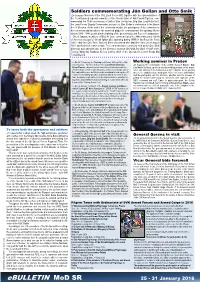
Soldiers commemorating Ján Golian and Otto Smik (26 January) Members of the SVL Land Forces HQ, together with the representatives of the Trenčín-based regional committee of the Slovak Union of Anti-Fascist Fighters, com- memorated the 110th anniversary of birth of Gen Ján Golian. Brig Gen Juraj Krištofovič, the Land Forces Deputy Commander, pointed out Gen Golian’s contribution to the libera- tion of Slovakia. At the end of the ceremonial muster, the participants of the commemora- tion ceremony laid wreaths to the memorial plaque to commemorate the uprising officers who in 1939 - 1944 operated in the building of the present-day Land Forces Headquarters. On 21 January, members of Sliač Air Base commemorated the 94th anniversary of birth of the most successful Slovak fighter pilot operating during WWII in the Royal Air Force (UK) – Maj Gen Otto Smik. Sliač Air Base was named after Maj Gen Smik on 28 August 2002 and bears his name to-date. The commemoration ceremony held at the Otto Smik Memorial was attended also by the General’s nephew Ján Smik; by Chief of Staff of the Tactical Wing Maj Rastislav Kučera and by Chief of the Operations Control Group Maj Tomáš Bajnok. ● On 18-22 January, the Training and Canine Military Police Divi- Working seminar in Prešov sion Vlkanová – Hronsek delivered the Land Rover Defender (25 January) The Commander of the 2nd Mechanized Brigade, Brig Driver Course. The participants familiarized themselves with the Gen Martin Stoklasa, opened a two-day working seminar on the prepa- vehicle’s basic technical specifications, construction design, opera- ration and building of the National Goal 2013 (NG13). -

Ebulletin 48/2017
Minister Gajdoš meets with Macedonian Chief of General Staff (30 November) SVK Minister of Defence Peter Gajdoš held talks with Lt Gen Metodija Velichkovski, Chief of the General Staff, Army of the Republic of Macedonia. Topics of discussion included international security priorities and bilateral defence engagement. Head of the SVK MOD informed the Macedonian No. 48 ● Vol. VI ● www.mosr.sk/ebulletin/ CHOD of the strategic documents the SVK MOD has formulated throughout 2017, as well as updating him on the modernisation projects of the SVK Armed Forces. Both leaders appreciated the cooperation between Slovak and Macedonian troops on operations abroad. Also discussed at the meeting was SVK support to the integration of the Republic of Macedonia into the EU and NATO. At the meeting, the Minister offered to keep the International Staff Officers Course (ISOC) open to Macedonian soldiers at the SVK Armed Forces Academy. Best soldiers and NCOs ● Commander SVK Land Forces announced a selection of (29 November) In the SVK Land Forces, PFC Martin Handzuš, service personnel to staff 112 (MOS Code) Human Recce Scout/Specialist of ISTAR Battalion, part of 2nd Mech Bde, Intelligence Specialist positions open to personnel ranked was named Best Soldier of the Year and Miroslav Ďurkovský, Lieutenant, Sergeant 1st Class, Staff Sergeant and Sergeant Section Leader of 11th Mech Bn, part of 1st Mech Bde, was made for service with the Intelligence Support Company, part of Best NCO of the Year. The announcement was made by a Land ISTAR Battalion Prešov. Applicants in the ranks listed above or Forces Commander's selection board at the Training and those eligible for required promotions are invited to apply for Mobilisation Base Martin. -

SITUATIONAL MANAGEMENT of INTEGRATED FLIGHT PREPARATION and TRAINING of PILOTS AS an EDUCATION SERVICE Pavol Petríček1, Stanislav Szabo2, Róbert Rozenberg3
INTERNATIONAL CONFERENCE ON INNOVATIONS IN SCIENCE AND EDUCATION MARCH 20-22, 2019, PRAGUE, CZECH REPUBLIC WWW.ISEIC.CZ, WWW.JOURNALS.CZ SITUATIONAL MANAGEMENT OF INTEGRATED FLIGHT PREPARATION AND TRAINING OF PILOTS AS AN EDUCATION SERVICE Pavol Petríček1, Stanislav Szabo2, Róbert Rozenberg3 Abstract: This article examines the situational management of the Knowledge Alliance of Aviation Education as an Education Service in the conditions of the Slovak Republic. It is the second part of our study. In order to ensure the continuity, quality and safety in the aviation education of future military and civil pilots as aviation professionals, research works of a similar nature are needed. This article uses analysis and synthesis tools, the method “per partes” (integration in parts) with the potential to apply the situational management method in the aviation practice and the expert method. Authors solved the following praxeological questions: What does situational management mean in the education and training of pilots? What are the sources of knowledge and good practice in the management of education and training of pilots? Which control processes can we use for the efficient management of education and training of pilots as a complex aviation system? The output of the article is the proposal of situational management of the comprehensive system of education and training of pilots with the support of evolutionary and cooperative management in the aviation practice of state-private entities. UDC Classification: 378, DOI: 10.12955/cbup.v7.1419 Keywords: situational management, service, safety, education, knowledge alliance, aviation Introduction In order to ensure continuity, quality and safety in the aviation education of future military and civil aviation professionals, research works, especially the doctoral thesis, of a similar nature are needed. -

Llaaddiissllaavvkkuuddr
LvNZ-Ob.qxd 17.3.2005 11:21 StrÆnka 1 55 Vážení a milí čtenáři, kniha, kterou právě držíte, přináší 55 44 44 99 zcela nový pohled na téma Českoslovenští letci v němec - 99 11 11 –– kém zajetí 1940–1945. Většina dosavadní literatury se sou - –– 00 00 44 středila pouze na to, jak byl dotyčný letec, osádka, sestře - 44 99 99 len a jak následně upadl do zajetí. Ani autor této knihy se 11 11 ÍÍ nevyhnul popisu sestřelení a následného zajetí, které je ÍÍ TT TT EE ovšem zpracováno z širšího pohledu po důkladném vytěže - EE JJ JJ AA ní archivních materiálů. Autor této knihy začíná tím, co AA ZZ ZZ předcházelo sestřelení. Tedy, jak byli naši letci připraveni M M M M ÉÉ a vybaveni na možnost zajetí. Následuje popis sestřelení ÉÉ KK KK CC a následného zajetí. Čím je ovšem tato kniha zcela nová? CC EE EE Především tím, že kniha zajetím dotyčného letce nekončí, M M M M ĚĚ ale právě naopak, teprve zde kniha začíná. Kniha mimo jiné ĚĚ NN NN pojednává o organizaci zajateckého tábora a života v zaje - VV VV II tí samého. Jak probíhaly všední, ale i sváteční a výjimečné II CC CC TT dny v zajateckém táboře. Nebude vynechána ani otázka TT EE EE LL ú r o v n ě s t r a v o v á n í a u b y t o v á n í . V z t a h y m e z i z a j a t c i LL ÍÍ ÍÍ a německými strážnými. -
Spitfire Mk.Ixc Late Version 8281 BRITISH WWII FIGHTER 1:48 SCALE PLASTIC KIT
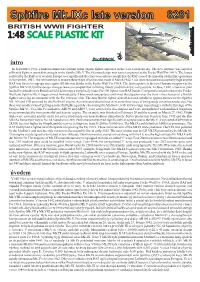
Spitfire Mk.IXc late version 8281 BRITISH WWII FIGHTER 1:48 SCALE PLASTIC KIT intro In September 1941, a hitherto unknown German radial engine fighter appeared in the west European sky. The new airplane was superior to British fighters, most distressingly to the Spitfire Mk.V. The German design was soon recognized as the Focke-Wulf Fw 190 A. The losses suffered by the RAF over western Europe rose rapidly and the crisis was serious enough that the RAF ceased the majority of daytime operations in November, 1941. The next attempt to resume these types of sorties was made in March 1942. Loss rates remained unacceptably high and the RAF was forces to stop ops once again. All this was thanks to the Focke-Wulf Fw 190 A. The first response to the new German weapon was the Spitfire Mk.VIII, but the design changes were so complex that initiating timely production was not possible. In June, 1942, a German pilot landed by mistake on a British airfield delivering a completely intact Fw 190 fighter into RAF hands. Comparative trials between the Focke- Wulf and Spitfire Mk.V began almost immediatelly. These mock encounters confirmed the situation over the front – the chances of a British fighter surviving an encounter with the Fw 190 were slim. The only British fighter aircraft deemed suitable to oppose them were the Spitfire Mk. VII and VIII powered by the Merlin 61 engine. As mentioned above these were some time away of being ready for series production. But there was another way of getting a powerful fighter quickly - by mating the Merlin 61, with its two-stage supercharger, with the fuselage of the Spitfire Mk.Vc. -

Turzovania Na Bojiskách 1
Turzovčania na bojiskách 1.a 2. svetovej vojny Leto roku 1914 vstúpilo do histórie 20. storočia vojnovým konfliktom ktorý zasiahol generáciu našich dedov a pradedov, ktorá dovtedy nezažila taký veľký otriasajúci úder ako vypuknutie prvej svetovej vojny. Dňa 28. júna 1914 v Sarajeve spáchali atentát na následníka habsburského trónu arcikiežaťa Františka Ferdinanda a jeho manželku kňažnu Žofiu Chotkovú Atentát pripravili a vykonali členovia študentskej frakcie „ Zjednotenie alebo smrť „ veľkosrbskej nacionalistickej dôstojníckej organizácie „Čierna ruka“. Atentát vykonali študenti Gavrilo Princip, Trifko Grabež a typograf Nedelko Gabrinovič počas provokačnej inšpekčnej cesty Františka Ferdinanda do Bosny – Hercegoviny v súvislosti s letnými manévrami rakúsko-uhorskej armády. Rakúsko-Uhorsko pod nátlakom Nemecka predložilo Srbsku ultimátum, ktoré obsahovalo preň neprijateľné požiadavky a podmienky. Srbsko odmietlo ultimátum a Rakúsko – Uhorsko toto odmietnutie vzalo ako dôvod na vypovedanie vojny Srbsku 28. júla 1914 . Cisár František Jozef I. /1830-1916 / podpísal vo svojom letnom sídle Bad Ischl známy manifest „ Mojim národom „ Začala sa 1. svetová vojna. Krátko po zverejnení cisárskeho manifestu sa v náhradnom prápore 71. pešieho pluku v Trenčíne sústredilo asi 8000 záložníkov. Odchádzali zo svojich domovov, opúšťali svojich najbližších a pritom zrejme mnohí z nich ani netušili, že sa vidia skutočne naposledy. Prápor bol doplnený regrútmi z troch vtedajších uhorských žúp – Trenčianskej / Turzovka patrila do nej/,Oravskej a Turčianskej. Do stavu najvyššej bojovej pohotovosti bola vtedajšia trenčianska posádka uvedená 6. augusta 1914. Pri príležitosti odchodu 71. pešieho pluku na východný front ktorého bol tzv. majiteľ od roku 1891 podmaršal Anton Galgótzy sa v sobotu 8. augusta uskutočnila poľná omša na vojenskom cvičisku na Hornej Sihoti ktorú slúžil poľný kurát pluku Dr. -

UNESCO EN.Indd 1 30.5.2013 17:24:25
www.slovakia.travel UNESCO Monuments UNESCO EN.indd 1 30.5.2013 17:24:25 www.slovakia.travel Spot Slovakia Cultural heritage UNESCO Natural heritage UNESCO Regional City International Airport Main Road Highway Cultural and natural heritage sites inscribed in the UNESCO World Heritage List VLKOLÍNEC Folk architecture heritage reservation LEŠTINY Evangelical articled Church TVRDOŠÍN Roman Catholic All Saints church HRONSEK Evangelical articled church BANSKÁ ŠTIAVNICA Historical town and technical monuments in the vicinity KEŽMAROK Evangelical articled church of the Holy Trinity LEVOČA Historical town centre Spiš Castle and associated monuments: Spišské Podhradie – village centre, SPIŠSKÝ HRAD Spišská Kapitula with St. Martin’s Cathedral, Žehra – Church of the Holy Spirit HERVARTOV Roman Catholic Church of St. Francis of Assisi BARDEJOV Historic town core BODRUŽAL Greek Catholic Church of St. Nicholas LADOMIROVÁ Greek Catholic Church of St. Michael Archangel RUSKÁ BYSTRÁ Greek Catholic Church of the relics of St. Nicholas VIHORLATSKÉ VRCHY Carpathian primeval beech forests (Vihorlatský prales) BUKOVSKÉ VRCHY Carpathian primeval beech forest (Stužica, Rožok and Havešová) DOBŠINSKÁ ĽADOVÁ JASKYŇA ice cave OCHTINSKÁ ARAGONITOVÁ JASKYŇA aragonite cave GOMBASECKÁ JASKYŇA karst cave JASKYŇA DOMICA karst cave KRÁSNOHORSKÁ JASKYŇA karst cave JASOVSKÁ JASKYŇA karst cave 2 UNESCO EN.indd 2 30.5.2013 17:24:31 Slovakia, rich in world heritage Captivating works of art created by na- ready have a privileged and permanent tee you an unforgettable and fascinating ture itself, accompanied by fascinating place among the elite world cultural experience. architectural treasures, document the and natural heritage sites inscribed on rich history and allure of the picturesque UNESCO list. Whether you trace back to Th e brochure you are holding is your per- country that is Slovakia. -

Od Vzniku Slovenského Státu a Protektorátu Do Osvobození Československ Aa
OD VZNIKU SLOVENSKÉHO STÁTU A PROTEKTORÁTU DO OSVOBOZENÍ ČESKOSLOVENSKA autoři: prof. PhDr. Roman Holec, CSc. prof. PhDr. Jan Rychlík, DrSc. doc. Mgr. Jaroslav Šebek, Ph.D. Mgr. Miroslav Stulák Zakroužkujte dle vašeho názoru správnou odpověď: 1.otázka: Ochranná zmluva (Schutzvertrag) medzi Nemeckou ríšou a Slovenskom parafovaná vo Viedni 18.3.1939 a podpísaná v Berlíne 23.3.1939 znamenala: a) zriadenie nemeckého protektorátu nad Slovenskom b) podriadenie slovenskej zahraničnej politiky a obrany (záležitosti armády) Nemecku c) záväzok Slovenska vytvoriť colnú úniu s Nemeckom d) záväzok Slovenska pripojiť sa k vojenským akciám po boku Nemecka 2. otázka: Říšskými příslušníky české národnosti (Reichsangehörige tschechischer Volkszugehörigkeit) se rozuměli: a) protektorátní státní příslušníci české národnosti, kteří získali říšské občanství b) Češi-starousedlíci žijící na území odstoupeném podle mnichovské dohody Německu nejméně od roku 1910, pokud podle československo-německé Dohody o úpravě státního občanství nepožádali o zachování československého občanství c) občané protektorátu Čechy a Morava hlásící se k české národnosti d) občané protektorátu Čechy a Morava, kteří po vzniku Slovenského státu zůstali na Slovensku, ale nezískali slovenské občanství 3. otázka: Náčelníkem čs. vojenské mise v Sovětském svazu byl od léta 1941: a) pplk. Ludvík Svoboda b) pplk. František Stoj c) plk. gšt. Heliodor Píka d) mjr. gšt. Jaroslav Pátý. 4. otázka: Pod ochrannou zónou (Schutzzone) sa rozumelo: a) územie na západnom Slovensku, na ktorom mohlo Nemecko podľa vlastného uváženia zriaďovať vojenské základne a objekty b) územie na východnom Slovensku obsadenom v lete 1944 dvoma východoslovenskými divíziami, ktoré mali za cieľ chrániť karpatské priesmyky c) územie na severnom Slovensku dočasne obsadenom v lete 1939 nemeckou armádou s cieľom pripraviť útok na Poľsko d) pás území na juhu Slovenska pri maďarskej hranici, ktoré malo za cieľ zabrániť pohraničným incidentom 26. -

Landscape Award of the Council of Europe
EUROPEAN LANDSCAPE CONVENTION LANDSCAPE AWARD OF THE COUNCIL OF EUROPE 6th Session – 2018-2019 APPLICATION FORM Council of Europe – European Landscape Convention Presentation The European Landscape Convention aims to promote the protection, management and planning of landscapes and to bring together European co-operation in this field. It is the first international treaty exclusively devoted to all dimensions of European landscape. Taking into account the landscape, natural and cultural values of the territory, it contributes to promoting the quality of life and well-being of Europeans. The Resolution on the Rules governing the Landscape Award of the Council of Europe, adopted by the Committee of Ministers on 20 February 2008 at the 1018th meeting of the Ministers’ Deputies, draws attention to the fact that Article 11 of the Convention institutes the Landscape Award of the Council of Europe and that it is in keeping with the work carried out by the Council of Europe concerning human rights, democracy and sustainable development. It effectively promotes the territorial dimension of human rights and democracy by acknowledging the importance of measures taken to improve the landscape for people’s living conditions. Opened to the Parties to the Convention, the Award is intended to raise civil society’s awareness of the value of landscapes, of their role and of changes to them. Its objective is to reward exemplary practical initiatives aimed at successful landscape quality objectives on the territories of the Parties to the Convention. The Award is conferred every two years and the files presenting applications must reach the Secretariat General of the Council of Europe. -

Slovak Republic 2003 FOREWORD
FOREWORD FOREWORD In May 2004, several years of efforts concentrated on meeting conditions for accession of Slovak Republic (SR) to European Union (EU) culminated. SR together with 9 other candidate countries became full members of the EU. The phase of negotiating and meeting conditions for EU accession for chapter 22 Environment within the meaning of National Accession Program - acquis communautaire was completed before the end of 2002. SR fulfilled all environmental requirements of EU, with the exception of 7 negotiated transitional periods for implementation of the most consumptive directions. By this time determinative steps for harmonisation of the Slovak environmental legislation with the one of EU had been made. In 2003 SR followed up with the integration efforts from previous years, and further effort was focused especially on introducing and implementation of the environmental legislation system into practice. From the viewpoint of the harmonisation of environmental legislation, one of the most important steps in 2003 was adoption of the Act No. 245/2003 Coll. on Integrated Prevention and Control of Environment Pollution and on Amendment of some Laws. The aim of this law is to accomplish an overall high level of environment protection by providing for a balanced integrated evaluation of all elements of the environment by the authorities of public administration while allowing facility, which can in crucial way pollution of environment cause. A significant role in this process has been entrusted to Slovak Environment Inspectorate. Consecutively to the EU General Directive on Waters, a proposal of a new Water Act was prepared in 2003, which was adopted by the National Council of Slovak Republic as Act No. -

Tour of Banská Štiavnica 13:30-21:00+
Preface We have the pleasure to present to you the Program of International Conference on Information and Digital Technologies (IDT 2019). IDT 2019 provides a forum for presentation and discussion of scientific contributions covering the theories and methods in the field of information and digital technologies, and their application to a wide range of industrial, civil and social sectors and problem areas. IDT 2019 is also an opportunity for researchers, practitioners, academics and engineers to meet, exchange ideas, and gain insights from each other. IDT 2019 offers a multidisciplinary platform to address the technological, societal and financial aspects of information systems. The conference program is divided into some workshops that cover numerous aspects of information and digital technologies: International Workshop on Biomedical Technologies; International Workshop on New Frontier Information Digital Technology; International Workshop on Computer-aided Modeling, etc. Also, in the time of the Conference the International Workshop on Reliability and Safety Technologies was hosted. This workshop thematically increases the conference subjects. We would like to thank colleagues who organized these Workshops. Initially, more than a hundred contributed papers were submitted for the review. Approximately half of these submission have been recommended by reviewers for the presentation at the Conference and publication in the proceedings. The review process was mainly organized by the Workshop chairs and the process was made by a large number of reviewers, which are gratefully acknowledged for their contributions to the improvement of quality of the accepted papers. Each paper was reviewed by at least two anonymous reviewers in order to ensure fair and high-quality reviews.