United States Department 01
Total Page:16
File Type:pdf, Size:1020Kb
Load more
Recommended publications
-
An Abstract of the Thesis Of
AN ABSTRACT OF THE THESIS OF Annie M. Chozinski for the degree of Master of Science in Horticulture presented on November 23. 1994. Title: The Evaluation of Cold Hardiness in Corvlus. Abstract approved: Shawn A. Mehlenbacher Anthesis of both staminate and pistillate flowers of Cory/us occurs in midwinter. To insure adequate pollination and nut set, these flowers must attain a sufficient hardiness level to withstand low temperatures. This study estimated cold hardiness of Cory/us cultivars and species using laboratory freezing of shoots without artificial hardening. In December, January and February of 1991-92 and 1992-93, one-year stems were collected 0 0 and frozen at regular intervals from -10 C to -38 C/ and visual browning assessed survival approximately 10 days after freezing. Elongated catkins were clipped prior to freezing. Percent flower bud survival was calculated and plotted against temperature. Linear regression generated an equation relating percent bud survival to temperature. From this equation, estimates of the LT^ (lethal temperature for 50% of the buds) was calculated for catkins, female inflorescences, and vegetative buds. C. avellana L. catkins, on average, were less hardy in both December and January than female inflorescences and vegetative buds. Maximum hardiness was reached in December and nearly all had elongated prior to the February freeze. Cultivars with the most hardy catkins were 'Morell', 'Brixnut', 'Creswell', 'Gem', 'Giresun OSU 54.080', 'Hall's Giant', 'Riccia di Talanico', 'Montebello' and 'Rode Zeller'. Maximum hardiness was observed for both vegetative and pistillate buds in January and was followed by a marked loss of hardiness in February. -

Approved Plant List 10/04/12
FLORIDA The best time to plant a tree is 20 years ago, the second best time to plant a tree is today. City of Sunrise Approved Plant List 10/04/12 Appendix A 10/4/12 APPROVED PLANT LIST FOR SINGLE FAMILY HOMES SG xx Slow Growing “xx” = minimum height in Small Mature tree height of less than 20 feet at time of planting feet OH Trees adjacent to overhead power lines Medium Mature tree height of between 21 – 40 feet U Trees within Utility Easements Large Mature tree height greater than 41 N Not acceptable for use as a replacement feet * Native Florida Species Varies Mature tree height depends on variety Mature size information based on Betrock’s Florida Landscape Plants Published 2001 GROUP “A” TREES Common Name Botanical Name Uses Mature Tree Size Avocado Persea Americana L Bahama Strongbark Bourreria orata * U, SG 6 S Bald Cypress Taxodium distichum * L Black Olive Shady Bucida buceras ‘Shady Lady’ L Lady Black Olive Bucida buceras L Brazil Beautyleaf Calophyllum brasiliense L Blolly Guapira discolor* M Bridalveil Tree Caesalpinia granadillo M Bulnesia Bulnesia arboria M Cinnecord Acacia choriophylla * U, SG 6 S Group ‘A’ Plant List for Single Family Homes Common Name Botanical Name Uses Mature Tree Size Citrus: Lemon, Citrus spp. OH S (except orange, Lime ect. Grapefruit) Citrus: Grapefruit Citrus paradisi M Trees Copperpod Peltophorum pterocarpum L Fiddlewood Citharexylum fruticosum * U, SG 8 S Floss Silk Tree Chorisia speciosa L Golden – Shower Cassia fistula L Green Buttonwood Conocarpus erectus * L Gumbo Limbo Bursera simaruba * L -

Tomo Kahni State Historic Park Tour Notes – Flora
Tomo Kahni State Historic Park Tour Notes – Flora Version 3.0 April 2019 Compiled by: Georgette Theotig Cynthia Waldman Tech Support: Jeanne Hamrick Plant List by Color - 1 Page Common Name Genus/Species Family Kawaisuu Name White Flowers 6 White Fiesta Flower Pholistoma membranaceum Borage (Boraginaceae) kaawanavi 6 Seaside Heliotrope Heliotropium curassavicum Borage (Boraginaceae) 6 California Manroot Marah fabacea Cucumber (Cucurbitaceae) parivibi 7 Stinging Nettles Urtica dioica Goosefoot (Urticaceae) kwichizi ataa (Bad Plate) 7 White Whorl Lupine Lupinus microcarpus var. densiflorus Legume/Pea (Fabaceae) 7 Mariposa Lily (white) Calochortus venustus Lily (Liliaceae) 7 Mariposa Lily (pinkish-white) Calochortus invenustus Lily (Liliaceae) 8 Wild Tobacco Nicotiana quadrivalvis Nightshade (Solanaceae) Soo n di 8 Wild Celery Apium graveolens Parsley (Umbelliferae) n/a Bigelow’s Linanthus Linanthus bigelovii Phlox (Polemoniaceae) 8 Linanthus Phlox Phlox (Polemoniaceae) 8 Evening Snow Linanthus dichotomus Phlox (Polemoniaceae) tutuvinivi 9 Miner’s Lettuce Claytonia perfoliata Miner’s Lettuce (Montiaceae) Uutuk a ribi 9 Thyme-leaf Spurge (aka Thyme-leaf Sandmat) Euphorbia serpyllifolia Spurge (Euphorbiaceae) tivi kagivi 9 Pale Yellow Layia Layia heterotricha Sunflower (Asteraceae) 9 Tidy Tips Layia glandulosa Sunflower (Asteraceae) April 8, 2019 Tomo Kahni Flora – Tour Notes Page 1 Plant List by Color – 2 Page Common Name Genus/Species Family Kawaisuu Name Yellow Flowers 10 Fiddleneck Amsinckia tessellata Borage (Boraginaceae) tiva nibi 10 -
View Plant List Here
11th annual Theodore Payne Native Plant Garden Tour planT list garden 2 in mid-city provided by homeowner Botanical Name Common Name Acalypha californica California Copperleaf Achillea millefolium Yarrow Achillea millefolium var rosea ‘Island Pink’ Island Pink Yarrow Adiantum jordanii California Maidenhair Fern Agave deserti Desert Agave Allium crispum Wild Onion Allium falcifolium Scythe Leaf Onion Allium haematochiton Red Skinned Onion Allium howellii var. clokeyi Mt. Pinos Onion Allium unifolium Single Leaf Onion Anemopsis californica Yerba Mansa Aquilegia formosa Western Columbine Arabis blepharophylla ‘Spring Charm’ Spring Charm Coast Rock Cress Arbutus menziesii Madrone Arctostaphylos ‘Baby Bear’ Baby Bear Manzanita Arctostaphylos ‘Emerald Carpet’ Emerald Carpet Manzanita Arctostaphylos ‘Howard McMinn’ Howard McMinn Manzanita Arctostaphylos bakeri ‘Louis Edmunds’ Louis Edmunds Manzanita Arctostaphylos densiflora ‘Sentinel’ Sentinel Manzanita Arctostaphylos glauca Big Berry Manzanita Arctostaphylos hookeri ‘Monterey Carpet’ Monterey Carpet Manzanita Arctostaphylos hookeri ‘Wayside’ Wayside Manzanita Arctostaphylos manzanita ‘Byrd Hill’ Byrd Hill Manzanita Arctostaphylos manzanita ‘Dr. Hurd’ Dr. Hurd Manzanita Arctostaphylos viscida Whiteleaf Manzanita Aristida purpurea Purple Three Awn Armeria maritima ‘Rubrifolia’ Rubrifolia Sea Thrift Artemisia californica California Sagebrush Artemisia californica ‘Canyon Grey’ Canyon Grey California Sagebrush Artemisia ludoviciana Silver Wormwood Artemisia pycnocephala ‘David’s Choice’ David’s -
AGS Seed List No 69 2020
Seed list No 69 2020-21 Garden Collected Seed 1001 Abelia floribunda 1057 Agrostemma githago 1002 Abies koreana 1058 Albuca canadensis (L. -
Qrno. 1 2 3 4 5 6 7 1 CP 2903 77 100 0 Cfcl3
QRNo. General description of Type of Tariff line code(s) affected, based on Detailed Product Description WTO Justification (e.g. National legal basis and entry into Administration, modification of previously the restriction restriction HS(2012) Article XX(g) of the GATT, etc.) force (i.e. Law, regulation or notified measures, and other comments (Symbol in and Grounds for Restriction, administrative decision) Annex 2 of e.g., Other International the Decision) Commitments (e.g. Montreal Protocol, CITES, etc) 12 3 4 5 6 7 1 Prohibition to CP 2903 77 100 0 CFCl3 (CFC-11) Trichlorofluoromethane Article XX(h) GATT Board of Eurasian Economic Import/export of these ozone destroying import/export ozone CP-X Commission substances from/to the customs territory of the destroying substances 2903 77 200 0 CF2Cl2 (CFC-12) Dichlorodifluoromethane Article 46 of the EAEU Treaty DECISION on August 16, 2012 N Eurasian Economic Union is permitted only in (excluding goods in dated 29 may 2014 and paragraphs 134 the following cases: transit) (all EAEU 2903 77 300 0 C2F3Cl3 (CFC-113) 1,1,2- 4 and 37 of the Protocol on non- On legal acts in the field of non- _to be used solely as a raw material for the countries) Trichlorotrifluoroethane tariff regulation measures against tariff regulation (as last amended at 2 production of other chemicals; third countries Annex No. 7 to the June 2016) EAEU of 29 May 2014 Annex 1 to the Decision N 134 dated 16 August 2012 Unit list of goods subject to prohibitions or restrictions on import or export by countries- members of the -

Recovery Plan for Pimelea Spicata Pimelea Spicata Recovery Plan
© Department of Environment and Conservation (NSW), 2005 This work is copyright, however material presented in this plan may be copied for personal use or published for educational purposes, providing that any extracts are fully acknowledged. Apart from this and any other use as permitted under the Copyright Act 1968, no part may be reproduced without prior written permission from the Department of Environment and Conservation. The NPWS is part of the Department of Environment and Conservation Department of Environment and Conservation 43 Bridge Street (PO Box 1967) Hurstville NSW 2220 www.nationalparks.nsw.gov.au Requests for information or comments regarding the recovery program for Pimelea spicata should be directed to: The Director General, Department of Environment and Conservation (NSW) C/- Coordinator Pimelea spicata recovery program Biodiversity Conservation Section, Metropolitan Branch Environment Protection and Regulation Division Department of Environment and Conservation (NSW) PO Box 1967 Hurstville NSW 2220 Ph: (02) 9585 6678 Fax: (02) 9585 6442 Cover photograph: Pimelea spicata in flower growing amongst grasses at Mt Warrigal in the Illawarra Photographer: Martin Bremner This Plan should be cited as following: Department of Environment and Conservation (2005) Pimelea spicata R. Br. Recovery Plan. Department of Environment and Conservation (NSW), Hurstville NSW. ISBN: 1 74137 333 6 DEC 2006/181 Approved Recovery Plan for Pimelea spicata Pimelea spicata Recovery Plan Executive summary This document constitutes the formal Commonwealth and New South Wales State Recovery Plan for the small shrub Pimelea spicata (Thymelaeaceae), and as such considers the conservation requirements of the species across its known range. It identifies the future actions to be taken to ensure the long-term viability of P. -

1 History of Vitaceae Inferred from Morphology-Based
HISTORY OF VITACEAE INFERRED FROM MORPHOLOGY-BASED PHYLOGENY AND THE FOSSIL RECORD OF SEEDS By IJU CHEN A DISSERTATION PRESENTED TO THE GRADUATE SCHOOL OF THE UNIVERSITY OF FLORIDA IN PARTIAL FULFILLMENT OF THE REQUIREMENTS FOR THE DEGREE OF DOCTOR OF PHILOSOPHY UNIVERSITY OF FLORIDA 2009 1 © 2009 Iju Chen 2 To my parents and my sisters, 2-, 3-, 4-ju 3 ACKNOWLEDGMENTS I thank Dr. Steven Manchester for providing the important fossil information, sharing the beautiful images of the fossils, and reviewing the dissertation. I thank Dr. Walter Judd for providing valuable discussion. I thank Dr. Hongshan Wang, Dr. Dario de Franceschi, Dr. Mary Dettmann, and Dr. Peta Hayes for access to the paleobotanical specimens in museum collections, Dr. Kent Perkins for arranging the herbarium loans, Dr. Suhua Shi for arranging the field trip in China, and Dr. Betsy R. Jackes for lending extant Australian vitaceous seeds and arranging the field trip in Australia. This research is partially supported by National Science Foundation Doctoral Dissertation Improvement Grants award number 0608342. 4 TABLE OF CONTENTS page ACKNOWLEDGMENTS ...............................................................................................................4 LIST OF TABLES...........................................................................................................................9 LIST OF FIGURES .......................................................................................................................11 ABSTRACT...................................................................................................................................14 -
Index Seminum Et Sporarum Quae Hortus Botanicus Universitatis Biarmiensis Pro Mutua Commutatione Offert
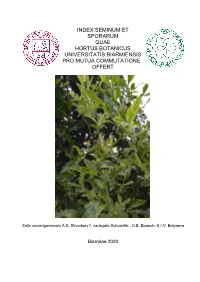
INDEX SEMINUM ET SPORARUM QUAE HORTUS BOTANICUS UNIVERSITATIS BIARMIENSIS PRO MUTUA COMMUTATIONE OFFERT Salix recurvigemmata A.K. Skvortsov f. variegata Schumikh., O.E. Epanch. & I.V. Belyaeva Biarmiae 2020 Federal State Autonomous Educational Institution of Higher Education «Perm State National Research University», A.G. Genkel Botanical Garden ______________________________________________________________________________________ СПИСОК СЕМЯН И СПОР, ПРЕДЛАГАЕМЫХ ДЛЯ ОБМЕНА БОТАНИЧЕСКИМ САДОМ ИМЕНИ А.Г. ГЕНКЕЛЯ ПЕРМСКОГО ГОСУДАРСТВЕННОГО НАЦИОНАЛЬНОГО ИССЛЕДОВАТЕЛЬСКОГО УНИВЕРСИТЕТА Syringa vulgaris L. ‘Красавица Москвы’ Пермь 2020 Index Seminum 2020 2 Federal State Autonomous Educational Institution of Higher Education «Perm State National Research University», A.G. Genkel Botanical Garden ______________________________________________________________________________________ Дорогие коллеги! Ботанический сад Пермского государственного национального исследовательского университета был создан в 1922 г. по инициативе и под руководством проф. А.Г. Генкеля. Здесь работали известные ученые – ботаники Д.А. Сабинин, В.И. Баранов, Е.А. Павский, внесшие своими исследованиями большой вклад в развитие биологических наук на Урале. В настоящее время Ботанический сад имени А.Г. Генкеля входит в состав регионального Совета ботанических садов Урала и Поволжья, Совет ботанических садов России, имеет статус научного учреждения и особо охраняемой природной территории. Основными научными направлениями работы являются: интродукция и акклиматизация растений, -

Broadleigh Gardens 2014 Spring List
Broadleigh Gardens 2014 Spring list MAIL ORDER • 01823 286231 Bishops Hull • Taunton • Somerset TA4 1AE www.broadleighbulbs.co.uk Specialists in small bulbs Broadleigh Gardens Bishops Hull, Taunton, Somerset TA4 1AE Telephone: 01823 286231 Fax: 01823 323646 www.broadleighbulbs.co.uk “...they think warm days will never cease” aving been asked about my ‘retirement’ after Chelsea I thought you might like to see one of Hthe growing grandsons with the growing plants. The species peony collection is also growing and we hope Iris Double Lament Lilium Friso to have sufficient to offer more varieties soon. Things never stand still and one of the consequences of not doing Chelsea is that we no longer need some of the large show plants so this year we are able to offer the evergreen Dianella tasmanica (page 12) with its extraordinary blue berries. Some of our plants did not enjoy the wonderful summer as much as we did but the Schizostylis were an eye opener. They are stream side plants from southern Africa so we think of them as wanting dampish soils but forget that The youngest grandson - but Eucomis pole-evansii is winning! they experience seasonal rainfall and very hot summers. They literally blossomed and are still in full flower as I varieties are grown in an open field so we know they are write this in mid November. They are perfect to keep the hardy and we lift plants for sale. There are many more interest going into autumn I grow them in my dry ditch varieties on the website. with iris and hostas. -

Phylogenetic Analysis of Vitaceae Based on Plastid Sequence Data
PHYLOGENETIC ANALYSIS OF VITACEAE BASED ON PLASTID SEQUENCE DATA by PAUL NAUDE Dissertation submitted in fulfilment of the requirements for the degree MAGISTER SCIENTAE in BOTANY in the FACULTY OF SCIENCE at the UNIVERSITY OF JOHANNESBURG SUPERVISOR: DR. M. VAN DER BANK December 2005 I declare that this dissertation has been composed by myself and the work contained within, unless otherwise stated, is my own Paul Naude (December 2005) TABLE OF CONTENTS Table of Contents Abstract iii Index of Figures iv Index of Tables vii Author Abbreviations viii Acknowledgements ix CHAPTER 1 GENERAL INTRODUCTION 1 1.1 Vitaceae 1 1.2 Genera of Vitaceae 6 1.2.1 Vitis 6 1.2.2 Cayratia 7 1.2.3 Cissus 8 1.2.4 Cyphostemma 9 1.2.5 Clematocissus 9 1.2.6 Ampelopsis 10 1.2.7 Ampelocissus 11 1.2.8 Parthenocissus 11 1.2.9 Rhoicissus 12 1.2.10 Tetrastigma 13 1.3 The genus Leea 13 1.4 Previous taxonomic studies on Vitaceae 14 1.5 Main objectives 18 CHAPTER 2 MATERIALS AND METHODS 21 2.1 DNA extraction and purification 21 2.2 Primer trail 21 2.3 PCR amplification 21 2.4 Cycle sequencing 22 2.5 Sequence alignment 22 2.6 Sequencing analysis 23 TABLE OF CONTENTS CHAPTER 3 RESULTS 32 3.1 Results from primer trail 32 3.2 Statistical results 32 3.3 Plastid region results 34 3.3.1 rpL 16 34 3.3.2 accD-psa1 34 3.3.3 rbcL 34 3.3.4 trnL-F 34 3.3.5 Combined data 34 CHAPTER 4 DISCUSSION AND CONCLUSIONS 42 4.1 Molecular evolution 42 4.2 Morphological characters 42 4.3 Previous taxonomic studies 45 4.4 Conclusions 46 CHAPTER 5 REFERENCES 48 APPENDIX STATISTICAL ANALYSIS OF DATA 59 ii ABSTRACT Five plastid regions as source for phylogenetic information were used to investigate the relationships among ten genera of Vitaceae. -
Feed Value of Native Forages of the Tibetan Plateau of China R.J
http://www.paper.edu.cn Animal Feed Science and Technology 80 (1999) 101±113 Feed value of native forages of the Tibetan Plateau of China R.J. Longa, S.O. Aporib, F.B. Castroc,*, E.R. érskovc aThe Royal Society Fellowship Grant, Gansu Agricultural University, Lanzhou, China bCommonwealth Fellowship Grant, University of Cape Coast, Cape Coast, Ghana cRowett Research Institute, Bucksburn, Aberdeen, AB21 9SB, UK Received 25 August 1998; received in revised form 2 March 1999; accepted 29 March 1999 Abstract The nutritive value of 22 native forages consisting of sedge, grass, forb and shrub species harvested in August, September and October from the Tibetan Plateau of China was assessed by using chemical, in sacco degradability and in vitro gas production analyses. Generally, data from the study showed that metabolizable energy value (ME) as estimated by in vitro gas production and chemical composition data decreased with maturity. Forb forages had the highest ME value (9.18 MJ/kg) and grasses the lowest (8.74 MJ/kg). ME value of grasses showed a sharp decrease from August to September, then it remained constant. Other forages showed a linear decrease of ME value with maturity. The relative decrease in the content of nitrogen available for microbial degradation (degradable N g/kg DOM) with maturity was similar for sedge, grass and forb species. Grazing of sedges and forbs in mixed communities of grasses may be important for supplying extra nitrogen for microbial fermentation and increasing efficiency of utilisation of grasses. Data from in vitro gas production completed in presence of polyethylene-glycol 4000 (PEG), a phenolic-related binding agent, showed that some species of sedges, forbs and shrub might contain large amounts of inhibitory compounds to rumen microbes.