Connecticut College Alumnae News, March 1964
Total Page:16
File Type:pdf, Size:1020Kb
Load more
Recommended publications
-

The Rhinehart Collection Rhinehart The
The The Rhinehart Collection Spine width: 0.297 inches Adjust as needed The Rhinehart Collection at appalachian state university at appalachian state university appalachian state at An Annotated Bibliography Volume II John higby Vol. II boone, north carolina John John h igby The Rhinehart Collection i Bill and Maureen Rhinehart in their library at home. ii The Rhinehart Collection at appalachian state university An Annotated Bibliography Volume II John Higby Carol Grotnes Belk Library Appalachian State University Boone, North Carolina 2011 iii International Standard Book Number: 0-000-00000-0 Library of Congress Catalog Number: 0-00000 Carol Grotnes Belk Library, Appalachian State University, Boone, North Carolina 28608 © 2011 by Appalachian State University. All rights reserved. First Edition published 2011 Designed and typeset by Ed Gaither, Office of Printing and Publications. The text face and ornaments are Adobe Caslon, a revival by designer Carol Twombly of typefaces created by English printer William Caslon in the 18th century. The decorative initials are Zallman Caps. The paper is Carnival Smooth from Smart Papers. It is of archival quality, acid-free and pH neutral. printed in the united states of america iv Foreword he books annotated in this catalogue might be regarded as forming an entity called Rhinehart II, a further gift of material embodying British T history, literature, and culture that the Rhineharts have chosen to add to the collection already sheltered in Belk Library. The books of present concern, diverse in their -

'The Publishers of the 1723 Book of Constitutions', AQC 121 (2008)
The Publishers of the 1723 Book of Constitutions Andrew Prescott he advertisements in the issue of the London newspaper, The Evening Post, for 23 February 1723 were mostly for recently published books, including a new edition of the celebrated directory originally compiled by John Chamberlayne, Magnae Britanniae Notitia, and books offering a new cure for scurvy and advice Tfor those with consumption. Among the advertisements for new books in The Evening Post of 23 February 1723 was the following: This Day is publiſh’d, † || § The CONSTITUTIONS of the FREE- MASONS, containing the Hiſtory, Charges, Regulations, &c., of that moſt Ancient and Right Worſhipful Fraternity, for the Uſe of the Lodges. Dedicated to his Grace the Duke of Montagu the laſt Grand Maſter, by Order of his Grace the Duke of Wharton, the preſent Grand Maſter, Authoriz’d by the Grand Lodge of Maſters and War- dens at the Quarterly Communication. Ordered to be publiſh’d and recommended to the Brethren by the Grand Maſter and his Deputy. Printed for J. Senex, and J. Hooke, both over againſt St Dunſtan’s Church, Fleet-ſtreet. An advertisement in similar terms, also stating that the Constitutions had been pub- lished ‘that day’, appeared in The Post Boy of 26 February, 5 March and 12 March 1723 Volume 121, 2008 147 Andrew J. Prescott and TheLondon Journal of 9 March and 16 March 1723. The advertisement (modified to ‘just publish’d’) continued to appear in The London Journal until 13 April 1723. The publication of The Constitutions of the Free-Masons, or the Book of Constitutions as it has become generally known, was a fundamental event in the development of Grand Lodge Freemasonry, and the book remains an indispensable source for the investigation of the growth of Freemasonry in the first half of the eighteenth century. -

UNITED STATES DISTRICT COURT NORTHERN DISTRICT of INDIANA SOUTH BEND DIVISION in Re FEDEX GROUND PACKAGE SYSTEM, INC., EMPLOYMEN
USDC IN/ND case 3:05-md-00527-RLM-MGG document 3279 filed 03/22/19 page 1 of 354 UNITED STATES DISTRICT COURT NORTHERN DISTRICT OF INDIANA SOUTH BEND DIVISION ) Case No. 3:05-MD-527 RLM In re FEDEX GROUND PACKAGE ) (MDL 1700) SYSTEM, INC., EMPLOYMENT ) PRACTICES LITIGATION ) ) ) THIS DOCUMENT RELATES TO: ) ) Carlene Craig, et. al. v. FedEx Case No. 3:05-cv-530 RLM ) Ground Package Systems, Inc., ) ) PROPOSED FINAL APPROVAL ORDER This matter came before the Court for hearing on March 11, 2019, to consider final approval of the proposed ERISA Class Action Settlement reached by and between Plaintiffs Leo Rittenhouse, Jeff Bramlage, Lawrence Liable, Kent Whistler, Mike Moore, Keith Berry, Matthew Cook, Heidi Law, Sylvia O’Brien, Neal Bergkamp, and Dominic Lupo1 (collectively, “the Named Plaintiffs”), on behalf of themselves and the Certified Class, and Defendant FedEx Ground Package System, Inc. (“FXG”) (collectively, “the Parties”), the terms of which Settlement are set forth in the Class Action Settlement Agreement (the “Settlement Agreement”) attached as Exhibit A to the Joint Declaration of Co-Lead Counsel in support of Preliminary Approval of the Kansas Class Action 1 Carlene Craig withdrew as a Named Plaintiff on November 29, 2006. See MDL Doc. No. 409. Named Plaintiffs Ronald Perry and Alan Pacheco are not movants for final approval and filed an objection [MDL Doc. Nos. 3251/3261]. USDC IN/ND case 3:05-md-00527-RLM-MGG document 3279 filed 03/22/19 page 2 of 354 Settlement [MDL Doc. No. 3154-1]. Also before the Court is ERISA Plaintiffs’ Unopposed Motion for Attorney’s Fees and for Payment of Service Awards to the Named Plaintiffs, filed with the Court on October 19, 2018 [MDL Doc. -
FALL 2019 2 | from the Executive Director
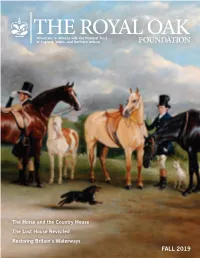
Americans in Alliance with the National Trust of England, Wales, and Northern Ireland The Horse and the Country House The Lost House Revisited Restoring Britain’s Waterways FALL 2019 2 | From the Executive Director THE ROYAL OAK FOUNDATION 20 West 44th Street, Suite 606 New York, New York 10036-6603 212.480.2889 | www.royal-oak.org BOARD OF DIRECTORS Chairman Lynne L. Rickabaugh Vice Chairman Renee Nichols Tucei Treasurer Susan Ollila Montacute House in Somerset is a masterpiece of Elizabethan Renaissance architecture and design. Secretary Royal Oak members visited the house on this year’s annual garden tour. Prof. Sir David Cannadine Directors Cheryl Beall Michael A. Boyd Dear Members & Friends, Michael J. Brown Though we are nearing the final quarter of 2019, our year is far from over. On November Susan Chapman 6, we will host our fall benefit dinner at the Century Association in New York City. This Constance M. Cincotta year’s event will honor the Duke of Devonshire for his contribution to the preservation Robert C. Daum of British culture and the 10 year restoration of Chatsworth. Sir David Cannadine will Tracey A. Dedrick join in discussion with the Duke about his project to restore Chatsworth to its full glory Anne Blackwell Ervin and it promises to be wonderful evening. Pamela K. Hull Linda A. Kelly We are well on our way to achieving our goal of raising $250,000 to preserve the library at Hilary McGrady Blickling Hall. This is one of the most significant libraries under the care of the National Eric J. -
The Architecture of Joseph Michael Gandy (1771-1843) and Sir John Soane (1753-1837): an Exploration Into the Masonic and Occult Imagination of the Late Enlightenment
University of Pennsylvania ScholarlyCommons Publicly Accessible Penn Dissertations 2003 The Architecture of Joseph Michael Gandy (1771-1843) and Sir John Soane (1753-1837): An Exploration Into the Masonic and Occult Imagination of the Late Enlightenment Terrance Gerard Galvin University of Pennsylvania Follow this and additional works at: https://repository.upenn.edu/edissertations Part of the Architecture Commons, European History Commons, Social and Behavioral Sciences Commons, and the Theory and Criticism Commons Recommended Citation Galvin, Terrance Gerard, "The Architecture of Joseph Michael Gandy (1771-1843) and Sir John Soane (1753-1837): An Exploration Into the Masonic and Occult Imagination of the Late Enlightenment" (2003). Publicly Accessible Penn Dissertations. 996. https://repository.upenn.edu/edissertations/996 This paper is posted at ScholarlyCommons. https://repository.upenn.edu/edissertations/996 For more information, please contact repository@pobox.upenn.edu. The Architecture of Joseph Michael Gandy (1771-1843) and Sir John Soane (1753-1837): An Exploration Into the Masonic and Occult Imagination of the Late Enlightenment Abstract In examining select works of English architects Joseph Michael Gandy and Sir John Soane, this dissertation is intended to bring to light several important parallels between architectural theory and freemasonry during the late Enlightenment. Both architects developed architectural theories regarding the universal origins of architecture in an attempt to establish order as well as transcend the emerging historicism of the early nineteenth century. There are strong parallels between Soane's use of architectural narrative and his discussion of architectural 'model' in relation to Gandy's understanding of 'trans-historical' architecture. The primary textual sources discussed in this thesis include Soane's Lectures on Architecture, delivered at the Royal Academy from 1809 to 1836, and Gandy's unpublished treatise entitled the Art, Philosophy, and Science of Architecture, circa 1826. -

Graves of Artists and Architects Buried There
Graves of architects and artists in the Chiswick Churchyard and Old Burial Ground A noteworthy feature of the burial ground associated with St Nicholas, Chiswick, is the remarkable number of graves of artists and architects buried there. This article records the graves of an important eighteenth-century architect and garden designer, a respected bricklayer and site manager, two well-regarded Victorian sculptors, and no fewer than six painters and printmakers. In comparison, I know of only one literary figure who was buried there: the maverick Italian poet and patriot, Ugo Foscolo (1778–1827). But perhaps he does not count, since his bones were exhumed in 1871 and returned to Italy for re-burial in Sta Croce, Florence. The churchyard harbours the tomb of only one theatrical figure, Charles Holland (1733–1769), but – as far as I am aware – of not one single composer. Two possible reasons for this bias in favour of the visual arts may be connected with two leading figures in the British eighteenth-century art world who were associated with St Nicholas, Chiswick. Lord Burlington (1694–1753) and William Hogarth (1697–1764) were close contemporaries, although they seldom if ever saw eye to eye. Lord Burlington was the architect of his ground- breaking Chiswick Villa, and he was also a celebrated aesthete and connoisseur. During highly profitable visits to Italy in the second decade, he amassed an important collection of Italian Renaissance and Baroque paintings. Chiswick Villa was designed in part specifically to display this collection, which enhanced Burlington’s status in the British art scene. His semi-permanent residence at Chiswick in the last 20 or so years of his life, and the inheritance of his estate by the Dukes of Devonshire from 1764, perhaps attracted other artists to the area, seeking aristocratic and royal patronage. -
Download the Final Program
Twelfth International Conference on Design Principles & Practices “No Boundaries Design” ELISAVA Barcelona School of Design and Engineering | Barcelona, Spain | 5–7 March 2018 www.designprinciplesandpractices.com www.facebook.com/DesignPrinciplesAndPractices @designpap | #DPP18 Twelfth International Conference on Design Principles & Practices www.designprinciplesandpractices.com First published in 2018 in Champaign, Illinois, USA by Common Ground Research Networks, NFP www.cgnetworks.org © 2018 Common Ground Research Networks All rights reserved. Apart from fair dealing for the purpose of study, research, criticism, or review as permitted under the applicable copyright legislation, no part of this work may be reproduced by any process without written permission from the publisher. For permissions and other inquiries, please contact support@cgnetworks.org. Common Ground Research Networks may at times take pictures of plenary sessions, presentation rooms, and conference activities which may be used on Common Ground’s various social media sites or websites. By attending this conference, you consent and hereby grant permission to Common Ground to use pictures which may contain your appearance at this event. Design Principles & Practices Table of Contents Welcome Letter - ELISAVA Barcelona School of Design and Engineering .........................................................1 Welcome Letter - Common Ground Research Networks .....................................................................................3 About Common Ground ........................................................................................................................................5 -
Edward Hawke Locker and the Foundation of The
EDWARD HAWKE LOCKER AND THE FOUNDATION OF THE NATIONAL GALLERY OF NAVAL ART (c. 1795-1845) CICELY ROBINSON TWO VOLUMES VOLUME II - ILLUSTRATIONS PhD UNIVERSITY OF YORK HISTORY OF ART DECEMBER 2013 2 1. Canaletto, Greenwich Hospital from the North Bank of the Thames, c.1752-3, NMM BHC1827, Greenwich. Oil on canvas, 68.6 x 108.6 cm. 3 2. The Painted Hall, Greenwich Hospital. 4 3. John Scarlett Davis, The Painted Hall, Greenwich, 1830, NMM, Greenwich. Pencil and grey-blue wash, 14¾ x 16¾ in. (37.5 x 42.5 cm). 5 4. James Thornhill, The Main Hall Ceiling of the Painted Hall: King William and Queen Mary attended by Kingly Virtues. 6 5. James Thornhill, Detail of the main hall ceiling: King William and Queen Mary. 7 6. James Thornhill, Detail of the upper hall ceiling: Queen Anne and George, Prince of Denmark. 8 7. James Thornhill, Detail of the south wall of the upper hall: The Arrival of William III at Torbay. 9 8. James Thornhill, Detail of the north wall of the upper hall: The Arrival of George I at Greenwich. 10 9. James Thornhill, West Wall of the Upper Hall: George I receiving the sceptre, with Prince Frederick leaning on his knee, and the three young princesses. 11 10. James Thornhill, Detail of the west wall of the Upper Hall: Personification of Naval Victory 12 11. James Thornhill, Detail of the main hall ceiling: British man-of-war, flying the ensign, at the bottom and a captured Spanish galleon at top. 13 12. ‘The Painted Hall’ published in William Shoberl’s A Summer’s Day at Greenwich, (London, 1840) 14 13. -

Yale in London: Spring 2015
1 BRST196/HIST 254J Keith Wrightson Time and Place in Early Modern England Yale in London: Spring 2015 This seminar explores perceptions of time and place in England, c. 1500-1800, and their relationship to both personal and social identity. These issues are approached using appropriate theoretical and substantive readings and both visual and textual primary sources. Particular attention will be given to the use of visual images as historical evidence. Specific issues addressed include the development of cartography, chorography and antiquarianism; conventions of time reckoning and the dating of events; perceptions of the life course; the creation of social memory and historical narratives; representations of social place; agrarian change and the transformation of the landscape; the impact of the Reformation on the calendar, the landscape, and senses of the past; representations of previously unknown places and peoples, and ‘iconic’ places and their significance. Primary sources for discussion include maps and prospects; chorographical surveys; illustrated antiquarian writings; almanacs; pictorial representations of notable events; engravings; paintings (portraits; ‘country house portraits’; landscapes; ‘conversation pieces’; History Painting and ‘documentary’ works); memorials; family histories; extracts from court records. A course packet of secondary readings is available from Tyco, Broadway. The syllabus contains URLs which will guide you to primary sources which can be accessed online from Early English Books Online [EEBO] or other online collections and downloaded. A number of additional primary sources will be posted in the resources section of the Classes*v2 server. A list of suggestions for Student Presentations is appended to this syllabus. N.B. It is vital that you have Cisco AnyConnect Secure Mobility Client on your computer so that you can access Yale Library resources from London. -
Of Pi Beta Ph'
THE OF PI BETA PH'. DE£E~IBEB 1943 THE AR R OW O F PI B ETA PHI ..... ,,, ..........................................................,, ........ '10'"'''' .. """"" •• ,"',''', ..... , ........... ",,,.,,',, ............ ,,.,,'' ................. "." .... " .01.".01' .. OFFICIAl. ORGAN OF THE ~ PI BETA PHI FRATERNI1Y F ...... Y 1861 STAF F Offiu 01 Publication: 206 National Bank Bldg., Decatur 16, Ill. Arrow Edilor: AohE TAYLOR ALFORD (Mrs. T. N.), 930 Olive Ave., Coronado, Calif. AHiJWII Edilor and BIiJinnJ Manager: GLADYS WAllEN, De<atur. Ill., or 115 Robin. son Ave., San Diego, Calif. A/Jlmn. CllIb Edilor: LOITA JOHNSON W~JR (Mrs. Benjamin). 8" 6th St., Charles ton, III. Chltpl" Lei", Editor: CANDACB SECOR ARMSTRONG (Mrs. James G.), R.R. I, Box 489. Orlando, Fla. News from lillie Pigeon : BETH BRAINARD LEROY (Mrs. H. G.). 142 Forest St., Win chester, Mass. Exchanl.'s lind Col/el.e Noles: NITA DAY CARMAN (Mrs. Ernest), 761 Wilson St., Ltguna Beach, Calif. F,om Pi Phi P~nJ: MAi.]ORlE BRIGHT SHARPE (Mrs. W . E.), 945 Summerland Ave., San Pedro, Calif. "What a F,aJ"nit] Girl Thinll': CANDACE SECOR ARMSTRONG (Mrs. James G .), R.R. I, Box 489, Orlando, Fla. A"ow Filt: Pi Beta Phi Central Office, 206 Natio nal Bank Bldg., Decatur 16, III. Arrow Cont,ibutor;.' WHITNEY SWITH; MARGARElTA SPENCE DRAXE ; FLO LELAND THOMPSON; HOPE lCJ.MBROUGH MCCROSKY; 1I.Wy ELIZABETH lAsHER. VOLUME 60 December • 1943 NUMBER 2 Our Magazine Agencv Is Doing a War Service, Too! It's hard for those of us who stay at home to realize that in many parts of the world, magazines are beyond reach. We are glad to print below, therefore, portioos of an advertisement published by Tim •. -

Histories of British Art 1660-1735 Reconstruction and Transformation
HISTORIES OF BRITISH ART 1660-1735 RECONSTRUCTION AND TRANSFORMATION ABSTRACTS OF PAPERS Day 1 (Thursday) Panel 1 Netherlandish influences on British Art Sander Karst (University of Utrecht) ‘The participation of Dutch Migrant artists in the London art market at the end of the seventeenth century’ In this paper presentation I will focus on the many Dutch migrant artists who participated in the London art market at the end of the seventeenth century. During this period London started to take over from Amsterdam as Europe’s most important economic centre. Due to an economic depression in the Dutch Republic, the demand for paintings in the republic decreased, the Dutch art market collapsed and many artists were forced to seek their fortune abroad. Most of them migrated to London. In London these Dutch artists found a new market for their paintings and anticipated the increasing demand for luxury products among London’s inhabitants. Whereas in the Dutch Republic pictures auctions had been organised from the early seventeenth century onwards and had enabled artists to produce their paintings on speculation, in London similar market conditions only began to emerge during the 1670s. For my masterthesis I made an analysis of as set of 132 London auction catalogues which cover the period between May 1689 and March 1692 (British Library, shelfmark 1402.g.1). This analysis demonstrates that 49% percent of all paintings which were offered at these auctions, and which were attributed to a specific artists, were produced by Dutch migrant artists. 1 During my paper presentation I will explain this analysis and will argue that the market for contemporary paintings was dominated by London-based Dutch artists. -

Newsletter 171 28/7/08 10:18 AM Page 1
Newsletter 171 28/7/08 10:18 AM Page 1 THE FURNITURE HISTORY SOCIETY Newsletter No. 171 August 2008 ‘SUCH COSTLY FURNITURE, SUCH BEDS OF STATE’*: REFLECTIONS ON THE CONSERVATION AND RE-DISPLAY OF QUEEN CHARLOTTE’S STATE BED This Summer and Autumn visitors to Hampton Court will have the opportunity to see Queen Charlotte’s magnificent bed, from the Royal Collection, for the first time in years as major conservation work reaches completion (figure 1). This work has a complex and chequered history of its own: what began in the 1950s as good, but old fashioned, restoration work transformed into conservation, only to be interrupted by the devastating fire of 1986. One of the benefits of this drawn-out process is the new information it has produced about the bed’s enigmatic past. The bed comes near the end of the line of great four-poster state beds in England. It is a relic of a bygone age of elaborate court etiquette and was probably never slept in. Within years of its creation the Royal Household had been drastically reformed and even the very proper George III and Queen Charlotte had little practical use for such empty show. As well as being a significant expression of the queen’s individual patronage and taste, its design is in the very latest neo-classical style. Unlike many eighteenth-century royal objects the precise origins of the bed are obscured among the records of the queen’s private purse (the choice of funds is significant as it betrays the Queen’s close personal interest).