Storer Full Vita September 2011NBNP
Total Page:16
File Type:pdf, Size:1020Kb
Load more
Recommended publications
-
Diversity and Toxigenicity of Fungi That Cause Pineapple Fruitlet Core Rot
toxins Article Diversity and Toxigenicity of Fungi that Cause Pineapple Fruitlet Core Rot Bastien Barral 1,2,* , Marc Chillet 1,2, Anna Doizy 3 , Maeva Grassi 1, Laetitia Ragot 1, Mathieu Léchaudel 1,4, Noel Durand 1,5, Lindy Joy Rose 6 , Altus Viljoen 6 and Sabine Schorr-Galindo 1 1 Qualisud, Université de Montpellier, CIRAD, Montpellier SupAgro, Univ d’Avignon, Univ de La Reunion, F-34398 Montpellier, France; marc.chillet@cirad.fr (M.C.); grassimaeva@gmail.com (M.G.); laetitiaragot@ymail.com (L.R.); mathieu.lechaudel@cirad.fr (M.L.); noel.durand@cirad.fr (N.D.); sabine.galindo@umontpellier.fr (S.S.-G.) 2 CIRAD, UMR Qualisud, F-97410 Saint-Pierre, Reunion, France 3 CIRAD, UMR PVBMT, F-97410 Saint-Pierre, Reunion, France; doizy.anna@gmail.com 4 CIRAD, UMR Qualisud, F-97130 Capesterre-Belle-Eau, Guadeloupe, France 5 CIRAD, UMR Qualisud, F-34398 Montpellier, France 6 Department of Plant Pathology, Stellenbosch University, Private Bag X1, Matieland 7600, South Africa; lindym@sun.ac.za (L.J.R.); altus@sun.ac.za (A.V.) * Correspondence: bastien.barral@cirad.fr; Tel.: +262-2-62-49-27-88 Received: 14 April 2020; Accepted: 14 May 2020; Published: 21 May 2020 Abstract: The identity of the fungi responsible for fruitlet core rot (FCR) disease in pineapple has been the subject of investigation for some time. This study describes the diversity and toxigenic potential of fungal species causing FCR in La Reunion, an island in the Indian Ocean. One-hundred-and-fifty fungal isolates were obtained from infected and healthy fruitlets on Reunion Island and exclusively correspond to two genera of fungi: Fusarium and Talaromyces. -

Silvicultural Systems for Restoration of Mahogany in Degraded Landscapes in Africa: Influence of Mixed Rainforest Plantation on Growth and Pest Damage
Open Journal of Forestry, 2014, 4, 414-425 Published Online July 2014 in SciRes. http://www.scirp.org/journal/ojf http://dx.doi.org/10.4236/ojf.2014.44046 Silvicultural Systems for Restoration of Mahogany in Degraded Landscapes in Africa: Influence of Mixed Rainforest Plantation on Growth and Pest Damage Emmanuel Opuni-Frimpong1, Nana Yaa Nyarko-Duah2, Ebenezer J. D. Belford2, Andrew J. Storer3 1Forestry Research Institute of Ghana, Kumasi, Ghana 2Faculty of Biosciences, Kwame Nkrumah University of Science and Technology, Kumasi, Ghana 3School of Forest Resources and Environmental Science, Michigan Technological University, Townsend, USA Email: eofrimpon@csir-forig.org.gh, eopunifr@mtu.edu Received 22 April 2014; revised 3 June 2014; accepted 4 July 2014 Copyright © 2014 by authors and Scientific Research Publishing Inc. This work is licensed under the Creative Commons Attribution International License (CC BY). http://creativecommons.org/licenses/by/4.0/ Abstract African mahogany, one of the world’s most valuable timber species is threatened by over-exploita- tion in natural forests and failure of plantations due to attacks by the shoot borer Hypsipyla ro- busta. Mixed-species plantations has been reported to be an effective component of integrated pest management of major pest in other crops; but there is very limited empirical data on its use for managing Hypsipyla in mahogany mixed stands in West Africa. The aim of this study was to as- sess the effect of mixed-species stands as management intervention, on the growth of Khaya gran- difoliola and Khaya ivorensis in relation to Hypsipyla robusta attack in a 10 ha experimental plan- tation in the wet evergreen forest type in Ghana. -

Field Bioassays of Synthetic Pheromones and Host Monoterpenes for Conophthorus Coniperda (Coleoptera: Scolytidae)
PHYSIOLXICAL AND CHEMICAL ECOLOGY Field Bioassays of Synthetic Pheromones and Host Monoterpenes for Conophthorus coniperda (Coleoptera: Scolytidae) PETER DE GROOT,’ GART L. DEBARR,3 AND GORAN BIRGERSSON’,* Environ. Entomol. Z(2): 38-W (1998) ABSTRACT Four major monoterpenes, (i-)-cu-pinene, 1 (S)-( -)-/3-pinene, (R)-( t )-limonene, and myrcene are found in the cones of eastern white pines, Pinusstrobus L. Mixtures ofthese, as well as. u-pinene or P-pinene alone. increased catches of male white pine cone beetles, Conophthorus coniperda (Schwartz). in traps baited xvith the female sex pheromone, ( z)-trans-pityol. The mono- terpenes by themsekes as mistures or individually (a-pinene, /3-pinene) were not attractants for males or females. Traps baited with I r )-tram-pityol and wpinene caught as many, or significantly more beetles than those baited with pity01 and a four monoterpene mixture (1:l:l:l) used in seed orch‘ards in North Carolina, Ohio. and Virginia. Three beetle-produced compounds, conophthorin, tram-pinocarveol. and myrtenol did not enhance catches of males or females in ( z)-trans-pityol- baited traps. Racemic E-(k)- conophthorin. E-( -)- conophthorin, and E-( +)- conophthorin sig- nificantly reduced catches of males in traps baited with ( -c)-tran.s-pityol alone. Female C. coniperda were not attracted to any ofthe host- or beetle-produced compounds tested. The study demonstrated that traps \vith baits releasing (z)-t,ans-pityol at about lmgiwk with ( z)-a-pinene (98%pure) are potentially valuable tools for C conipwda pest management. Baited traps can be used to monitor C. cmipwdn populations or possibl>. to reduce seed losses in a beetle trap-out control strategy. -
Effects of Landscape, Intraguild Interactions, and a Neonicotinoid on Natural Enemy and Pest Interactions in Soybeans
University of Kentucky UKnowledge Theses and Dissertations--Entomology Entomology 2016 EFFECTS OF LANDSCAPE, INTRAGUILD INTERACTIONS, AND A NEONICOTINOID ON NATURAL ENEMY AND PEST INTERACTIONS IN SOYBEANS Hannah J. Penn University of Kentucky, hmc224@uky.edu Author ORCID Identifier: http://orcid.org/0000-0002-3692-5991 Digital Object Identifier: https://doi.org/10.13023/ETD.2016.441 Right click to open a feedback form in a new tab to let us know how this document benefits ou.y Recommended Citation Penn, Hannah J., "EFFECTS OF LANDSCAPE, INTRAGUILD INTERACTIONS, AND A NEONICOTINOID ON NATURAL ENEMY AND PEST INTERACTIONS IN SOYBEANS" (2016). Theses and Dissertations-- Entomology. 30. https://uknowledge.uky.edu/entomology_etds/30 This Doctoral Dissertation is brought to you for free and open access by the Entomology at UKnowledge. It has been accepted for inclusion in Theses and Dissertations--Entomology by an authorized administrator of UKnowledge. For more information, please contact UKnowledge@lsv.uky.edu. STUDENT AGREEMENT: I represent that my thesis or dissertation and abstract are my original work. Proper attribution has been given to all outside sources. I understand that I am solely responsible for obtaining any needed copyright permissions. I have obtained needed written permission statement(s) from the owner(s) of each third-party copyrighted matter to be included in my work, allowing electronic distribution (if such use is not permitted by the fair use doctrine) which will be submitted to UKnowledge as Additional File. I hereby grant to The University of Kentucky and its agents the irrevocable, non-exclusive, and royalty-free license to archive and make accessible my work in whole or in part in all forms of media, now or hereafter known. -

Hypsipyla SHOOT BORERS in MELIACEAE: CURRENT STATUS
o Proceedings of the Second Annual Forestry Symposium 1996: Management and Sustainable Utilization of Forest Resources, Sri Lanka, 6-7 December 1996. (Eds. Amarasekera, H S, Ranasinghe, D M S H K and Finlayson, W). Published by Deparlment of Forestry and Environmental Science, University of Sri Jayewardenepura, Sri Lanka (1998) Hypsipyla SHOOT BORERS IN MELIACEAE: CURRENT STATUS Jayanthi P. Edirisinghe Department of Zoology. University ofPeradeniya Abstract A briefofan international meeting held in Kandy in August /996 to discuss the present situation with regard 10 this insects. II is suggested that the relatively 10111 level of' attack in Sri Lanka may he due to good overhead shade were the trees have been planted Introduction The first international workshop on Hypsipyla shoot borers in Meliaceae was held in Kandy in August 1996, with 18 countries participating. The objective was to assess the work done in the recent past on Hypsipyla shoot borers and discuss future priorities. This paper highlights some of the aspects that were discussed. The family Mcliaceae occurs throughout the tropics and includes many of the world's finest cabinet timbers. such as Swictenia (mahogany). Khava (African mahogany). TOOI/O and Cedrela ('"cedars"). They occur naturally or arc planted in sonic 25-:\0 countries. Two Hypsipyla species. H grandel!a (Zeller) and If. robusta (Moore). arc the most important pests of the Meliaceae. They have a distinct distribution. with II. grandel/a confined to the New World and II. robusta to Africa. Asia. Australia. and the Pacific islands. Table I lists the species grown in the countries that participated at the workshop. -

Acaricidal Activity of Fusarium Subglutinans 12A on Tetranychus Urticae Koch (Acari: Tetranychidae
Ziraat Fakültesi Dergisi 14 (1):83-88, 2019 ISSN 1304-9984, e-ISSN 2687-3419 Araştırma Makalesi Acaricidal activity of Fusarium subglutinans 12A on Tetranychus urticae Koch (Acari: Tetranychidae Asiye UZUN1* Ozan DEMİRÖZER1 Ş. Evrim ARICI1 Isparta University of Applied Sciences, Faculty of Agricultural Sciences and Technologies, Department of Plant Protection, 32260, Isparta/Turkey *Corresponding author: asiyeuzun@isparta.edu.tr The arrival date:01.03.2019, Acceptance date: 28.05.2019 Abstract: In this study, efficacy of different spore concentrations of Fusarium subglutinans 12A isolate on Tetranychus urticae Koch females was investigated. The experimental design was a complete randomized block and all trials were conducted in five replications. In the study, 1x10⁴, 1x10⁶ and 1x10⁸ spores/ml spore concentrations were applied to shell bean leaves that were prepared according to leaf disc method spraying in droplets at 1 atm pressure. Observations on mortality of females and also mycosis developing on dead individuals were conducted on the 3rd, 5th, and 7th days after application. According to the study results, mortality rates were higher than control at three spore concentrations, but they did not differ from each other (F 44,239; df 3; P> 0.05). Mycosis were not significant at three spore concentrations (F 2,387; df 2; P> 0.05). Moreover, it was determined that the time-dependent mortality rate after application of Fusarium subglutinans 12A isolate was the highest on the 7th day at all spore concentrations. Keywords: Biological control, enthomopathogen fungi, two-spotted spider mite Tetranychus urticae Koch (Acari: Tetranychidae) üzerinde Fusarium subglutinans 12A'nın akarisidal aktivitesi Özet: Bu çalışmada, Fusarium subglutinans 12A izolatının farklı spor konsantrasyonlarının Tetranychus urticae Koch dişi bireyleri üzerindeki etkililiği araştırılmıştır. -
Fusarium Awaxy Fungal Planet Description Sheets 363
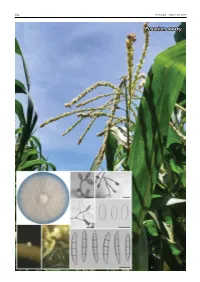
362 Persoonia – Volume 43, 2019 Fusarium awaxy Fungal Planet description sheets 363 Fungal Planet 1012 – 18 December 2019 Fusarium awaxy Petters-Vandresen, Galli-Terasawa, Terasawa & Glienke, sp. nov. Etymology. Named after the Tupi-Guarani word for maize, ‘awaxy’, Additionally, based on a BLAST search and a phylogenetic referring to the substrate (maize ears and stalks) and geographical location analysis using tef1 sequences, other strains, which were mis- (Arapoti and Guarapuava cities in Paraná, as these names come from the identified as F. subglutinans, are now identified as F. awaxy. Tupi-Guarani language). Such strains include isolates from Zea mays from China (Gen- Classification — Nectriaceae, Hypocreales, Hypocreomyce- Bank KT716223; Identities = 630/630 (100 %)) (Zhang et al. tidae, Sordariomycetes. 2016), South Korea (GenBank JX867945; Identities = 641/641 (100 %)) (Kim et al. 2012), Argentina (GenBank MG857113; On synthetic nutrient agar (SNA) with carnation leaves: Micro- Identities = 641/641 (100 %)) (Martinez et al. unpubl. data) and conidia forming abundantly in false heads in aerial mycelium, Brazil (GenBank KP336408; Identities = 545/545 (100 %)) arising in monophialides and polyphialides, oval, 7.8–16 µm (Faria et al. 2012), as well as one strain isolated from Sorghum (x̅ = 11.7 µm) long, 2.1–5.7 µm (x̅ = 4.4 µm) wide, aseptate. bicolor in the USA (GenBank KX681493; Identities = 634/634 Chlamydospores absent. Sporodochia tan to cream coloured, (100 %)) (Funnell-Harris et al. 2017). Furthermore, another iso- formed on the surface of carnation leaves and seldom covered late from Zea mays from South Africa (MRC 115, GenBank with aerial mycelium, occasionally formed on the surface of MH582309; Identities = 649/649 (100 %)), which was previ- carnation leaf agar (CLA) or potato dextrose agar (PDA). -
Pine Seeds Treatment with Trichoderma for Fusarium Control
Floresta e Ambiente 2019; 26(2): e20170875 https://doi.org/10.1590/2179-8087.087517 ISSN 2179-8087 (online) Original Article Silviculture Pine Seeds Treatment with Trichoderma for Fusarium Control Thaisa Wendhausen Ramos Silva1 , Alvaro Figueredo dos Santos2 , Celso Garcia Auer2 , Dauri José Tessmann3 1Seminis Vegetable Seeds Inc., Campinas/SP, Brasil 2Embrapa Florestas, Colombo/PR, Brasil 3Universidade Estadual de Maringá – UEM, Maringá/PR, Brasil ABSTRACT This study analyzes the in vitro antagonistic activity of Trichoderma sp. isolates against Fusarium subglutinans and evaluates the effect of the pine seeds treatment with Trichoderma sp. on the incidence of root rot. Twelve Trichoderma sp. isolates and two F. subglutinans isolates were included in the study. Trichoderma sp. inhibited F. subglutinans mycelial growth through direct contact with hyphae and the production of volatile antifungal compounds. Pine seeds treatment with the antagonist Trichoderma sp. reduced the incidence of root rot, increased the emergence and initial growth in the height of seedlings, and improved seedling health. Keywords: biological control, forest seeds, forest pathology. Creative Commons License. All the contents of this journal, except where otherwise noted, is licensed under a Creative Commons Attribution License. 2/8 Silva TWR, Santos AF, Auer CG, Tessmann DJ Floresta e Ambiente 2019; 26(2): e20170875 1. INTRODUCTION Limited information available on seed pathology has been pointed out as a determining factor in the low The planted pine Pinus( spp.) area in Brazil has adoption of pine seed treatment (Santos & Parisi, 2011; approximately 1.6 million hectares and is concentrated Santos et al., 2011). Seed treatment with antagonistic in the southern region (IBÁ, 2016). -

THE SIRICID WOOD WASPS of CALIFORNIA (Hymenoptera: Symphyta)
Uroce r us californ ic us Nott on, f ema 1e. BULLETIN OF THE CALIFORNIA INSECT SURVEY VOLUME 6, NO. 4 THE SIRICID WOOD WASPS OF CALIFORNIA (Hymenoptera: Symphyta) BY WOODROW W. MIDDLEKAUFF (Department of Entomology and Parasitology, University of California, Berkeley) UNIVERSITY OF CALIFORNIA PRESS BERKELEY AND LOS ANGELES 1960 BULLETIN OF THE CALIFORNIA INSECT SURVEY Editors: E. G: Linsley, S. B. Freeborn, P. D. Hurd, R. L. Usinget Volume 6, No. 4, pp. 59-78, plates 4-5, frontis. Submitted by editors October 14, 1958 Issued April 22, 1960 Price, 50 cents UNIVERSITY OF CALIFORNIA PRESS BERKELEY AND LOS ANGELES CALIFORNIA CAMBRIDGE UNIVERSITY PRESS LONDON, ENGLAND PRINTED BY OFFSET IN THE UNITED STATES OF AMERICA THE SIRICID WOOD WASPS OF CALIFORNIA (Hymenoptera: Symphyta) BY WOODROW W. MIDDLEKAUFF INTRODUCTION carpeting. Their powerful mandibles can even cut through lead sheathing. The siricid wood wasps are fairly large, cylin- These insects are widely disseminated by drical insects; usually 20 mm. or more in shipments of infested lumber or timber, and length with the head, thorax, and abdomen of the adults may not emerge until several years equal width. The antennae are long and fili- have elapsed. Movement of this lumber and form, with 14 to 30 segments. The tegulae are timber tends to complicate an understanding minute. Jn the female the last segment of the of the normal distribution pattern of the spe- abdomen bears a hornlike projection called cies. the cornus (fig. 8), whose configuration is The Nearctic species in the family were useful for taxonomic purposes. This distinc- monographed by Bradley (1913). -

The Sirex Woodwasp, Sirex Noctilio: Pest in North America May Be the Ecology, Potential Impact, and Management in the Southeastern U.S
SREF-FH-003 June 2016 woodwasp has not become a major The Sirex woodwasp, Sirex noctilio: pest in North America may be the Ecology, Potential Impact, and Management in the Southeastern U.S. many insects that are competitors or natural enemies. Some of these insects compete for resources AUTHORED BY: LAUREL J. HAAVIK AND DAVID R. COYLE (e.g. native woodwasps, bark and ambrosia beetles, and longhorned beetles) while others (e.g.parasitoids) are natural enemies and use Sirex woodwasp larvae as hosts. However, should the Sirex woodwasp arrive in the southeastern U.S., with its abundant pine plantations and areas of natural pine, this insect could easily be a major pest for the region. Researchers have monitored and tracked Sirex woodwasp populations since its discovery in North America. The most common detection tool is a flight intercept trap (Fig. 2a) baited with a synthetic chemical lure that consists of pine scents (70% α-pinene, 30% β-pinene) or actual pine branches (Fig. 2b). Woodwasps are attracted to the odors given off by the lure or cut pine branches, and as they fly toward the scent they collide with the sides of the trap and drop Figure 1. The high density of likely or confirmed pine (Pinus spp.) hosts of the Sirex woodwasp suggests the southeastern U.S. may be heavily impacted should this non-native insect become into the collection cup at the bottom. established in this region. The collection cup is usually filled with a liquid (e.g. propylene glycol) that acts as both a killing agent and Overview and Detection preservative that holds the insects until they are collected. -

A Review of the Genus Amylostereum and Its Association with Woodwasps
70 South African Journal of Science 99, January/February 2003 Review Article A review of the genus Amylostereum and its association with woodwasps B. Slippers , T.A. Coutinho , B.D. Wingfield and M.J. Wingfield Amylostereum.5–7 Today A. chailletii, A. areolatum and A. laevigatum are known to be symbionts of a variety of woodwasp species.7–9 A fascinating symbiosis exists between the fungi, Amylostereum The relationship between Amylostereum species and wood- chailletii, A. areolatum and A. laevigatum, and various species of wasps is highly evolved and has been shown to be obligatory siricid woodwasps. These intrinsic symbioses and their importance species-specific.7–10 The principal advantage of the relationship to forestry have stimulated much research in the past. The fungi for the fungus is that it is spread and effectively inoculated into have, however, often been confused or misidentified. Similarly, the new wood, during wasp oviposition.11,12 In turn the fungus rots phylogenetic relationships of the Amylostereum species with each and dries the wood, providing a suitable environment, nutrients other, as well as with other Basidiomycetes, have long been unclear. and enzymes that are important for the survival and develop- Recent studies based on molecular data have given new insight ment of the insect larvae (Fig. 1).13–17 into the taxonomy and phylogeny of the genus Amylostereum. The burrowing activity of the siricid larvae and rotting of the Molecular sequence data show that A. areolatum is most distantly wood by Amylostereum species makes this insect–fungus symbio- related to other Amylostereum species. Among the three other sis potentially harmful to host trees, which include important known Amylostereum species, A. -

Hypsipyla Shoot Borers in Meliaceae
Hypsipyla Shoot Borers in Meliaceae Proceedings of an International Workshop held at Kandy, Sri Lanka 20–23 August 1996 Editors: R.B. Floyd and C. Hauxwell Australian Centre for International Agricultural Research Canberra, 2001 i The Australian Centre for International Agricultural Research (ACIAR) was established in June 1982 by an Act of the Australian Parliament. Its mandate is to help identify agricultural problems in developing countries and to commission collaborative research between Australian and developing country researchers in fields where Australia has a special research competence. Where trade names are used this constitutes neither endorsement of nor discrimination against any product by the Centre. ACIAR PROCEEDINGS This series of publications includes the full proceedings of research workshops or symposia organised or supported by ACIAR. Numbers in this series are distributed internationally to selected individuals and scientific institutions. © Australian Centre for International Agricultural Research, GPO Box 1571, Canberra, ACT 2601 Floyd, R.B. and Hauxwell, C., ed. 2001. Hypsipyla Shoot Borers in Meliaceae. Proceedings of an International Workshop, Kandy, Sri Lanka 20–23 August 1996. ACIAR Proceedings No. 97, 189pp. ISBN 0 642 45621 6 (print) ISBN 0 642 45624 0 (electronic) Editorial management: P.W. Lynch Production editing: PK Editorial Services Pty Ltd, Brisbane Typesetting, page layout and illustrations: Sun Photoset Pty Ltd, Brisbane Printing: Brown Prior Anderson, Melbourne ii CONTENTS Foreword v Country Reports Hypsipyla Shoot Borers of Meliaceae in Sri Lanka D. Tilakaratna 3 Hypsipyla Shoot Borers of Meliaceae in India R.V. Varma 7 Hypsipyla Shoot Borers of Meliaceae in Bangladesh M.W. Baksha 10 Hypsipyla Shoot Borers of Meliaceae in Philippines E.B.