AGAINST ORTHODOXY Studies in Nationalism
Total Page:16
File Type:pdf, Size:1020Kb
Load more
Recommended publications
-
The Commune Movement During the 1960S and the 1970S in Britain, Denmark and The
The Commune Movement during the 1960s and the 1970s in Britain, Denmark and the United States Sangdon Lee Submitted in accordance with the requirements for the degree of Doctor of Philosophy The University of Leeds School of History September 2016 i The candidate confirms that the work submitted is his own and that appropriate credit has been given where reference has been made to the work of others. This copy has been supplied on the understanding that it is copyright material and that no quotation from the thesis may be published without proper acknowledgement ⓒ 2016 The University of Leeds and Sangdon Lee The right of Sangdon Lee to be identified as Author of this work has been asserted by him in accordance with the Copyright, Designs and Patents Act 1988 ii Abstract The communal revival that began in the mid-1960s developed into a new mode of activism, ‘communal activism’ or the ‘commune movement’, forming its own politics, lifestyle and ideology. Communal activism spread and flourished until the mid-1970s in many parts of the world. To analyse this global phenomenon, this thesis explores the similarities and differences between the commune movements of Denmark, UK and the US. By examining the motivations for the communal revival, links with 1960s radicalism, communes’ praxis and outward-facing activities, and the crisis within the commune movement and responses to it, this thesis places communal activism within the context of wider social movements for social change. Challenging existing interpretations which have understood the communal revival as an alternative living experiment to the nuclear family, or as a smaller part of the counter-culture, this thesis argues that the commune participants created varied and new experiments for a total revolution against the prevailing social order and its dominant values and institutions, including the patriarchal family and capitalism. -

“Art Is in Our Heart”
“ART IS IN OUR HEART”: TRANSNATIONAL COMPLEXITIES OF ART PROJECTS AND NEOLIBERAL GOVERNMENTALITY _____________________________________________ A Dissertation Submitted to the Temple University Graduate Board _____________________________________________ in Partial Fulfillment of the Requirements for the Degree of Doctor of Philosophy _____________________________________________ By G.I Tinna Grétarsdóttir January, 2010 Examining Committee Members: Dr. Jay Ruby, Advisory Chair, Anthropology Dr. Raquel Romberg, Anthropology Dr. Paul Garrett, Anthropology Dr. Roderick Coover, External Member, Film and Media Arts, Temple University. i © Copyright 2010 by G.I Tinna Grétarsdóttir All Rights Reserved ii ABSTRACT “ART IS IN OUR HEART”: TRANSNATIONAL COMPLEXITIES OF ART PROJECTS AND NEOLIBERAL GOVERNMENTALITY By G.I Tinna Grétarsdóttir Doctor of Philosophy Temple University, January 2010 Doctoral Advisory Committee Chair: Dr. Jay Ruby In this dissertation I argue that art projects are sites of interconnected social spaces where the work of transnational practices, neoliberal politics and identity construction take place. At the same time, art projects are “nodal points” that provide entry and linkages between communities across the Atlantic. In this study, based on multi-sited ethnographic fieldwork in Canada and Iceland, I explore this argument by examining ethnic networking between Icelandic-Canadians and the Icelandic state, which adopted neoliberal economic policies between 1991 and 2008. The neoliberal restructuring in Iceland was manifested in the implementation of programs of privatization and deregulation. The tidal wave of free trade, market rationality and expansions across national borders required re-imagined, nationalized accounts of Icelandic identity and society and reconfigurations of the margins of the Icelandic state. Through programs and a range of technologies, discourses, and practices, the Icelandic state worked to create enterprising, empowered, and creative subjects appropriate to the neoliberal project. -
Michael Parenti, Democracy for The
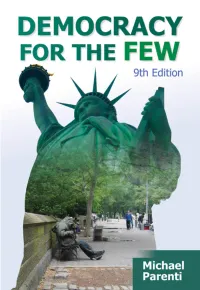
Democracy for the Few NINTH EDITION Michael Parenti, Ph.D. www.michaelparenti.org Australia • Brazil • Japan • Korea • Mexico • Singapore • Spain • United Kingdom • United States Democracy for the Few, © 2011, 2008, 2002 Wadsworth, Cengage Learning Ninth Edition Michael Parenti, Ph.D. No part of this work covered by the copyright herein may be reproduced, transmitted, stored or used in any form or by any Executive Editor: Carolyn Merrill means graphic, electronic, or mechanical, including but not limited to photocopying, recording, scanning, digitizing, taping, Web Editorial Assistant: distribution, information networks, or information storage and Angela Hodge retrieval systems, except as permitted under Section 107 or 108 of Marketing Manager: the 1976 United States Copyright Act, without the prior written Amy Whitaker permission of the publisher. Marketing Communications Manager: Heather Baxley For product information and technology assistance, contact us Art Director: Linda Helcher at Cengage Learning Customer & Sales Support, 1-800-354-9706 Print Buyer: Rebecca Cross . Text Permissions Account For permission to use material from this text or product, submit all requests online at cengage.com/permissions. Manager: Katie Huha Further permissions questions can be emailed to Photo Permissions Account permissionrequest@cengage.com. Manager: Jennifer Meyer Dare Production Service: 2009944057 PrePressPMG Library of Congress Control Number: Cover Designer: Grannan ISBN-13: 978-0-495-91126-5 Graphic Design, Ltd. ISBN-10: 0-495-91126-7 Cover Image: ©Grannan Graphic Design, Ltd. Wadsworth Compositor: PrePressPMG 20 Channel Center Street Boston, MA 02210 USA Cengage Learning is a leading provider of customized learning solutions with office locations around the globe, including Singapore, the United Kingdom, Australia, Mexico, Brazil, and Japan. -
2020 Monthly Review Press Catalog [PDF]
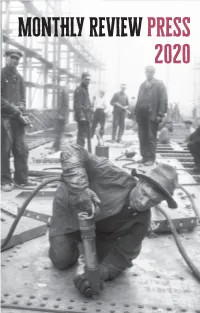
MONTHLY review press 2020 The Return of Nature Socialism and Ecology John Bellamy Foster Twenty years ago, John Bellamy Foster’s Marx’s Ecol- ogy introduced a new understanding of Karl Marx’s revolutionary ecological materialism. More than simply a study of Marx, it commenced an intel- lectual and social history, encompassing thinkers from Epicurus to Darwin, who developed materi- AVAILABLE APRIL alist and ecological ideas. Now, with The Return of 672 pages | CLOTH ONLY Nature, Foster continues this narrative. In so doing, Cloth 978-1-58367-836-7 he uncovers a long history of efforts to unite issues $35.00 | £30.00 | $49.95Can of social justice and environmental sustainability that will help us comprehend and counter today’s e-book available unprecedented planetary emergencies. The Return of Nature begins with the deaths of Darwin (1882) and Marx (1883) and moves on until the rise of the ecological age in the 1960s and 1970s. Foster explores how socialist analysts and material- ist scientists of various stamps, first in Britain, then the United States, from William Morris and Freder- ick Engels, to Joseph Needham, Rachel Carson, and Stephen Jay Gould, sought to develop a dialectical naturalism, rooted in a critique of capitalism. In the process, he delivers a far-reaching and fascinating reinterpretation of the radical and socialist origins of ecology. Ultimately, what this book asks for is noth- ing short of revolution: a long, ecological revolution, aimed at making peace with the planet while meet- ing collective human needs, including those of the entire chain of human generations and life on the Earth as a whole. -

Please Cite the Original Version: Vinsamlega Vísið Til Útgefnu
___________________________________ This is not the published version of the article / Þetta er ekki útgefna útgáfa greinarinnar Author(s)/Höf.: Kristín Loftsdóttir Title/Titill: The Exotic North: Gender, Nation Branding and Post-colonialism in Iceland Year/Útgáfuár: 2015 Version/Útgáfa: Post-print (lokagerð höfundar) Please cite the original version: Vinsamlega vísið til útgefnu greinarinnar: Kristín Loftsdóttir. 2015. “The Exotic North: Gender, Nation Branding and Postcolonialism in Iceland”. NORA – Nordic Journal of Feminist and Gender Research, 23(4), bls. 246-260. DOI: 10.1080/08038740.2015.1086814 Rights/Réttur: © 2015 Nordic Association for Women’s Studies and Gender Research Kristín Loftsdóttir. 2015. “The Exotic North: Gender, Nation Branding and Post- colonialism in Iceland”. NORA – Nordic Journal of Feminist and Gender Research, 23(4), bls. 246-260. DOI: 10.1080/08038740.2015.1086814 kristinl@hi.is The Exotic North: Gender, Nation Branding and Post-colonialism in Iceland Kristín Loftsdóttir Abstract This discussion stresses that looking at countries on the margins of European colonial rule can be useful when considering the wider dynamics of the present, reflecting the persistence of colonial discourses and how racism “endures”. Iceland’s colonial experience was characterized by duality, in which the country was an object of colonialism, while actively participating in the racist discourses predominant in Europe at that time. This paper demonstrates how Iceland’s long association with the exotic and its gendered manifestations is currently being perpetuated by the tourist and state industries, under the influence of neo-liberal ideas about nation branding. When contextualized within the larger geopolitical environment, Iceland as an “exotic” destination unravels the racist and colonized narratives still at play within a wider geopolitical context. -

Resistance, Rebellion and Revolt!
OCIALiT SCHOLARS CONFERENCE Resistance, Rebellion and Revolt! April 18, 19 & 20, 1986 The 4th Annual Boro of Manhattan Community College, CUNY, 199 Chambers Street, New York City FRIDAY SATURDAY SUNDAY 7-10 pm 9:30 am-lO pm 9:30 am-6 pm Resistance, Rebellion and Revolt! A broad range of academics and social activists have gathered for a 4th Annual Socialist Scholars Conference on Friday through Sunday, April 18-20 at the Boro of Manhattan Community College. This year's theme of Resistance, Rebellion and Revolt focuses upon a century of mass workers movements: 100th Anniversary of the Haymarket Riots, 75th Anniversary of the Triangle Shirtwaist Factory Fire (which helped galvanize the women's working-class movement here in New York City), the 50th Anniversary of the great sit-down strikes which helped found the CIO, the 50th Anniversary of the Spanish Civil War, and the 30th Anniversary of the Hungarian Revolt. This year we are commemorating the millions who have fought and died in the real socialist struggle, the continual revolt from below. CHILDCARE AVAILABLE Saturday 9:00 am - 5:00 pm Sunday 9:00 am - 5:00 pm Children must toilet trained and at least three years old. ROOM N312 The Graduate School and University Center of the City University of New York Ph.D. Program in Sociology I Box 375 Graduate Center: 33 West 42 Street, New York, N.Y. 10036-8099 212 790-4320 To Our Fellow Participants: Socialism, in the multifaceted forms it has adopted, has inspired a vast number of social movements in a wide range of countries. -

Separatism and Regionalism in Modern Europe
Separatism and Regionalism in Modern Europe Separatism and Regionalism in Modern Europe Edited by Chris Kostov Logos Verlag Berlin λογος Bibliographic information published by the Deutsche Nationalbibliothek The Deutsche Nationalbibliothek lists this publication in the Deutsche Nationalbibliografie; detailed bibliographic data are available in the Internet at http://dnb.d-nb.de . Book cover art: c Adobe Stock: Silvio c Copyright Logos Verlag Berlin GmbH 2020 All rights reserved. ISBN 978-3-8325-5192-6 The electronic version of this book is freely available under CC BY-NC-ND 4.0 licence, thanks to the support of Schiller University, Madrid. Logos Verlag Berlin GmbH Georg-Knorr-Str. 4, Gebäude 10 D-12681 Berlin - Germany Tel.: +49 (0)30 / 42 85 10 90 Fax: +49 (0)30 / 42 85 10 92 https://www.logos-verlag.com Contents Editor's introduction7 Authors' Bios 11 1 The EU's MLG system as a catalyst for separatism: A case study on the Albanian and Hungarian minority groups 15 YILMAZ KAPLAN 2 A rolling stone gathers no moss: Evolution and current trends of Basque nationalism 39 ONINTZA ODRIOZOLA,IKER IRAOLA AND JULEN ZABALO 3 Separatism in Catalonia: Legal, political, and linguistic aspects 73 CHRIS KOSTOV,FERNANDO DE VICENTE DE LA CASA AND MARÍA DOLORES ROMERO LESMES 4 Faroese nationalism: To be and not to be a sovereign state, that is the question 105 HANS ANDRIAS SØLVARÁ 5 Divided Belgium: Flemish nationalism and the rise of pro-separatist politics 133 CATHERINE XHARDEZ 6 Nunatta Qitornai: A party analysis of the rhetoric and future of Greenlandic separatism 157 ELLEN A. -

U.S. Pop Culture Decontextualized: Neoliberalist Ideologies in Socialist East Germany
Mandy Tröger U.S. Pop Culture Decontextualized: Neoliberalist Ideologies in Socialist East Germany This paper sketches a broader critique to the study over economic processes and rationalities” or that of popular culture as it is currently undertaken they have become relatively autonomous. Rather, it in various fields in Western academia. While follows Karl Polanyi’s analysis, which shows that it stresses that popular culture must be taken through the processes of modernity’s structural seriously as a subject of critical inquiry, it contends differentiation (“great transformation”) and the that the divergence from the original agenda of separation of the economic and cultural sphere, the critical cultural studies currently leaves us with latter received a particular political meaning within analytical “blind spots” in the study of pop culture. the public sphere increasingly subordinate to the These blind spots relate to what political scientist laws of the market. The cultural realm, generally in Michael Parenti observed with regard to his field: tension with the marketplace as the sole organizer of the economic sphere, increasingly depended There are political scientists [in on the same as a source of revenue and, thus, is the US] who spend their entire shaped by market demands even if just by creating lives writing about American favorable conditions for the market’s legitimacy. government, the presidency, and To make this point clear, this paper draws from public policy without ever once the historical analysis of the German-German mentioning capitalism, a feat of media context prior to the fall of the Berlin Wall omission that would be judged in 1989, and, more specifically, the role of U.S. -

Single Women Who Emigrated from Iceland to North America, 1870–1914
10 SINGLE WOMEN WHO EMIGRATED FROM ICELAND Single women who emigrated from Iceland to North America, 1870 –1914 Forgotten women with agency? Sigrídur Matthíasdóttir & Thorgerdur Einarsdóttir In the period 1820–1950, about 2.9 million people emigrated from the Nordic countries.1 This article will consider the unmarried women who emigrated from Iceland to North America in the period 1870–1914.2 In terms of emigration from Europe, proportionally the greatest number of people came from Ireland, but both Norway and Iceland were not far behind.3 Those who emigrated from Iceland amounted to 23 per cent of the country’s total population.4 The high proportion of women was a particular feature of Icelandic emigration. As a rule, men had a ‘higher rate of emigration than women in the Nordic countries’, although there were deviations from this pattern;5 women, however, accounted for 50.7 per cent of the Icelandic emigrants. According to the Icelandic historians Helgi Skúli Kjartansson and Steinthór Heidarsson, this ratio was ‘high and remarkably stable’ in comparison to other countries.6 No figures exist concerning the proportion of unmarried women, but it may be assumed that the number was high, since the general proportion of unmarried women in Icelandic society at this time was large. Being single was a factor that affected the circumstances and prospects of women who emigrated. The role of married women in their new countries was predetermined to a far larger degree, consisting of care for the home and the family. Single women’s prospects, on the other hand, were more precarious, involving greater uncertainty about their livelihoods and future lives.7 Moreover, it has been suggested that the difference between emig- rating when married with children, compared to emigrating as a single person, was greater for women than for men. -

Hypotheses on Nationalism and War Author(S): Stephen Van Evera Source: International Security, Vol
Hypotheses on Nationalism and War Author(s): Stephen van Evera Source: International Security, Vol. 18, No. 4 (Spring, 1994), pp. 5-39 Published by: The MIT Press Stable URL: http://www.jstor.org/stable/2539176 . Accessed: 07/09/2011 07:32 Your use of the JSTOR archive indicates your acceptance of the Terms & Conditions of Use, available at . http://www.jstor.org/page/info/about/policies/terms.jsp JSTOR is a not-for-profit service that helps scholars, researchers, and students discover, use, and build upon a wide range of content in a trusted digital archive. We use information technology and tools to increase productivity and facilitate new forms of scholarship. For more information about JSTOR, please contact support@jstor.org. The MIT Press is collaborating with JSTOR to digitize, preserve and extend access to International Security. http://www.jstor.org Hypotheses on StephenVan Evera Nationalismand War Scholars have written widely on the causes of nationalism'but said littleabout its effects,especially its effectson internationalpolitics. Most strikingly,the impact of nationalism on the risk of war has barely been explored. Most authors take the war- causing characterof nationalism for granted, assuming it without proof or explanation.2Factors that govern the size of the dangers posed by nationalism are neglected. What types of nationalismare most likelyto cause war? What background conditions catalyze or dampen this causal process? These ques- StephenVan Everateaches in thepolitical science department at theMassachusetts Institute of Technology. Thanks to RobertArt, Don Blackmer,David Laitin,John Mearsheimer, Barry Posen, JackSnyder, and Stephen Walt forsharing theirthoughts on nationalismand theircomments on this paper. -
SDS's Failure to Realign the Largest Political Coalition in the 20Th Century
NEW DEAL TO NEW MAJORITY: SDS’S FAILURE TO REALIGN THE LARGEST POLITICAL COALITION IN THE 20TH CENTURY Michael T. Hale A Dissertation Submitted to the Graduate College of Bowling Green State University in partial fulfillment of the requirements for the degree of DOCTOR OF PHILOSOPHY December 2015 Committee: Clayton Rosati, Advisor Francisco Cabanillas Graduate Faculty Representative Ellen Berry Oliver Boyd-Barret Bill Mullen ii ABSTRACT Clayton Rosati, Advisor Many historical accounts of the failure of the New Left and the ascendency of the New Right blame either the former’s militancy and violence for its lack of success—particularly after 1968—or the latter’s natural majority among essentially conservative American voters. Additionally, most scholarship on the 1960s fails to see the New Right as a social movement. In the struggles over how we understand the 1960s, this narrative, and the memoirs of New Leftists which continue that framework, miss a much more important intellectual and cultural legacy that helps explain the movement’s internal weakness. Rather than blame “evil militants” or a fixed conservative climate that encircled the New Left with both sanctioned and unsanctioned violence and brutality––like the Federal Bureau of Investigation’s (FBI) counter intelligence program COINTELPRO that provide the conditions for a unstoppable tidal wave “with the election of Richard M. Nixon in 1968 and reached its crescendo in the Moral Majority, the New Right, the Reagan administration, and neo-conservatism” (Breines “Whose New Left” 528)––the key to this legacy and its afterlives, I will argue, is the implicit (and explicit) essentialism bound to narratives of the “unwinnability” of especially the white working class. -

Reimagining the Past to Revitalize the Present
Háskóli Íslands Hugvísindasvið Viking and Medieval Norse Studies Reimagining the Past to Revitalize the Present Legends and nationalism in Irish and Icelandic revivalist poetry Ritgerð til BA / MA-prófs í Viking and Medieval Norse Studies Vanessa Iacocca Kt.: 031289-4249 Leiðbeinandi: Gísli Sigurðsson May 2016 Abstract As an element of cultural memory, the legendary past of a nation can be constantly reworked and reinterpreted in each particular context to suit contemporary concerns. In the nineteenth century, Irish revivalist poets, such as William Butler Yeats and George William Russell, and Icelandic revivalist poets, such as Bjarni Thorarensen and Jónas Hallgrímsson, purposefully reconstructed their countries' legendary pasts as golden ages in order to reinvest them with nationalistic significance. Recontextualizing the cycles of Irish mythology, in the Irish case, and the sagas and Eddas, in the Icelandic case, the Irish and Icelandic revivalist poets sought to establish unified national identities, justify the greatness and distinctiveness of each of their nations, and reinvigorate their countrymen with vigor and nationalism. In doing so, these poets helped form the ideological bases of Irish and Icelandic pursuits of increased autonomy. Therefore, using a memory studies perspective, this thesis will demonstrate that through reinterpretions of their nations' legendary pasts, Irish and Icelandic revivalist poets played instrumental roles in developing nationalist ideologies and, thus, in contributing to the early stages of the Irish and Icelandic independence movements. Although previous research has focused on the reception of Icelandic and Irish legendary texts individually, by employing a comparative approach, this thesis will not only attempt to render greater insight into the Irish and Icelandic cases, but to provide further implications for other nineteenth century European nationalistic movements and even for other contexts as well.