Khangchendzonga National Park and Biosphere Reserve
Total Page:16
File Type:pdf, Size:1020Kb
Load more
Recommended publications
-
Proposals to Amend CITES Appendices I and II at the 14Th Meeting of the Conference of the Parties
Proposals for amendment of Appendices I and II at the 16th Meeting of the Conference of the Parties (CoP16) A total of 71 proposals have been submitted to the Secretariat of the Convention on International Trade in Endangered Species of Wild Fauna and Flora (CITES) for amendment of the Appendices of CITES. These proposals will be discussed at the 16th meeting of the Conference of the Parties (COP16) to CITES which will be held in Bangkok, Thailand in March 2013. Below is a summary table of the proposals based on the information posted at the website of CITES Secretariat. You may wish to browse the CITES website at http://www.cites.org/eng/cop/16/prop/index.php for details of the proposals. Please note that in case of discrepancy, the information on the CITES website shall prevail. For enquiries regarding the proposals, please give us an E-mail at hk_cites@afcd.gov.hk or contact our officers: For enquiries about plants – Mr. Henry Ho (Tel. 2150 6968) For enquiries about animals – Mr. Horace Iu (Tel. 2150 6969) Agriculture, Fisheries and Conservation Department Species covered by the No. Higher taxa Common name Proponent Proposal proposal F A U N A CHORDATA MAMMALIA ARTIODACTYLA 1. Bovidae Rupicapra pyrenaica Abruzzo Chamois Denmark* Transfer from Appendix I to Appendix II ornata 2. Camelidae Vicugna vicugna Vicuña Ecuador Transfer of populations of Ecuador from Appendix I to 1 Appendix II CARNIVORA 3. Ursidae Ursus maritimus Polar bear United States of Transfer from Appendix II to Appendix I America CHIROPTERA 4. Pteropodidae Pteropus brunneus Dusky flying-fox Australia Deletion from Appendix II DASYUROMORPHIA 5. -
An Annotated List of Birds Wintering in the Lhasa River Watershed and Yamzho Yumco, Tibet Autonomous Region, China
FORKTAIL 23 (2007): 1–11 An annotated list of birds wintering in the Lhasa river watershed and Yamzho Yumco, Tibet Autonomous Region, China AARON LANG, MARY ANNE BISHOP and ALEC LE SUEUR The occurrence and distribution of birds in the Lhasa river watershed of Tibet Autonomous Region, People’s Republic of China, is not well documented. Here we report on recent observations of birds made during the winter season (November–March). Combining these observations with earlier records shows that at least 115 species occur in the Lhasa river watershed and adjacent Yamzho Yumco lake during the winter. Of these, at least 88 species appear to occur regularly and 29 species are represented by only a few observations. We recorded 18 species not previously noted during winter. Three species noted from Lhasa in the 1940s, Northern Shoveler Anas clypeata, Solitary Snipe Gallinago solitaria and Red-rumped Swallow Hirundo daurica, were not observed during our study. Black-necked Crane Grus nigricollis (Vulnerable) and Bar-headed Goose Anser indicus are among the more visible species in the agricultural habitats which dominate the valley floors. There is still a great deal to be learned about the winter birds of the region, as evidenced by the number of apparently new records from the last 15 years. INTRODUCTION limited from the late 1940s to the early 1980s. By the late 1980s the first joint ventures with foreign companies were The Lhasa river watershed in Tibet Autonomous Region, initiated and some of the first foreign non-governmental People’s Republic of China, is an important wintering organisations were allowed into Tibet, enabling our own area for a number of migratory and resident bird species. -
Phylogeography of Finches and Sparrows
In: Animal Genetics ISBN: 978-1-60741-844-3 Editor: Leopold J. Rechi © 2009 Nova Science Publishers, Inc. Chapter 1 PHYLOGEOGRAPHY OF FINCHES AND SPARROWS Antonio Arnaiz-Villena*, Pablo Gomez-Prieto and Valentin Ruiz-del-Valle Department of Immunology, University Complutense, The Madrid Regional Blood Center, Madrid, Spain. ABSTRACT Fringillidae finches form a subfamily of songbirds (Passeriformes), which are presently distributed around the world. This subfamily includes canaries, goldfinches, greenfinches, rosefinches, and grosbeaks, among others. Molecular phylogenies obtained with mitochondrial DNA sequences show that these groups of finches are put together, but with some polytomies that have apparently evolved or radiated in parallel. The time of appearance on Earth of all studied groups is suggested to start after Middle Miocene Epoch, around 10 million years ago. Greenfinches (genus Carduelis) may have originated at Eurasian desert margins coming from Rhodopechys obsoleta (dessert finch) or an extinct pale plumage ancestor; it later acquired green plumage suitable for the greenfinch ecological niche, i.e.: woods. Multicolored Eurasian goldfinch (Carduelis carduelis) has a genetic extant ancestor, the green-feathered Carduelis citrinella (citril finch); this was thought to be a canary on phonotypical bases, but it is now included within goldfinches by our molecular genetics phylograms. Speciation events between citril finch and Eurasian goldfinch are related with the Mediterranean Messinian salinity crisis (5 million years ago). Linurgus olivaceus (oriole finch) is presently thriving in Equatorial Africa and was included in a separate genus (Linurgus) by itself on phenotypical bases. Our phylograms demonstrate that it is and old canary. Proposed genus Acanthis does not exist. Twite and linnet form a separate radiation from redpolls. -

Download Download
OPEN ACCESS The Journal of Threatened Taxa fs dedfcated to bufldfng evfdence for conservafon globally by publfshfng peer-revfewed arfcles onlfne every month at a reasonably rapfd rate at www.threatenedtaxa.org . All arfcles publfshed fn JoTT are regfstered under Creafve Commons Atrfbufon 4.0 Internafonal Lfcense unless otherwfse menfoned. JoTT allows unrestrfcted use of arfcles fn any medfum, reproducfon, and dfstrfbufon by provfdfng adequate credft to the authors and the source of publfcafon. Journal of Threatened Taxa Bufldfng evfdence for conservafon globally www.threatenedtaxa.org ISSN 0974-7907 (Onlfne) | ISSN 0974-7893 (Prfnt) Revfew Nepal’s Natfonal Red Lfst of Bfrds Carol Inskfpp, Hem Sagar Baral, Tfm Inskfpp, Ambfka Prasad Khafwada, Monsoon Pokharel Khafwada, Laxman Prasad Poudyal & Rajan Amfn 26 January 2017 | Vol. 9| No. 1 | Pp. 9700–9722 10.11609/jot. 2855 .9.1. 9700-9722 For Focus, Scope, Afms, Polfcfes and Gufdelfnes vfsft htp://threatenedtaxa.org/About_JoTT.asp For Arfcle Submfssfon Gufdelfnes vfsft htp://threatenedtaxa.org/Submfssfon_Gufdelfnes.asp For Polfcfes agafnst Scfenffc Mfsconduct vfsft htp://threatenedtaxa.org/JoTT_Polfcy_agafnst_Scfenffc_Mfsconduct.asp For reprfnts contact <fnfo@threatenedtaxa.org> Publfsher/Host Partner Threatened Taxa Journal of Threatened Taxa | www.threatenedtaxa.org | 26 January 2017 | 9(1): 9700–9722 Revfew Nepal’s Natfonal Red Lfst of Bfrds Carol Inskfpp 1 , Hem Sagar Baral 2 , Tfm Inskfpp 3 , Ambfka Prasad Khafwada 4 , 5 6 7 ISSN 0974-7907 (Onlfne) Monsoon Pokharel Khafwada , Laxman Prasad -

Mail: Tropicbird@Bluewin.Ch ) and Marco (M.Salvioni@Bluewin.Ch ), Switzerland
Ladakh 25 Febraury – 14 March 2020 Paola (mail: tropicbird@bluewin.ch ) and Marco (m.salvioni@bluewin.ch ), Switzerland We went to Ladakh especially for the snow leopard, and in winter because was said that is the best period to see the animal. Practicalities We (Marco and Paola) generally take “last minute” decisions for our travels and also this time we began searching the web in December for a local company. We found Exotic Travel (Phunchok Tzering, www.Exoticladakh.com) in Leh; there were good comments in the web about the company, we took contact and in less than 2 weeks everything was organized, and at a reasonable price. At this point we want to comment about prices and the using of foreign companies. Has been more than 30 years that we travel around the world, especially for birding, always using local companies or even contacting directly local guides, and we never had bad experiences. Through other birders or mammal-watchers’ trip reports (www.mammalwatching.com) is now quite easy to gather comments on local guides and local companies and so finding a reliable one. If you are able to arrive by your own at the destination (this time Leh), from there you can use the local company, saving good money and being freer. Anyway, foreign companies often relay on local companies for the final organisation in loco. Many young people could not afford the price of a foreign company but could using the local one! If you are just two, or travelling with known friends, you can also be more flexible and still adapt the itinerary as the trip unrolls. -

Lhasa and the Tibetan Plateau Cumulative
Lhasa and the Tibetan Plateau Cumulative Bird List Column A: Total number of tours (out of 6) that the species was recorded Column B: Total number of days that the species was recorded on the 2016 tour Column C: Maximum daily count for that particular species on the 2016 tour Column D: H = Heard Only; (H) = Heard more than seen Globally threatened species as defined by BirdLife International (2004) Threatened birds of the world 2004 CD-Rom Cambridge, U.K. BirdLife International are identified as follows: EN = Endangered; VU = Vulnerable; NT = Near- threatened. A B C D 6 Greylag Goose 2 15 Anser anser 6 Bar-headed Goose 4 300 Anser indicus 3 Whooper Swan 1 2 Cygnus cygnus 1 Common Shelduck Tadorna tadorna 6 Ruddy Shelduck 8 700 Tadorna ferruginea 3 Gadwall 2 3 Anas strepera 1 Eurasian Wigeon Anas penelope 5 Mallard 2 8 Anas platyrhynchos 2 Eastern Spot-billed Duck Anas zonorhyncha 1 Indian or Eastern Spot-billed Duck Anas poecilorhynchos or A. zonorhyncha 1 Northern Shoveler Anas clypeata 1 Northern Pintail Anas acuta 1 Garganey 2 15 Anas querquedula 4 Eurasian Teal 2 50 Anas crecca 6 Red-crested Pochard 3 2000 Netta rufina 6 Common Pochard 2 200 Aythya ferina 3 Ferruginous Duck NT 1 8 Aythya nyroca 6 Tufted Duck 2 200 Aythya fuligula 5 Common Goldeneye 2 11 Bucephala clangula 4 Common Merganser 3 51 Mergus merganser 5 Chinese Grouse NT 2 1 Tetrastes sewerzowi 4 Verreaux's Monal-Partridge 1 1 H Tetraophasis obscurus 5 Tibetan Snowcock 1 5 H Tetraogallus tibetanus 4 Przevalski's Partridge 1 1 Alectoris magna 1 Daurian Partridge Perdix dauurica 6 Tibetan Partridge 2 11 Perdix hodgsoniae ________________________________________________________________________________________________________ WINGS ● 1643 N. -

A Detailed Report on Implementation of Catchment Area Treatment Plan of Teesta Stage-V Hydro-Electric Power Project (510Mw) Sikkim
A DETAILED REPORT ON IMPLEMENTATION OF CATCHMENT AREA TREATMEN PLAN OF TEESTA STAGE-V HYDRO-ELECTRIC POWER PROJECT (510MW) SIKKIM - 2007 FOREST, ENVIRONMENT & WILDLIFE MANAGEMENT DEPARTMENT GOVERNMENT OF SIKKIM GANGTOK A DETAILED REPORT ON IMPLEMENTATION OF CATCHMENT AREA TREATMENT PLAN OF TEESTA STAGE-V HYDRO-ELECTRIC POWER PROJECT (510MW) SIKKIM FOREST, ENVIRONMENT & WILDLIFE MANAGEMENT DEPARTMENT GOVERNMENT OF SIKKIM GANGTOK BRIEF ABOUT THE ENVIRONMENT CONSERVATION OF TEESTA STAGE-V CATCHMENT. In the Eastern end of the mighty Himalayas flanked by Bhutan, Nepal and Tibet on its end lays a tiny enchanting state ‘Sikkim’. It nestles under the protective shadow of its guardian deity, the Mount Kanchendzonga. Sikkim has witnessed a tremendous development in the recent past year under the dynamic leadership of Honorable Chief Minister Dr.Pawan Chamling. Tourism and Power are the two thrust sectors which has prompted Sikkim further in the road of civilization. The establishment of National Hydro Project (NHPC) Stage-V at Dikchu itself speaks volume about an exemplary progress. Infact, an initiative to treat the land in North and East districts is yet another remarkable feather in its cap. The project Catchment Area Treatment (CAT) pertains to treat the lands by various means of action such as training of Jhoras, establishing nurseries and running a plantation drive. Catchment Area Treatment (CAT) was initially started in the year 2000-01 within a primary vision to control the landslides and to maintain an ecological equilibrium in the catchment areas with a gestation period of nine years. Forests, Environment & Wildlife Management Department, Government of Sikkim has been tasked with a responsibility of nodal agency to implement catchment area treatment programme by three circle of six divisions viz, Territorial, Social Forestry followed by Land Use & Environment Circle. -

China: Sichuan Tour
CHINA: SICHUAN TOUR 21st MAY - 7th JUNE 2020 Temminck’s Tragopan is one of our targets on this trip. www.birdingecotours.com info@birdingecotours.com 2 | ITINERARY China: Sichuan May-June 2020 Sichuan offers an excellent introduction to birdwatching in China with large numbers of endemic and specialty species, set in some seriously stunning mountain landscapes. The huge, mountainous province of Sichuan is blessed with a range of interesting habitats, and we will ensure that we visit a representative sample of as many of these as possible in our quest to find the region's exciting birds. The tour will start and end in Chengdu, the capital of the province, and we will visit the renowned Longcanggou Forest Park, Labahe Nature Reserve, Wolong National Nature Reserve with Balang Shan, the slopes of Mengbi Shan, and the Baxi Forest areas in our search for birds. We will find many gorgeous game birds, parrotbills, laughingthrushes, and rosefinches during the tour, with particular highlights likely to include Chinese Monal, Blood, White Eared, Blue Eared, Golden, and Lady Amherst’s Pheasants, Tibetan Snowcock, Temminck’s Tragopan, Snow Partridge, Black-necked Crane, Giant Laughingthrush, Firethroat, Golden Bush Robin, Chinese Rubythroat, Siberian Rubythroat, Emei Shan Liocichla, Grandala, Przevalski’s Nuthatch, Pere David’s Tit, Wallcreeper, and Crested Tit-warbler, along with a near endless list of interesting thrushes, robins, and warblers. Throw in some excellent food, friendly local people, and a great infrastructure, and a fantastic, bird-filled trip is on the cards This tour can be combined with our China: 9-day Yunnan pre-tour 2020 tour and/or with our China: 15-day Qinghai extension 2020 tour into a mind-boggling 43-day China mega tour. -

Punjab Board Class 9 Social Science Textbook Part 1 English
SOCIAL SCIENCE-IX PART-I PUNJAB SCHOOL EDUCATION BOARD Sahibzada Ajit Singh Nagar © Punjab Government First Edition : 2018............................ 38406 Copies All rights, including those of translation, reproduction and annotation etc., are reserved by the Punjab Government. Editor & Co-ordinator Geography : Sh. Raminderjit Singh Wasu, Deputy Director (Open School), Punjab School Education Board. Economics : Smt. Amarjit Kaur Dalam, Deputy Director (Academic), Punjab School Education Board. WARNING 1. The Agency-holders shall not add any extra binding with a view to charge extra money for the binding. (Ref. Cl. No. 7 of agreement with Agency-holders). 2. Printing, Publishing, Stocking, Holding or Selling etc., of spurious Text- book qua text-books printed and published by the Punjab School Education Board is a cognizable offence under Indian Penal Code. Price : ` 106.00/- Published by : Secretary, Punjab School Education Board, Vidya Bhawan Phase-VIII, Sahibzada Ajit Singh Nagar-160062. & Printed by Tania Graphics, Sarabha Nagar, Jalandhar City (ii) FOREWORD Punjab School Education Board, has been engaged in the endeavour to prepare textbooks for all the classes at school level. The book in hand is one in the series and has been prepared for the students of class IX. Punjab Curriculum Framework (PCF) 2013 which is based on National Curriculum Framework (NCF) 2005, recommends that the child’s life at school must be linked to their life outside the school. The syllabi and textbook in hand is developed on the basis of the principle which makes a departure from the legacy of bookish learning to activity-based learning in the direction of child-centred system. -

Askot Landscape, Uttarakhand Phase
Evaluation of Birds as Potential Indicator Species for Long Term Monitoring: Askot Landscape, Uttarakhand Phase – 1 Report BCRLIP Coordinator Sh. V. K. Uniyal Bird Component Investigator Sh. R. Suresh Kumar Project Assistant Ankita Bhattacharya Ministry of Environment, Forests & Climate Change Uttarakhand Forest Department World Bank Wildlife Instituute of India January, 2015 Further Contact: BCRLIP Coordinator Sh. V. K. Uniyal Department of Protected Area Network, WL Management and Conservation Education Wildlife Institute of India, Chandrabani Dehradun, India 248 001 Tell: 00 91 135 2646207 Fax: 00 91 135 2640117 E-mail; vku50@wii.gov.in Bird Component Investigator Sh. R Suresh Kumar Department of Endangered Species Management Wildlife Institute of India, Chandrabani Dehradun, India 248 001 Tell: 00 91 135 2646161 Fax: 00 91 135 2640117 E-mail; suresh@wii.gov.in Photo Credits: Front and Back Cover Photographs: Pankaj Kumar, Ankita Bhattacharya, Soni Bisht and Suresh Kumar Rana Main report Photographs: Suresh Kumar Rana and World Pheasant Asssociation (WPA) Citation: Bhattacharya, A., Kumar, R. S. and Uniyal, V. K. (2015): Evaluation of Birds as Potential Indicator Species for Long Term Monitoring: Askot landscape, Uttarakhand, Phase 1 – Report, Wildlife Institute of India. Pp 29. Contents List of Tables ii List of Figures iii Acknowledgements iv 1 Background 1 2 Study area 2 3 Methods 4 4 Findings of the study 6 5 Future Plans 24 6 References 24 Annexure I: Checklist of birds of Askot Landscape with 25 reports of birds seen during this study List of Tables Table No. Table Name Page No. 1 a. List of villages surveyed along Gori river basin in Askot 6 Landscape 1 b. -

Download/Eth Fomap.Pdf 136
i Biodiversity Strategy and Action Plan (BSAP) of Sikkim and the Resource Mobilisation Strategy for implementing the BSAP with focus on Khangchendzonga – Upper Teesta Valley Rita Pandey Priya Anuja Malhotra Supported by: United Nations Development Program, New Delhi, India Suggested citation: Pandey, Rita, Priya, Malhotra, A. Biodiversity Strategy and Action Plan (BSAP) of Sikkim and the Resource Mobilisation Strategy for implementing the BSAP with the focus on Khangchendzonga – Upper Teesta Valley. National Institute of Public Finance and Policy, March, 2021, New Delhi, India. Contact information: Rita Pandey, rita.pandey@nipfp.org.in; rita_pandey@yahoo.com Disclaimer: The views expressed and any errors are entirely those of the authors and do not necessarily corroborate to policy view points of the contacted individuals and institutions. Final Report March 2021 National Institute of Public Finance and Policy, New Delhi ii Contents List of Tables, Figures, Boxes and Annexures List of Abbreviations Preface Acknowledgement Chapter 1: Overview of International Conventions and Legislative and Policy Actions for Biodiversity Conservation in India 1.1 Background 1.2 The Convention on Biological Diversity (CBD), Biological Diversity Act 2002 and National Biodiversity Action Plan (NBAP), 2008 1.3 Linkages of NBTs with Sustainable Development Goal (SDGs) 1.4 Linkages and Synergies between NBTs and NDCs 1.5 Rationale for and Scope of Sikkim Biodiversity Strategy and Action Plan (SBSAP) 1.6 Key Objectives of the Study Chapter 2: Overview and Process -
Threatened Ecosystems of Myanmar
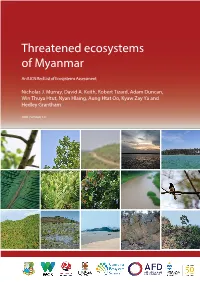
Threatened ecosystems of Myanmar An IUCN Red List of Ecosystems Assessment Nicholas J. Murray, David A. Keith, Robert Tizard, Adam Duncan, Win Thuya Htut, Nyan Hlaing, Aung Htat Oo, Kyaw Zay Ya and Hedley Grantham 2020 | Version 1.0 Threatened Ecosystems of Myanmar. An IUCN Red List of Ecosystems Assessment. Version 1.0. Murray, N.J., Keith, D.A., Tizard, R., Duncan, A., Htut, W.T., Hlaing, N., Oo, A.H., Ya, K.Z., Grantham, H. License This document is an open access publication licensed under a Creative Commons Attribution-Non- commercial-No Derivatives 4.0 International (CC BY-NC-ND 4.0). Authors: Nicholas J. Murray University of New South Wales and James Cook University, Australia David A. Keith University of New South Wales, Australia Robert Tizard Wildlife Conservation Society, Myanmar Adam Duncan Wildlife Conservation Society, Canada Nyan Hlaing Wildlife Conservation Society, Myanmar Win Thuya Htut Wildlife Conservation Society, Myanmar Aung Htat Oo Wildlife Conservation Society, Myanmar Kyaw Zay Ya Wildlife Conservation Society, Myanmar Hedley Grantham Wildlife Conservation Society, Australia Citation: Murray, N.J., Keith, D.A., Tizard, R., Duncan, A., Htut, W.T., Hlaing, N., Oo, A.H., Ya, K.Z., Grantham, H. (2020) Threatened Ecosystems of Myanmar. An IUCN Red List of Ecosystems Assessment. Version 1.0. Wildlife Conservation Society. ISBN: 978-0-9903852-5-7 DOI 10.19121/2019.Report.37457 ISBN 978-0-9903852-5-7 Cover photos: © Nicholas J. Murray, Hedley Grantham, Robert Tizard Numerous experts from around the world participated in the development of the IUCN Red List of Ecosystems of Myanmar. The complete list of contributors is located in Appendix 1.