60 Fotografias Do Acervo
Total Page:16
File Type:pdf, Size:1020Kb
Load more
Recommended publications
-
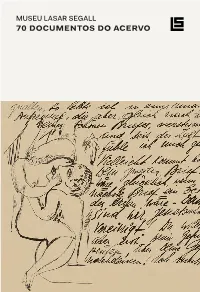
70 Documentos Do Acervo
DOBRA DOBRA MUSEU LASAR SEGALL MUSEU LASAR SEGALL Os documentos reunidos em vida por Lasar Segall ( ) formam o Arquivo Lasar Segall, uma importante coleção para pesquisa da história da arte brasileira e europeia. Esse acervo, composto por cerca de . itens, constitui-se, pelo seu ineditismo, natureza e dimensão, em uma das mais importantes fontes para a análise e compreensão da vida e da obra do artista, um dos principais nomes da arte moderna brasileira. _CAPA final_70 documentos_MLS.indd 1 06/02/20 11:05 DOBRA DOBRA _CAPA final_70documentos_MLS.indd 2 DOBRA DOBRA DOBRA DOBRA 06/02/20 11:05 MeMória e História MUSEU LASAR SEGALL 70 DOCUMENTOS DO ACERVO LASAR SEGALL MUSEUM 70 DOCUMENTS FROM THE ARCHIVES _FINAL_miolo novo_70 documentos_sem codigo com inglês.indd 1 06/02/20 11:04 _FINAL_miolo novo_70 documentos_sem codigo com inglês.indd 2 06/02/20 11:04 MUSEU LASAR SEGALL 70 DOCUMENTOS DO ACERVO LASAR SEGALL MUSEUM 70 DOCUMENTS FROM THE ARCHIVES _FINAL_miolo novo_70 documentos_sem codigo com inglês.indd 3 06/02/20 11:04 _FINAL_miolo novo_70 documentos_sem codigo com inglês.indd 4 06/02/20 11:04 7 ApresentAção Daniel Rincon caiRes 11 MeMóriA e históriA VeRa D’HoRta 31 CurAdoriA e Arquivos de Museus de Arte ana MagalHães 49 divisAs biográficas 63 diásporAs, derivAs, desloCAMentos 79 inquietAções estéticas 99 revolução ModernistA nA AleMAnhA 133 ModernisMos brAsileiros 169 intiMidAde 177 rAízes JudAicas 189 AnotAções téCnicas 197 biblioteCA pArtiCulAr 209 eMpreendiMentos iMobiliários 221 english version 287 Créditos _FINAL_miolo novo_70 documentos_sem codigo com inglês.indd 5 06/02/20 11:04 _FINAL_miolo novo_70 documentos_sem codigo com inglês.indd 6 06/02/20 11:04 Apresentação Daniel Rincon caiRes Em 1986 o Arquivo Lasar Segall inaugurava a sua jorna- da. -

Degenerate Art – 80 Years: Repercussions in Brazil (São Paulo, 25-27 Apr 18)
Degenerate Art – 80 Years: Repercussions in Brazil (São Paulo, 25-27 Apr 18) São Paulo, Museu de Arte Contemporânea, Apr 25–27, 2018 Deadline: Mar 9, 2018 Erika Zerwes In 1937 the German government, led by Adolf Hitler, opened a large exhibition of modern art with about 650 works confiscated from the country's leading public museums entitled Degenerate Art (Entartete Kunst). Marc Chagall, Otto Dix, Max Ernst, George Grosz, Wassily Kandinsky, Paul Klee, László Moholy-Nagy, Piet Mondrian and Lasar Segall were among the 112 artists who had works selected for the show. Conceived to be easily assimilated by the general public, the exhibition pre- sented a highly negative and biased interpretation of modern art. The Degenerate Art show had a rather large impact in Brazil. There have been persecutions to modern artists accused of degeneration, as well as expressions of support and commitment in the struggle against totalitarian regimes. An example of this second case was the exhibition Arte condenada pelo III Reich (Art condemned by the Third Reich), held at the Askanasy Gallery (Rio de Janeiro, 1945). The event sought to get support from the local public against Nazi-fascism and to make modern art stand as a synonym of freedom of expression. In the 80th anniversary of the Degenerate Art exhibition, the University of São Paulo’s Museum of Contemporary Art, in partnership with the Lasar Segall Museum, holds the International Seminar “Degenerate Art – 80 Years: Repercussions in Brazil”. The objective is to reflect on the repercus- sions of the exhibition Degenerate Art (Entartete Kunst) in Brazil and on the persecution of mod- ern art in the country in the first half of the 20th century. -

7. Tarsila Do Amaral
ONTENTS Tarsila, Brazil, Europe Fundaciön Juan March IS Study of an Oeuvre. And a Biography Aracy Amaral 1. Manifestos and Testimonials of Avant-garde Brazil 19 Oswald de Andrade: Manifesto of Pau-Brasil Poetry (1924) • 23 Mario de Andrade: Letter to Tarsila (November 15, 1924) • 25 Oswald de Andrade: Anthropophagite Manifesto (1928) • 31 Tarsila do Amaral: Pau-Brasil and Anthropophagite Painting (1939) • 34 Tarsila do Amaral: Lasar Segall (1936) • 37 Blaise Cendrars (1938) • 41 Still the "Week" (1943) • 44 Anita Malfatti (1945) • 46 General Confession (1950) • 48 Memories of Paris (1952) * * • 2. Four Views of Tarsila 55 Tarsila: A Structural Painting Haroldo de Campos 59 Tarsila Revisited Aracy Amaral 67 A "Quest"for Tarsila Juan Manuel Bonet 93 Tarsila and Oswald in the Wise Laziness of the Sun Jorge Schwartz 105 3. Tarsila do Amaral: Works 177 4. History and Context: From the Virgin Jungle to Tarsila's Brazil 5. Tarsila the Writer (1936-39) 203 A Master of Modern Painting • 204 Fernand Leger • 205 The School ofLhote • 207 Rousseau, the Other • 208 Mystic Cubism • 209 Brancusi • 211 Delaunay and the Eiffel Tower • 212 From Joseph Monier to Le Corbusier • 213 The Poet of Gardens • 21S From the Banks of the Nile to the Modern Book • 216 Carnival • 217 Trends in Modern Art • 218 Forests 6. Tarsila Seen by Her Contemporaries 223 Antonio Ferro: Tarsila do Amoral (1926) • 223 Mario de Andrade: Tarsila (1927) • 224 Manuel Bandeira, Emiliano Di Cavalcanti and Jorge de Lima: About Tarsila (1940) • 225 Mario de Andrade: Decorativism (1940) • 226 Ribeiro Couto: Arbitrary Prose on Tarsila (1940) • 226 Sergio Milliet: Tarsila (1940) • 226 Carlos Drummond de Andrade: The Word "Tarsila" (1940) • 227 Sergio Milliet: Tarsila (1953) 7. -

Recorte Modernista
Recorte Modernista galeriaRICARDO CAMARGO 1 1 Exposição e Vendas 50 14 artistas 41 obras 1918 a 1967 Recorte Modernista Alfredo Volpi Anita Malfatti Antonio Bandeira Antonio Gomide Candido Portinari RICARDO CAMARGO Cícero Dias galeria Diego Rivera em parceria com Djanira da Mota e Silva Emiliano Di Cavalcanti Ferrignac (Inácio da Costa Ferreira) Flávio de Carvalho Lasar Segall Tarsila do Amaral Victor Brecheret As obras estarão à venda a partir do recebimento deste catálogo 22 de Setembro a 18 Novembro de 2017 2a a 6a feira das 10 às 19 h Sábado das 10 às 15 h capa: Emiliano Di Cavalcanti Bordel, c.1938 guache e pastel s/ papel, 45 x 56 cm. reproduzida à pág. 228 do livro “Di Cavalcanti Conquistador de lirismos” Denise Mattar e Elisabeth di Cavalcanti 2016 contracapa: Cícero Dias Família, c. 1931/33 Rua Frei Galvão 121 J. Paulistano São Paulo SP Cep 01454 060 Tels. (55 11) 30313879 / 38190277 aquarela s/ papel s/ madeira, 39 x 43,5 cm www.rcamargoarte.com.br • rcamargoarte@terra.com.br 45 5 O papel dos modernistas Sabe-se que em épocas de crise todos procuram estabilidade e segurança. Assim acontece também no mercado de arte, quando os colecionadores se voltam para os clássicos, os valores já firmados na história. Esta é uma exposição dos clássicos do modernismo no Brasil, entendendo-se modernismo em sentido amplo. Vai de Anita Malfatti, sua protomártir em 1917, até o começo do abstracionismo, com Antônio Ban- deira, nos anos 1950. Entre esses extremos, os grandes nomes como Di Cavalcanti, Tarsila, Portinari, Volpi, Gomide, Segall e – constituindo na verdade uma sala especial, uma outra exposição em separado, com outro catálogo – Ismael Nery. -

Influence and Cannibalism in the Works of Blaise Cendrars and Oswald De Andrade
Modernist Poetics between France and Brazil: Influence and Cannibalism in the Works of Blaise Cendrars and Oswald de Andrade Sarah Lazur Submitted in partial fulfillment of the requirements for the degree of Doctor of Philosophy in the Graduate School of Arts and Sciences COLUMBIA UNIVERSITY 2019 1 © 2019 Sarah Lazur All rights reserved 2 ABSTRACT Modernist Poetics between France and Brazil: Influence and Cannibalism in the Works of Blaise Cendrars and Oswald de Andrade Sarah Lazur This dissertation examines the collegial and collaborative relationship between the Swiss-French writer Blaise Cendrars and the Brazilian writer Oswald de Andrade in the 1920s as an exemplar of shifting literary influence in the international modernist moment and examines how each writer’s later accounts of the modernist period diminished the other’s influential role, in revisionist histories that shaped later scholarship. In analyzing a broad range of source texts, published poems, fiction and essays as well as personal correspondence and preparatory materials, I identify several areas of likely mutual influence or literary cannibalism that defied contemporaneous expectations for literary production from European cultural capitals or from the global south. I argue that these expectations are reinforced by historical circumstances, including political and economic crises and cultural nationalism, and by tracing the changes in the authors’ accounts, I give a fuller narrative that is lacking in studies approaching either of the authors in a monolingual context. 3 Table of Contents Abbreviations ii Acknowledgements iii Introduction 1 Chapter 1 – Foreign Paris 20 Chapter 2 – Primitivisms and Modernity 57 Chapter 3 – Collaboration and Cannibalism 83 Chapter 4 – Un vaste malentendu 121 Conclusion 166 Bibliography 170 i Abbreviations ABBC A Aventura Brasileira de Blaise Cendrars: Eulalio and Calil’s major anthology of articles, correspondence, essays, by all major participants in Brazilian modernism who interacted with Cendrars. -

ART DECO and BRAZILIAN MODERNISM a Dissertation
SLEEK WORDS: ART DECO AND BRAZILIAN MODERNISM A Dissertation submitted to the Faculty of the Graduate School of Arts and Sciences of Georgetown University in partial fulfillment of the requirement for the degree of Doctor in Philosophy in Spanish By Patricia A. Soler, M.S. Washington, DC January 23, 2014 Copyright by Patricia A. Soler All rights reserved ii SLEEK WORDS: ART DECO AND BRAZILIAN MODERNISM Patricia A. Soler, M.S. Thesis advisor: Gwen Kirkpatrick, Ph.D. ABSTRACT I explore Art Deco in the Brazilian Modernist movement during the 1920s. Art Deco is a decorative arts style that rose to global prominence during this decade and its proponents adopted and adapted the style in order to nationalize it; in the case of Brazil, the style became nationalized primarily by means of the application of indigenous motifs. The Brazilian Modernists created their own manifestations of the style, particularly in illustration and graphic design. I make this analysis by utilizing primary source materials to demonstrate the style’s prominence in Brazilian Modernism and by exploring the handcrafted and mechanical techniques used to produce the movement’s printed texts. I explore the origins of the Art Deco style and the decorative arts field and determine the sources for the style, specifically avant-garde, primitivist, and erotic sources, to demonstrate the style’s elasticity. Its elasticity allowed it to be nationalized on a global scale during the 1920s; by the 1930s, however, many fascist-leaning forces co- opted the style for their own projects. I examine the architectural field in the Brazil during the 1920s. -

Holzbildwerke Von Christoph Voll in Memoriam Anne-Marie Kassay-Friedländer, Jerusalem
Originalveröffentlichung in: Anzeiger des Germanischen Nationalmuseums 2006, S. 173-188 Dietrich Schubert Holzbildwerke von Christoph Voll In memoriam Anne-Marie Kassay-Friedländer, Jerusalem Zusammenfassung Abstract Das Germanische Nationalmuseum zeigt in seinen Sammlungen The Germanisches Nationalmuseum exhibits in its galleries five fünf Figuren aus Holz von Christoph Voll (18971939). Nach wooden figures by Christoph Voll (1 8971939). After an ex einer von übermäßiger Strenge geprägten Kindheit in einem cessively harsh childhood in an orphanage, Voll trained as a Waisenhaus ließ sich Voll bei Albert Starke in Dresden zum Bild sculptor with Albert Starke in Dresden and subsequently served hauer ausbilden und nahm anschließend als Soldat am Frank as a soldier in the French Campaign. Traumatic childhood oc reichfeldzug teil. Traumatische Kindheitserfahrungen und Kriegs currences and wartime experiences left their mark on his later erlebnisse fanden in seinen späteren Arbeiten, in denen er den work, in which he thematized human misery and devastation. In elenden und geschundenen Menschen thematisiert, ihren Nie 1920, Voll became a member of the Dresden Secession and derschlag. 1920 wurde Voll Mitglied der Dresdner Secession was appointed, at the age of 27, to the Staatliche Schule für und erhielt mit 27 Jahren einen Ruf an die Staatliche Schule für Kunst und Handwerk in Saarbrücken. From there, he went on, Kunst und Handwerk in Saarbrücken, von wo er 1928 an die in 1928, to the Badische Landeskunstschule in Karlsruhe. Public Badische Landeskunstschule in Karlsruhe wechselte. Seine all recognition of Voll ended abruptly when the National Socialists gemeine Anerkennung fand ein jähes Ende, als die National defamed his work as »degenerate art« and dismissed him from sozialisten seine Arbeiten als »entartete Kunst« diffamierten und his teaching position. -

Signal Zum Aufbruch! 100 Jahre Gründung Der Dresdner Sezession – Gruppe 1919
PRESSEINFORMATION Signal zum Aufbruch! 100 Jahre Gründung der Dresdner Sezession – Gruppe 1919 Pressegespräch am Freitag, dem 14. Juni 2019, 11 Uhr der Anlass Vor 100 Jahren, am 29. Januar 1919, fand sich die Dresdner Sezession – Gruppe 1919 zusammen. Nach der Gründung der „Brücke“ 1905 war dies das zweite wichtige Ereignis der Geschichte der Moderne in Dresden. Die Gruppe prägte das Ausstellungsgeschehen der folgenden Jahre in Dresden und vernetzte sich deutschlandweit mit anderen progressiven Künstlergruppen. Zum Jubiläum der ersten Einführung der Demokratie in Deutschland weist die Städtische Galerie Dresden mit einer Ausstellung zur Kunst der Sezession in deren Gründungsjahr auf den Elan und Veränderungswillen der jungen Künstler des Jahres 1919 hin. die Sezession Die Initiative zur Gründung der Sezession 1919 ging auf den Maler Conrad Felixmüller zurück. Dieser hatte sich schon mehrere Jahre mit der Idee einer Künstlergruppe beschäftigt, welche an die Tradition und den Erfolg der „Brücke“ in Dresden anknüpfen sollte. In den Kriegsjahren war er mit der Veranstaltung „expressionistischer Soiréen“, mit der Gründung der Zeitschrift „Menschen“ und mit der „Gruppe 1917“ bereits erste Schritte in diese Richtung gegangen. In der Umbruchsituation nach der November-revolution war die Zeit reif dafür. Der Dresdner Künstlerrat schottete sich mit restriktiven Zugangsbedingungen gegen die jüngste Künstlergeneration ab. Diese antworteten mit der Gründung der Sezession und konnten sich durch die Mitarbeit des Architekten und Publizisten Hugo Zehder die Kooperation der Galerie von Emil Richter sichern. Dort fand in den Räumen der Neuen Vereinigung für Kunst im April 1919 eine erste, viel beachtete Ausstellung der Gruppe statt. Im Juni 1919 folgte eine zweite Schau mit auswärtigen Gästen, während die Sezession gleichzeitig nach Berlin, Düsseldorf, Chemnitz und Darmstadt ausschwärmte. -

Assis Chateaubriand, the Museu De Arte De São Paulo (MASP) and the Musee De Arte Moderna (MAM)
Nelson A. Rockefeller and Art Patronage in Brazil after World War II: Assis Chateaubriand, the Museu de Arte de São Paulo (MASP) and the Musee de Arte Moderna (MAM) Zueler R. M. A. Lima, Ph.D. Associate Professor, School of Architecture Washington University in Saint Louis © 2010 by Zueler R. M. A. LIma zlima@wustl.edu My research at the Rockefeller Archive Center looked for evidence of Nelson A. Rockefeller's involvement in the creation of art museums and cultural programs promoted by Brazilian philanthropists, particularly in São Paulo in the decade after the end of World War II. This research is part of the project for a comprehensive book about the work and life of Italian-born Brazilian architect Lina Bo Bardi (1914-1992) who, among other important buildings, designed the temporary and permanent facilities for the Museum of Art of São Paulo (MASP). The museum, co-founded in 1947 by Brazilian press magnate Assis Chateaubriand (1892-1968) and her husband, Italian art dealer and critic Pietro Maria Bardi (1900-1999), contains one of the most prestigious art collections in Latin America and pioneered the layout of modern museums and the concept of comprehensive art institutes based on North American and Bauhaus models. The archival material reveals that the creation of MASP was closely related with the creation of the Museu de Arte Moderna (MAM), and that both represented the aspirations of local elites in creating a modern, cosmopolitan culture in the city with the direct and indirect help of Nelson A. Rockefeller. This report aims at organizing specific and relevant material found at the Rockefeller Archive Center into a chronological narrative based on my broader research. -

La Modernidad En Tránsito De Lasar Segall
La modernidad en tránsito de Lasar Segall Extrait du Artelogie http://cral.in2p3.fr/artelogie/spip.php?article85 Florencia Garramuño La modernidad en tránsito de Lasar Segall - Dossier thématique : Brésil, questions sur le modernisme - Date de mise en ligne : jeudi 24 mars 2011 Description : Modernismo, vanguardia, migraciones, arte latinoamericano, nomadismo Artelogie Copyright © Artelogie Page 1/9 La modernidad en tránsito de Lasar Segall Este artículo interroga algunas obras de Lasar Segall y su ubicación dentro del impulso nacionalista del modernismo brasileño, buscando arrojar luz sobre las tramas internacionales, los dramas humanos, y los flujos económicos y sociales que conformaron la estética modernista. La pintura de Lasar Segall y su ubicación dentro del modernismo brasileño ofrece un escenario productivo para pensar los avatares de la modernidad en Europa y en América latina. El aspecto trágico de esa modernidad, evidenciado con intensidad inusitada en los años en los que Segall emprende su partida de Europa con destino a Brasil para instalarse definitivamente en ese país, se revela de modos complejos en la obra del artista, atravesada por algunos de los signos más perturbadores de las catástrofes que castigaron al tumultuoso inicio del siglo XX : los refugiados, los apátridas, los emigrantes, la miseria, la prostitución. Si bien es una constante en la bibliografía sobre la vanguardia rescatar su aspecto de celebración de la modernidad, muchos de estos movimientos fueron también muy críticos de ella, exhibiendo a través de sus soluciones formales algunos de los costados más oscuros y conflictivos de esa modernidad. En el caso de la tradición brasileña, la idea de una vanguardia eufórica puede leerse en trabajos escritos desde las más diversas disciplinas. -

A Morte No Cinzel De Victor Brecheret: Musa Impassível
UNIVERSIDADE DE SÃO PAULO PROGRAMA DE PÓS-GRADUAÇÃO INTERUNIDADES EM ESTÉTICA E HISTÓRIA DA ARTE ROSANA GARCETE MIRANDA FERNANDES DE ALMEIDA A MORTE NO CINZEL DE VICTOR BRECHERET: MUSA IMPASSÍVEL Versão Corrigida De acordo SÃO PAULO 2015 UNIVERSIDADE DE SÃO PAULO PROGRAMA DE PÓS-GRADUAÇÃO INTERUNIDADES EM ESTÉTICA E HISTÓRIA DA ARTE ROSANA GARCETE MIRANDA FERNANDES DE ALMEIDA A MORTE NO CINZEL DE VICTOR BRECHERET: MUSA IMPASSÍVEL Dissertação de Mestrado apresentada ao Programa de Pós-Graduação em Estética e História da Arte, da Universidade de São Paulo, para a obtenção do título de Mestre em Estética e História da Arte. Área de Concentração: Produção e Circulação da Arte Orientador: Prof. Dr. Edson Leite. SÃO PAULO 2015 AUTORIZO A REPRODUÇÃO E DIVULGAÇÃO TOTAL OU PARCIAL DESTE TRABALHO, POR QUALQUER MEIO CONVENCIONAL OU ELETRÔNICO, PARA FINS DE ESTUDO E PESQUISA, DESDE QUE CITADA A FONTE. Catalogação da Publicação Biblioteca Lourival Gomes Machado Museu de Arte Contemporânea da Universidade de São Paulo Almeida, Rosana Garcete Miranda Fernandes de. A morte no cinzel de Victor Brecheret: Musa Impassível /Rosana Garcete Miranda Fernandes de Almeida; Orientador Edson Leite. – São Paulo, 2015. 161 f. :il. Dissertação (Mestrado–Programa de Pós-Graduação Interunidades em Estética e História da Arte) – Universidade de São Paulo, 2015. 1. Arte Funerária. 2. Modernismo – Brasil. 3. Escultores – Brasil – Século 20. 4. Victor Brecheret, 1894-1955. 5. Silva, Francisca Júlia da, 1871-1920. I. Leite, Edson. II. Título. CDD 726.8 ALMEIDA, Rosana Garcete Miranda Fernandes de A morte no cinzel de Victor Brecheret: Musa Impassível Dissertação de Mestrado apresentada ao Programa de Pós-Graduação em Estética e História da Arte, da Universidade de São Paulo, para a obtenção do título de Mestre em Estética e História da Arte. -
PDF Released for Review Purposes Only Not for Publication Or Wide
only purposes distribution reviewwide for or released publication PDF for Not only purposes distribution reviewwide for or released publication PDF for Not AMONG OTHERS Darby English and Charlotte Barat BLACKNESS AT MoMA The Museum of Modern Art, New York CONTENTS BLACKNESS AT MoMA: A LEGACY OF DEFICIT Foreword Glenn D. Lowry onlyCharlotte Barat and Darby English 9 14 → 99 Acknowledgments 11 purposes distribution WHITE reviewwide BY DESIGN for Mabel O. Wilson or 100 → 109 released publication AMONG OTHERS PDF Plates for 111 → 475 Not Contributors 476 Trustees of The Museum of Modern Art 480 Plates Terry Adkins Marcel Broodthaers Melvin Edwards Leslie Hewitt Man Ray John Outterbridge Raymond Saunders James Van Der Zee A Akili Tommasino 112 Christophe Cherix 154 Paulina Pobocha 194 Roxana Marcoci 246 M Quentin Bajac 296 Nomaduma Rosa Masilela 340 Richard J. Powell 394 Kristen Gaylord 438 John Akomfrah Charles Burnett William Eggleston Richard Hunt Robert Mapplethorpe Euzhan Palcy Lasar Segall Melvin Van Peebles Kobena Mercer 114 Dessane Lopez Cassell 156 Matthew Jesse Jackson 196 Samuel R. Delany 248 Tavia Nyong’o 298 P Anne Morra 342 Edith Wolfe 396 Anne Morra 440 Njideka Akunyili Crosby Elizabeth Catlett Minnie Evans Hector Hyppolite Kerry James Marshall Gordon Parks Ousmane Sembène Kara Walker Christian Rattemeyer 116 C Anne Umland 158 Samantha Friedman 198 J. Michael Dash 250 Laura Hoptman 300 Dawoud Bey 344 Samba Gadjigo 398 W Yasmil Raymond 442 Emma Amos Nick Cave Fred Eversley Arthur Jafa Rodney McMillian Benjamin Patterson Richard Serra Jeff Wall Christina Sharpe 118 Margaret Aldredge-Diamond 160 Cara Manes 200 J Claudrena N.