Wastewater Stabilization Lagoon Training Manual
Total Page:16
File Type:pdf, Size:1020Kb
Load more
Recommended publications
-
Thesis, Dissertation
AN EXPLORATION OF SMALL TOWN SENSIBILTIES by Lucas William Winter A thesis submitted in partial fulfillment of the requirements for the degree of Master of Architecture in Architecture MONTANA STATE UNIVERSITY Bozeman, Montana April 2010 ©COPYRIGHT by Lucas William Winter 2010 All Rights Reserved ii APPROVAL of a thesis submitted by Lucas William Winter This thesis has been read by each member of the thesis committee and has been found to be satisfactory regarding content, English usage, format, citation, bibliographic style, and consistency and is ready for submission to the Division of Graduate Education. Steven Juroszek Approved for the Department of Architecture Faith Rifki Approved for the Division of Graduate Education Dr. Carl A. Fox iii STATEMENT OF PERMISSION TO USE In presenting this thesis in partial fulfillment of the requirements for a master’s degree at Montana State University, I agree that the Library shall make it available to borrowers under rules of the Library. If I have indicated my intention to copyright this thesis by including a copyright notice page, copying is allowable only for scholarly purposes, consistent with “fair use” as prescribed in the U.S. Copyright Law. Requests for permission for extended quotation from or reproduction of this thesis in whole or in parts may be granted only by the copyright holder. Lucas William Winter April 2010 iv TABLE OF CONTENTS 1. THESIS STATEMENT AND INRO…...........................................................................1 2. HISTORY…....................................................................................................................4 3. INTERVIEW - WARREN AND ELIZABETH RONNING….....................................14 4. INTERVIEW - BOB BARTHELMESS.…………………...…....................................20 5. INTERVIEW - RUTH BROWN…………………………...…....................................27 6. INTERVIEW - VIRGINIA COFFEE …………………………...................................31 7. CRITICAL REGIONALISM AS RESPONSE TO GLOBALIZATION…………......38 8. -

The Biological Treatment Method for Landfill Leachate
E3S Web of Conferences 202, 06006 (2020) https://doi.org/10.1051/e3sconf/202020206006 ICENIS 2020 The biological treatment method for landfill leachate Siti Ilhami Firiyal Imtinan1*, P. Purwanto1,2, Bambang Yulianto1,3 1Master Program of Environmental Science, School of Postgraduate Studies, Diponegoro University, Semarang - Indonesia 2Department of Chemical Engineering, Faculty of Engineering, Diponegoro University, Semarang - Indonesia 3Department of Marine Sciences, Faculty of Fisheries and Marine Sciences, Diponegoro University, Semarang - Indonesia Abstract. Currently, waste generation in Indonesia is increasing; the amount of waste generated in a year is around 67.8 million tons. Increasing the amount of waste generation can cause other problems, namely water from the decay of waste called leachate. Leachate can contaminate surface water, groundwater, or soil if it is streamed directly into the environment without treatment. Between physical and chemical, biological methods, and leachate transfer, the most effective treatment is the biological method. The purpose of this article is to understand the biological method for leachate treatment in landfills. It can be concluded that each method has different treatment results because it depends on the leachate characteristics and the treatment method. These biological methods used to treat leachate, even with various leachate characteristics, also can be combined to produce effluent from leachate treatment below the established standards. Keywords. Leachate treatment; biological method; landfill leachate. 1. Introduction Waste generation in Indonesia is increasing, as stated by the Minister of Environment and Forestry, which recognizes the challenges of waste problems in Indonesia are still very large. The amount of waste generated in a year is around 67.8 million tons and will continue to grow in line with population growth [1]. -
Trickling Filter Technology for Treating Abattoir Wastewater
Trickling Filter Technology for Treating Abattoir Wastewater Project code: 2014 /1016 Prepared by: GHD Pty Ltd Date Published: April 2015 Published by: Australian Meat Processor Corporation Disclaimer: The information contained within this publication has been prepared by a third party commissioned by Australian Meat Processor Corporation Ltd (AMPC). It does not necessarily reflect the opinion or position of AMPC. Care is taken to ensure the accuracy of the information contained in this publication. However, AMPC cannot accept responsibility for the accuracy or completeness of the information or opinions contained in this publication, nor does it endorse or adopt the information contained in this report. No part of this work may be reproduced, copied, published, communicated or adapted in any form or by any means (electronic or otherwise) without the express written permission of Australian Meat Processor Corporation Ltd. All rights are expressly reserved. Requests for further authorisation should be directed to the Chief Executive Officer, AMPC, Suite 1, Level 5, 110 Walker Street Sydney NSW. Table of Contents Executive Summary 4 1. Introduction 6 1.1 Project Background 6 1.2 Objectives 6 1.3 Workscope and Basis 6 1.4 Overview 7 2. Treatment of Abattoir Wastewater 11 2.1 Characterisation of Wastewater 11 2.2 Typical Treatment Train 11 2.3 Treatment 12 3. Trickling Filtration 15 3.1 General 15 3.2 Description 15 3.3 Trickling Filter Media 17 3.4 Construction 18 3.5 Recirculation 19 3.6 Air Access / Circulation 19 3.7 Broad Design 19 3.8 Activated Sludge Versus Trickling Filters 22 4. -
Helpful Study Guide (PDF)
WASTEWATER STABILIZATION POND (WWSP) STUDY GUIDE ALASKA DEPARTMENT OF ENVIRONMENTAL CONSERVATION DIVISION OF WATER OPERATOR TRAINING AND CERTIFICATION PROGRAM http://dec.alaska.gov/water/opcert/index.htm Phone: (907) 465-1139 Email: dec.water.fco.opcert@alaska.gov January 2011 Edition Introduction This study guide is made available to examinees to prepare for the Wastewater Stabilization Pond (WWSP) certification exam. This study guide covers only topics concerning non-aerated WWSPs. The WWSP certification exam is comprised of 50 multiple choice questions in various topics. These topics will be addressed in this study guide. The procedure to apply for the WWSP certification exam is available on our website at: http://www.dec.state.ak.us/water/opcert/LargeSystem_Operator.htm. It is highly recommended that an examinee complete one of the following courses to prepare for the WWSP certification exam. 1. Montana Water Center Operator Basics 2005 Training Series, Wastewater Lagoon module; 2. ATTAC Lagoons online course; or 3. CSUS Operation of Wastewater Treatment Plants, Volume I, Wastewater Stabilization Pond chapter. If you have any questions, please contact the Operator Training and Certification Program staff at (907) 465-1139 or dec.water.fco.opcert@alaska.gov. Definitions 1. Aerobic: A condition in which “free” or dissolved oxygen is present in an aquatic environment. 2. Algae: Simple microscopic plants that contain chlorophyll and require sunlight; they live suspended or floating in water, or attached to a surface such as a rock. 3. Anaerobic: A condition in which “free” or dissolved oxygen is not present in an aquatic environment. 4. Bacteria: Microscopic organisms consisting of a single living cell. -

Safety Evaluation of the Zhaoli Tailings Dam a Seepage, Deformation and Stability Analysis with Geostudio
UPTEC ES 16 031 Examensarbete 30 hp September 2016 Safety Evaluation of the Zhaoli Tailings Dam A seepage, deformation and stability analysis with GeoStudio Johan Bäckström Malin Ljungblad Abstract Safety Evaluation of the Zhaoli Tailings Dam Johan Bäckström and Malin Ljungblad Teknisk- naturvetenskaplig fakultet UTH-enheten The mining industry produce large amount of mine waste, also called tailings, which must be kept in tailings dams. In this thesis the safety and stability of a tailings dam Besöksadress: have been studied, where some of the tailing material is being used as filling material. Ångströmlaboratoriet Lägerhyddsvägen 1 The dam has been modelled and simulated using the software Geostudio. To evaluate Hus 4, Plan 0 the safety and stability of the dam seepage, stress and strain as well as slope stability have been simulated with SEEP/W, SIGMA/W and SLOPE/W, which are different Postadress: modules in the Geostudio software. Box 536 751 21 Uppsala The results show that the dam is stable for all tested scenarios. However, in this Telefon: thesis many simplifications and assumptions have been made so it is recommended to 018 – 471 30 03 do a more detailed study to confirm the safety of the dam. The dam should also be Telefax: simulated for earthquakes before a definite evaluation can be made. 018 – 471 30 00 This master thesis has been conducted in cooperation with Vattenfall AB, Energiforsk Hemsida: AB, Uppsala University and Tsinghua University in Beijing, China. The project has http://www.teknat.uu.se/student been carried out on the planned Zhaoli ditch tailing dam in the Shanxi Province, China. -

General Sewer Plan
CITY OF GRANDVIEW GENERAL SEWER PLAN Prepared by PROJECT NO. 08032 January 2009 CITY OF GRANDVIEW GENERAL SEWER PLAN Prepared by PROJECT NO. 08032 January 2009 TABLE OF CONTENTS Page No. INTRODUCTION AND EXECUTIVE SUMMARY ......................................................................................... 1 INTRODUCTION ............................................................................................................................... 2 REQUIREMENTS.............................................................................................................................. 2 PURPOSE AND OBJECTIVE OF PLAN ........................................................................................... 2 SUMMARY OF RECOMMENDED IMPROVEMENTS ...................................................................... 3 SCHEDULE OF IMPROVEMENTS ................................................................................................... 3 ESTIMATED COSTS AND PROPOSED SEWER SYSTEM FINANCIAL PROGRAM ..................... 3 CHAPTER 1 - BASIC PLANNING INFORMATION ...................................................................................... 4 1.1 BACKGROUND INFORMATION .............................................................................................. 5 Wastewater System Ownership .......................................................................................... 5 Geography ........................................................................................................................... 5 Wastewater -
Pond Infiltration and Watertable Mounding
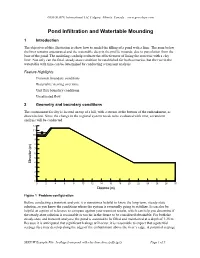
GEO-SLOPE International Ltd, Calgary, Alberta, Canada www.geo-slope.com Pond Infiltration and Watertable Mounding 1 Introduction The objective of this illustration is show how to model the filling of a pond with a liner. The zone below the liner remains unsaturated and the watertable deep in the profile mounds, due to percolation from the base of the pond. The modeling can help evaluate the effectiveness of lining the reservoir with a clay liner. Not only can the final, steady-state condition be established for both scenarios, but the rise in the watertable with time can be determined by conducting a transient analysis. Feature Highlights Transient boundary conditions Watertable viewing over time Unit flux boundary conditions Unsaturated flow 2 Geometry and boundary conditions The containment facility is located on top of a hill, with a stream at the bottom of the embankment, as shown below. Since the change in the regional system needs to be evaluated with time, a transient analysis will be conducted. 12 11 10 9 ) 8 m ( 7 n o i 6 t a v 5 e l E 4 3 2 1 0 0 2 4 6 8 10 12 14 16 18 20 22 24 26 28 30 Distance (m) Figure 1 Problem configuration Before conducting a transient analysis, it is sometimes helpful to know the long-term, steady-state solution, so you know the conditions where the system is eventually going to stabilize. It can also be helpful as a point of reference to compare against your transient results, which can help you determine if the steady-state solution is reasonable or too far in the future to be considered obtainable. -
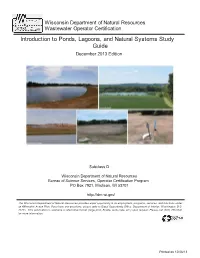
Introduction to Ponds, Lagoons, and Natural Systems Study Guide December 2013 Edition
Wisconsin Department of Natural Resources Wastewater Operator Certification Introduction to Ponds, Lagoons, and Natural Systems Study Guide December 2013 Edition Subclass D Wisconsin Department of Natural Resources Bureau of Science Services, Operator Certification Program PO Box 7921, Madison, WI 53707 http://dnr.wi.gov/ The Wisconsin Department of Natural Resources provides equal opportunity in its employment, programs, services, and functions under an Affirmative Action Plan. If you have any questions, please write to Equal Opportunity Office, Department of Interior, Washington, D.C. 20240. This publication is available in alternative format (large print, Braille, audio tape. etc.) upon request. Please call (608) 266-0531 for more information. Printed on 12/06/13 Introduction to Ponds, Lagoons, and Natural Systems Study Guide - December 2013 Edition Preface This operator's study guide represents the results of an ambitious program. Operators of wastewater facilities, regulators, educators and local officials, jointly prepared the objectives and exam questions for this subclass. How to use this study guide with references In preparation for the exams you should: 1. Read all of the key knowledges for each objective. 2. Use the resources listed at the end of the study guide for additional information. 3. Review all key knowledges until you fully understand them and know them by memory. It is advisable that the operator take classroom or online training in this process before attempting the certification exam. Choosing a Test Date: Before you choose a test date, consider the training opportunities available in your area. A listing of training opportunities and exam dates is available on the internet at http://dnr.wi.gov, keyword search "operator certification". -

Wastewater Treatment Technologies List.Cdr
GK.TAMILGOD.ORG List Of Wastewater Treatment TECHNOLOGIES TECHNOLOGIES G K . T A M I L G O D . O R G G K . TA M I L G O D . O R G A Ta m i l Q A P o r t a l . Wastewater Treatment Technologies Activated sludge model Activated sludge systems Adsorption/Bio-oxidation process Advanced oxidation process Aerated lagoon Aerobic granular reactor Aerobic granular sludge technology Aerobic granulation Aerobic treatment system Anaerobic clarigester Anaerobic digester types Anaerobic digestion Anaerobic filter Anaerobic lagoon Anammox API oil-water separator Belt filter Bioconversion of biomass to mixed alcohol fuels Biofilters Bioreactor Bioretention Biorotor Capacitive deionization Carbon filtering Cesspit Chemical addition wastewater treatment Clarifier Coarse bubble diffusers Composting toilet Constructed wetland Cross-flow filtration Dark fermentation Decentralized wastewater system Diffuser (sewage) Page 01 G K . TA M I L G O D . O R G A Ta m i l Q A P o r t a l . G K . TA M I L G O D . O R G A Ta m i l Q A P o r t a l . Wastewater Treatment Technologies Dissolved air flotation Dissolved gas flotation Desalination Distillation EcocyclET systems Electrocoagulation Electrodeionization Electrodialysis Electrolysis Enhanced biological phosphorus removal Expanded granular sludge bed digestion Extended aeration Facultative lagoon Fenton's reagent Filtration Fine bubble diffusers Flocculation & sedimentation Flotation process Forward osmosis Froth flotation Hydrocyclone Imhoff tank Induced gas flotation Ion exchange Lamella clarifier (inclined plate clarifier)[1] Living machines Maceration (sewage) Media filter Membrane bioreactor Membrane distillation Membrane fouling Microbial fuel cell Microflotation Moving bed biofilm reactor Page 02 G K . -

Sewage/ Wastewater Treatment Technologies 1. Activated Sludge
Sewage/ Wastewater Treatment Technologies 1. Activated Sludge Process The most common suspended growth process used for municipal wastewater treatment is the activated sludge process. The municipal wastewater treatment is the BOD-removal. The removal of BOD is done by a biological process, such as the suspended growth treatment process. This biological process is an aerobic process and takes place in the aeration tank, in where the wastewater is aerated with oxygen. By creating good conditions, bacteria will grow fast. The grow of bacteria creates flocks and gases. These flocks will removed by a secondary clarifier. In the activated sludge process, the dispersed-growth reactor is an aeration tank or basin containing as suspension of the wastewater and microorganisms, the mixed liquor. The contents of the aeration tank are mixed vigorously by aeration devices which also supply oxygen to the biological suspension. Aeration devices commonly used include submerged diffusers that release compressed air and mechanical surface aerators that introduce air by agitating the liquid surface. Hydraulic retention time in the aeration tanks usually ranges from 3 to 8 hours but can be higher with high BOD5 wastewaters. Following the aeration step, the microorganisms are separated from the liquid by sedimentation and the clarified liquid is secondary effluents. A portion of the biological sludge is recycled to the aeration basin to maintain a high mixed-liquor suspended solids (MLSS) level. The remainder is removed from the process and sent to sludge processing to maintain a relatively constant concentration of microorganisms in the system. Several variation of the basic activated sludge process, such as extended aeration and oxidation ditches, are in common use, but the principal are similar: 2. -

2021 OKG58 Fact Sheet
FACT SHEET FOR THE GENERAL PERMIT TO DISCHARGE WASTEWATER FROM MUNICIPAL LAGOONS TO WATERS OF THE UNITED STATES UNDER THE OKLAHOMA POLLUTANT DISCHARGE ELIMINATION SYSTEM (OPDES) DEQ Permit No.: OKG58 Applicant: Operators of Discharging Facultative Municipal/Domestic Lagoons Located in the State of Oklahoma Issuing Office:: Oklahoma Department of Environmental Quality Water Quality Division 707 N. Robinson P.O. Box 1677 Oklahoma City, OK 73101-1677 Prepared By: Kelly Pham, P.E., Permit Writer Municipal Discharge and Stormwater Permit Section Water Quality Division Date Prepared: January 12, 2021 Date Modified: March 4, 2021 Reviewed By: Michael B. Moe, P.E., Engineering Manager Municipal Discharge and Stormwater Permit Section Water Quality Division Patrick Rosch, P.E., Engineering Manager Municipal Wastewater Group Water Quality Division Permit Action: Renewal of a general permit for discharge of treated wastewater from facultative municipal/domestic lagoons. General Permit OKG58 for Discharge from Facultative Lagoons General Permit OKG58 FACT SHEET Page 2 I. PURPOSE AND SCOPE OF PERMIT The purpose of the General Wastewater Discharge Permit OKG58 (the permit) is to expedite the permitting process for municipal facultative lagoons that discharge generally small quantities (less than one million gallons per day) of treated wastewater with relatively low risk of water quality degradation to the receiving streams. The permit provides a uniform measure of environmental protection consistent with all the laws, rules and regulations of the Oklahoma Department of Environmental Quality (DEQ) and the Environmental Protection Agency (EPA). Facilities that meet qualifying requirements specified in Section I.A and meet the restrictions for receiving waters specified in Section I.B may be granted an authorization by the DEQ to discharge under the permit. -

Optimization of Lagoon Operation
OPTIMIZATION OF LAGOON OPERATION A BEST PRACTICE BY THE NATIONAL GUIDE TO SUSTAINABLE MUNICIPAL INFRASTRUCTURE Optimization of Lagoon Operation Issue No. 1.0 Publication Date: August 2004 © 2004 Federation of Canadian Municipalities and National Research Council The contents of this publication are presented in good faith and are intended as general guidance on matters of interest only. The publisher, the authors and the organizations to which the authors belong make no representations or warranties, either express or implied, as to the completeness or accuracy of the contents. All information is presented on the condition that the persons receiving it will make their own determinations as to the suitability of using the information for their own purposes and on the understanding that the information is not a substitute for specific technical or professional advice or services. In no event will the publisher, the authors or the organizations to which the authors belong, be responsible or liable for damages of any nature or kind whatsoever resulting from the use of, or reliance on, the contents of this publication. Optimization of Lagoon Operations Table of Contents TABLE OF CONTENTS Introduction ........................................................................................................ v Acknowledgements........................................................................................... vii Executive Summary........................................................................................... xi 1. General.........................................................................................................