Věstníku Odrúd
Total Page:16
File Type:pdf, Size:1020Kb
Load more
Recommended publications
-

Apples Catalogue 2019
ADAMS PEARMAIN Herefordshire, England 1862 Oct 15 Nov Mar 14 Adams Pearmain is a an old-fashioned late dessert apple, one of the most popular varieties in Victorian England. It has an attractive 'pearmain' shape. This is a fairly dry apple - which is perhaps not regarded as a desirable attribute today. In spite of this it is actually a very enjoyable apple, with a rich aromatic flavour which in apple terms is usually described as Although it had 'shelf appeal' for the Victorian housewife, its autumnal colouring is probably too subdued to compete with the bright young things of the modern supermarket shelves. Perhaps this is part of its appeal; it recalls a bygone era where subtlety of flavour was appreciated - a lovely apple to savour in front of an open fire on a cold winter's day. Tree hardy. Does will in all soils, even clay. AERLIE RED FLESH (Hidden Rose, Mountain Rose) California 1930’s 19 20 20 Cook Oct 20 15 An amazing red fleshed apple, discovered in Aerlie, Oregon, which may be the best of all red fleshed varieties and indeed would be an outstandingly delicious apple no matter what color the flesh is. A choice seedling, Aerlie Red Flesh has a beautiful yellow skin with pale whitish dots, but it is inside that it excels. Deep rose red flesh, juicy, crisp, hard, sugary and richly flavored, ripening late (October) and keeping throughout the winter. The late Conrad Gemmer, an astute observer of apples with 500 varieties in his collection, rated Hidden Rose an outstanding variety of top quality. -

Osher Lifelong Learning Institute
USDA-ARS National Plant Germplasm System Conservation of Fruit & Nut Genetic Resources Joseph Postman Plant Pathologist & Curator National Clonal Germplasm Repository Corvallis, Oregon May 2010 Mission: Collect – Preserve Evaluate – Enhance - Distribute World Diversity of Plant Genetic Resources for Improving the Quality and Production of Economic Crops Important to U.S. and World Agriculture Apple Accessions at Geneva Malus angustifolia ( 59 Accessions) Malus sikkimensis ( 14 Accessions) Malus baccata ( 67 Accessions) Malus sp. ( 41 Accessions) Malus bhutanica ( 117 Accessions) Malus spectabilis ( 9 Accessions) Malus brevipes ( 2 Accessions) Malus sylvestris ( 70 Accessions) Malus coronaria ( 98 Accessions) Malus toringo ( 122 Accessions) Malus domestica ( 1,389 Accessions) Malus transitoria ( 63 Accessions) Malus doumeri ( 2 Accessions) Malus trilobata ( 2 Accessions) Malus florentina ( 4 Accessions) Malus tschonoskii ( 3 Accessions) Malus floribunda ( 12 Accessions) Malus x adstringens ( 2 Accessions) Malus fusca ( 147 Accessions) Malus x arnoldiana ( 2 Accessions) Malus halliana ( 15 Accessions) Malus x asiatica ( 20 Accessions) Malus honanensis ( 4 Accessions) Malus x astracanica ( 1 Accessions) Malus hupehensis ( 185 Accessions) Malus x atrosanguinea ( 2 Accessions) Malus hybrid ( 337 Accessions) Malus x dawsoniana ( 2 Accessions) Malus ioensis ( 72 Accessions) Malus x hartwigii ( 5 Accessions) Malus kansuensis ( 45 Accessions) Malus x magdeburgensis ( 2 Accessions) Malus komarovii ( 1 Accessions) Malus x micromalus ( 25 Accessions) -
Dates of Full Bloom Table 4 Variety Full Bloom Z David Pear 5/18/2014 Z Illinka Pear 5/20/2014 Dolgo Sdl 5 5/26/2014 Dolgo Sdl 6
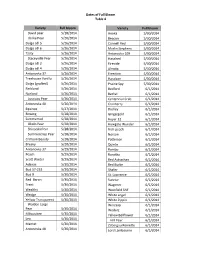
Dates of Full Bloom Table 4 Variety Full bloom Variety Full bloom z David pear 5/18/2014 Anoka 5/30/2014 z Illinka Pear 5/20/2014 Beacon 5/30/2014 Dolgo sdl 5 5/26/2014 Connell Red 5/30/2014 Dolgo sdl 6 5/26/2014 Marlin Stephens 5/30/2014 Tasty 5/26/2014 Antonovka 109 5/30/2014 z Staceyville Pear 5/26/2014 Haralred 5/30/2014 Dolgo sdl 2 5/26/2014 Fireside 5/30/2014 Dolgo sdl 4 5/26/2014 Almata 5/30/2014 Antonovka 37 5/26/2014 Freedom 5/30/2014 Treehouse Vanilla 5/26/2014 Haralson 5/30/2014 Dolgo (grafted) 5/26/2014 Prairie Spy 5/30/2014 Parkland 5/26/2014 Bedford 6/1/2014 Norland 5/26/2014 Bethel 6/1/2014 z Luscious Pear 5/26/2014 Centennial Crab 6/1/2014 Antonovka 40 5/26/2014 Cranberry 6/1/2014 Equinox 5/27/2014 Dudley 6/1/2014 Bowing 5/28/2014 Gingergold 6/1/2014 Summerred 5/28/2014 Heyer 12 6/1/2014 z Okolo Pear 5/28/2014 Howgate Wonder 6/1/2014 z Shinseiki Pear 5/28/2014 Irish peach 6/1/2014 z Summercrisp Pear 5/28/2014 Norson 6/1/2014 Crimson Beauty 5/28/2014 Patterson 6/1/2014 Breaky 5/28/2014 Quinte 6/1/2014 Antonovka 37 5/29/2014 Rambo 6/1/2014 Peach 5/29/2014 Ranetka 6/1/2014 Scott Winter 5/29/2014 Red Astrachan 6/1/2014 Adanac 5/30/2014 Red Burke 6/1/2014 Bud 57-233 5/30/2014 Shafer 6/1/2014 Bud 9 5/30/2014 St. -

Apple Varieties in Maine Frederick Charles Bradford
The University of Maine DigitalCommons@UMaine Electronic Theses and Dissertations Fogler Library 6-1911 Apple Varieties in Maine Frederick Charles Bradford Follow this and additional works at: http://digitalcommons.library.umaine.edu/etd Part of the Agriculture Commons Recommended Citation Bradford, Frederick Charles, "Apple Varieties in Maine" (1911). Electronic Theses and Dissertations. 2384. http://digitalcommons.library.umaine.edu/etd/2384 This Open-Access Thesis is brought to you for free and open access by DigitalCommons@UMaine. It has been accepted for inclusion in Electronic Theses and Dissertations by an authorized administrator of DigitalCommons@UMaine. A thesis submitted to the faculty of the University of Maine in partial fulfillment of the requirements for the degree of MASTER OF SCIENCE IN AGRICULTURE by FREDERICK CHARLES BRADFORD, B. S . Orono, Maine. June, 1911. 8 2 8 5 INTRODUCTION The following pages represent an effort to trace the causes of the changing procession of varieties of apples grown in Maine. To this end the history of fruit growing in Maine has been carefully studied, largely through the Agricultural Reports from 1850 to 1909 and the columns of the Maine Farmer fran 1838 to 1875. The inquiry has been confined as rigidly as possible to this state, out side sources being referred to only for sake of compari son. Rather incidentally, soil influences, modifications due to climate, etc., have been considered. Naturally* since the inquiry was limited to printed record, nothing new has been discovered in this study. Perhaps a somewhat new point of view has been achieved. And, since early Maine pomological literature has been rather neglected by our leading writers, some few forgot ten facts have been exhumed. -
Variety Description Origin Approximate Ripening Uses
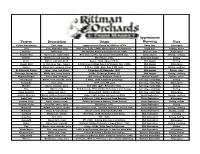
Approximate Variety Description Origin Ripening Uses Yellow Transparent Tart, crisp Imported from Russia by USDA in 1870s Early July All-purpose Lodi Tart, somewhat firm New York, Early 1900s. Montgomery x Transparent. Early July Baking, sauce Pristine Sweet-tart PRI (Purdue Rutgers Illinois) release, 1994. Mid-late July All-purpose Dandee Red Sweet-tart, semi-tender New Ohio variety. An improved PaulaRed type. Early August Eating, cooking Redfree Mildly tart and crunchy PRI release, 1981. Early-mid August Eating Sansa Sweet, crunchy, juicy Japan, 1988. Akane x Gala. Mid August Eating Ginger Gold G. Delicious type, tangier G Delicious seedling found in Virginia, late 1960s. Mid August All-purpose Zestar! Sweet-tart, crunchy, juicy U Minn, 1999. State Fair x MN 1691. Mid August Eating, cooking St Edmund's Pippin Juicy, crisp, rich flavor From Bury St Edmunds, 1870. Mid August Eating, cider Chenango Strawberry Mildly tart, berry flavors 1850s, Chenango County, NY Mid August Eating, cooking Summer Rambo Juicy, tart, aromatic 16th century, Rambure, France. Mid-late August Eating, sauce Honeycrisp Sweet, very crunchy, juicy U Minn, 1991. Unknown parentage. Late Aug.-early Sept. Eating Burgundy Tart, crisp 1974, from NY state Late Aug.-early Sept. All-purpose Blondee Sweet, crunchy, juicy New Ohio apple. Related to Gala. Late Aug.-early Sept. Eating Gala Sweet, crisp New Zealand, 1934. Golden Delicious x Cox Orange. Late Aug.-early Sept. Eating Swiss Gourmet Sweet-tart, juicy Switzerland. Golden x Idared. Late Aug.-early Sept. All-purpose Golden Supreme Sweet, Golden Delcious type Idaho, 1960. Golden Delicious seedling Early September Eating, cooking Pink Pearl Sweet-tart, bright pink flesh California, 1944, developed from Surprise Early September All-purpose Autumn Crisp Juicy, slow to brown Golden Delicious x Monroe. -
Cedar-Apple Rust
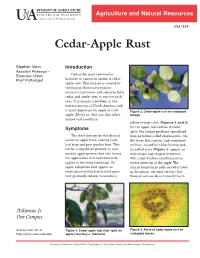
DIVISION OF AGRICULTURE RESEARCH & EXTENSION Agriculture and Natural Resources University of Arkansas System FSA7538 Cedar-Apple Rust Stephen Vann Introduction Assistant Professor One of the most spectacular Extension Urban Plant Pathologist diseases to appear in spring is cedar- apple rust. This disease is caused by the fungus Gymnosporangium juniperi-virginianae and requires both cedar and apple trees to survive each year. It is mainly a problem in the eastern portion of North America and is most important on apple or crab Figure 2. Cedar-apple rust on crabapple apple (Malus sp), but can also affect foliage. quince and hawthorn. yellow-orange color (Figures 1 and 2). Symptoms On the upper leaf surface of these spots, the fungus produces specialized The chief damage by this disease fruiting bodies called spermagonia. On occurs on apple trees, causing early the lower leaf surface (and sometimes leaf drop and poor quality fruit. This on fruit), raised hair-like fruiting bod can be a significant problem to com ies called aecia (Figure 3) appear as mercial apple growers but also harms microscopic cup-shaped structures. the appearance of ornamental crab Wet, rainy weather conditions favor apples in the home landscape. On severe infection of the apple. The apple, symptoms first appear as fungus forms large galls on cedar trees small green-yellow leaf or fruit spots in the spring (see next section), but that gradually enlarge to become a these structures do not greatly harm Arkansas Is Our Campus Visit our web site at: Figure 1. Cedar-apple rust (leaf spot) on Figure 3. Aecia of cedar-apple rust on https://www.uaex.uada.edu apple (courtesy J. -

Apples: Organic Production Guide
A project of the National Center for Appropriate Technology 1-800-346-9140 • www.attra.ncat.org Apples: Organic Production Guide By Tammy Hinman This publication provides information on organic apple production from recent research and producer and Guy Ames, NCAT experience. Many aspects of apple production are the same whether the grower uses low-spray, organic, Agriculture Specialists or conventional management. Accordingly, this publication focuses on the aspects that differ from Published nonorganic practices—primarily pest and disease control, marketing, and economics. (Information on March 2011 organic weed control and fertility management in orchards is presented in a separate ATTRA publica- © NCAT tion, Tree Fruits: Organic Production Overview.) This publication introduces the major apple insect pests IP020 and diseases and the most effective organic management methods. It also includes farmer profiles of working orchards and a section dealing with economic and marketing considerations. There is an exten- sive list of resources for information and supplies and an appendix on disease-resistant apple varieties. Contents Introduction ......................1 Geographical Factors Affecting Disease and Pest Management ...........3 Insect and Mite Pests .....3 Insect IPM in Apples - Kaolin Clay ........6 Diseases ........................... 14 Mammal and Bird Pests .........................20 Thinning ..........................20 Weed and Orchard Floor Management ......20 Economics and Marketing ........................22 Conclusion -

Phenolic Compounds As Markers of Wine Quality and Authenticity
foods Review Phenolic Compounds as Markers of Wine Quality and Authenticity Vakare˙ Merkyte˙ 1,2 , Edoardo Longo 1,2,* , Giulia Windisch 1,2 and Emanuele Boselli 1,2 1 Faculty of Science and Technology, Free University of Bozen-Bolzano, Piazza Università 5, 39100 Bozen-Bolzano, Italy; Vakare.Merkyte@natec.unibz.it (V.M.); giulia.windisch@unibz.it (G.W.); emanuele.boselli@unibz.it (E.B.) 2 Oenolab, NOI Techpark South Tyrol, Via A. Volta 13B, 39100 Bozen-Bolzano, Italy * Correspondence: edoardo.longo@unibz.it; Tel.: +39-0471-017691 Received: 29 October 2020; Accepted: 28 November 2020; Published: 1 December 2020 Abstract: Targeted and untargeted determinations are being currently applied to different classes of natural phenolics to develop an integrated approach aimed at ensuring compliance to regulatory prescriptions related to specific quality parameters of wine production. The regulations are particularly severe for wine and include various aspects of the viticulture practices and winemaking techniques. Nevertheless, the use of phenolic profiles for quality control is still fragmented and incomplete, even if they are a promising tool for quality evaluation. Only a few methods have been already validated and widely applied, and an integrated approach is in fact still missing because of the complex dependence of the chemical profile of wine on many viticultural and enological factors, which have not been clarified yet. For example, there is a lack of studies about the phenolic composition in relation to the wine authenticity of white and especially rosé wines. This review is a bibliographic account on the approaches based on phenolic species that have been developed for the evaluation of wine quality and frauds, from the grape varieties (of V. -

Survey of Apple Clones in the United States
Historic, archived document Do not assume content reflects current scientific knowledge, policies, or practices. 5 ARS 34-37-1 May 1963 A Survey of Apple Clones in the United States u. S. DFPT. OF AGRffini r U>2 4 L964 Agricultural Research Service U.S. DEPARTMENT OF AGRICULTURE PREFACE This publication reports on surveys of the deciduous fruit and nut clones being maintained at the Federal and State experiment stations in the United States. It will b- published in three c parts: I. Apples, II. Stone Fruit. , UI, Pears, Nuts, and Other Fruits. This survey was conducted at the request of the National Coor- dinating Committee on New Crops. Its purpose is to obtain an indication of the volume of material that would be involved in establishing clonal germ plasm repositories for the use of fruit breeders throughout the country. ACKNOWLEDGMENT Gratitude is expressed for the assistance of H. F. Winters of the New Crops Research Branch, Crops Research Division, Agricultural Research Service, under whose direction the questionnaire was designed and initial distribution made. The author also acknowledges the work of D. D. Dolan, W. R. Langford, W. H. Skrdla, and L. A. Mullen, coordinators of the New Crops Regional Cooperative Program, through whom the data used in this survey were obtained from the State experiment stations. Finally, it is recognized that much extracurricular work was expended by the various experiment stations in completing the questionnaires. : CONTENTS Introduction 1 Germany 298 Key to reporting stations. „ . 4 Soviet Union . 302 Abbreviations used in descriptions .... 6 Sweden . 303 Sports United States selections 304 Baldwin. -

Treeid Variety Run 2 DNA Milb005 American Summer Pearmain
TreeID Variety Run 2 DNA Run 1 DNA DNA Sa… Sourc… Field Notes milb005 American Summer Pearmain/ "Sara's Polka American Summer Pearmain we2g016 AmericanDot" Summer Pearmain/ "Sara's Polka American Summer Pearmain we2f017 AmericanDot" Summer Pearmain/ "Sara's Polka American Summer Pearmain we2f018 AmericanDot" Summer Pearmain/ "Sara's Polka American Summer Pearmain eckh001 BaldwinDot" Baldwin-SSE6 eckh008 Baldwin Baldwin-SSE6 2lwt007 Baldwin Baldwin-SSE6 2lwt011 Baldwin Baldwin-SSE6 schd019 Ben Davis Ben Davis mild006 Ben Davis Ben Davis wayb004 Ben Davis Ben Davis andt019 Ben Davis Ben Davis ostt014 Ben Davis Ben Davis watt008 Ben Davis Ben Davis wida036 Ben Davis Ben Davis eckg002 Ben Davis Ben Davis frea009 Ben Davis Ben Davis frei009 Ben Davis Ben Davis frem009 Ben Davis Ben Davis fres009 Ben Davis Ben Davis wedg004 Ben Davis Ben Davis frai006 Ben Davis Ben Davis frag004 Ben Davis Ben Davis frai004 Ben Davis Ben Davis fram006 Ben Davis Ben Davis spor004 Ben Davis Ben Davis coue002 Ben Davis Ben Davis couf001 Ben Davis Ben Davis coug008 Ben Davis Ben Davis, error on DNA sample list, listed as we2a023 Ben Davis Bencoug006 Davis cria001 Ben Davis Ben Davis cria008 Ben Davis Ben Davis we2v002 Ben Davis Ben Davis we2z007 Ben Davis Ben Davis rilcolo Ben Davis Ben Davis koct004 Ben Davis Ben Davis koct005 Ben Davis Ben Davis mush002 Ben Davis Ben Davis sc3b005-gan Ben Davis Ben Davis sche019 Ben Davis, poss Black Ben Ben Davis sche020 Ben Davis, poss Gano Ben Davis schi020 Ben Davis, poss Gano Ben Davis ca2e001 Bietigheimer Bietigheimer/Sweet -

Chemical Characteristics of Wine Made by Disease Tolerant Varieties
UNIVERSITÀ DEGLI STUDI DI UDINE in agreement with FONDAZIONE EDMUND MACH PhD School in Agricultural Science and Biotechnology Cycle XXX Doctoral Thesis Chemical characteristics of wine made by disease tolerant varieties PhD Candidate Supervisor Silvia Ruocco Dr. Urska Vrhovsek Co-Supervisor Prof. Doris Rauhut DEFENCE YEAR 2018 To the best gift that life gave us: to you Nonna Rosa CONTENTS Abstract 1 Aim of the PhD project 2 Chapter 1 Introduction 3 Preface to Chapter 2 17 Chapter 2 The metabolomic profile of red non-V. vinifera genotypes 19 Preface to Chapter 3 and 4 50 Chapter 3 Study of the composition of grape from disease tolerant varieties 56 Chapter 4 Investigation of volatile and non-volatile compounds of wine 79 produced by disease tolerant varieties Concluding remarks 140 Summary of PhD experiences 141 Acknowledgements 142 Abstract Vitis vinifera L. is the most widely cultivated Vitis species around the world which includes a great number of cultivars. Owing to the superior quality of their grapes, these cultivars were long considered the only suitable for the production of high quality wines. However, the lack of resistance genes to fungal diseases like powdery and downy mildew (Uncinula necator and Plasmopara viticola) makes it necessary the application of huge amounts of chemical products in vineyard. Thus, the search for alternative and more sustainable methods to control the major grapevine pathogens have increased the interest in new disease tolerant varieties. Chemical characterisation of these varieties is an important prerequisite to evaluate and promote their use on the global wine market. The aim of this project was to produce a comprehensive study of some promising new disease tolerant varieties recently introduced to the cultivation by identifying the peculiar aspects of their composition and measuring their positive and negative quality traits. -
Low Temperature Injury to Apple Trees in Maine M
The University of Maine DigitalCommons@UMaine Technical Bulletins Maine Agricultural and Forest Experiment Station 6-1-1973 TB64: Low Temperature Injury to Apple Trees in Maine M. T. Hilborn W. C. Stiles Follow this and additional works at: https://digitalcommons.library.umaine.edu/aes_techbulletin Part of the Fruit Science Commons Recommended Citation Hilborn, M.T., and W.C. Stiles. 1973. Low temperatur injury to apple trees in Maine. Life Sciences and Agriculture Experiment Station Technical Bulletin 64. This Article is brought to you for free and open access by DigitalCommons@UMaine. It has been accepted for inclusion in Technical Bulletins by an authorized administrator of DigitalCommons@UMaine. For more information, please contact um.library.technical.services@maine.edu. Low Temperature Injury To Apple Trees in Maine M. T. HILBORN and W. C. Stiles FE SCIENCES AND AGRICULTURE EXPERIMENT STATION UNIVERSITY OF MAINE AT ORONO iCHNICAL BULLETIN 64 JUNE 1973 Table of Contents PAGES Introduction 3 Winter killing of apple trees in Maine in 1933-34 4 Hardy trunk-forming stocks 9 Age of the Ironclads 9 Revi\al of Hardy trunk-forming stocks 10 The Patten Orchard 11 Trunk-forming stock planting at Highmoor Farm 12 Characteristics of a trunk-forming stock 15 Growth in circumference 16 Other characteristics 17 Rapidity of top-working 17 Stem pitting virus 19 Influence of stock-scion combination on hardiness 19 Specific conductivity studies 20 Artificial freezing studies 23 Final Orchard Evaluation 27 Discussion 28 Conclusions 30 Literature cited 30 low Temperature Injury to Apple Trees in Maine M.T. Hilborn and W.C.