304 Alice Walker's Womanism
Total Page:16
File Type:pdf, Size:1020Kb
Load more
Recommended publications
-

Invisible Woman
University of Montana ScholarWorks at University of Montana Graduate Student Theses, Dissertations, & Professional Papers Graduate School 2009 Invisible Woman Kristin Deanne Howe The University of Montana Follow this and additional works at: https://scholarworks.umt.edu/etd Let us know how access to this document benefits ou.y Recommended Citation Howe, Kristin Deanne, "Invisible Woman" (2009). Graduate Student Theses, Dissertations, & Professional Papers. 599. https://scholarworks.umt.edu/etd/599 This Thesis is brought to you for free and open access by the Graduate School at ScholarWorks at University of Montana. It has been accepted for inclusion in Graduate Student Theses, Dissertations, & Professional Papers by an authorized administrator of ScholarWorks at University of Montana. For more information, please contact scholarworks@mso.umt.edu. INVISIBLE WOMAN By KRISTIN DEANNE HOWE Bachelor of Arts, Southwest Minnesota State University, Marshall, Minnesota, 2005 Thesis presented in partial fulfillment of the requirements for the degree of Master of Arts in Philosophy The University of Montana Missoula, MT December 2009 Approved by: Perry Brown, Associate Provost for Graduate Education Graduate School Deborah Slicer, Chairperson Philosophy Christopher Preston Philosophy Elizabeth Hubble Women and Gender Studies ii Howe, Kristin, M.A. December 2009 Philosophy Invisible Women Chairperson: Deborah Slicer Abstract: The aim of this paper is to illuminate the ways in which working class women are invisible within the feminist and ecofeminist movements. Using the faces and forces of oppression as presented by Iris Marion Young and Hilde Lindemann, I show how the working class experiences oppression. I also show how oppression based on class differs from that based on gender and how these differences contribute to the invisibility of working class women within feminism. -
What White Feminism Gets Wrong BEING INTENTIONAL ABOUT INTERSECTIONALITY
What White Feminism Gets Wrong BEING INTENTIONAL ABOUT INTERSECTIONALITY Tiesha Shankin | Sharalle Arnold | Jennifer Palm | Suzy Herman | Ashley McCarter | Dionna Cheatham Ground Rules •Speaking from our two perspectives – African American (Black) and Caucasian (White) • Cannot speak for those that are not represented by the group (key) •Purpose is not intended to offend or point blame – but to learn/grow •Acknowledge the diversity of the feminist thought •Accept that feminist movements have made many beneficial societal contributions • These movements have made improvements for society and individual women • Not about if feminism as a whole is good or not but how to improve feminism Ground Rules, cont. • Listen to understand – not just to gather ammunition • Opinions are not right or wrong – rather different • Try not to make assumptions – no two individuals think alike • Listen and speak with the same respect you personally like shown to you • Try not to interrupt each other when speaking – respect • We will try to use evidence and/or examples • Maintain confidentiality • Try not to use names/specific places/etc • “Ouch” and “Oops” • If someone says something that offends you, say “Ouch.” This allows the other person to say, “Oops!” Then we can educate them on why what they said could come across offensive. What is the definition of feminism? As defined by bell hooks: feminism is the struggle against sexist oppression. Review of Feminism •Various types •Questions emerge •Thinking intersectionality When considering the exclusive nature of feminism… “Part of the problem with Western feminists, I find, is that they take after their brothers and their fathers. And that’s a real problem.” -Alice Walker Feminism and Intersectionality Examples of White Feminism in Modern Culture The Real First Family Controversy or Praise? Serena Williams VIDEO Kelly Osbourne “If you kick every Latino out of this country, then who is going to be cleaning your toilet, Donald Trump?” Meryl Streep In children’s media… Lean In Sheryl Sandburg It was a watershed moment for me. -
Womanism: the Fight for Social Equality
University of Washington Tacoma UW Tacoma Digital Commons Gender & Sexuality Studies Student Work Collection School of Interdisciplinary Arts and Sciences Spring 6-2-2020 Womanism: The Fight for Social Equality Demetria Hawkins demehawk@uw.edu Follow this and additional works at: https://digitalcommons.tacoma.uw.edu/gender_studies Recommended Citation Hawkins, Demetria, "Womanism: The Fight for Social Equality" (2020). Gender & Sexuality Studies Student Work Collection. 58. https://digitalcommons.tacoma.uw.edu/gender_studies/58 This Undergraduate Zine is brought to you for free and open access by the School of Interdisciplinary Arts and Sciences at UW Tacoma Digital Commons. It has been accepted for inclusion in Gender & Sexuality Studies Student Work Collection by an authorized administrator of UW Tacoma Digital Commons. Z I N E P R O J E C T WOMANISM: The Fight for Social Equality Presented by Demetria Hawkins -What is Womanism? -Womanism vs. Feminism -Gender/ Racial Discrimination in the Content Summary Work Place -Quality of Life: Men vs. Women DISCUSSION OVERVIEW -What does this all mean? MERRIAM- WEBSTER DEFINITION What is "A form of feminism focused especially on the conditions and concerns of black women." WOMANISM? THOUGHT CO. DEFINITION BY LINDA NAPIKOSKI "Identifies and critically analyzes sexism, black racism, and their intersection." ALICE WALKER DEFINITION "A [B]lack feminist or feminist of color," and "a woman who loves other women, sexually and/or non-sexually [...] committed to survival and wholeness of entire people, male and female." Alice Walker FOUNDER OF WOMANISM WHO IS SHE? Alice Walker is a known social activist, poet, novelist and known famously as the woman who coined the phrase Womanism. -
Intersectionality: T E Fourth Wave Feminist Twitter Community
#Intersectionality: T e Fourth Wave Feminist Twitter Community Intersectionality, is the marrow within the bones of fem- Tegan Zimmerman (PhD, Comparative Literature, inism. Without it, feminism will fracture even further – University of Alberta) is an Assistant Professor of En- Roxane Gay (2013) glish/Creative Writing and Women’s Studies at Stephens College in Columbia, Missouri. A recent Visiting Fel- This article analyzes the term “intersectional- low in the Centre for Contemporary Women’s Writing ity” as defined by Kimberlé Williams Crenshaw (1989, and the Institute of Modern Languages Research at the 1991) in relation to the digital turn and, in doing so, University of London, Zimmerman specializes in con- considers how this concept is being employed by fourth temporary women’s historical fiction and contempo- wave feminists on Twitter. Presently, little scholarship rary gender theory. Her book Matria Redux: Caribbean has been devoted to fourth wave feminism and its en- Women’s Historical Fiction, forthcoming from North- gagement with intersectionality; however, some notable western University Press, examines the concepts of ma- critics include Kira Cochrane, Michelle Goldberg, Mik- ternal history and maternal genealogy. ki Kendall, Ealasaid Munro, Lola Okolosie, and Roop- ika Risam.1 Intersectionality, with its consideration of Abstract class, race, age, ability, sexuality, and gender as inter- This article analyzes the term “intersectionality” as de- secting loci of discriminations or privileges, is now the fined by Kimberlé Williams Crenshaw in relation to the overriding principle among today’s feminists, manifest digital turn: it argues that intersectionality is the dom- by theorizing tweets and hashtags on Twitter. Because inant framework being employed by fourth wave fem- fourth wave feminism, more so than previous feminist inists and that is most apparent on social media, espe- movements, focuses on and takes up online technolo- cially on Twitter. -
Mainstream Feminism
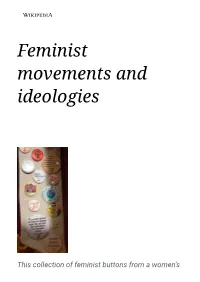
Feminist movements and ideologies This collection of feminist buttons from a women's museum shows some messages from feminist movements. A variety of movements of feminist ideology have developed over the years. They vary in goals, strategies, and affiliations. They often overlap, and some feminists identify themselves with several branches of feminist thought. Groupings Judith Lorber distinguishes between three broad kinds of feminist discourses: gender reform feminisms, gender resistant feminisms, and gender revolution feminisms. In her typology, gender reform feminisms are rooted in the political philosophy of liberalism with its emphasis on individual rights. Gender resistant feminisms focus on specific behaviors and group dynamics through which women are kept in a subordinate position, even in subcultures which claim to support gender equality. Gender revolution feminisms seek to disrupt the social order through deconstructing its concepts and categories and analyzing the cultural reproduction of inequalities.[1] Movements and ideologies Mainstream feminism … "Mainstream feminism" as a general term identifies feminist ideologies and movements which do not fall into either the socialist or radical feminist camps. The mainstream feminist movement traditionally focused on political and legal reform, and has its roots in first- wave feminism and in the historical liberal feminism of the 19th and early- 20th centuries. In 2017, Angela Davis referred to mainstream feminism as "bourgeois feminism".[2] The term is today often used by essayists[3] and cultural analysts[4] in reference to a movement made palatable to a general audience by celebrity supporters like Taylor Swift.[5] Mainstream feminism is often derisively referred to as "white feminism,"[6] a term implying that mainstream feminists don't fight for intersectionality with race, class, and sexuality. -

Black Feminism and Radical Planning
PLT0010.1177/1473095218763221Planning TheoryJacobs 763221research-article2018 Article Planning Theory 2019, Vol. 18(1) 24 –39 Black feminism and radical © The Author(s) 2018 Article reuse guidelines: planning: New directions for sagepub.com/journals-permissions https://doi.org/10.1177/1473095218763221DOI: 10.1177/1473095218763221 disaster planning research journals.sagepub.com/home/plt Fayola Jacobs Texas A&M University, USA Abstract After Hurricane Katrina’s devastation of the United States’ Gulf Coast, conversations about flooding became focused on the interconnections between so-called “natural” disasters, poverty, gender and race. Although research has long shown that women, people of color and low- income communities are more vulnerable to natural hazards, the disproportionate effects of Hurricane Katrina and subsequent federal and state disaster response efforts forced the national spotlight on the institutional and systemic nature of racism, classism and sexism. Using Black feminism and radical planning theory, two lenses that provides a comprehensive framework for understanding racism, classism and sexism, this article examines the concept and literature of social vulnerability. I argue while social vulnerability research has made significant contributions to planners’ understandings of disasters and inequity, it fails to center community knowledge, identify intersectional oppressions and name them as such and encourage community activism, all of which are keys to making meaningful change. Keywords Black feminism, disasters, environmental justice, feminism, social vulnerability, urban planning In the wake of Hurricane Katrina’s devastation and the images that emerged from the Gulf Coast in general and New Orleans in particular, the nation began to pay attention to the inequitable impacts of disasters on poor communities and communities of color. -

Cashing in on “Girl Power”: the Commodification of Postfeminist Ideals in Advertising
CASHING IN ON “GIRL POWER”: THE COMMODIFICATION OF POSTFEMINIST IDEALS IN ADVERTISING _______________________________________ A Thesis presented to the Faculty of the Graduate School at the University of Missouri-Columbia _______________________________________________________ In Partial Fulfillment of the Requirements for the Degree Master of Arts _____________________________________________________ by MARY JANE ROGERS Dr. Cristina Mislán, Thesis Supervisor DECEMBER 2017 © Copyright by Mary Jane Allison Rogers 2017 All Rights Reserved The undersigned, appointed by the dean of the Graduate School, have examined the thesis entitled CASHING IN ON “GIRL POWER”: THE COMMODIFICATION OF POSTFEMINIST IDEALS IN ADVERTISING presented by Mary Jane Rogers, a candidate for the degree of master of arts, and hereby certify that, in their opinion, it is worthy of acceptance. Professor Cristina Mislán Professor Cynthia Frisby Professor Amanda Hinnant Professor Mary Jo Neitz CASHING IN ON “GIRL POWER” ACKNOWLEDGEMENTS My utmost gratitude goes to my advisor, Dr. Cristina Mislán, for supporting me throughout this process. She honed my interest in critically studying gender issues in the media, and her guidance, honesty and encouragement are the reasons I was able to develop the conclusions presented in this paper. I would also like to thank Dr. Amanda Hinnant, Dr. Cynthia Frisby, and Dr. Mary Jo Neitz for their immensely helpful suggestions before and during the research process of this study. Their enthusiasm and guidance was incredibly meaningful, especially during the developmental stages of my research. Additionally, I would like to thank my friends and family for their ongoing support. Special mention needs to be made of Mallory, my cheerleader and motivator from the first day of graduate school, and my Dad and Mom, who have been there since the beginning. -

Is Womanism Feminism?” by Angela Bowen
Journal of International Women's Studies Volume 22 Issue 8 The Practice and Legacy of a Black Lesbian Feminist: Selections from the Archive Article 41 of Dr. Angela Bowen (1936-2018) August 2021 2002 conference talk “Calling the Question; Is Womanism Feminism?” by Angela Bowen Angela Bowen Follow this and additional works at: https://vc.bridgew.edu/jiws Part of the Women's Studies Commons Recommended Citation Bowen, Angela (2021). 2002 conference talk “Calling the Question; Is Womanism Feminism?” by Angela Bowen. Journal of International Women's Studies, 22(8), 118-130. Available at: https://vc.bridgew.edu/jiws/vol22/iss8/41 This item is available as part of Virtual Commons, the open-access institutional repository of Bridgewater State University, Bridgewater, Massachusetts. CALLING THE QUESTION: IS WOMANISM FEMINISM? Panel presentation and workshop; double session NWSA conference. June 15, 2002. Las Vegas, Nevada BOARDROOM C EXPLAIN WHY ELIZABETH HADLEY IS NOT THERE, THEN START WITH INTRO AND A 2-MINUTE REVIEW OF LAST YEAR’S “IS WOMANISM FEMINISM?” I. Where black women were once in the vanguard of a political movement for radical change (Combahee Statement, for instance), addressing race, class, gender, and sexual orientation in a simultaneity of oppression and of consciousness of that oppression, challenging and pushing the edges, we can no longer claim that edge if our feminist politics becomes a matter of identity only. The women of the Combahee River Collective was a group of black lesbian feminists of the 1970s, who used their ethnicity to construct a carefully considered analysis of the simultaneity of oppression, a new concept then but one of the earliest theories that fledgling women’s studies students grasp and reiterate easily. -
The Trouble with White Feminism: Whiteness, Digital Feminism and the Intersectional Internet
City University of New York (CUNY) CUNY Academic Works Publications and Research CUNY Graduate Center 2016 The Trouble with White Feminism: Whiteness, Digital Feminism and the Intersectional Internet Jessie Daniels Hunter College How does access to this work benefit ou?y Let us know! More information about this work at: https://academicworks.cuny.edu/gc_pubs/194 Discover additional works at: https://academicworks.cuny.edu This work is made publicly available by the City University of New York (CUNY). Contact: AcademicWorks@cuny.edu “The Trouble with White Feminism: Whiteness, Digital Feminism and the Intersectional Internet” by Jessie Daniels, PhD Professor, Sociology Hunter College and The Graduate Center, CUNY 2180 Third Avenue, New York, NY, 10035 email: jdaniels@hunter.cuny.edu or jessiedanielsnyc@gmail.com Submitted for consideration to the volume The Intersectional Internet, Section Two: Cultural Values in the Machine (2016) PRE-PRINT VERSION, 16 FEBRUARY 2015 ABSTRACT (210): In August, 2013 Mikki Kendall, writer and pop culture analyst, started the hashtag #SolidarityisforWhiteWomen as a form of cyberfeminist activism directed at the predominantly white feminist activists and bloggers at sites like Feministing, Jezebel and Pandagon who failed to acknowledge the racist, sexist behavior of one their frequent contributors. Kendall’s hashtag activism quickly began trending and reignited a discussion about the trouble with white feminism. A number of journalists have excoriated Kendall specifically, and women of color more generally, for contributing to a “toxic” form of feminism. Yet what remains unquestioned in these journalistic accounts and in the scholarship to date, is the dominance of white women as architects and defenders of a framework of white feminism – not just in the second wave but today, in the digital era. -

The Feminist Fourth Wave
Conclusion The history of the wave is a` troubled one, even while it might seem to describe surges of feminist activism very accurately. It has led to progress and loss narratives emerging, both of which are used to justify tension and divisions between different generations of the social move- ment. The attention received by the multiple waves has also resulted in certain time periods being considered as ‘outside’ or ‘inactive’. Understanding feminism as divided into four wave moments of notable action, implies that the politics lapses into inaction between the surges. This, of course, is not the case, but our understanding of the wave ensures that ongoing and long-term activism are effaced from our overall understanding of the social movement. Waves have also come to be associated with specific figureheads and identities. The second and third wave are crudely characterised as earnest, consciousness-raising, and then DIY zine and punk cultures, respectively. The surge in activist intensity in those times ensures that specific women are positioned as representa- tive of the wave as a whole. The women, unfortunately, are often not reflective of the diversity actually occurring within the wave itself, making the narrative appear to be entirely tied to white feminism, as opposed to a more multicultural and intersectional social movement. It © The Author(s) 2017 185 P. Chamberlain, The Feminist Fourth Wave, DOI 10.1007/978-3-319-53682-8 186 Conclusion is no surprise then, that the wave has been widely critiqued, and in some cases, wholly rejected in relation to a historical understanding of feminism. -

Intersectionality, Identity Politics, and Violence Against Women of Color Author(S): Kimberle Crenshaw Source: Stanford Law Review, Vol
Stanford Law Review Mapping the Margins: Intersectionality, Identity Politics, and Violence against Women of Color Author(s): Kimberle Crenshaw Source: Stanford Law Review, Vol. 43, No. 6 (Jul., 1991), pp. 1241-1299 Published by: Stanford Law Review Stable URL: http://www.jstor.org/stable/1229039 Accessed: 21/07/2010 14:45 Your use of the JSTOR archive indicates your acceptance of JSTOR's Terms and Conditions of Use, available at http://www.jstor.org/page/info/about/policies/terms.jsp. JSTOR's Terms and Conditions of Use provides, in part, that unless you have obtained prior permission, you may not download an entire issue of a journal or multiple copies of articles, and you may use content in the JSTOR archive only for your personal, non-commercial use. Please contact the publisher regarding any further use of this work. Publisher contact information may be obtained at http://www.jstor.org/action/showPublisher?publisherCode=slr. Each copy of any part of a JSTOR transmission must contain the same copyright notice that appears on the screen or printed page of such transmission. JSTOR is a not-for-profit service that helps scholars, researchers, and students discover, use, and build upon a wide range of content in a trusted digital archive. We use information technology and tools to increase productivity and facilitate new forms of scholarship. For more information about JSTOR, please contact support@jstor.org. Stanford Law Review is collaborating with JSTOR to digitize, preserve and extend access to Stanford Law Review. http://www.jstor.org Mappingthe Margins: Intersectionality, Identity Politics, and Violence Against Women of Color KimberleCrenshaw* INTRODUCTION Over the last two decades, women have organized against the almost routine violence that shapes their lives.1 Drawing from the strength of sharedexperience, women have recognizedthat the political demandsof mil- lions speak more powerfully than the pleas of a few isolated voices. -

A Critical Analysis of American Horror Story: Coven
Volume 5 ׀ Render: The Carleton Graduate Journal of Art and Culture Witches, Bitches, and White Feminism: A Critical Analysis of American Horror Story: Coven By Meg Lonergan, PhD Student, Law and Legal Studies, Carleton University American Horror Story: Coven (2013) is the third season an attempt to tell a better story—one that pushes us to imag- analysis thus varies from standard content analysis as it allows of the popular horror anthology on FX1. Set in post-Hurricane ine a better future. for a deeper engagement and understanding of the text, the Katrina New Orleans, Louisiana, the plot centers on Miss Ro- symbols and meaning within the text, and theoretical relation- This paper combines ethnographic content analysis bichaux’s Academy and its new class of female students— ships with other texts and socio-political realities. This method and intersectional feminist analysis to engage with the televi- witches descended from the survivors of the witch trials in Sa- is particularly useful for allowing the researcher deep involve- sion show American Horror Story: Coven (2013) to conduct a lem, Massachusetts in 16922. The all-girls school is supposed ment with the text to develop a descriptive account of the com- close textual reading of the show and unpack how the repre- to be a haven for witches to learn about their heritage and plexities of the narrative (Ferrell et al. 2008, 189). In closely sentations of a diversity of witches can be read and under- powers while fostering a community which protects them from examining the text (Coven) to explore the themes and relation- stood as representing a diversity of types of feminism.