The Civil Law Tradition in the Department
Total Page:16
File Type:pdf, Size:1020Kb
Load more
Recommended publications
-
The Four Courts of Sir Lyman Duff
THE FOUR COURTS OF SIR LYMAN DUFF RICHARD GOSSE* Vancouver I. Introduction. Sir Lyman Poore Duff is the dominating figure in the Supreme Court of Canada's first hundred years. He sat on the court for more than one-third of those years, in the middle period, from 1906 to 1944, participating in nearly 2,000 judgments-and throughout that tenure he was commonly regarded as the court's most able judge. Appointed at forty-one, Duff has been the youngest person ever to have been elevated to the court. Twice his appointment was extended by special Acts of Parliament beyond the mandatory retirement age of seventy-five, a recogni- tion never accorded to any other Canadian judge. From 1933, he sat as Chief Justice, having twice previously-in 1918 and 1924 - almost succeeded to that post, although on those occasions he was not the senior judge. During World War 1, when Borden considered resigning over the conscription issue and recommending to the Governor General that an impartial national figure be called upon to form a government, the person foremost in his mind was Duff, although Sir Lyman had never been elected to public office. After Borden had found that he had the support to continue himself, Duff was invited to join the Cabinet but declined. Mackenzie King con- sidered recommending Duff for appointment as the first Canadian Governor General. Duff undertook several inquiries of national interest for the federal government, of particular significance being the 1931-32 Royal Commission on Transportation, of which he was chairman, and the 1942 investigation into the sending of Canadian troops to Hong Kong, in which he was the sole commissioner . -

A THREAT to LEADERSHIP: C.A.Dunning and Mackenzie King
S. Peter Regenstreif A THREAT TO LEADERSHIP: C.A.Dunning and Mackenzie King BY Now mE STORY of the Progressive revolt and its impact on the Canadian national party system during the 1920's is well documented and known. Various studies, from the pioneering effort of W. L. Morton1 over a decade ago to the second volume of the Mackenzie King official biography2 which has recently appeared, have dealt intensively with the social and economic bases of the movement, the attitudes of its leaders to the institutions and practices of national politics, and the behaviour of its representatives once they arrived in Ottawa. Particularly in biographical analyses, 3 a great deal of attention has also been given to the response of the established leaders and parties to this disrupting influence. It is clearly accepted that the roots of the subsequent multi-party situation in Canada can be traced directly to a specific strain of thought and action underlying the Progressivism of that era. At another level, however, the abatement of the Pro~ gressive tide and the manner of its dispersal by the end of the twenties form the basis for an important piece of Canadian political lore: it is the conventional wisdom that, in his masterful handling of the Progressives, Mackenzie King knew exactly where he was going and that, at all times, matters were under his complete control, much as if the other actors in the play were mere marionettes with King the manipu lator. His official biographers have demonstrated just how illusory this conception is and there is little to be added to their efforts on this score. -

Brief by Professor François Larocque Research Chair In
BRIEF BY PROFESSOR FRANÇOIS LAROCQUE RESEARCH CHAIR IN LANGUAGE RIGHTS UNIVERSITY OF OTTAWA PRESENTED TO THE SENATE STANDING COMMITTEE ON OFFICIAL LANGUAGES AS PART OF ITS STUDY OF THE OFFICIAL LANGUAGES REFORM PROPOSAL UNVEILED ON FEBRUARY 19, 2021, BY THE MINISTER OF ECONOMIC DEVELOPMENT AND OFFICIAL LANGUAGES, ENGLISH AND FRENCH: TOWARDS A SUBSTANTIVE EQUALITY OF OFFICIAL LANGUAGES IN CANADA MAY 31, 2021 Professor François Larocque Faculty of Law, Common Law Section University of Ottawa 57 Louis Pasteur Ottawa, ON K1J 6N5 Telephone: 613-562-5800, ext. 3283 Email: Francoislarocque@uottawa.ca 1. Thank you very much to the honourable members of the Senate Standing Committee on Official Languages (the “Committee”) for inviting me to testify and submit a brief as part of the study of the official languages reform proposal entitled French and English: Towards a Substantive Equality of Official Languages in Canada (“the reform proposal”). A) The reform proposal includes ambitious and essential measures 2. First, I would like to congratulate the Minister of Economic Development and Official Languages for her leadership and vision. It is, in my opinion, the most ambitious official languages reform proposal since the enactment of the Constitution Act, 1982 (“CA1982”)1 and the Canadian Charter of Rights and Freedoms (“Charter”),2 which enshrined the main provisions of the Official Languages Act (“OLA”)3 of 1969 in the Canadian Constitution. The last reform of the OLA was in 1988 and it is past time to modernize it to adapt it to Canada’s linguistic realities and challenges in the 21st century. 3. The Charter and the OLA proclaim that “English and French are the official languages of Canada and have equality of status and equal rights and privileges as to their use in all institutions of the Parliament and government of Canada.”4 In reality, however, as reported by Statistics Canada,5 English is dominant everywhere, while French is declining, including in Quebec. -

CONSTITUTION-MAKING AS INTERGOVERNMENTAL RELATIONS a Case Study of the 1980 Canadian Constitutional Negotiations Adam D
CONSTITUTION-MAKING AS INTERGOVERNMENTAL RELATIONS A Case Study of the 1980 Canadian Constitutional Negotiations Adam D. McDonald1, University of Waterloo The Constitution Act, 1982 is a document that profoundly changed the Canadian political landscape. It brought home the highest law of the land; it provided Canadians a mechanism to change their Constitution; it created a Charter of Rights and Freedoms, entrenched within the Constitution, out of the reach of one government. Perhaps its most important legacies, however, are the seemingly permanent isolation of Quebec and the primacy of place in Canadian history it gave Pierre Trudeau. This paper will examine the constitutional history of Canada with a view to determining what made the 1980 negotiating sessions successful when the sessions that led to both the Meech Lake Accord and the Charlottetown Accord were not. It is important, however, to note that the word “successful” is used in the sense that an agreement was reached. Unlike Meech and Charlottetown, the repatriated constitution did not have unanimity among the participants. The question that comes to mind is this: if the governments did not really agree in 1981, why was a Constitution ratified? More importantly, are there lessons that can be drawn from this agreement that can be applied to the failed accords of the Mulroney era? In order to complete this examination, the paper will be divided into two parts. In the first part, Canada’s constitutional story will be told. This is a necessary part of any examination of the constitutional negotiations, for without knowing what the players wanted historically, one cannot see what was changed by the 1980s. -

Officers of the British Forces in Canada During the War of 1812-15
J Suxjnp ep-eu'BQ UT aqq. jo sjaoijjo II JC-B.IJUIOH 'i SUTAJI n Auvuan oiNOHOi do 13>IDOd SIH1 lAIOUd SdHS HO SQdVD 3AOIAI3d ION 00 3SV31d r? 9 VlJVf .Si Canadian Military Institute OFFICERS OF THE British Forces in Canada DURING THE WAR OF 1812=15 BY HOMFRAY IRVING, Honorary librarian. WETLAND TRIBUNE PRINT. 1908 ~* u u Gin co F>. Year Nineteen Hundred and Entered According to Act of Parliament, in the in the Office of the Minister of Agriculture. Eight, by L. Homfray Irving, INTRODUCTION " A which takes no in the noble " people pride achievements of remote ancestors will never "achieve anything worthy to be remembered "with pride by remote descendants." Macaulay's History of England. The accompanying lists of officers, who served during the war of 1812-15, are compiled from the records of the grants of land made in Upper Canada to officers, non-commissioned officers and men who had served in "the first flank Companies, the Provincial Artillery, the Incorporated Regiment, the Corps of Artillery Drivers, the Provincial Dragoons, the Marine and General Staff of the Army,"* and in Lower Canada, to "the officers and men of the Embodied Militia, discharged troops and others."** All those who participated in the Prince Regent's Bounty, as these land grants were called, are indicated by a star in front of their respective names. The names of those who received land grants as above have been supplemented by names from pay lists, appointments and promotions as published in Militia Orders, returns, petitions and correspondence in the office of the Archivist and Keeper of the Records, Arthur G. -

The Ukrainian Weekly 1991, No.36
www.ukrweekly.com^ Published by the Ukrainian National Association inc., a fraternal non-profit association! crainian Weeklї vol. LIX No. 36 THE UKRAINIAN WEEKLY SUNDAY, SEPTEMBER 8,1991 50 cents Ukraine's independence in forefront in the woke of independence of Canadian PM's Edmonton appearanceParliamen t of U kraine dissolves by Christopher Guly Ukraine will visit Canada later this month. A tentative schedule includes a Communist Party organizations EDMONTON - Emerging from an September 23 meeting with the prime August 30 meeting with six executive minister in Ottawa and a visit to To– by Chrystyna N. Lapychak After suffering one defeat after members of the Ukrainian Canadian ronto the following day. Kiev Press Bureau another, a visibly upset Oleksander Committee, Canadian Prime Minister The announcement followed a tele- Moroz, leader of the Communist majo– Brian Mulroney refused to grant imme– gram, sent by Mr. Kravchuk to Mr. KlEv - The Supreme Soviet of rity in the Supreme Soviet, announced diate diplomatic recognition to U– Mulroney, calling for Canada's imme– Ukraine convened its fourth session in on September 4 that the majority was kraine, choosing instead to wait for the diate recognition of Ukrainian Ukraine's capital city last week, its first officially dissolved within Parliament results of the December 1 referendum in sovereignty. as the Parliament of an independent because the CPU leadership had "be– that republic. The prime minister also agreed to democratic Ukrainian state. trayed" them. include Dr. Dmytro Cipywnyk, presi– -

The Good Fight Marcel Cadieux and Canadian Diplomacy
THE GOOD FIGHT MARCEL CADIEUX AND CANADIAN DIPLOMACY BRENDAN KELLY UBC PRESS © SAMPLE MATERIAL CONTENTS Foreword / ix Robert Bothwell and John English Preface / xii 1 The Birth of a French Canadian Nationalist, 1915–41 / 3 2 Premières Armes: Ottawa, London, Brussels, 1941–47 / 24 3 The Making of a Diplomat and Cold Warrior, 1947–55 / 55 4 A Versatile Diplomat, 1955–63 / 98 5 Departmental Tensions: Cadieux, Paul Martin Sr., and Canadian Foreign Policy, 1963–68 / 135 6 A Lonely Fight: Countering France and the Establishment of Quebec’s “International Personality,” 1963–67 / 181 7 The National Unity Crisis: Resisting Quebec and France at Home and in la Francophonie, 1967–70 / 228 UBC PRESS © SAMPLE MATERIAL CONTENTS 8 The Politician and the Civil Servant: Pierre Trudeau, Cadieux, and the DEA, 1968–70 / 260 9 Ambassadorial Woes: Washington, 1970–75 / 296 10 Final Assignments, 1975–81 / 337 Conclusion / 376 Acknowledgments / 380 List of Abbreviations / 382 Notes / 384 Bibliography / 445 Illustration Credits / 461 Index / 463 UBC PRESS ©viii SAMPLE MATERIAL 1 THE BIRTH OF A FRENCH CANADIAN NATIONALIST, 1915–41 n an old christening custom that is all but forgotten today, Joseph David Roméo Marcel Cadieux was marked from birth by a traditional IFrench Canadian Catholicism. As a boy, he was named after Saint Joseph. The Hebraic David was the first name of his godfather, his paternal grandfather, a Montreal plasterer. Marcel’s father, Roméo, joined the Royal Mail and married Berthe Patenaude in 1914. She was one of more than a dozen children of Arthur Patenaude, a “gentleman” landowner whose family had deep roots in what had once been the Seigneury of Longueuil, on the south shore of the St. -

Lieutenant-Governors of Provinces, 1S67-1941, and Present Ministries- -Continued NEW BRUNSWICK LIEUTENANT-GOVERNORS
38 CONSTITUTION AND GOVERNMENT 11.—Lieutenant-Governors of Provinces, 1S67-1941, and Present Ministries- -continued NEW BRUNSWICK LIEUTENANT-GOVERNORS Name Date of Name Date of Appointment Appointment Major-Gen. Sir C. Hastings Doyle July 1, 1867 Jabez B. Snowball Feb. 5, 1902 Col. F. P.Harding Oct. 18, 1867 L. J. Tweedie Mar. 2, 1907 L. A. Wilmot July 14, 1868 Josiah Wood Mar. 6, 1912 Samuel Leonard Tilley Nov. 5, 1873 G. W. Ganong June 29, 1916 E. Baron Chandler July 16, 1878 Robert Duncan Wilmot Feb. 11, 1880 William Pugsley Nov. 6, 1917 Sir Samuel Leonard Tilley Oct. 31, 1885 William F. Todd Feb. 24, 1923 John Boyd Sept. 21, 1893 Major-Gen. Hugh H. McLean. Dec. 28, 1928 John A. Fraser Dec. 20, 1893 Murray MacLaren Feb. 5, 1935 A. R. McClelan Dec. 9, 1896 W.G.Clark Mar. 5, 1940 TWENTV-FIRST MINISTRY NOTE.- -See headnote under Thirteenth Ministry, Nova Scotia. Office Name Date of Appointment Premier and President of the Executive Council Hon.J. B.McNair, K.C Mar. 13, 1940 Minister of Public Works Hon. W. S . Anderson... July 16, 1938 Minister of Lands and Mines Hon. F. W. Pirie July 16, 1935 Minister of Agriculture Hon. Austin C. Taylor.. July 16, 1935 Attorney General Hon. J. B. McNair, K.C July 16, 1935 Minister of Health and Labour Hon. J. A. Doucet Mar. 13, 1940 Provincial Secretary-Treasurer Hon. J. J. Hayes Doone. Mar. 13, 1940 Minister of Education, Federal and Municipal Relations Hon. C. H. Blakney Mar. 13, 1940 Minister without portfolio and Chairman, N.B. -
1866 (C) Circa 1510 (A) 1863
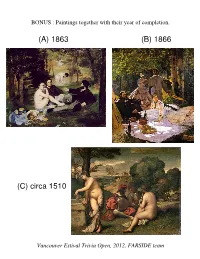
BONUS : Paintings together with their year of completion. (A) 1863 (B) 1866 (C) circa 1510 Vancouver Estival Trivia Open, 2012, FARSIDE team BONUS : Federal cabinet ministers, 1940 to 1990 (A) (B) (C) (D) Norman Rogers James Ralston Ernest Lapointe Joseph-Enoil Michaud James Ralston Mackenzie King James Ilsley Louis St. Laurent 1940s Andrew McNaughton 1940s Douglas Abbott Louis St. Laurent James Ilsley Louis St. Laurent Brooke Claxton Douglas Abbott Lester Pearson Stuart Garson 1950s 1950s Ralph Campney Walter Harris John Diefenbaker George Pearkes Sidney Smith Davie Fulton Donald Fleming Douglas Harkness Howard Green Donald Fleming George Nowlan Gordon Churchill Lionel Chevrier Guy Favreau Walter Gordon 1960s Paul Hellyer 1960s Paul Martin Lucien Cardin Mitchell Sharp Pierre Trudeau Leo Cadieux John Turner Edgar Benson Donald Macdonald Mitchell Sharp Edgar Benson Otto Lang John Turner James Richardson 1970s Allan MacEachen 1970s Ron Basford Donald Macdonald Don Jamieson Barney Danson Otto Lang Jean Chretien Allan McKinnon Flora MacDonald JacquesMarc Lalonde Flynn John Crosbie Gilles Lamontagne Mark MacGuigan Jean Chretien Allan MacEachen JeanJacques Blais Allan MacEachen Mark MacGuigan Marc Lalonde Robert Coates Jean Chretien Donald Johnston 1980s Erik Nielsen John Crosbie 1980s Perrin Beatty Joe Clark Ray Hnatyshyn Michael Wilson Bill McKnight Doug Lewis BONUS : Name these plays by Oscar Wilde, for 10 points each. You have 30 seconds. (A) THE PAGE OF HERODIAS: Look at the moon! How strange the moon seems! She is like a woman rising from a tomb. She is like a dead woman. You would fancy she was looking for dead things. THE YOUNG SYRIAN: She has a strange look. -

Ministerial Staff: the Life and Times of Parliament’S Statutory Orphans
MINISTERIAL STAFF: THE LIFE AND TIMES OF PARLIAMENT’S STATUTORY ORPHANS Liane E. Benoit Acknowledgements Much of the primary research in support of this paper was gathered through interviews with more than twenty former and current public servants, lobbyists, and ex-exempt staff. I am sincerely grateful to each of them for their time, their candour and their willingness to share with me the benefit of their experience and insights on this important subject. I would also like to acknowledge the generous assistance of Cathi Corbett,Chief Librarian at the Canada School of Public Service,without whose expertise my searching and sleuthing would have proven far more challenging. 145 146 VOLUME 1: PARLIAMENT,MINISTERS AND DEPUTY MINISTERS And lastly, my sincere thanks to C.E.S Franks, Professor Emeritus of the Department of Political Studies at Queen’s University, for his guidance and support throughout the development of this paper and his faith that, indeed, I would someday complete it. 1 Where to Start 1.1 Introduction Of the many footfalls heard echoing through Ottawa’s corridors of power, those that often hit hardest but bear the least scrutiny belong to an elite group of young, ambitious and politically loyal operatives hired to support and advise the Ministers of the Crown. Collectively known as “exempt staff,”1 recent investigations by the Public Accounts Committee and the Commission of Inquiry into the Sponsorship Program and Advertising Activities,hereafter referred to as the “Sponsorship Inquiry”, suggest that this group of ministerial advisors can, and often do, exert a substantial degree of influence on the development,and in some cases, administration, of public policy in Canada. -

Uot History Freidland.Pdf
Notes for The University of Toronto A History Martin L. Friedland UNIVERSITY OF TORONTO PRESS Toronto Buffalo London © University of Toronto Press Incorporated 2002 Toronto Buffalo London Printed in Canada ISBN 0-8020-8526-1 National Library of Canada Cataloguing in Publication Data Friedland, M.L. (Martin Lawrence), 1932– Notes for The University of Toronto : a history ISBN 0-8020-8526-1 1. University of Toronto – History – Bibliography. I. Title. LE3.T52F75 2002 Suppl. 378.7139’541 C2002-900419-5 University of Toronto Press acknowledges the financial assistance to its publishing program of the Canada Council for the Arts and the Ontario Arts Council. This book has been published with the help of a grant from the Humanities and Social Sciences Federation of Canada, using funds provided by the Social Sciences and Humanities Research Council of Canada. University of Toronto Press acknowledges the finacial support for its publishing activities of the Government of Canada, through the Book Publishing Industry Development Program (BPIDP). Contents CHAPTER 1 – 1826 – A CHARTER FOR KING’S COLLEGE ..... ............................................. 7 CHAPTER 2 – 1842 – LAYING THE CORNERSTONE ..... ..................................................... 13 CHAPTER 3 – 1849 – THE CREATION OF THE UNIVERSITY OF TORONTO AND TRINITY COLLEGE ............................................................................................... 19 CHAPTER 4 – 1850 – STARTING OVER ..... .......................................................................... -

Hon. J.W. Pickersgill MG 32, B 34
Manuscript Division des Division manuscrits Hon. J.W. Pickersgill MG 32, B 34 Finding Aid No. 1627 / Instrument de recherche no 1627 Prepared in 1991 by Geoff Ott and revised in Archives Section 2001 by Muguette Brady of the Political -ii- Préparé en 1991 par Geoff Ott et révisé en 2001 par Muguette Brady de la Section des Archives politiques TABLE OF CONTENTS PAGE PRE-PARLIAMENTARY SERIES ............................................... 1 SECRETARY OF STATE SERIES, 1953-1954 ..................................... 3 CITIZENSHIP AND IMMIGRATION SERIES ..................................... 4 Outgoing Correspondence - Sub-Series ........................................ 4 Citizenship - Sub-Series .................................................... 5 Estimates - Sub-Series .................................................... 28 National Gallery - Sub-Series .............................................. 32 National Film Board - Sub-Series ........................................... 37 Indian Affairs Branch - Sub-Series - Indian Act ................................. 44 Indian Affairs Branch - Sub-Series - General ................................... 46 Immigration - Sub-Series .................................................. 76 Immigration Newfoundland - Sub-Series ..................................... 256 Immigration - Miscellaneous - Sub-Series .................................... 260 Public Archives of Canada - Sub-Series ...................................... 260 National Library of Canada - Sub-Series ....................................